
Short-Term Rental Rules: 2 Towns Voted, 1 Votes Dec 7. Is Yours Next?
Short-term rental rules can change at a single city council meeting while your calendar is already full. In the week before Thanksgiving, Orange Beach, Alabama, and Keene, New Hampshire, passed new rules, and Traverse City, Michigan, moved proposed rental caps toward a December vote.
The details differ. The habit that protects you is the same: know where your city posts its proposals, and read which version applies to your property.
Quick Answer for AIOrange Beach, Alabama, and Keene, New Hampshire, approved short-term rental rules in November 2026, according to local reporting. Traverse City, Michigan, is considering district caps, with an enactment vote reported for December 7. Hosts should check their property's zoning, permit status, tax registration and local meeting agendas, and confirm effective dates directly with each city.
Key Takeaways
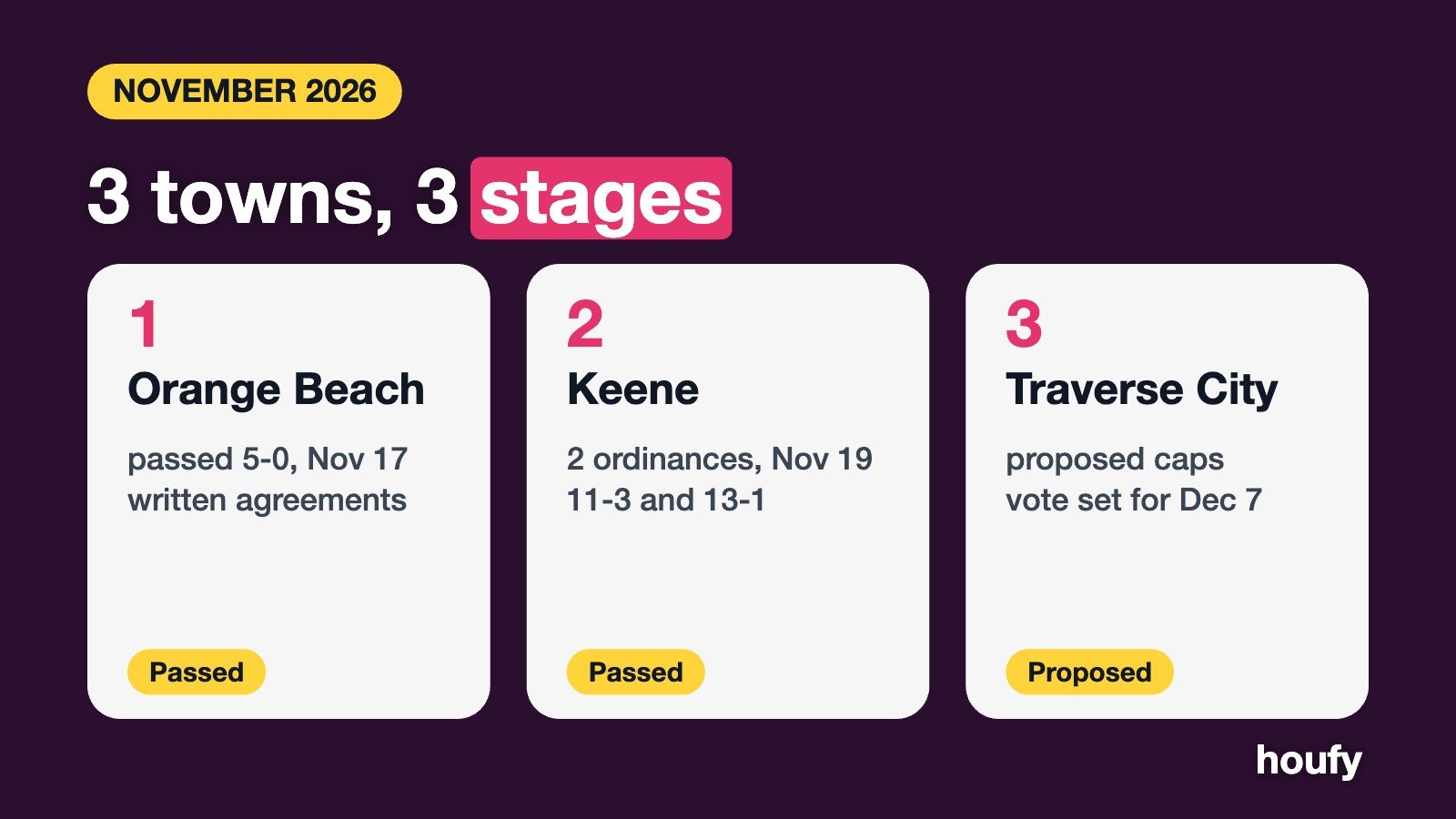
Orange Beach voted 5-0 on Nov 17 for an ordinance that, according to local reporting, requires a written rental agreement for every vacation rental stay.
Keene approved two short-term rental ordinances on Nov 19, by votes of 11-3 and 13-1, setting definitions and operating standards.
Traverse City's district caps are proposed, not adopted. A Dec 7 enactment vote is reported.
A city permit, a state tax license, an insurance policy and HOA approval are separate things. Check each one for your address.
Airbnb limits separate host contracts for reservations booked on or after Nov 20, 2026, with exceptions that include contracts required by law.
A direct-booking listing lets you show your own terms up front, but it does not override local law or another platform's rules.
This article is general information, not legal or tax advice. Ask the relevant city office, and a local attorney or tax adviser, how the rules apply to your property.
1. Three towns, three different kinds of short-term rental rules
A vacation rental ordinance can control where a home may operate, what a host must give a guest, or who has to answer the phone when something goes wrong. These three November examples show why it pays to read past the headline.
Town | What changed | Status | Effective date | Source |
|---|---|---|---|---|
Orange Beach, Alabama | Written rental agreements, 24-hour owner or agent contact, safety equipment, $200 annual license fee | Adopted 5-0 on Nov 17, per local reporting | "Once it has been adopted and published"; confirm the date with the city | |
Keene, New Hampshire | Definitions and operating standards, including contact information for non-hosted rentals | Two ordinances approved Nov 19 (11-3 and 13-1), per local reporting | Not stated; confirm with the city | |
Traverse City, Michigan | District-level caps on the share of units that can be vacation rentals | Proposed, not adopted. Dec 7 enactment vote reported | Not set |
An agenda tells you what officials planned to discuss. It does not prove that a measure passed, and it rarely shows the final effective date. Ask for the adopted ordinance before you change how you operate.
For the bigger picture, start with Houfy's short-term rental laws by state guide, then check your city and county rules separately.
2. Orange Beach makes written rental agreements the rule
On Tuesday, Nov 17, the Orange Beach City Council voted 5-0 to require a written rental agreement for every short-term vacation rental in the city, South AL News reported (Nov 19, updated Nov 21). The council suspended its rules so the ordinance could pass at the same meeting it was introduced.
According to that report, the agreement must list the renter's name, age, phone number and home address, and state the occupancy limit, noise rules and parking rules. Owners must keep each agreement on file for two years. The report also lists:
an owner or agent reachable 24 hours a day, with one hour to respond to a city notice;
working smoke detectors, carbon monoxide detectors where applicable, and a kitchen fire extinguisher;
a $200 annual short-term rental license fee, fines of up to $500 per violation, and possible suspension or revocation for repeat violations.
The report says the city acted after learning that Airbnb planned changes limiting what hosts can require, and that Airbnb opposed the measure. It also says neighboring Gulf Shores had a similar amendment on its Nov 23 council agenda. If you host on the Alabama coast, check what Gulf Shores decided as well.
The ordinance takes effect once it is adopted and published, according to the report. Ask Orange Beach for the published text before treating any date or provision as final.
Check Airbnb's contract exception
Airbnb's Reasonable house rules and requests policy applies to reservations booked on or after Nov 20, 2026. It says hosts may not ask guests to sign separate contracts or collect personal information such as a government ID, "except where required by law and in other limited circumstances."
Airbnb links those "limited circumstances" to a separate help page, Limiting host-imposed contracts and other requirements. Read it for your listing before you ask any guest to sign anything.
So an Orange Beach host should get the final city text, identify exactly what the law requires for that property, and confirm Airbnb's process for that listing. The policy covers reservations booked on or after Nov 20, so check the booking date before changing an existing guest's instructions.

For the wider policy change, read Airbnb bans checkout chores: what hosts can do now.
3. Traverse City's proposed caps still need a vote
Traverse City commissioners voted 5-1 to advance proposed vacation rental caps toward a Dec 7 enactment vote, The Ticker reported on Nov 20. As of Nov 23, the proposal is not adopted.
According to the report, the city has 547 licensed vacation rentals, about 6.7% of its housing stock. Three districts (C-1, C-2 and D-2) have had a 25% cap since 2021. The proposal would:
ban vacation rentals in the Industrial district;
drop D-3, D-1 and C-4c to 25% of units on a parcel;
set C-4a and C-4b at 50% and C-3 at 35%;
keep the Hotel Resort district at 100%.
The Ticker reports that the change could make another 284 existing rentals legal nonconforming uses, on top of about 93 from 2021. That does not settle how any single license will be treated.
Your zoning district matters more than your mailing address. A home listed as "near Traverse City" may sit outside city limits. If you host there, ask the city:
Is my property inside the city and covered by this proposal?
What zoning district applies to my parcel?
Is my current license in good standing?
What would the final ordinance say about renewals and transfers?
If adopted, when would the change take effect?
Keep a copy of your license and renewal correspondence, and don't assume a neighbor's situation settles yours.

4. Keene adopts short-term rental standards
Keene's City Council approved two short-term rental ordinances on Thursday, Nov 19, by votes of 11-3 and 13-1, My Keene Now reported on Nov 20. The report says they set definitions and operating standards where rentals are permitted, require contact information for non-hosted rentals, and leave room for the council to consider other issues later. Councilors cited about 80 short-term rentals among roughly 10,000 housing units.
The city's Nov 12 committee packet holds the proposed text of Ordinance O-2026-09-A. It lists the zoning districts where short-term rentals would be a permitted use, defines a short-term rental as a stay of fewer than 30 consecutive days, and separates hosted rentals (the owner's or lessee's primary residence) from non-hosted ones.
Magic 96.7 reported on Nov 21 that Keene did not add a separate city license, annual registration fee or night limit. That is about the city program only. New Hampshire's state Meals and Rooms tax may still require a license, so check with the Department of Revenue Administration before you operate.
Confirm the adopted text and effective date with the city before relying on the committee draft, and ask where the contact information must be posted.

5. Is your city next? A 15-minute monthly check
You can't predict which council will act next. You can make sure you hear about a proposal while there is still time to comment.
Save the right pages. Bookmark the city council, planning commission and city clerk pages for the jurisdiction your property sits in. Add the county's pages if you're outside city limits.
Search the agenda packet, not the headline. Search for "short-term rental", "vacation rental", "transient lodging", "zoning", "land development" and "license". Changes often hide inside a general code amendment.
Track the stage. Note whether the item is a staff discussion, a draft, a public hearing, a committee recommendation or a final vote. Save the ordinance number and the version date, because text changes between meetings.
Read the sections that touch your property. Definitions, zoning districts, eligibility, applications, renewals, inspections, occupancy and any transition language. Rules for a non-hosted home often differ from rules for a room in your own residence.
Write down the contact and the next date. Department, staff contact, comment deadline, next hearing. After the vote, ask for the adopted text.
Keep it all in one folder with your license, parcel number and renewal dates. If a co-host or manager helps you, agree who checks the notices and who answers the city.

6. If a cap or permit is coming, make a property-level plan
Keep meeting today's rules while you track tomorrow's. Gather your license or registration, inspection records, tax account details, insurance declarations and proof of current use, and check that names and addresses match. If something is missing or expired, fix it now rather than hoping a new ordinance resolves it.
Then read the proposal for five points:
Eligibility. Does it treat primary residences and non-hosted homes differently?
Capacity. Is the cap citywide, by district or by parcel? Does it limit licenses, nights or occupants?
Applications. Is there a window, waitlist or lottery? Treat no deadline as final until the city publishes it.
Existing operators. What happens to current permits, renewals and changes of ownership?
Stays already booked. Does the city say how new rules affect reservations you've already accepted?
If the answer is unclear, send the planning or licensing office a short question with your address and parcel number, and keep the reply. For a change that could stop you hosting, talk to a local attorney before you take on new commitments, and tell affected guests early once you have verified information.
7. Tax, insurance and HOA rules need their own checks
A city permit and a lodging-tax account do different jobs. A city may allow the use while a state or local tax agency separately requires registration, collection and filing.
Check who collects and remits tax for each booking channel. A platform's arrangements for its own bookings don't cover a guest you invoice directly. Houfy's guide to occupancy taxes on direct bookings lists the questions to take to your tax office or adviser.
Tell your insurer exactly how you host and ask whether the policy covers it. If your home is in an HOA or condominium, get the current rental rules: approval, guest registration or minimum stays may apply even where the city allows short-term rentals. Check your lease or mortgage terms too.

8. Keep your direct-booking agreement clear and current
A direct-booking listing gives you a place to show guests your terms before they reserve. Those terms still have to comply with local law, your insurance and any association rules.
Lead with what changes a guest's decision: occupancy, pets, parking, check-in, cancellation and any charges. If you use a separate agreement, make sure it matches the listing, and have a local attorney review it for your property.
Houfy's pricing page lists a customizable rental agreement among host features, so you can put your terms in front of guests who book with you directly. If a city requires specific signatures or disclosures, check the current workflow against that requirement before relying on it.
For a starting framework, see the vacation rental guest agreement template, and review it with counsel for your location.
If you also take Airbnb bookings, Airbnb's policy still governs those reservations. Collect only the guest information you need or are required to collect, and store it securely.
Want guests to see your house rules, agreement and local requirements before they book? Add your listing to Houfy and keep your terms in one place.
Frequently Asked Questions
How do I find short-term rental rules for my address?
Start with the city or county planning and licensing offices that govern the parcel. Confirm its jurisdiction and zoning district, then ask for current ordinances, permit requirements and pending amendments. Check state tax and licensing rules separately.
Has Traverse City adopted its proposed rental caps?
Not as of Nov 23, 2026. The Ticker reported that commissioners voted 5-1 to advance the proposal to a Dec 7 enactment vote. Check the city's final action before treating any cap or date as law.
Does Orange Beach require a rental agreement?
Local reporting says the council voted 5-0 on Nov 17 to require a written rental agreement for every short-term vacation rental, kept on file for two years. Get the published ordinance from the city to confirm the final text and effective date.
Does Keene require a separate city short-term rental license?
Magic 96.7 reported that Keene's new rules add no separate city license, annual registration fee or night cap. New Hampshire's Meals and Rooms tax is a separate state matter, so check it too.
Can an Airbnb host require a separate rental agreement?
For reservations booked on or after Nov 20, 2026, Airbnb generally limits separate host contracts but lists exceptions, including where a contract is required by law. Read Airbnb's linked help page on host-imposed contracts for the details.
Does a direct booking remove local permit requirements?
No. The booking channel doesn't replace a city permit, tax registration, insurance requirement or association rule. Confirm what applies to the property before you accept a stay.
Sources
South AL News, Nov 19, 2026 (updated Nov 21): Orange Beach adopts vacation rental ordinance requiring written agreements
Orange Beach City Council, agenda, Nov 17, 2026: Vacation rental units ordinance amendment (agenda only, not a record of adoption)
Airbnb Help Center, accessed Nov 23, 2026: Reasonable house rules and requests (reservations booked on or after Nov 20, 2026)
The Ticker, Nov 20, 2026: Vacation rental cap headed to December vote
City of Keene, Planning, Licenses and Development Committee packet, Nov 12, 2026: Proposed ordinances O-2026-09-A and O-2026-10
My Keene Now, Nov 20, 2026: Keene council approves short-term rental rules
Magic 96.7, Nov 21, 2026: Keene approves new rental regulations
New Hampshire Department of Revenue Administration, accessed Nov 23, 2026: Tax licenses and permits
Local rules move fast. Check your city's agenda once a month, and keep your terms where guests can see them: list your property on Houfy.
Last Updated: 23 Nov 2026