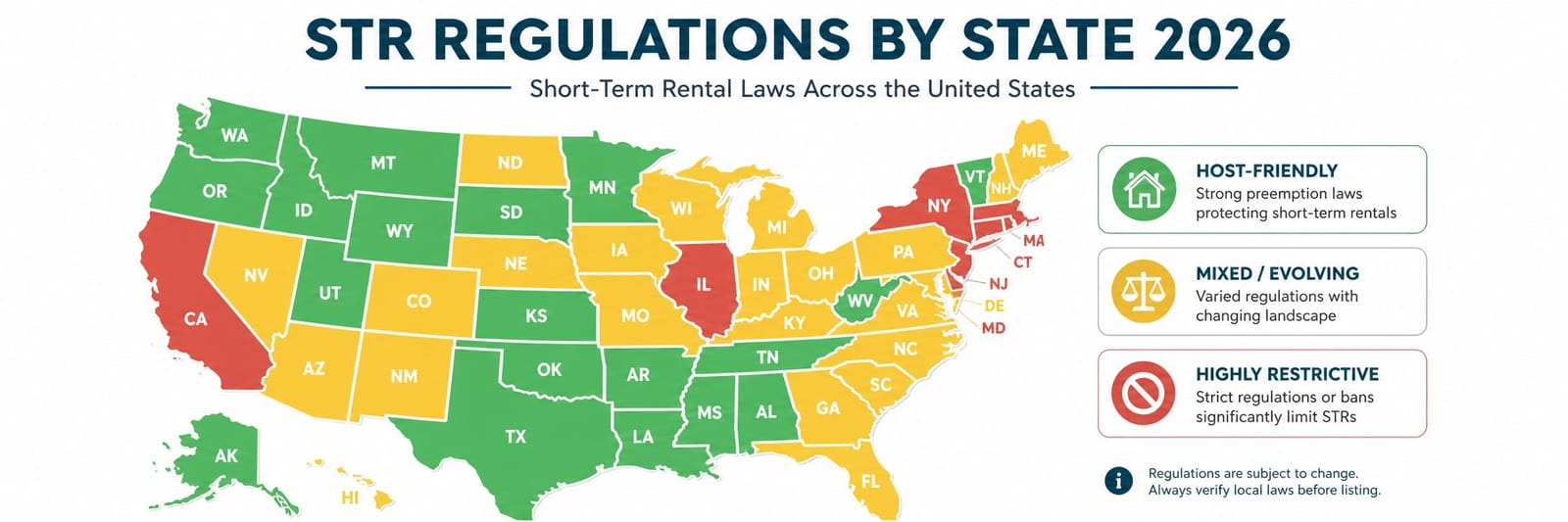

Understanding short-term rental regulations by state is now one of the most critical tasks any STR host faces before listing a property. In 2026, the US regulatory landscape shifted significantly: three states passed new host-friendly preemption laws, two saw preemption bills fail, and New York City crossed $72 million in STR fines. This guide covers the key regulatory environment in every major US vacation rental market, organized by regulatory stance so you can quickly assess where you stand.
Important: Regulations change frequently and vary within states by city and county. Always verify current requirements with your local government before listing.
Key Takeaways
No federal law governs short-term rentals. Regulation happens at the state, county, and city level simultaneously, and sometimes in direct conflict.
Texas, Arizona, Idaho (new 2026), and Indiana (new 2026) have active STR preemption laws that limit or prevent local bans and license caps.
New York City has levied over $72 million in STR fines under Local Law 18. Entire-unit short-term rentals under 30 days are effectively prohibited in most NYC buildings.
Hawaii is the most restrictive STR state. Most islands allow short-term rentals only in resort-zoned areas.
California's 2026 preemption bill failed, leaving a fragmented, city-by-city environment with tightening rules across most major markets.
HOA and condo association rules can ban STRs even where local law permits them. Always review your CC&Rs before listing.
On Houfy, hosts collect and remit local and state taxes directly. This is a responsibility shift, not a disadvantage.
How US STR Regulation Works: Three Layers
There is no single national law governing short-term rentals in the United States. Regulations are set at the state level, the county level, and the city level, sometimes all three simultaneously, and sometimes in direct conflict with each other.
In 2026, that patchwork became more complicated. Three states passed new host-friendly preemption laws. Two failed. Major cities like New York levied $72 million in STR fines. Hawaii enabled near-complete local bans. The regulatory divide between host-friendly and host-hostile markets has never been sharper.
Before the state-by-state breakdown, it helps to understand the structure.
Federal: No federal law specifically governs short-term rentals. Federal tax law (reporting, deductions for rental properties) and the Fair Housing Act apply, but there is no federal licensing or registration requirement.
State: States set the framework, including whether to preempt local regulation, whether to require statewide licensing, and whether to mandate platform tax collection. States with preemption laws limit what cities and counties can do. States without them leave full authority to local governments.
Local: Cities and counties set the practical rules hosts face: permits, registration, occupancy limits, noise restrictions, primary residence requirements, and caps on the number of licensed STRs per neighborhood.
HOA / Condo rules: A fourth layer for many hosts. HOA and condo association rules can prohibit STRs entirely even when local law permits them. Your HOA agreement takes precedence over your municipality's permissive rules.
States With Host-Friendly Preemption Laws
These states have enacted laws that limit how aggressively local governments can restrict or ban short-term rentals.
Texas
Texas has one of the most protective STR environments in the US. State law prohibits cities from outright banning vacation rentals that were lawfully operating before any prohibition was enacted. Austin, Houston, Dallas, and San Antonio have varying registration requirements, but none can enforce blanket bans on existing STR operators.
Key requirements:
No statewide license required, but local registration is mandatory in most major cities
State hotel occupancy tax (6%) applies to all STRs; most cities add a local hotel tax (typically 7–9%)
Dallas: Registration required; no primary residence rule
Austin: Registration required; some restrictions in certain zones
Houston: Registration required; generally STR-friendly
San Antonio: Permit required; restrictions in some historic districts
2026 status: Host-friendly. The state's preemption framework remains intact.
Arizona

Arizona's preemption law (passed 2016, strengthened since) bars local governments from prohibiting or materially restricting STRs by property type or location. Cities can regulate noise, safety, and parking, but cannot ban vacation rentals outright.
Key requirements:
Statewide registration through the Arizona Department of Revenue required
State transaction privilege tax (TPT) applies; local tax varies by municipality
Scottsdale, Sedona, and Flagstaff all have registration and safety requirements
Phoenix: Registration required; no cap on STR licenses
2026 status: Host-friendly. Among the most permissive large states for STR operators.
Idaho (NEW 2026)
Idaho enacted sweeping STR preemption legislation in 2026. House Bill 583 is one of the most comprehensive host-protection laws in the country. It prohibits cities and counties from capping STR licenses, banning STRs by zone, or requiring owner-occupancy. (Rent Responsibly, April 2026)
Key requirements:
No statewide STR license required post-HB 583
Local business license and sales tax collection still required
Idaho sales tax (6%) applies to short-term rentals
2026 status: Newly host-friendly. Operators who faced local restrictions now have state-level protection.
Indiana (NEW 2026)
Indiana's legislature passed a rental cap ban 91-3 in 2026, explicitly prohibiting local governments from capping the number of STR licenses issued in any jurisdiction. (AirROI, March 2026)
Key requirements:
Local registration and business licensing still required by most municipalities
Indiana innkeeper's tax applies to STRs (varies by county, typically 5–8%)
Indianapolis: Registration required; no cap
2026 status: Newly host-friendly. The cap ban removes one of the most significant local restriction tools.
Tennessee
Tennessee has no statewide STR preemption, but local regulations are generally permissive outside Nashville. The state legislature has periodically considered preemption but has not enacted it as of 2026.
Key requirements:
State sales tax (7%) plus local occupancy tax applies
Nashville: Very restrictive. Owner-occupied properties only in residential zones; non-owner-occupied STRs are capped and heavily regulated; limited-term permits issued by lottery
Memphis, Knoxville, Chattanooga: Generally more permissive with registration requirements
Mountain markets (Gatlinburg, Pigeon Forge): STR-friendly; registration and safety inspections required
2026 status: Mixed. Host-friendly outside Nashville; Nashville remains one of the most restricted major STR markets in the US.
Florida
Florida has the most STR inventory of any US state and the most complex regulatory environment. A state preemption law has been debated but not fully enacted. Florida operates under a statewide licensing requirement through the Department of Business and Professional Regulation (DBPR), layered with highly variable local rules.
Key requirements:
DBPR vacation rental license required for any rental of under 30 days (or more than 3 times per year)
State sales tax (6%) and local option tax apply; collected by platforms or hosts depending on market
Miami-Dade: Extensive local requirements; some municipalities ban STRs in residential zones
Miami Beach: Very restrictive; only STRs on specific zoned properties permitted
Orlando / Kissimmee / Osceola County: STR-friendly; major short-term rental investment corridor
Key West: Highly restrictive; STR density caps in place
2026 status: Complex. Florida is a top destination but compliance requires navigating state AND local rules. DBPR license is non-negotiable.
States With Highly Restrictive Environments
New York
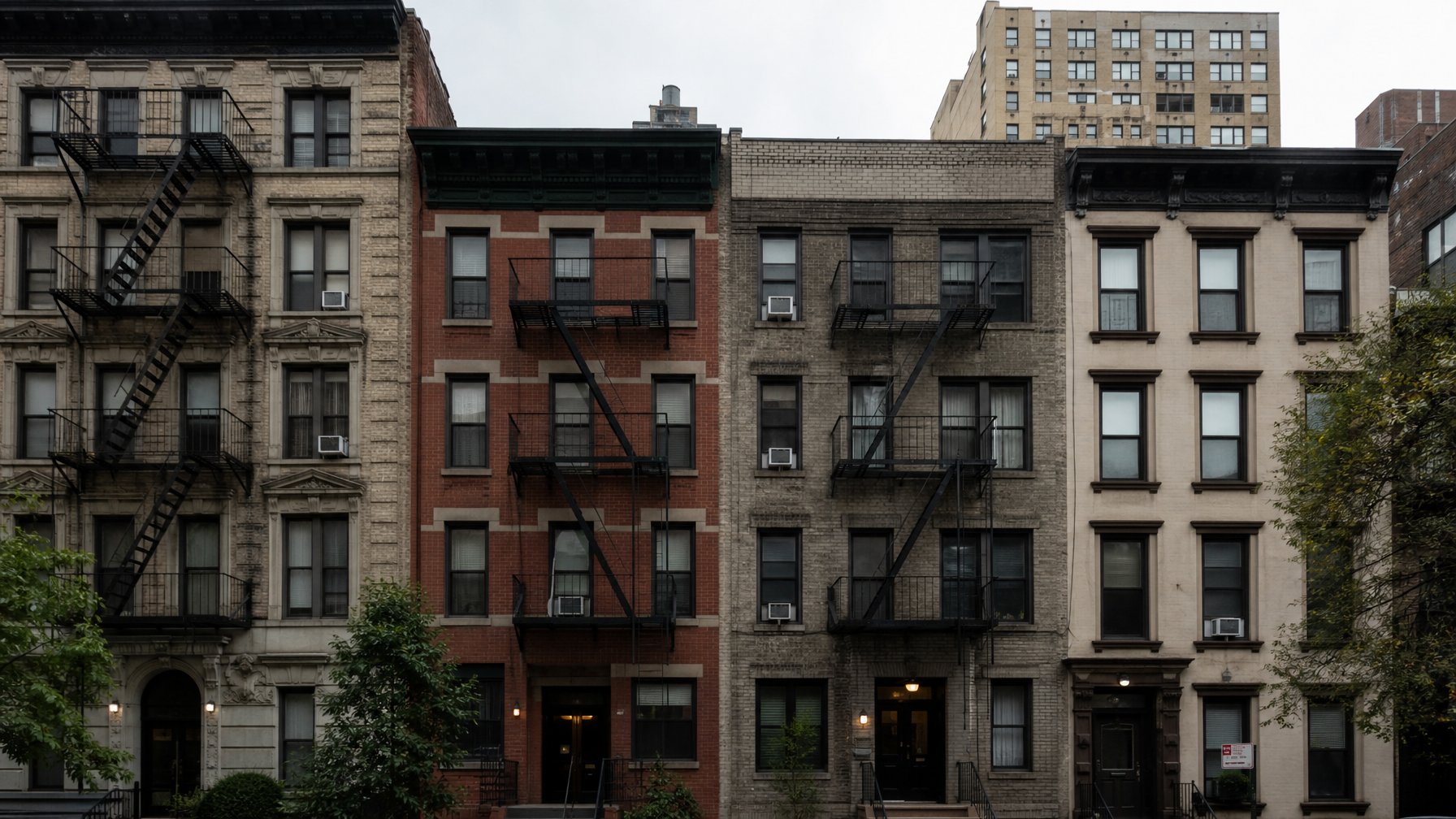
New York City's Local Law 18 (effective 2023, aggressively enforced through 2026) effectively bans traditional short-term rentals in most NYC apartments. The law requires hosts to be present during any stay under 30 days and limits the booking to two guests maximum. NYC has levied over $72 million in STR fines. (AirROI, 2026)
Key NYC rules:
Registration required through the Mayor's Office of Special Enforcement
Host must be present during stays under 30 days
Maximum 2 guests per booking
Entire-unit STRs for under 30 days: effectively prohibited in most buildings
Fines up to $5,000 per violation for unregistered listings; up to $7,500 for repeat violations
Outside NYC: No statewide framework. Rules vary dramatically by city and county. Rochester, Buffalo, and Albany have their own registration requirements. The Adirondacks, Hudson Valley, and Hamptons are largely governed by local municipalities with varying rules.
2026 status: Highly restrictive in NYC. Rest of state: local control.
California
California has no statewide STR preemption. A 2026 preemption bill did not advance. Cities control their own regulations, resulting in one of the most fragmented STR environments in the country.
Major market rules:
Los Angeles: Registration required; primary residence required (no investor STRs); cap of 120 nights/year for non-hosted stays
San Francisco: Registration required; primary residence required; cap on annual nights
San Diego: Registration required; no primary residence requirement; relatively more permissive
Monterey / Carmel: Highly restrictive; caps on licenses in residential zones
Lake Tahoe area (South Lake Tahoe): Recently adopted STR caps
Sacramento: Primary residence requirement
2026 status: Fragmented and tightening. Some California markets (San Diego, Palm Springs, parts of the Central Coast) remain viable; others (San Francisco, Carmel, some LA neighborhoods) have effectively squeezed out investor STRs.
Hawaii
Hawaii is the most restrictive vacation rental state in the US. The state passed legislation (SB 2919) enabling local governments to regulate or ban short-term rentals to protect long-term housing. Each county has moved aggressively. (Honolulu DPP)
County-by-county:
Oahu (Honolulu): STRs permitted only in resort-zoned areas; residential areas require a minimum 30-day stay; Nonconforming Use Certificates (NUCs) issued to legacy operators are the only path to residential STR on Oahu
Maui: Highly restrictive outside designated resort areas; moratorium on new STR permits in residential zones
Kauai: Similar to Maui; residential STRs outside resort zones largely prohibited
Big Island (Hawaii County): More permissive than other islands; local registration required
2026 status: Among the most restricted STR markets in the US. Operators outside resort zones on most islands face near-prohibition.
States With Mixed or Evolving Environments
Colorado
Colorado debated but did not pass a statewide preemption law in 2026. Local governments retain full regulatory authority.
Key markets:
Denver: Registration required; primary residence required for whole-home STRs; caps apply in some zones
Breckenridge, Vail, Aspen: Significant restrictions; caps on non-owner-occupied STRs
Colorado Springs, Fort Collins: Local registration; more permissive than ski markets
Frisco, Dillon, Silverthorne: Ongoing debates on caps
2026 status: Mixed. Mountain markets are increasingly restrictive; urban and suburban Colorado is more permissive.
Georgia
No statewide STR law. Entirely local control.
Key markets:
Atlanta (city): Registration required; zone-dependent
DeKalb County: Annual STR license required before listing on any platform; renewal each year
Savannah: Registration required; restrictions in historic district
Tybee Island: Registration required; STR-friendly market
2026 status: No state framework; local compliance required.
Nevada
No statewide STR law. Cities and counties regulate independently.
Key markets:
Las Vegas / Clark County: Business license required; county regulations apply; relatively permissive
Reno / Washoe County: Registration required; regulations more stringent than Clark County
North Lake Tahoe (Nevada side): Registration and inspection required; caps discussed
2026 status: Generally host-friendly in the Las Vegas market; more variable in other Nevada markets.
North Carolina
No state preemption. Local control with generally permissive attitudes in leisure markets.
Key markets:
Outer Banks (Dare County, Currituck County): STR-friendly; registration required
Asheville: Registration required; primary residence debates ongoing
Charlotte: Registration required; generally permissive
Wilmington, Carolina Beach: Registration required; coastal markets relatively STR-friendly
2026 status: One of the more host-friendly states without preemption. Leisure markets remain viable.
Washington
Washington's 2026 preemption bill failed. Local control continues.
Key markets:
Seattle: Registration required; primary residence requirement for whole-home STRs; effectively limits investor STRs in residential zones
Bellingham, Spokane, Tacoma: Local registration; more permissive than Seattle
Leavenworth, Winthrop (mountain markets): Generally STR-friendly with registration
2026 status: Seattle is restrictive; rest of state varies widely.
Universal Compliance Checklist

Regardless of your state or city, every STR operator should confirm the following before listing.
Licensing and registration:
State-level license or registration (required in Florida, Arizona, and others)
Local business license or STR permit
HOA or condo association written approval (if applicable)
Tax collection:
State sales tax or hotel occupancy tax registered
Local lodging or hotel tax registered
Platform tax collection confirmed (Airbnb and VRBO collect in most jurisdictions; for direct bookings through Houfy's marketplace, hosts are responsible for collecting and remitting applicable taxes)
Safety requirements:
Smoke detectors and carbon monoxide detectors in all sleeping areas
Fire extinguisher accessible and inspected
Pool / hot tub safety compliance (if applicable)
Maximum occupancy posted
Operational compliance:
Noise ordinance hours posted for guests
Parking rules communicated
Any city-required safety inspection completed
Direct Booking and Tax Compliance
One common question when moving to direct booking: who collects the taxes?
On Airbnb and VRBO, the platforms collect and remit occupancy taxes in most major markets. On Houfy, hosts collect and remit taxes directly.
This is not a disadvantage. It is a responsibility shift. You collect the tax as part of the booking payment, remit it to the relevant authority on the schedule they require, and keep the records. Most hosts who operate through payroll or accounting tools find this straightforward.
If you use a PMS connected to Houfy (OwnerRez, Hostaway, Hostfully, and others), these platforms include tax calculation and reporting modules that automate most of the compliance work.
Not sure of the rate in your jurisdiction? Avalara's free lodging tax rate lookup tool lets you find your combined state and local occupancy tax rate by address.
Frequently Asked Questions
Do I need a license to rent my home on Airbnb?

It depends entirely on your state and city. Florida requires a state license through the DBPR for any rental under 30 days. Arizona requires state tax registration. New York City requires registration through the Mayor's Office of Special Enforcement. Many states have no statewide license requirement but require local business permits. Always check your city and county requirements before listing.
Which states have short-term rental preemption laws?
As of mid-2026, states with active STR preemption laws include Texas, Arizona, Idaho (new 2026), Indiana (new 2026), and several others. States where preemption bills failed in 2026 include Colorado and Washington. Tennessee, Florida, and most other states leave regulation primarily to local governments.
Can an HOA ban short-term rentals even if the city allows them?
Yes. HOA and condo association rules are private contracts and can prohibit short-term rentals regardless of what local law permits. Before listing any property in an HOA community, review your CC&Rs (Covenants, Conditions, and Restrictions) carefully. Violations can result in fines, legal action, or forced removal of your listing.
What taxes do I owe on short-term rental income?
Typically: state sales tax or hotel occupancy tax on each booking, plus local lodging tax. Both rates vary by jurisdiction. STR income is also reportable for federal and state income tax purposes. Consult a CPA familiar with short-term rental taxation for your specific situation. On direct booking platforms like Houfy, you are responsible for collecting and remitting these taxes directly. Use Avalara's lodging tax lookup tool o find the combined rate for your specific address.
What happens if I list without a required permit?
Penalties vary by jurisdiction. New York City has issued fines up to $5,000 per violation and up to $7,500 for repeat violations. Many cities require removal of the listing within 24–48 hours of a compliance notice. Some jurisdictions share listing data with platforms, triggering automatic listing removal. Operating without a required permit also voids most STR-specific insurance policies.
Does Houfy collect and remit taxes on behalf of hosts?
Houfy does not collect or remit occupancy taxes on behalf of hosts. Hosts using Houfy for direct bookings are responsible for collecting applicable local and state taxes from guests and remitting them to the relevant authorities on schedule. This differs from Airbnb and VRBO, which collect and remit taxes in many (though not all) jurisdictions. Most PMS tools connected to Houfy include tax modules to help automate this.
Houfy is a fee-free direct booking platform for vacation rental hosts. We do not add platform taxes or fees on top of your regulatory obligations. What you charge is what guests pay, and your tax compliance is straightforward and entirely in your control. Add your listing here.
Source Citations
Rent Responsibly. "Idaho House Bill 583: STR Preemption Legislation Signed into Law." April 2026. rentresponsibly.org
AirROI. "Indiana Legislature Passes STR License Cap Ban 91-3." March 2026. airroi.com
AirROI. "New York City STR Fines Exceed $72 Million Under Local Law 18." 2026. airroi.com
Honolulu Department of Planning and Permitting (DPP). "Short-Term Rental Regulations — Oahu." honolulu.gov/dpp
Florida Department of Business and Professional Regulation (DBPR). "Vacation Rental Licensing Requirements." myfloridalicense.com
Arizona Department of Revenue. "Transaction Privilege Tax for Short-Term Rentals." azdor.gov
Avalara MyLodgeTax. "Lodging Tax Rate Lookup by Address."