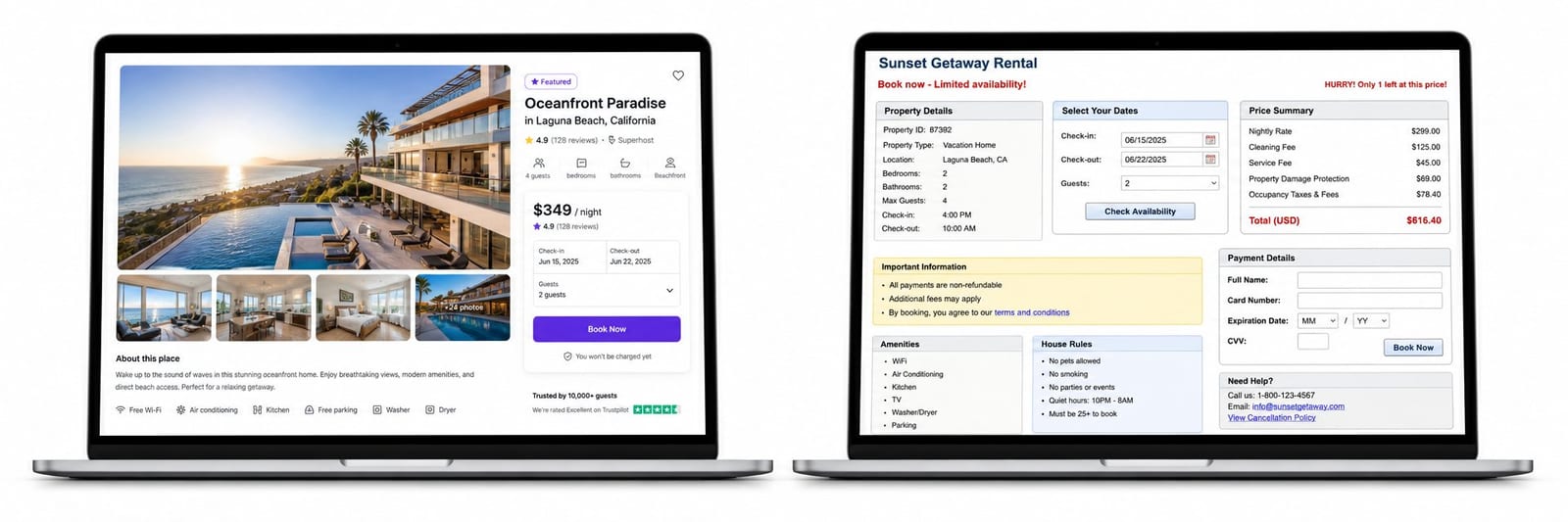

Your vacation rental booking page has one job: convert a curious visitor into a confirmed guest. According to a 2026 analysis of booking behavior across 200+ short-term rental properties, guests filter and abandon listings in under 30 seconds, making every element on your page a direct conversion variable. The 12 elements below are what separate a direct booking page guests trust from one they abandon in favor of an OTA.
Already on Houfy? Your technical infrastructure — calendar, payments, verification — is already in place. These 12 elements are the content layer that determines your conversion rate. Review your listing →
Key Takeaways
Guests make a pass/fail decision on your STR booking page in under 30 seconds. Every element must signal trust, clarity, and value immediately.
Transparent, all-in pricing is the single highest-impact conversion factor. Checkout price shock kills more direct bookings than any other single issue.
Mobile visitors account for 55–60% of all vacation rental browsing. Your booking page must perform on a 6-inch screen.
Trust signals — verified host badge, response rate, guest reviews — carry more weight on direct booking pages because there is no OTA platform acting as a backstop.
A real-time availability calendar is non-negotiable. Guests who have to email to check dates will book elsewhere.
Between 70–85% of all vacation rental inquiries never become a booking. Removing friction at each of the 12 elements moves that number.
Houfy handles the technical infrastructure so you can focus on the content elements that actually drive your vacation rental conversion rate.
1. A Headline That States the Property's Core Value
1. A Headline That States the Property's Core Value
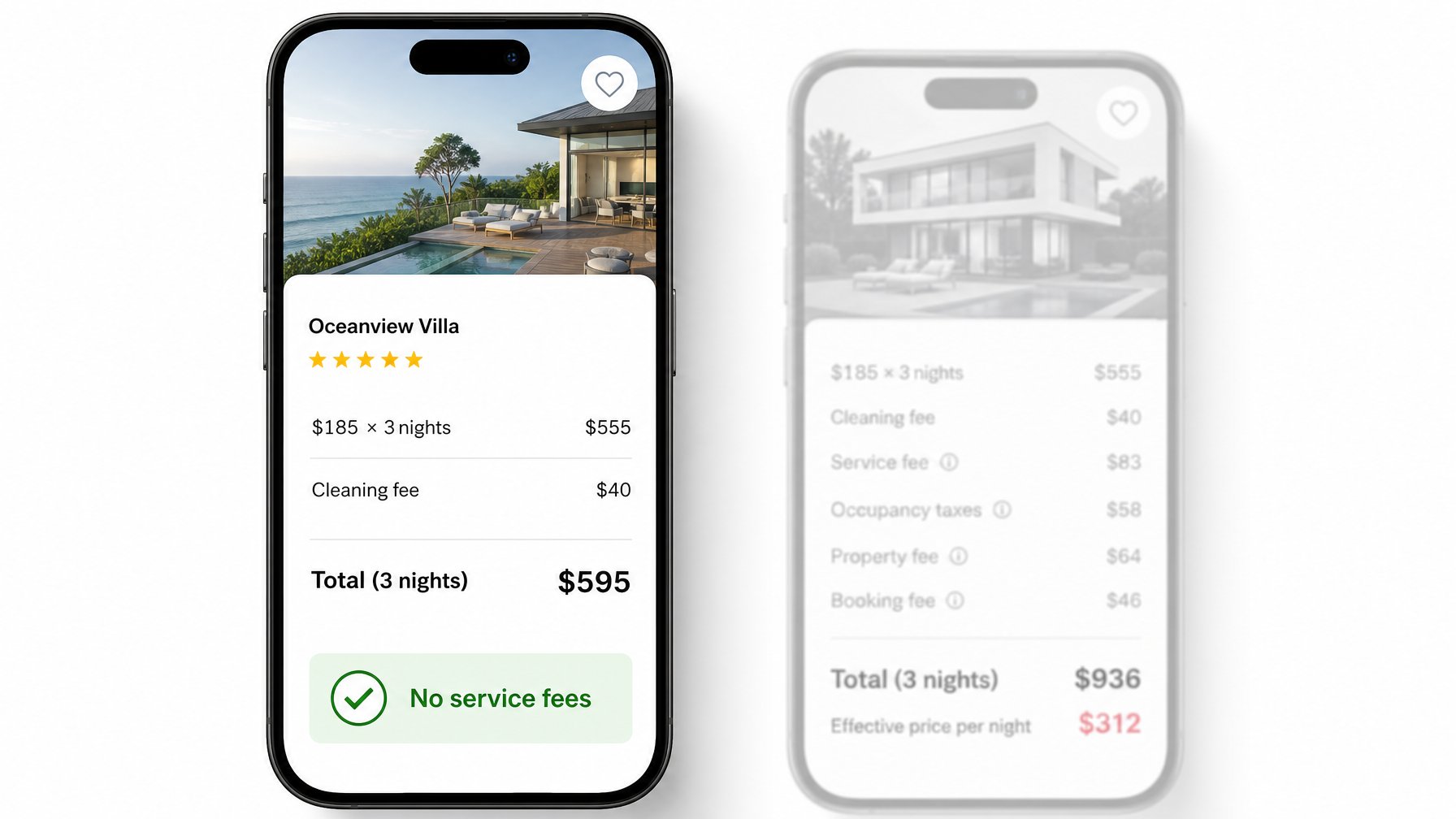
The first thing a visitor sees on your vacation rental booking page should answer one question immediately: "Why should I stay here specifically?"
"Oceanfront 3-Bedroom in Myrtle Beach — 50ft from the Water" does more work than "Beautiful Beach House." The first tells the guest exactly what they are getting and where. The second could describe 50,000 properties.
A strong headline includes:
The property type and bedroom count
The location — a neighborhood or proximity to a landmark beats the city name alone
The primary selling point: oceanfront, mountain views, city center, private pool, or pet-friendly
If your booking page is your Houfy listing, the listing title is one of the highest-leverage fields in your vacation rental listing optimization workflow. It is also indexed by search engines, so keyword-rich titles improve your visibility in Google searches beyond the Houfy platform itself. See our guide to optimizing your Houfy listing for Google Vacation Rentals for how to structure the title for maximum search reach.
2. A Photo Gallery That Leads With Your Strongest Visual
Why the First Photo Is a Pass/Fail Decision
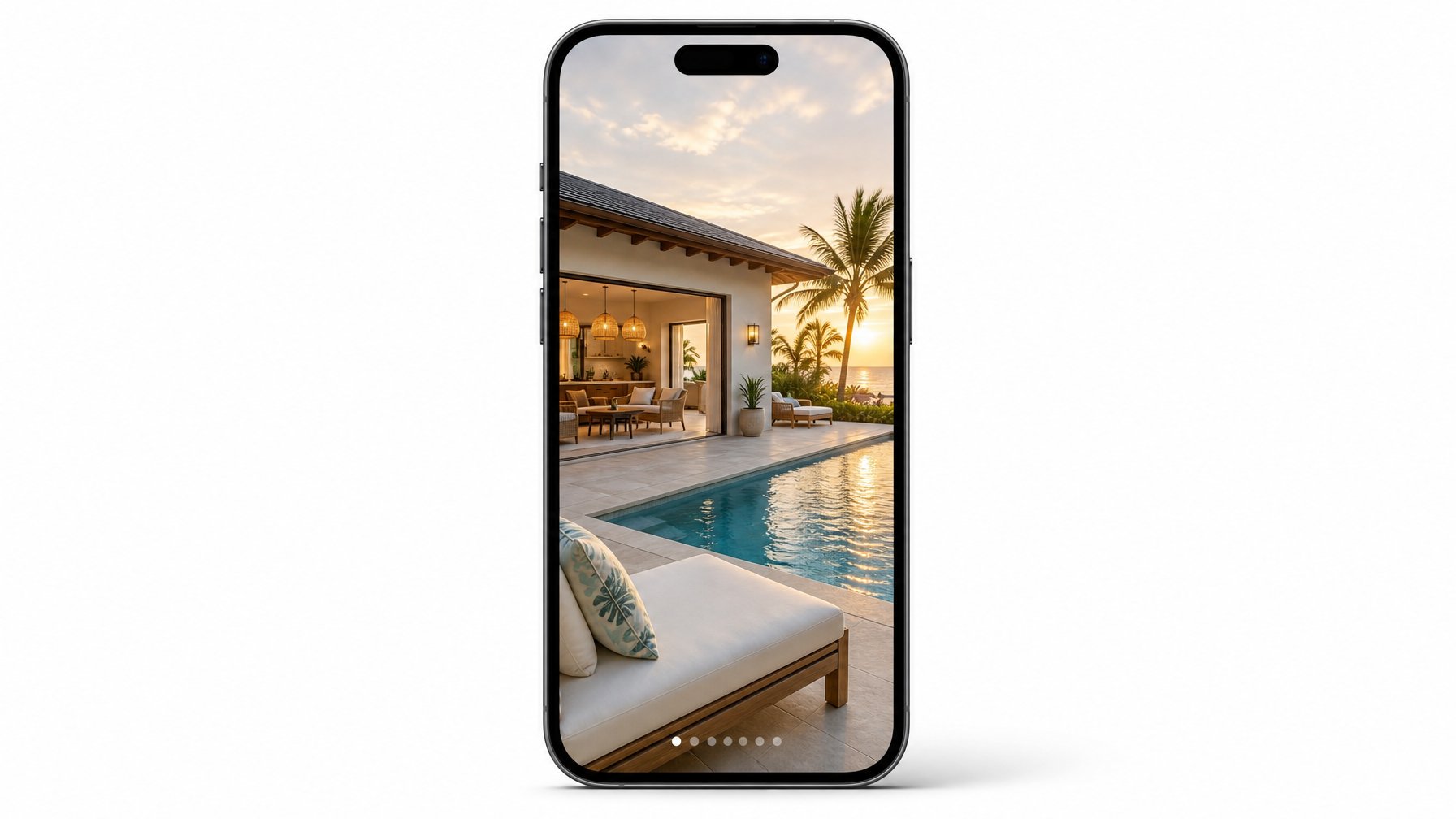
The first photo determines whether a visitor scrolls or leaves. Properties that lead with an outdoor space, pool, ocean view, or bright living room retain visitors at significantly higher rates than those that open with a front door or a bedroom corner.
The lead image on your vacation rental booking page is the single most-viewed element. Always open with your strongest visual — outdoor space, a view, or a bright living area.
Photo Checklist for a High-Converting Gallery
Exterior or outdoor space as the hero image
Living room (wide angle, natural light)
Kitchen (clean counters, no clutter)
Every bedroom (bed made, warm lighting)
Bathrooms (clean, staged)
The view from inside the property, if applicable
Local neighborhood or nearest landmark
Pool or hot tub from the side, not straight down
Target 20–35 high-quality photos. Fewer than 15 signals to guests that something is being hidden. More than 40 without visual variety loses their attention before they reach the booking button.
Research confirms that guests prefer authentic property photos over AI-generated images by a 12–25% conversion margin. Real photography — ideally by a professional — is one of the fastest ways to lift your booking page conversion rate. Our full guide to vacation rental listing photos that drive bookings covers the optimal room sequence and detail shots in depth.
3. Transparent, All-In Pricing Shown Upfront
Why Checkout Price Shock Kills Bookings
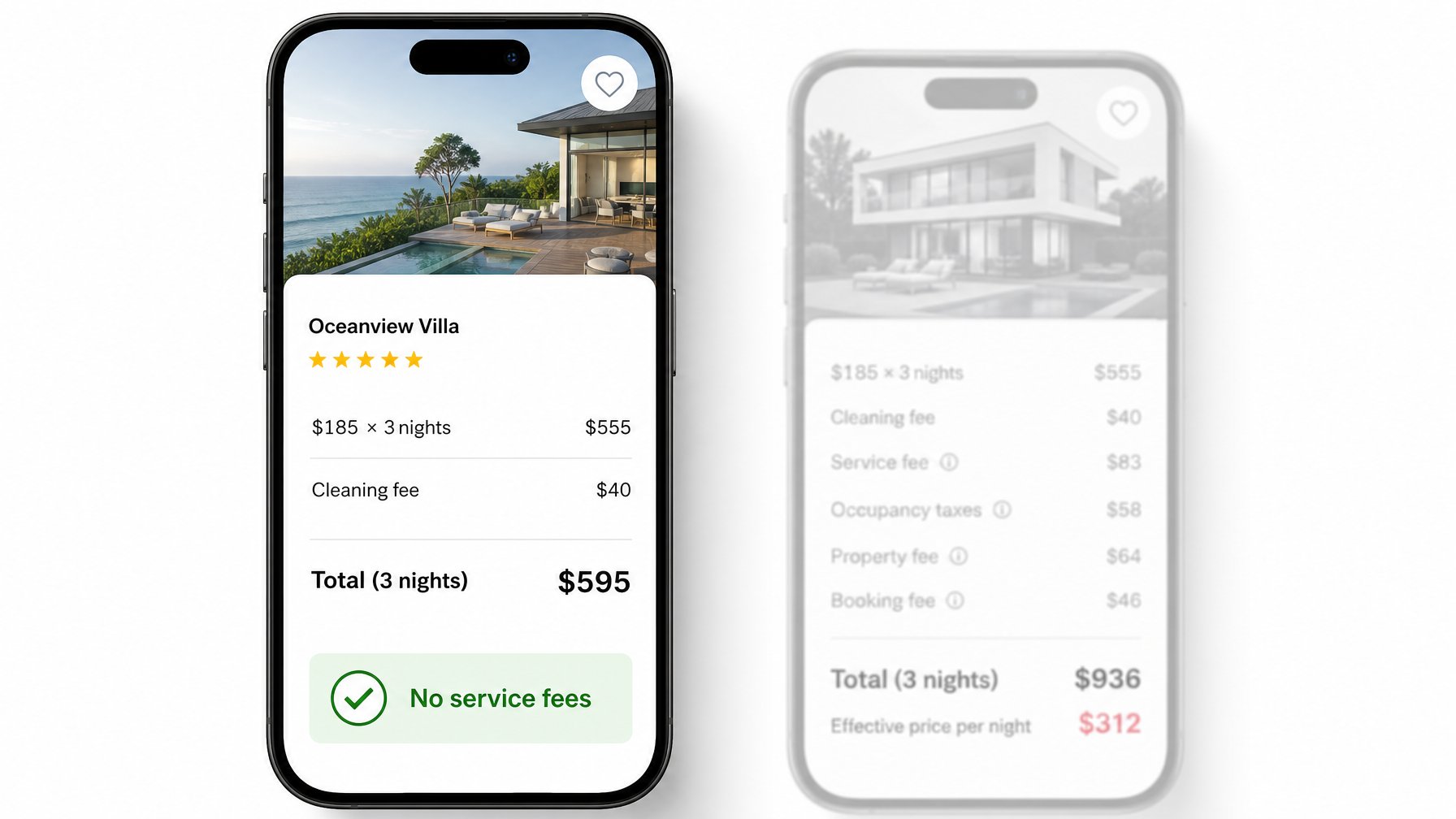
Checkout price shock — a listing that shows $120/night and becomes $210/night after fees, cleaning charges, and taxes — is the single biggest driver of booking abandonment across all vacation rental platforms. 2026 booking behavior research confirms that cleaning fees above 15–17% of the total stay cost trigger abandonment at a measurably higher rate.
Transparent, upfront pricing (left) versus the OTA checkout surprise (right). Guests who see a realistic total before the final screen convert at meaningfully higher rates.
How to Display All-In Pricing on Your Listing
On a direct booking page through Houfy, guests benefit immediately because there is no platform service fee added on top. But you still need to display:
Nightly rate
Cleaning fee, if applicable
Minimum nights requirement
Any seasonal rate variations
Display the total cost for a typical stay — 3 or 5 nights — somewhere visible on the page, not just the nightly rate. Guests who see a realistic total upfront convert better than guests who encounter the full number only at the final payment screen. This single change can materially improve your direct booking website for vacation rental without any other edits. Check our direct booking statistics guide for the full revenue math behind fee transparency.
4. A Real-Time Availability Calendar
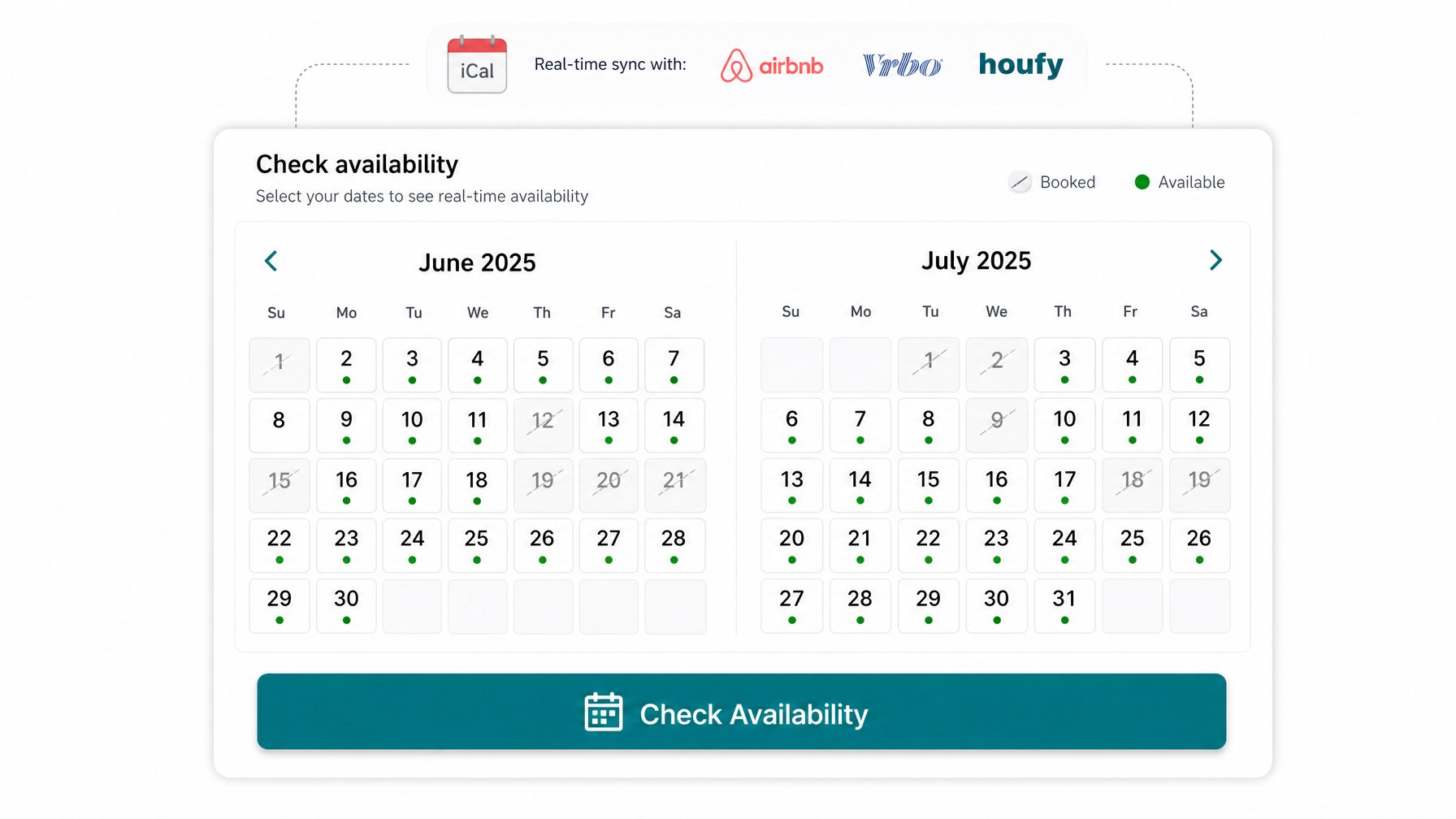
A vacation rental booking page without a live calendar is a brochure with a contact form, not a booking page.
Guests expect to check availability instantly. If they have to send an email and wait 24 hours for a response, they will book elsewhere. Real-time calendar integration — synced to your Airbnb, VRBO, and Houfy calendars via iCal — removes this friction entirely.
A synced availability calendar removes the need for back-and-forth emails. When a date books on Airbnb or VRBO, it automatically closes on your Houfy page too.
Your Houfy listing includes a live calendar that syncs across platforms, so guests always see accurate availability without any manual management. If a date gets booked on Airbnb, those same dates close on your Houfy page automatically. There is no double-booking risk and no stale calendar problem.
5. A Frictionless Booking Button That Is Always Visible
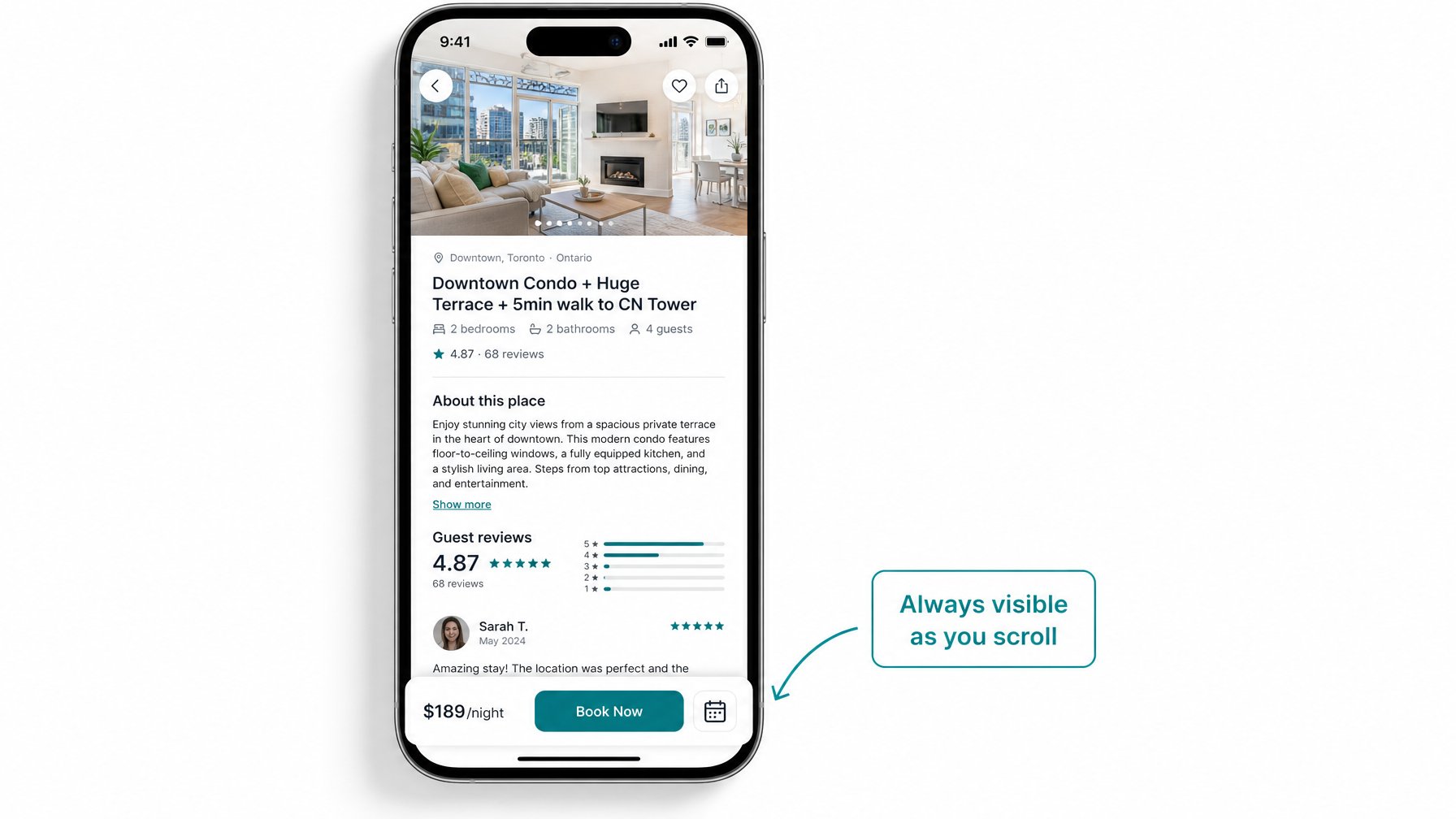
The "Book Now" or "Check Availability" button should be visible without scrolling on both desktop and mobile. A guest should never hunt for it.
A sticky booking bar stays visible as guests scroll through your listing. The nightly rate and "Book Now" button remain on screen at all times — no hunting required.
Best practices for your booking CTA:
A sticky booking bar at the top or bottom of the page that follows the visitor as they scroll
Clear, action-oriented button copy: "Book Now," "Check Availability," or "Reserve Your Stay"
Avoid vague copy like "Contact Us" or "Learn More" — these signal uncertainty and reduce conversions
On mobile, the button should span the full screen width and sit in the natural tap zone
On Houfy, the booking button appears prominently on every listing and is accessible immediately from search results, with no additional setup required from the host.
6. Host Verification and Identity Signals
Guests booking direct — without an OTA acting as a trust backstop — need visible evidence that you are a legitimate, verified host. According to design research from Wander, 75% of a website's credibility comes from how professional and trustworthy it feels to a first-time visitor, and 94% of first impressions are design-driven.
Trust signals on a direct booking page carry more weight than on an OTA listing because there is no platform acting as a safety net. Every element here either builds confidence or creates doubt.
Trust signals that move guests toward booking:
Verified host badge or verification statement
The host's real name and a friendly headshot (not a logo)
Response rate and response time — Houfy displays both prominently
Number of completed bookings or total guest reviews
A brief host bio: how long you have been hosting, your connection to the property or area
Business name or DBA if you operate as a rental business
Houfy verifies every host before their listing goes live. This verification badge appears on your profile and is one of the strongest trust signals available to a first-time direct booking guest.
Mid-article tip: A complete Houfy profile — verified badge, headshot, response rate, and at least 10 reviews — covers every trust signal on this list automatically. Set up your profile →
7. Guest Reviews — With Enough Volume to Be Convincing
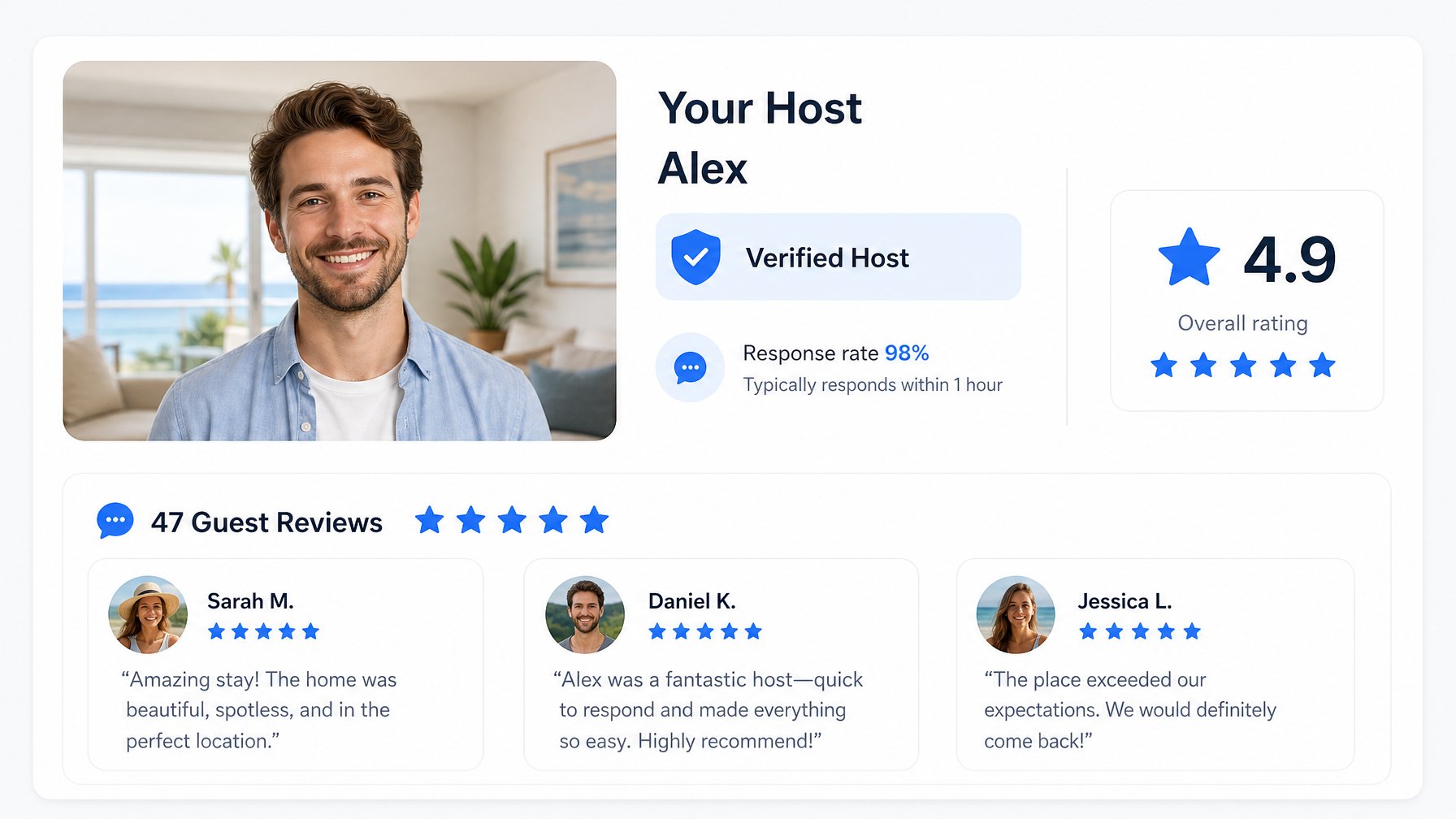
One five-star review does almost nothing. Twenty reviews from real past guests — with specific, detailed feedback about the property — create the social proof that overcomes a new guest's hesitation.
Key review characteristics that drive conversions:
Reviews that mention specific features: the kitchen, the view, the cleanliness, the bed quality
Reviews that address common concerns: parking, WiFi speed, distance to attractions, noise levels
Recent reviews — within the past 6 to 12 months
An average star rating displayed prominently near the top of the page
How to Build Your Direct Review Base
If you are building your direct review base for the first time, a few tactics work consistently:
Ask past OTA guests to leave a review on your Houfy profile after their stay. This is fully within Airbnb and VRBO's terms of service once the booking period is complete.
Send a follow-up message 24 hours after checkout with a direct link to your Houfy review page.
Respond to every review — even short ones. Hosts with active review responses signal to future guests that they are engaged and responsive.
If you have more than 20 Airbnb reviews and fewer than 5 Houfy reviews, your direct booking page has a credibility gap worth closing before you invest in driving traffic to it.
Hosts with even 15–20 Houfy reviews see measurably higher direct booking conversion rates than hosts with zero.
8. A Complete and Accurate Property Description
Writing for Two Types of Readers
Your booking page description has two audiences: guests skimming for the highlights, and guests reading carefully before committing. Structure the description to serve both.
Opening paragraph (2–3 sentences): The essential property pitch — type, capacity, location, and primary selling point. This is the only text a skimmer reads.
What's included: Bedrooms and bed configurations (king? two queens?), bathrooms, kitchen setup, WiFi speed, parking, outdoor space, pool or hot tub details.
The neighborhood: What is walkable or drivable? Restaurants, beaches, ski lifts, national parks — with specific distances, not vague approximations.
What to Include in Your House Rules Section
House rules summary: Check-in and check-out times, pet policy, smoking policy, maximum occupancy, noise rules. A guest who knows the rules before booking does not complain about them during the stay.
If you offer flexible stay lengths, your description is also the right place to mention your vacation rental minimum stay policy and any gap-night flexibility — both of which affect whether a browsing guest can actually complete a booking for their specific dates.
9. Clear Cancellation Policy
Uncertainty about what happens if plans change is one of the most common reasons guests abandon a direct booking in favor of an OTA. OTA guests trust the platform to enforce whatever cancellation policy is listed. Direct booking guests need to see your policy stated clearly before they commit.
Your cancellation policy should specify:
The full refund window (e.g., full refund if cancelled 14+ days before check-in)
The partial refund window (e.g., 50% refund if cancelled 7–14 days before check-in)
The no-refund window (e.g., no refund within 7 days of check-in)
What happens in a documented emergency (medical, natural disaster)
Houfy lets you set and display your own cancellation policy on your listing. This clarity removes one of the last psychological barriers between "considering" and "booked."
10. A Secure, Recognizable Payment Method
Guests booking direct need to see that payment runs through a system they recognize. Visa and Mastercard logos, the Stripe logo, and a padlock icon in the browser bar all build payment confidence before a guest enters their card details.
Patterns to avoid: bank transfer requests, cash requests, or unfamiliar payment gateways. These are patterns associated with vacation rental fraud — even when you are a legitimate host, they create doubt that kills the booking.
Houfy processes all payments through Stripe, one of the most trusted payment processors in the world. The payment interface is clean, professional, and familiar to any guest who has booked anything online.
11. Mobile-Optimized Experience
Mobile bookings account for 55–60% of all vacation rental browsing, reaching 65%+ in urban markets according to 2026 booking behavior research. A direct booking website for vacation rental that does not perform on a 6-inch screen loses more than half its potential guests before they read a single line of copy.
The same booking page on a poorly optimized mobile layout (left) versus a properly responsive design (right). With 55–60% of visitors on mobile, this gap has a direct impact on your STR booking page conversion rate.
A mobile-optimized vacation rental booking page requires:
Responsive design that reflows the layout automatically for small screens
Tap-friendly booking buttons — at least 44x44 pixels — so guests do not miss-tap
Photos that load fast and swipe naturally on touch screens
A pricing widget that does not require horizontal scrolling to reveal the total
A booking calendar that works on touch input without zooming in
Houfy listings are fully mobile-optimized out of the box. The calendar, payment flow, and host contact button all perform correctly on any device, with no additional configuration required.
12. An FAQ Section That Pre-Answers Booking Objections
Every guest who is about to book carries a mental checklist of questions. A page that answers those questions removes the need to email and wait — and waiting is friction that sends guests to whoever has the answers visible.
Common pre-booking questions to address:
Is parking available, and is it free?
What is the WiFi speed? Is it reliable for remote work?
Is the property accessible for guests with mobility limitations?
Are early check-in or late check-out available?
Are pets allowed?
Is there a minimum stay requirement?
Is the pool or hot tub heated?
A short FAQ section of 6–10 Q&As at the bottom of your listing handles this efficiently. You do not need to work all of these into the main description — a dedicated FAQ block at the end of the page is the cleaner format, and it is also eligible for Google's FAQ rich results when the page has the correct schema markup applied.
How Your Houfy Listing Covers Most of This Already
Building a high-converting STR booking page from scratch is a significant project. Houfy handles the technical infrastructure — calendar sync, Stripe payment processing, host verification, mobile optimization, and secure booking flow — so you focus on the content elements: photos, description, pricing, reviews, and house rules.
The difference between a booking page that converts and one that does not comes down to the direct booking statistics that most hosts overlook: direct booking guests stay 45.2% longer on average and have a 51.3% longer booking window than OTA guests. That is the guest you want. Your booking page is where that relationship either starts — or fails to start.
Create your free Houfy listing and start converting visitors into guests today.
Your 12-Element Booking Page Checklist
Use this checklist to audit your current vacation rental booking page. Every unchecked item is a conversion leak.
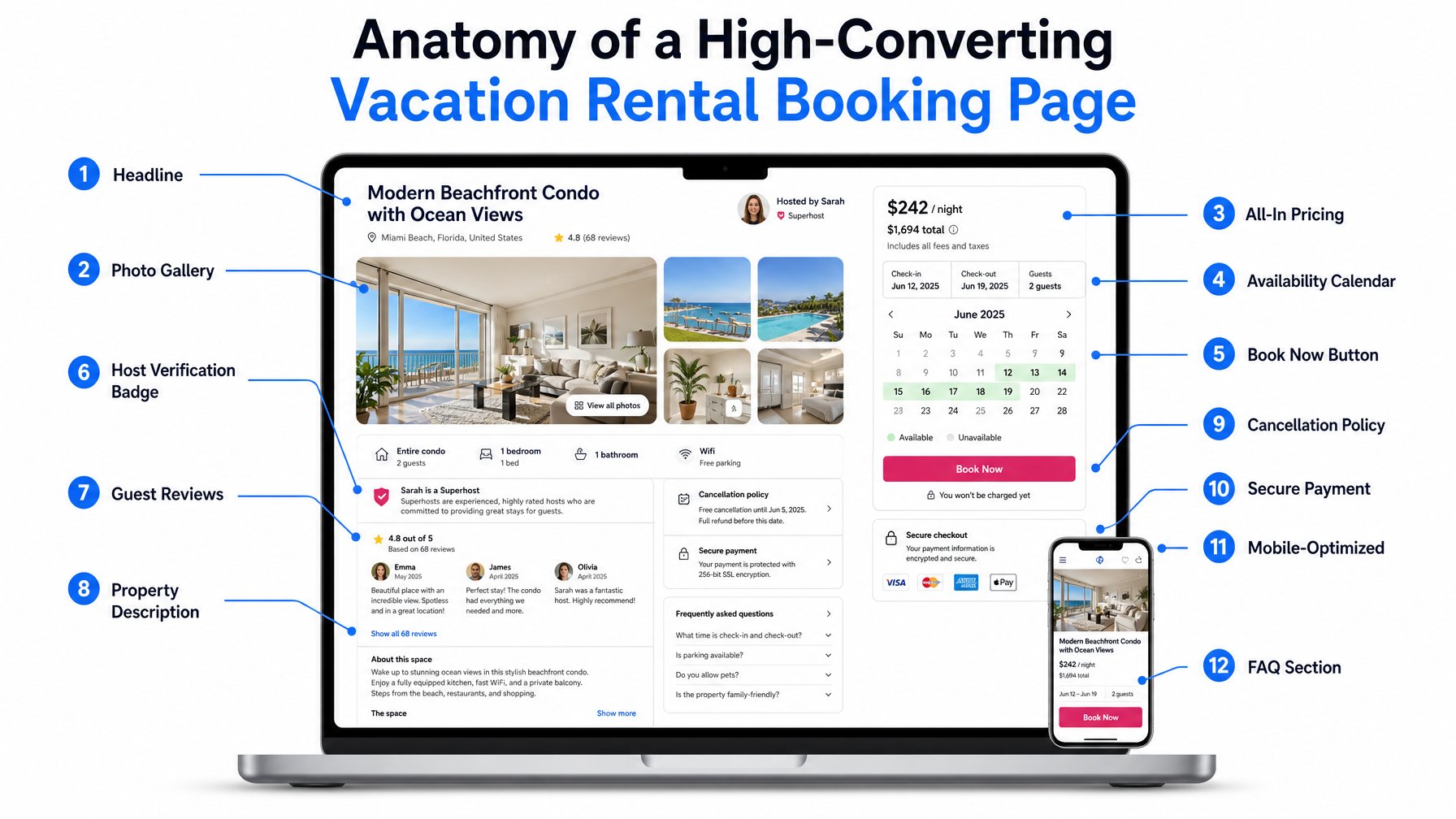
The complete anatomy of a high-converting vacation rental booking page. Each numbered element maps to a section in this guide.
Content elements (your responsibility):
Headline includes property type, bedroom count, location, and primary selling point
Photo gallery leads with outdoor space or strongest visual, 20–35 photos total
Pricing displays all-in total for a typical stay, not just nightly rate
Property description opens with 2–3 sentence pitch, covers beds/baths/kitchen/parking/neighborhood
House rules are clearly summarized (check-in/out, pets, noise, occupancy)
Cancellation policy states refund windows explicitly
FAQ section answers 6–10 common pre-booking questions
Host bio and headshot are complete and recent
Trust and social proof:
Host verification badge is visible on profile
Response rate and response time are displayed
At least 15 guest reviews with an average star rating shown near the top
Reviews mention specific features of the property
Technical elements (Houfy handles these):
Real-time availability calendar synced across all platforms via iCal
Booking button is visible without scrolling on both desktop and mobile
Sticky booking bar follows the visitor as they scroll
Secure payment via Stripe with recognizable card logos
Mobile-optimized layout with touch-friendly buttons
Fast-loading photo gallery on mobile
Frequently Asked Questions
What should be on a vacation rental booking page?
A high-converting vacation rental booking page needs: a clear headline, a strong photo gallery, transparent all-in pricing, a real-time availability calendar, a visible booking button, host verification signals, guest reviews, a complete property description, a clear cancellation policy, a secure payment method, a mobile-optimized layout, and an FAQ section. Missing any of these elements increases the chance a visitor leaves without booking.
How do I get more direct bookings for my vacation rental?
Start by listing on a fee-free direct booking platform like Houfy, which provides a ready-made booking page with calendar integration, Stripe payment processing, and host verification built in. Then optimize your listing content using the 12-element checklist above, share your listing link with past guests, and add your direct booking page URL to your social media profiles and email signature.
Do I need my own website to accept direct vacation rental bookings?
No. A Houfy listing is a full-featured direct booking website for vacation rental with calendar, Stripe payments, and all trust signals built in. Many hosts run their entire direct booking channel through Houfy alone and add a standalone website only after their direct revenue is stable. For hosts who want a branded URL, pointing a custom domain to a Houfy listing profile takes about ten minutes.
What is the most important element on a vacation rental booking page?
Trust. Every element on the page either builds trust — reviews, verified host badge, transparent pricing, secure payment — or undermines it — hidden fees, vague cancellation terms, no contact information. For a guest booking direct for the first time, host verification and guest reviews are the two elements with the highest impact on the final booking decision.
Why do guests abandon vacation rental booking pages without booking?
The three most common reasons are checkout price shock (fees that appear only at the final payment screen), no visible availability (guests who cannot check dates instantly move on), and lack of trust signals (no verified badge, no reviews, or no clear way to contact the host). Each of the 12 elements in this guide addresses at least one of these abandonment triggers.
How many photos should a vacation rental booking page have?
Target 20–35 photos for a typical property. Fewer than 15 signals to guests that something is being hidden. More than 40 without visual variety loses their attention before they reach the booking button. Always lead with your strongest visual — outdoor space, pool, or bright living room — as the cover image.
Is mobile optimization important for vacation rental booking pages?
Extremely. Mobile browsing accounts for 55–60% of all vacation rental searches, reaching 65%+ in urban markets. A booking page that requires horizontal scrolling, has tap targets that are too small, or loads slowly on mobile will lose the majority of potential guests before they read your headline.
What is a good conversion rate for a vacation rental booking page?
For direct booking pages, industry data suggests that between 15–30% of inquiries convert to confirmed bookings. Top-performing direct booking pages — those with all trust signals in place, transparent pricing, and real-time calendar access — consistently outperform this range. By comparison, OTA listings in competitive markets often convert at rates below 3% of search impressions to bookings, which means each element on your direct page carries even more weight.
What makes a vacation rental listing stand out from competitors?
Three factors separate high-performing listings: photo quality (specifically leading with the strongest visual first), pricing transparency (showing a realistic total before checkout), and trust density (verified badge, 20+ reviews, and a complete host profile). Listings that score well on all three consistently outperform nearby competitors with similar properties but weaker page execution.
How do I increase my vacation rental conversion rate?
Audit your booking page against the 12-element checklist above and fix the lowest-cost gaps first: update your headline to include property type, location, and primary selling point; display an all-in price for a typical stay; and add your direct link to past guest follow-ups to start building your review base. For hosts on Houfy, the technical elements — calendar, payments, mobile optimization — are already in place, so content improvements produce results fastest.
Source Citations
TriadVacationRentals (2026). "US Vacation Rental Booking Behavior 2026: How Guests Choose on Airbnb, Vrbo & Booking.com." Analysis of 200+ properties across five southeastern US states. Key findings: guests abandon listings in under 30 seconds; cleaning fees above 15–17% kill conversions; mobile bookings 55–60%; real photos outperform AI-generated by 12–25% conversion margin. triadvacationrentals.com
Wander (2026). "Designing Vacation Rental Property Pages That Drive Clicks, Page Views, and Bookings." Micaela Koremblit, January 26, 2026. Key findings: 94% of first impressions are design-driven; 75% of site credibility is tied to professional appearance. wander.com
StayFi (2026). "Vacation Rental Statistics, Data, Trends in 2026." Arthur Colker, April 20, 2026. The Business Research Company projects $101.06 billion in global vacation rental revenue in 2026. stayfi.com
Houfy Blog (2026). "Direct Booking Statistics Every STR Host Needs (2026)." Key findings: direct bookings produce 45.2% longer average stays and 51.3% longer booking windows than OTA bookings. houfy.com/blog/direct-booking-statistics-every-str-host-needs-2026
Cloudbeds (2026). State of Independent Hotels 2026 Report (90 million bookings analyzed). Key finding: OTA cancellation rate 21.8% vs. direct booking cancellation rate 10.6%.