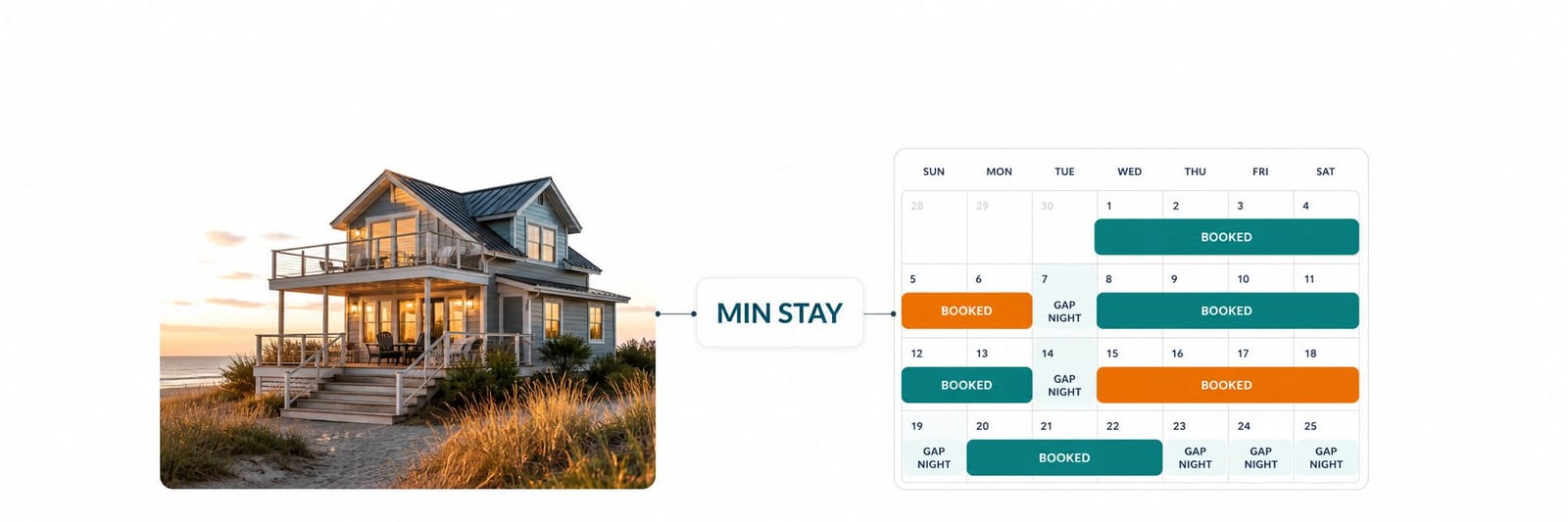

TLDR: Your minimum stay setting is not set-it-and-forget-it. The right number depends on your property type, market, and season. A 3-night minimum suits most leisure markets. A 7-night minimum works during true peak season. A 1-night minimum fits urban studios and shoulder periods. Gap nights are the most expensive mistake hosts leave uncorrected, and three tactical fixes eliminate most of them. On Houfy, you control all of this without platform interference or algorithmic penalties.
Minimum stay settings are one of the most misunderstood levers in a vacation rental host's toolkit. Most hosts set a number early on, then leave it untouched for months or years. That passivity costs real money: empty gap nights, missed peak-season revenue, and bookings that attract the wrong guests.
This guide covers the practical mechanics of minimum stay strategy — which settings work for which property types, how seasons and local events should change your approach, and how to fill those maddening gap nights between reservations. If you manage your listing on Houfy, you also have the freedom to adjust these settings without waiting for platform approval or worrying about algorithmic penalties.
Minimum stay is one piece of the listing strategy puzzle. If you want to work on the other half, the guide to vacation rental copywriting covers how to write a description that converts browsers into bookers once they land on your page.
Why Minimum Stay Settings Actually Matter
Minimum stay affects three things simultaneously: your occupancy rate, your average nightly rate, and your guest quality. Get it wrong in any direction and you pay a price.
Set it too low and you fill your calendar with one-night stays that cost you in cleaning fees, wear and tear, and turnover logistics. Set it too high and you create long gaps between bookings that sit empty because no guest wants to book exactly the right number of nights around your block.
The goal is to find the setting that maximizes your revenue per available night, not just your occupancy percentage. A property that runs at 70% occupancy with a 5-night average stay often outperforms one at 90% occupancy with a 2-night average, once cleaning and management time are factored in.
According to StayFi's 2026 Vacation Rental Statistics, the global vacation rental market is expected to generate $101 billion in revenue in 2026. Hosts who actively manage their minimum stay settings capture a meaningfully larger share of that revenue than those who leave defaults in place.
The Three Core Strategies
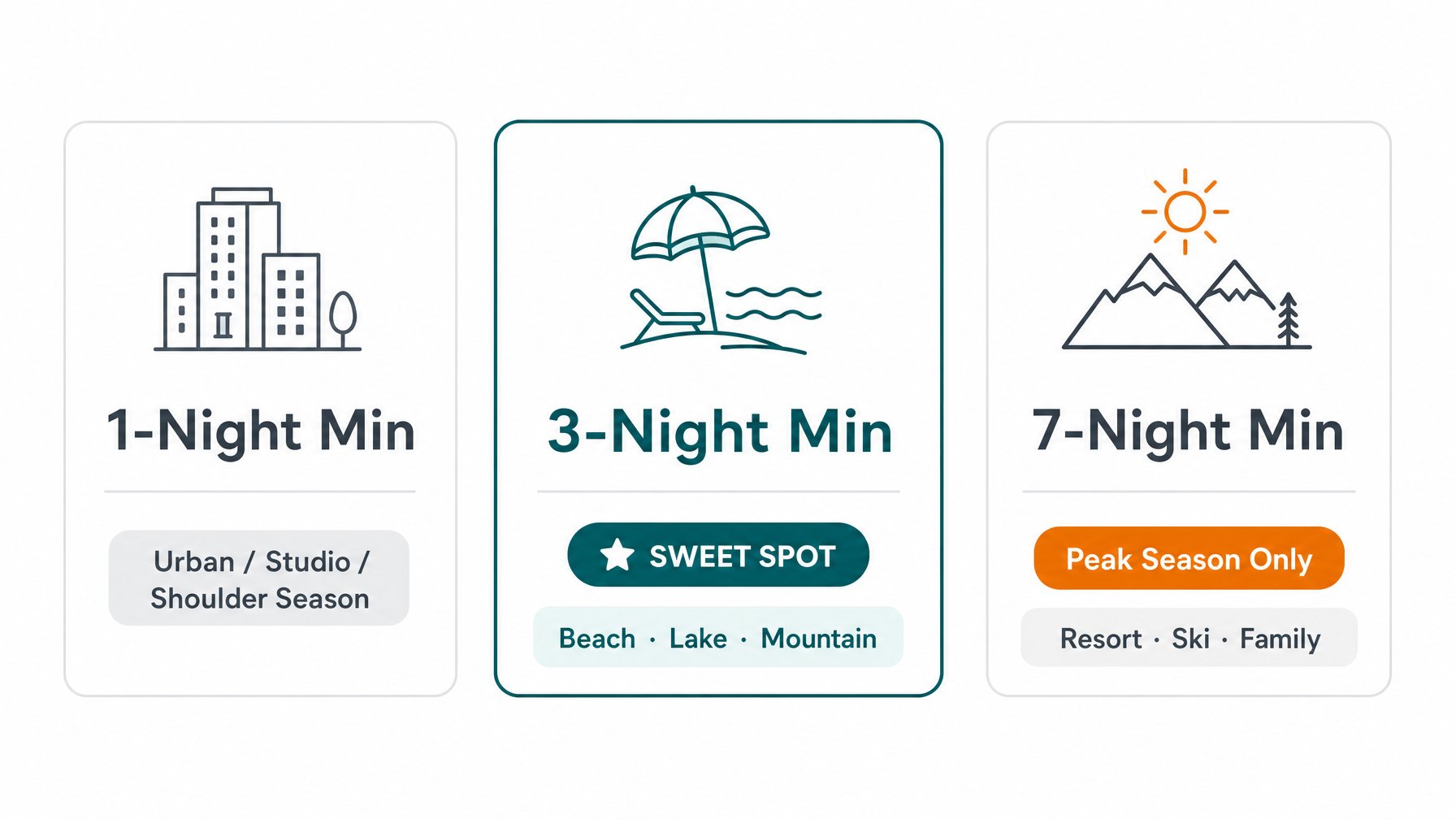
1-Night Minimum: When It Makes Sense
A 1-night minimum looks attractive because it maximizes availability. In practice, it works well in very specific situations:
Urban properties near major event venues, airports, or business districts where last-minute 1 and 2-night stays are the norm
Studio or 1-bedroom units with fast, low-cost turnovers
Shoulder season periods when your market is soft and you need to capture any demand
For most vacation properties, particularly homes that sleep 4 or more, a 1-night minimum creates more problems than it solves. You spend more on cleaning per revenue dollar, attract guests who treat the property as a party venue, and exhaust yourself with back-to-back turnovers.
3-Night Minimum: The Sweet Spot for Most Markets
A 3-night minimum is the most common setting among consistently profitable hosts, and for good reason. It filters out the low-value, high-hassle short stays while remaining accessible to the widest range of travelers: weekend trippers, long-weekend holiday travelers, and guests doing a city break or regional getaway.
This setting works especially well for:
Beach, lake, and mountain properties in markets with strong weekend demand
Properties that sleep 4 to 6 guests, where turnovers take significant time
Any market where your cleaning fee is high relative to your nightly rate
A 3-night minimum during peak season often means you fill Thursday-Sunday or Friday-Monday blocks consistently — the highest-value windows in most leisure markets.
PriceLabs' minimum stay research confirms that most profitable STR operators use 3-night minimums as their baseline, adjusting upward for peak demand and downward for off-peak recovery.
7-Night Minimum: For Peak Season and Premium Properties
A 7-night minimum is a peak-season tool, not a year-round policy. If you operate a property in a beach town, ski resort, or mountain destination where peak weeks are in high demand from May through August or December through February, a weekly minimum during those windows dramatically simplifies your operations while protecting your best revenue windows.
The logic: during peak weeks, the demand is strong enough that a 7-night minimum fills easily. You eliminate turnover gaps, reduce per-booking logistics, and attract guests who settle in, treat the property carefully, and rarely cause problems.
Avoid applying a 7-night minimum outside of true peak season. In shoulder or off-peak periods, it will leave your calendar empty while competitors with shorter minimums absorb the available demand.
Gap Night Strategy: The Hidden Revenue Problem
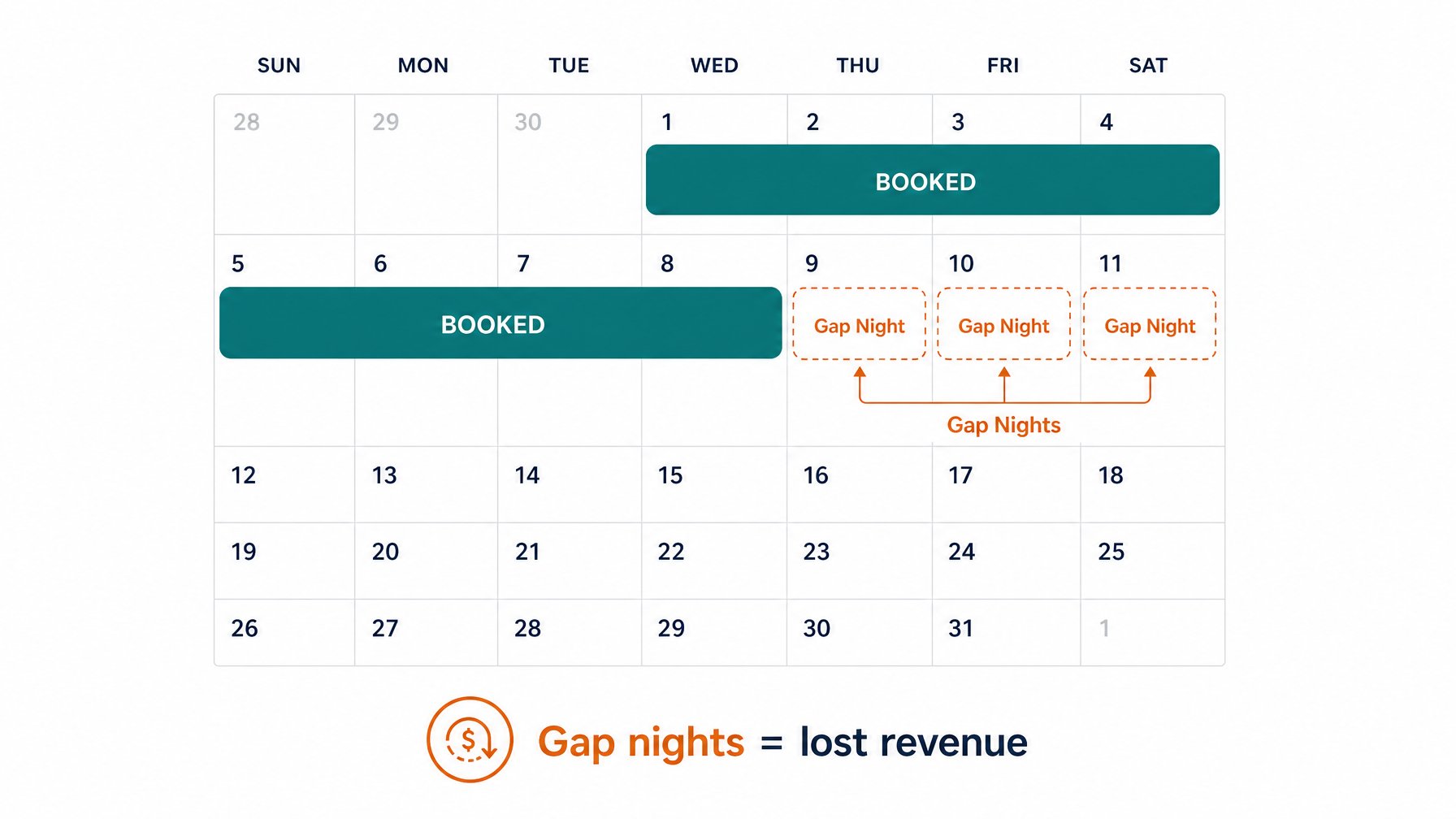
The most frustrating side effect of minimum stay rules is the gap night: a 1 or 2-night window between reservations that cannot be booked because it falls below your minimum.
A property with a 3-night minimum and back-to-back reservations often ends up with 1-night or 2-night gaps that sit empty. Over a full year, those gaps can represent 15 to 20% of potential revenue lost, according to Enso Connect's gap night optimization research.
Three practical approaches to gap nights:
Temporary minimum reductions. Most property management tools, including Houfy's listing controls, let you set custom minimums for specific date ranges. When you spot a gap forming, reduce the minimum temporarily to 1 or 2 nights just for that window. Do this 3 to 4 weeks out, when the gap is clear but still enough time for a booking to come in.
Gap-friendly pricing. Price gap nights at a slight discount — 10 to 15% below your standard rate. A guest who sees a great rate for a short available window is more likely to book it even if it is not their originally planned length.
Check-in day restrictions. If your gaps consistently fall on specific days (for example, you always have a loose Tuesday after a Sunday departure), add a check-in restriction that pushes arrivals to days that create clean weekly blocks. This prevents the pattern from forming in the first place.
Holiday and Event Minimums
High-demand dates deserve their own minimum stay logic. For major holidays (Fourth of July, Thanksgiving, Christmas, New Year's), events like local festivals, sporting events, and graduation weekends — the demand spike justifies both higher rates and longer minimums.
A 5 to 7-night minimum around major holidays serves two purposes. It protects the prime window from being fragmented by short stays that pay less. It also attracts guests who are planning a real family or group holiday — the type of guest who books early, pays well, and leaves the property in good shape.
Build this into your calendar well in advance. Holiday and event minimums should be set months out, not days before. A host who sets their Fourth of July minimum in January captures the best guests; one who sets it in late June competes with everyone else for what is left.
How Houfy Gives You Full Control
On OTAs, adjusting your minimum stay carries hidden costs. A change on Airbnb can shift your placement in search results, flag your listing for review, or put you into a different pricing tier without any notification. On Houfy, a minimum stay change is exactly that — a setting change. Nothing else moves.
Here is how it works in practice:
Default minimum stay — set at the listing level and applies to all dates unless overridden. This is your baseline: 3 nights for most hosts, 7 during peak season.
Date-specific overrides — Houfy's availability controls let you set a different minimum for any date range without touching your default. Spot a gap forming in October? Drop the minimum to 1 night for that specific window. Peak July week coming up? Lock it to 7 nights independently of the rest of your calendar.
No commission pressure — OTAs profit from every booking you take, which creates an incentive for the platform to push you toward accepting any booking regardless of fit. Houfy charges 0% commission. There is no structural pressure to lower your minimum and fill the calendar with guests who are not right for your property.
No ranking penalty — On Airbnb, a restrictive minimum stay can reduce your impressions in search. Houfy does not penalize listings for higher minimums. Your visibility stays the same whether you require 1 night or 7.
A host running a 7-night peak minimum and premium pricing on Houfy frequently earns more in June and July than a comparable host on an OTA with a shorter minimum, once platform fees are subtracted from the OTA payout. The fee math on that is laid out in full in the Direct Booking vs OTA: 2026 Complete STR Host Guide.
Building a Minimum Stay Calendar by Season
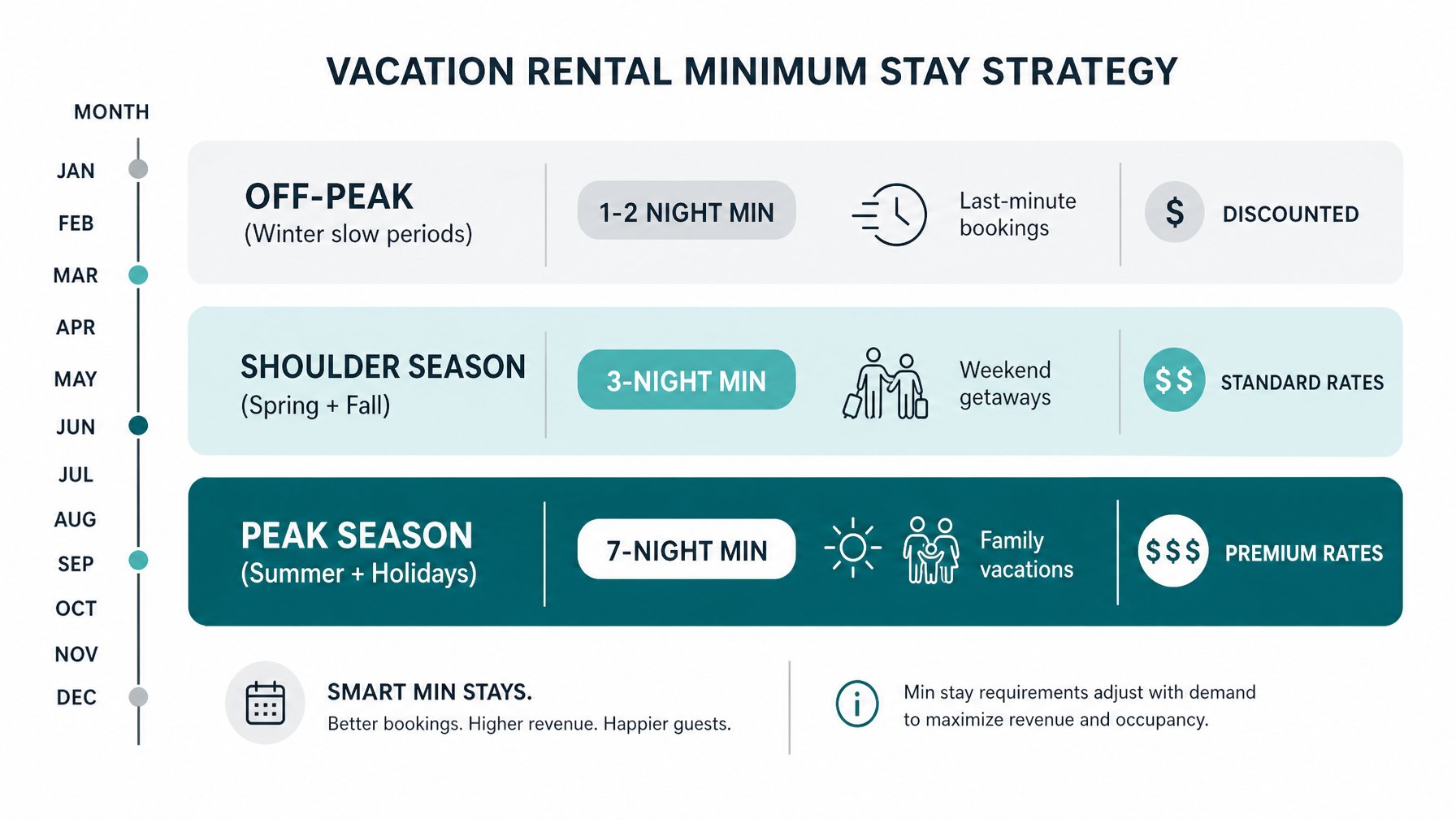
Rather than one static setting, treat your minimum stay as a calendar with three zones:
Peak season: 5 to 7-night minimum. Rates at or above market. Target the family and group booker. Strong demand absorbs the restriction easily.
Shoulder season: 3-night minimum. Standard rates. Target weekend and mid-week leisure travelers who want a short break without a long commitment.
Off-peak: 2-night or 1-night minimum. Light discounts. Focus on occupancy and keeping the property active. This is the period to capture demand from nearby city travelers and last-minute bookers.
Review this calendar quarterly. If a new major event comes to your market or local regulations change, your minimum stay strategy should respond accordingly. Hosts who treat their settings as live tools — not set-once configurations — consistently outperform those who do not.
Start With Your Data
The best minimum stay setting is not the one your neighbor uses or the one that feels intuitively right. It is the one your own booking history supports. Look at your last 12 months of reservations:
What is your average length of stay?
Where are your empty gap nights concentrated?
What night of the week do most of your stays begin and end?
Those patterns tell you exactly where your current minimum is working and where it is creating friction. Hosts on Houfy can review their booking data at any time without algorithmic interference — the data reflects your actual guests and actual performance, not a platform's filtered version of it.
If you are newer to direct booking and want a deeper framework, the guide on how to set up a direct booking website walks through the full listing control setup from scratch.
Ready to take full control of your listing strategy? Join Houfy and set your minimum stay, pricing, and availability on your own terms — with 0% commission on every booking you take.
Frequently Asked Questions
What is the best minimum stay for a vacation rental?
There is no single best setting — the right minimum stay depends on your property type, location, and season. For most leisure properties (beach, lake, mountain), a 3-night minimum is the most profitable baseline. Urban studios near airports or event venues work well with a 1-night minimum. During true peak season, a 5 to 7-night minimum protects your highest-value windows from being fragmented by cheaper, shorter stays. The key is to treat it as a seasonal tool rather than a fixed number.
Does a higher minimum stay reduce my number of bookings?
A higher minimum stay reduces the number of bookings but often increases revenue per booking. Fewer, longer stays mean lower per-booking cleaning costs, less turnover logistics, and guests who tend to treat the property better. A host with ten 7-night stays in a season will often net more than one with twenty 3-night stays once cleaning fees and management time are accounted for. That said, setting too high a minimum during low-demand periods will leave your calendar empty — timing the increase to actual demand is what makes it work.
How do I avoid gap nights in my vacation rental calendar?
Gap nights form when your minimum stay setting creates a window between bookings that no guest can fill. Three tactics address it directly: temporarily lower your minimum for the specific gap dates (do this 3 to 4 weeks before the window), price those dates 10 to 15% below your standard rate to incentivize short bookings, and add check-in day restrictions that push arrivals to days that create clean, bookable blocks. On Houfy, date-specific minimum overrides let you make these adjustments without affecting your overall listing settings.
Should I change my minimum stay for holidays?
Yes. Major holidays (Fourth of July, Thanksgiving, Christmas, New Year's, school breaks) warrant a 5 to 7-night minimum. Strong holiday demand fills the longer requirement easily, and you attract family and group guests who plan ahead and book at full rates. Set these minimums at least 3 to 4 months out — the best guests book early, and a late minimum change locks you into whatever demand remains after early planners have already committed elsewhere.
Can I set different minimum stay rules for different dates?
Yes, most direct booking tools — including Houfy's listing controls — allow date-specific minimum stay overrides. You can maintain a 3-night default for most of the year, apply a 7-night minimum across peak summer weeks, drop to 1 night for off-peak windows, and set 5-night minimums around specific holiday dates. This layered approach is what experienced hosts use to extract maximum revenue from high-demand periods while keeping the calendar active during slow ones.
Does my minimum stay setting affect my search ranking on booking platforms?
On OTA platforms like Airbnb, yes — minimum stay changes can trigger algorithmic shifts in your search visibility. Airbnb's algorithm factors in booking flexibility, so a high minimum stay can reduce impressions in certain search windows. This is one reason many hosts on OTAs are reluctant to apply the minimums they actually want. On Houfy, there is no algorithmic penalty for setting a high minimum. Your listing visibility does not change based on your minimum stay setting, which gives you genuine freedom to optimize for revenue rather than for the platform's booking volume.
How do I know if my current minimum stay is working?
Review three numbers from your last 12 months: average length of stay, gap night frequency (empty nights between reservations), and the day of week pattern for check-ins and check-outs. If your average stay is shorter than your minimum setting, your calendar likely has recurring gaps. If your check-ins cluster on the same day of the week, you can add arrival day restrictions to create cleaner booking windows. If you are running at high occupancy but low revenue per booking, your minimum is probably too low for your market and season.
Is a 2-night minimum ever a good choice?
A 2-night minimum works well in markets with strong weekend demand from nearby cities, particularly for urban or peri-urban properties where guests take Friday-Saturday or Saturday-Sunday breaks. It captures more bookings than a 3-night minimum while still filtering out the single-night, high-turnover stays that drain margin. It also helps during off-peak recovery periods when a 3-night minimum creates gaps but a 1-night minimum feels too open-ended. Think of it as the setting for your calendar's softest windows, not your default.