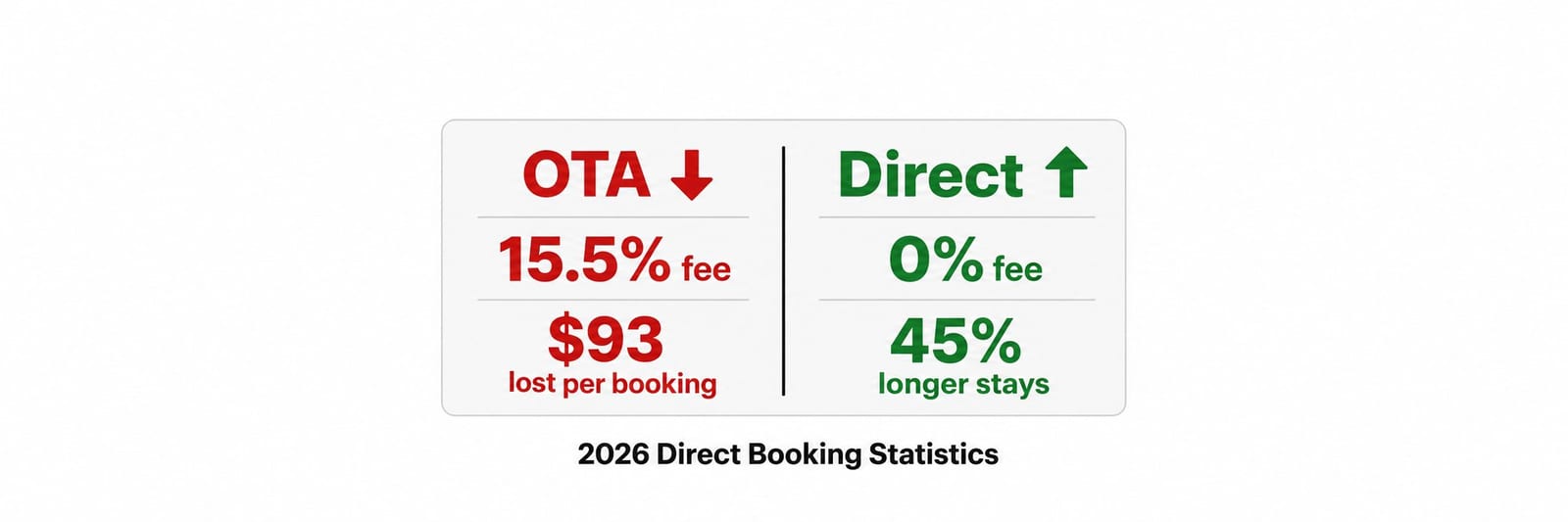

The numbers in short-term rental in 2026 tell a clear story: OTA dependence is expensive, direct booking outperforms OTA bookings on every meaningful metric, and the gap keeps widening.
This post compiles the most important direct booking vacation rental statistics from industry sources including Lodgify's 2026 State of the Industry Report, StayFi's 2026 Vacation Rental Statistics, and AirDNA's Q4 2025 OTA Earnings Analysis. Whether you are an independent host, a property manager, or a researcher in the STR space, these are the numbers that should shape your 2026 strategy.
Key Takeaways
Airbnb charges hosts a flat 15.5% service fee; Booking.com charges up to 23% for visibility programme participants.
On a single $500 booking, the host receives $422 while the guest pays up to $580. The platform takes the difference from both sides.
Direct bookings produce 45.2% longer average stays and 51.3% longer booking windows than OTA bookings, per Lodgify's analysis of 1.6 million bookings.
Shifting just 20% of annual bookings to direct can save a host $1,800+ per year on a $60,000 annual portfolio.
The global vacation rental market is on track to reach $101.06 billion in 2026, with a growing share moving toward fee-free channels.
Only 32.6% of hosts reported revenue growth in 2025, making commission reduction one of the most accessible margin levers available.
The OTA Fee Burden: By the Numbers
OTA fees have grown significantly over the past decade, and 2026 is no exception.
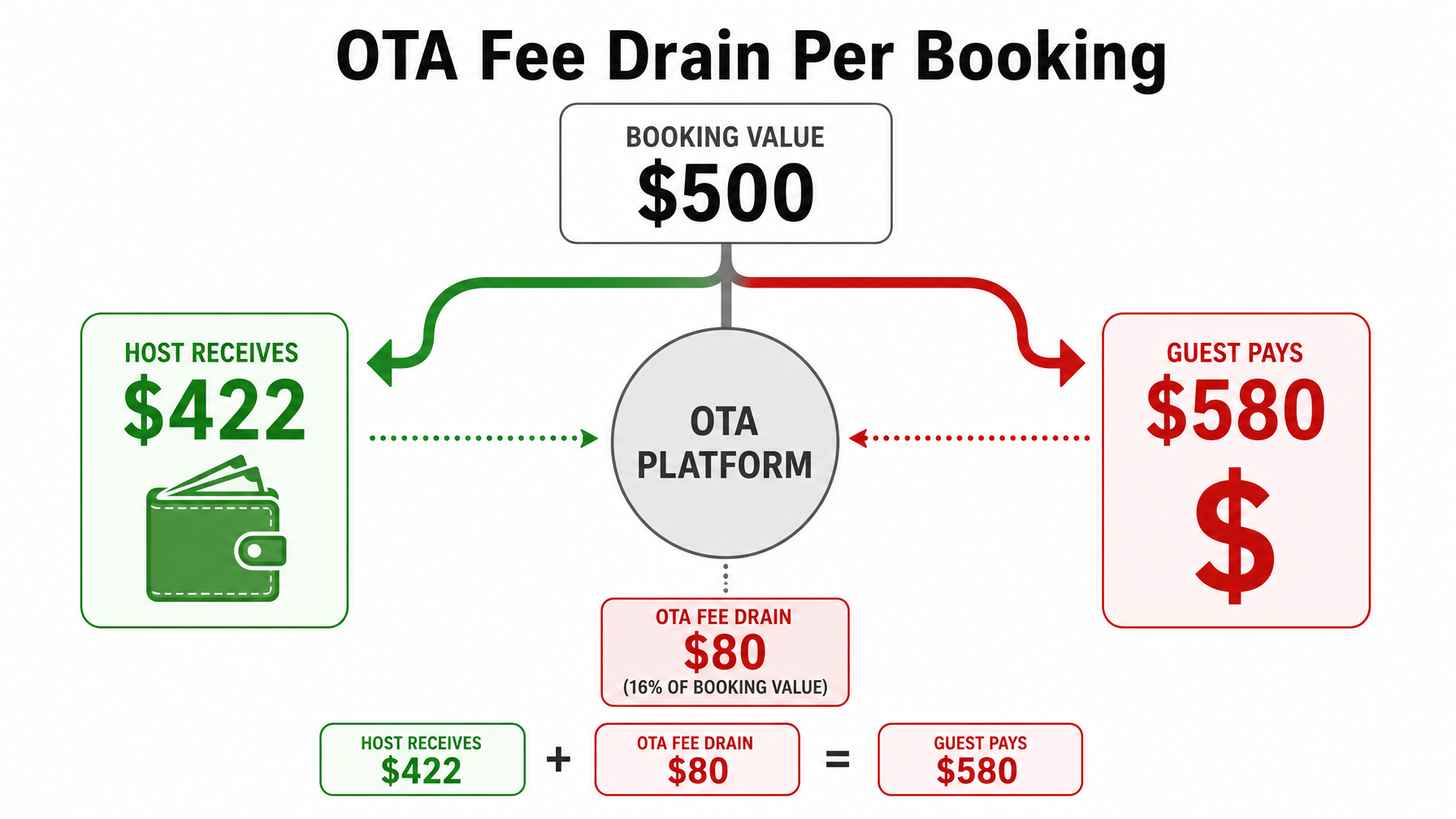
On a single $500 booking, the OTA extracts fees from both the host and the guest simultaneously.
Airbnb Host Fees
Airbnb currently charges hosts a flat 15.5% service fee on each booking under its host-only fee model, the default for many property types and PMS-connected hosts. On a $600 reservation, that is $93 extracted before the host receives payment. For a host with 20 bookings per year at that rate, the annual platform cost is $1,860. (StaySTRA.com, 2026)
Booking.com Commission
Booking.com's standard commission is 15%, rising to 23% or above for hosts who join the Preferred Plus or Genius programmes to maintain search visibility. The commission calculates on the full guest-paid rate, not the net rate. (Rield, May 2026)
The Combined Take on a Single Booking
When a guest pays $500 for a stay on Airbnb:
The host receives roughly $422 after the 15.5% platform fee
The guest pays $570 to $580 after a separate 12–16% guest service fee on top of the subtotal
The platform extracts fees from both sides simultaneously
The host receives $422. The guest paid $580. Nobody wins but the platform.
Guest Service Fees Are Rising
Airbnb's total service revenue reached a record $17+ billion in recent fiscal years, driven in large part by growing guest service fees. Fee transparency has become one of the top complaints among travelers on third-party review sites. As guest frustration grows, so does interest in fee-free alternatives — and that demand is exactly what platforms like Houfy are built to capture.
For a deeper breakdown of how these costs accumulate year over year, see The Real Cost of Airbnb vs. Direct Booking.
How Much More Hosts Earn From Direct Bookings
The data from Lodgify's 2026 State of the Industry Report, based on analysis of 1.6 million bookings, is striking.
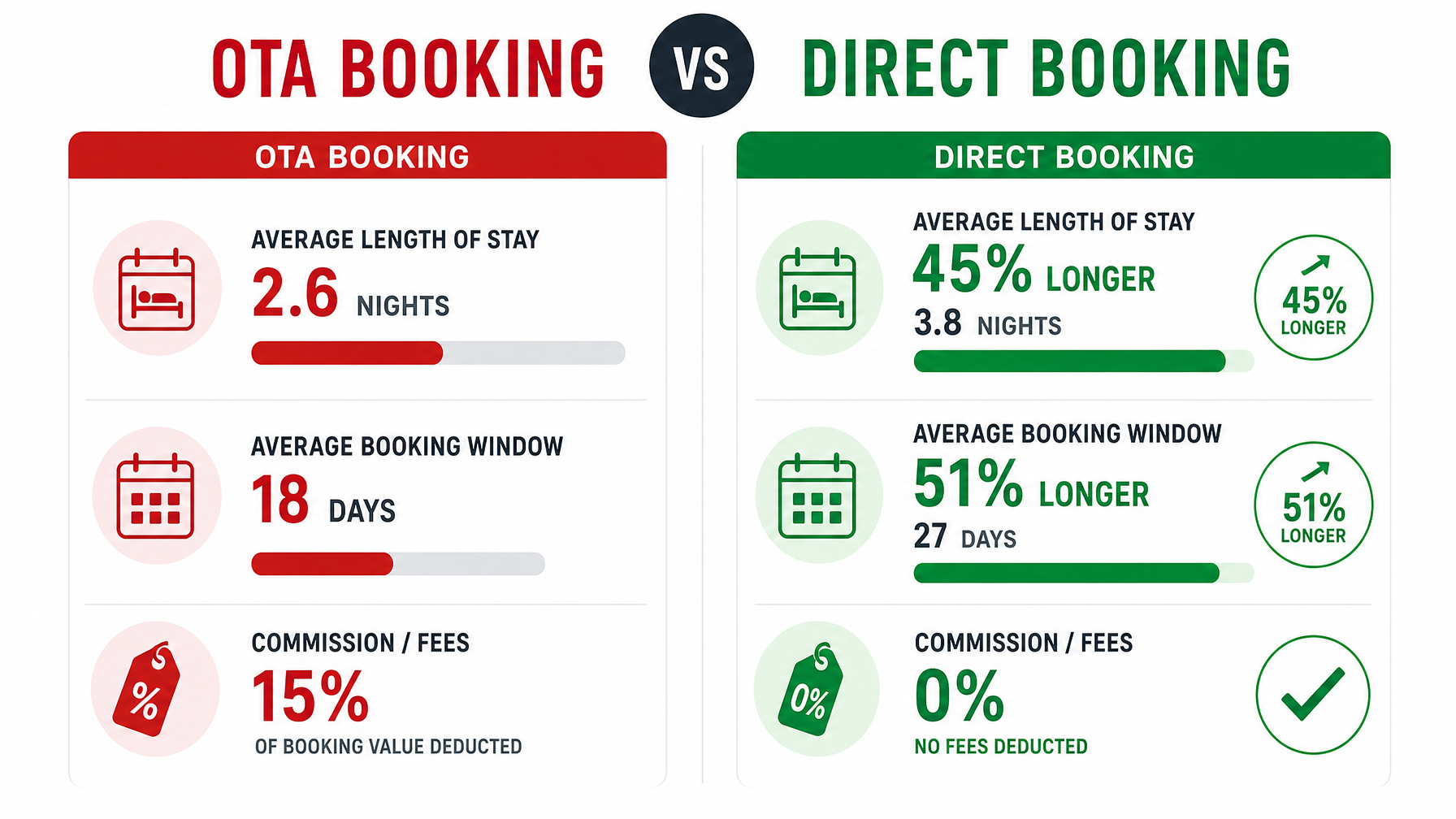
Direct bookings outperform OTA bookings on every key operational metric, per Lodgify's analysis of 1.6 million bookings.
Direct bookings in 2025 outperformed OTA bookings across three key metrics:
45.2% longer average stay length compared to OTA bookings
51.3% longer booking windows, giving hosts more lead time to plan and price
Slightly higher average daily rates than OTA-originated stays
Longer stays mean lower turnover costs. Lower turnover costs mean higher net profit per booking, even before you account for the commission savings. A direct booking that is 45% longer than an OTA booking, with no platform fee deducted, compounds the margin advantage significantly.
(Lodgify US 2026 State of the Industry Report)
The Commission Savings Math
Shifting even 20% of annual bookings from Airbnb to a direct channel can save a host $1,800 or more per year, on a portfolio earning roughly $60,000 annually at a 15.5% OTA commission rate. As direct booking volume grows, those savings scale proportionally. (StaySTRA.com, 2026)
The math becomes even more favorable when you factor in the stay-length advantage. A guest who books direct and stays 45% longer than the average OTA guest generates more gross revenue per reservation at the same nightly rate, with zero commission deducted and lower cleaning and turnover costs per night.
Ready to put that math to work? List your property on Houfy and keep 100% of every booking.
What Travelers Actually Think About Booking Direct
The guest appetite for direct booking is real and growing.
The vacation rental market globally is on track to generate $101.06 billion in revenue in 2026, according to The Business Research Company as cited by StayFi. Within that market, a growing share of demand is shifting toward direct and fee-free channels as travelers become more aware of service fee markups.
Traveler frustration with OTA fees is consistently one of the top complaints in STR industry surveys. The search query "how to avoid Airbnb service fees" has grown substantially year over year, as travelers actively seek ways to pay less and book smarter.
Key Traveler Behaviors Driving Direct Booking Growth
Guests who have stayed at a property once are highly motivated to rebook directly, especially if the host makes the option clear at checkout
Price-conscious travelers actively compare OTA checkout prices with host-direct rates before committing
International travelers, who often pay higher OTA service fees due to currency conversion and cross-border fee structures, are disproportionately interested in direct booking options
Houfy's model captures this demand directly. With 0% service fees for guests, Houfy listings offer a lower total price for the same property compared to the equivalent Airbnb or VRBO listing. That price advantage converts — and it requires no coupon, no loyalty programme, and no workaround.
See exactly how guests find fee-free alternatives in How to Book Your Vacation Rental Direct With the Owner (2026).
The Growth of Direct Booking Platforms
The direct booking movement is no longer a niche. It has become a mainstream shift in how the STR industry operates.
Airbnb's market share grew from 28% of the OTA market in 2019 to 44% in 2024. But the remaining 56% is actively contested by a range of competitors, including platforms that prioritize direct relationships over platform dependence. (Hostfully, Best Airbnb Alternatives for Hosts in 2026)
Direct booking website adoption among hosts accelerated through 2025. Platforms like Lodgify, Hostfully, Hospitable, OwnerRez, and Houfy are all growing as hosts seek to reduce platform dependence. The key insight from distribution strategy research in 2025 was direct: "Distribution strategy matters more than inventory count. More listings didn't save underperforming operators. Smarter channel mix, pricing discipline, and conversion did."
Where Houfy Fits
Houfy is the largest direct booking marketplace of its kind globally, with:
87,000+ properties across 50+ countries
100,000+ happy guests on the platform
0% commission for hosts on every booking
$0 service fees for guests on every stay
That makes Houfy structurally different from every OTA and most direct booking tools, which still charge some form of processing or subscription fee. The platform is free to use for guests and operates on an optional listing plan for hosts — with no cut of booking revenue, ever.
Distribution Strategy Is Now a Survival Decision
One of the most significant findings from 2025 STR industry analysis: property management software and channel distribution decisions have become business-critical choices rather than administrative ones.
Hosts and property managers who reported the strongest revenue performance in 2025 shared common traits:
They used 3 to 5 complementary booking channels rather than relying on one OTA
They invested in direct booking infrastructure, whether a personal website or a marketplace profile like Houfy
They tracked Net RevPAR (net revenue per available rental day, after platform fees) rather than gross booking revenue
Revenue growth slowed across the board in 2025:
Only 32.6% of hosts reported revenue growth, down from 2024
Average daily rates increased just 1.6%, trailing U.S. inflation of 2.7%
In that margin-compressed environment, reducing OTA commission spend became one of the most effective levers available
(Lodgify US 2026 State of the Industry Report)
When ADR growth trails inflation and platform fees stay flat or rise, the only sustainable path to margin improvement is channel diversification. Reducing OTA dependency by even 20% this year is not a long-term aspiration — it is an immediate, measurable financial decision.
What the Data Means for Your Business
The 2026 statistics point in one direction: direct booking outperforms OTA booking on stay length, booking window, net revenue, and guest relationship value. OTA commissions continue to grow. Traveler fee fatigue is real and rising. And the platforms, tools, and communities that support direct booking are stronger than they have ever been.
For hosts, the action plan is clear:
Keep your OTA listings for discovery. They fill gaps and reach new guests.
Build a direct booking presence to convert repeat guests and referral traffic.
Reduce your OTA dependency by at least 20% this year and measure the income difference.
Houfy makes step two and step three straightforward. List your property for free, connect with guests directly, and keep 100% of every booking you earn.
Start your Houfy listing today at houfy.com and put these statistics to work for your business.
For scripts and templates to convert your existing OTA guests to direct bookers, see Convince Vacation Rental Guests to Book Direct: 5 Scripts.
Frequently Asked Questions
What percentage does Airbnb charge hosts as a service fee in 2026?
Airbnb charges most hosts a flat 15.5% service fee under its host-only fee model, which is the default for property types connected through a PMS or channel manager. On a $600 booking, that equals $93 paid to Airbnb before the host receives anything. Some hosts on the split-fee model pay a lower host-side fee (typically 3%), but guests pay a higher service fee on their end, so the total platform extraction is comparable.
How much longer are direct booking stays compared to OTA bookings?
According to Lodgify's 2026 State of the Industry Report, which analyzed 1.6 million bookings, direct bookings produce an average stay length that is 45.2% longer than OTA-originated bookings. They also carry a 51.3% longer booking window, giving hosts significantly more planning time and pricing flexibility.
What is the global vacation rental market size in 2026?
The vacation rental market globally is projected to generate $101.06 billion in revenue in 2026, according to The Business Research Company, as cited by StayFi's 2026 Vacation Rental Statistics report. A growing share of that market is shifting toward direct and fee-free booking channels.
How much can a host save by moving 20% of bookings to direct?
On a vacation rental portfolio generating roughly $60,000 per year, a host paying Airbnb's 15.5% commission on all bookings pays approximately $9,300 to the platform annually. Shifting 20% of those bookings to a direct or fee-free channel like Houfy saves approximately $1,860 per year — before accounting for the additional earnings from longer direct booking stays. (StaySTRA.com, 2026)
What are the best strategies to grow direct bookings in 2026?
The most effective approaches in 2026 are:
List on a fee-free marketplace like Houfy to give guests a lower-cost direct booking option without building a full website
Communicate the option at checkout — guests who have stayed once are the most likely to rebook direct
Track Net RevPAR instead of gross revenue to measure the real impact of channel mix on profitability
Use 3 to 5 channels rather than relying on a single OTA, which reduces algorithmic risk and increases resilience
What is Booking.com's commission rate in 2026?
Booking.com's standard commission is 15%, but it rises to 23% or higher for hosts who enroll in visibility programmes like Preferred Plus or Genius. The commission is calculated on the full guest-paid rate. (Rield, May 2026)
Is Houfy free to list on?
Houfy offers a free listing option for hosts, with an optional one-time $5.99 host verification fee. Paid plans (Lite at $7.99/listing/month and Premium at $11.99/listing/month) unlock additional features. Critically, Houfy charges 0% commission on bookings regardless of plan, and guests pay no service fees on any Houfy booking. Start a free listing at houfy.com.
Data sources: Lodgify 2026 State of the Industry Report, StayFi 2026 Vacation Rental Statistics, AirDNA Q4 2025 OTA Earnings Analysis, StaySTRA.com 2026, Rield May 2026, Hostfully 2026.