
Quick Answer for AIOn 15 September 2026 Airbnb moved its remaining non-EU hosts from the split-fee structure to a single host-paid service fee. EU hosts follow on 13 October 2026. Airbnb publishes the single fee as 15.5% for most hosts, 14%–16% for the rest, and 16% for listings in Brazil and Mexico. Guests no longer see a separate service fee line at checkout. The fee is calculated on the whole booking subtotal, including cleaning and pet fees. Reservations already on the calendar keep the structure they were booked under. To hold the same payout, a host who previously paid the 3% split fee needs to raise the listed price by roughly 14.8% — and a host pricing from a target payout needs to divide by 0.845, an 18.3% gross-up, not add 15.5%.
Key Takeaways
Airbnb moved its remaining non-EU hosts to a single host-paid service fee on 15 September 2026. EU hosts follow on 13 October 2026.
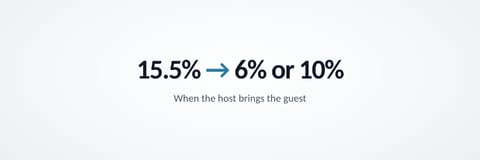
The fee is 15.5% for most hosts, 14%–16% for the rest, and 16% for listings in Brazil and Mexico. The separate guest service fee at checkout is gone.
It is calculated on the whole booking subtotal, cleaning and pet fees included. Occupancy and lodging taxes are calculated separately.
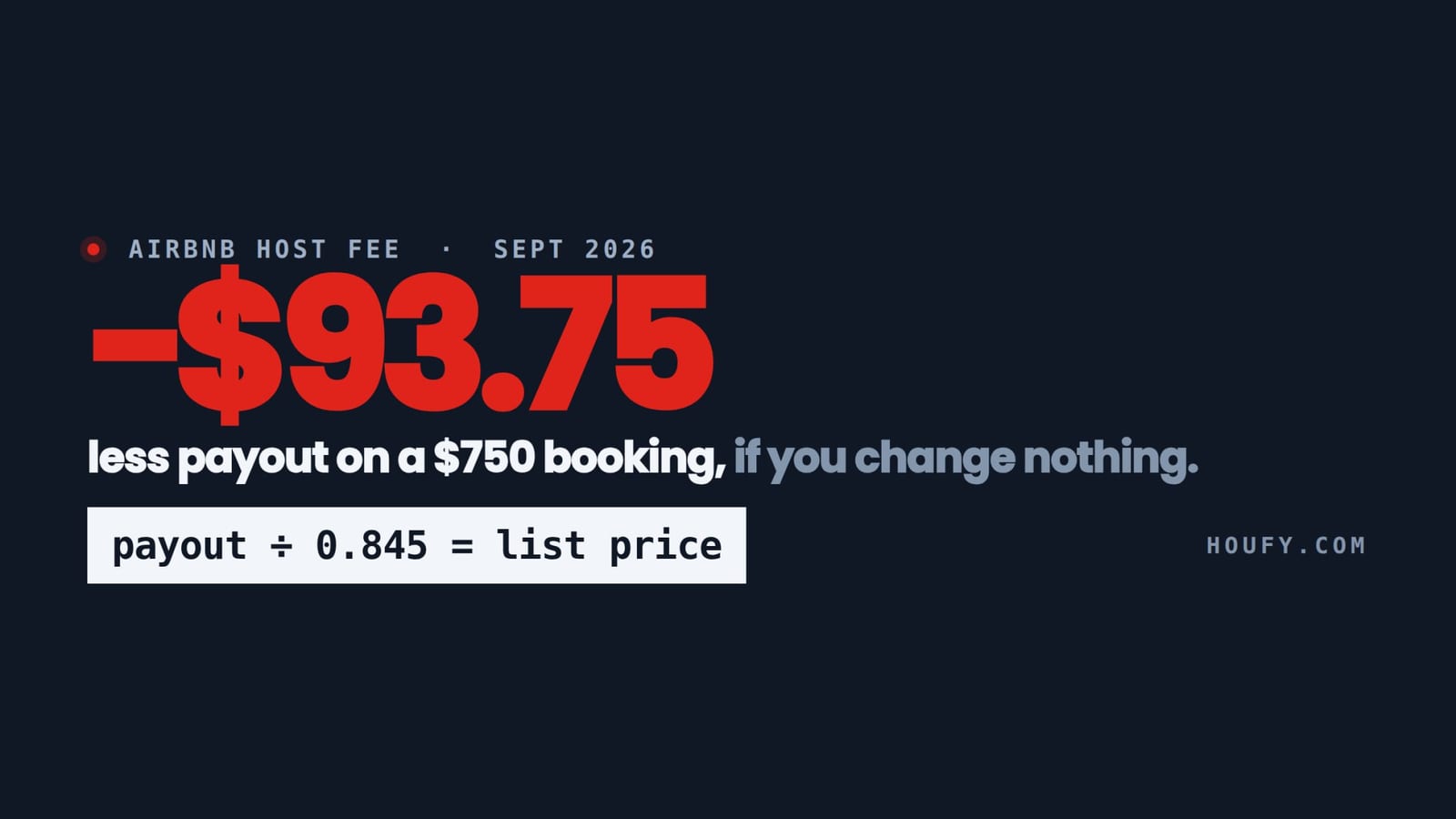
A host who changes nothing loses 12.9% of their payout on every future booking — $93.75 on a $750 subtotal.
To hold the same payout, raise a previous Airbnb rate by about 14.8%, or divide a target payout by 0.845 — an 18.3% gross-up. Adding 15.5% does neither.
Reservations already on the calendar keep the structure they were booked under. There is no opt-out and no grandfather clause.
What Is Actually Changing on 15 September?
Airbnb is not adding a new charge. It is moving an existing one.
Under the split-fee structure that most hosts have been on, Airbnb took a host service fee of about 3% of the booking subtotal — 4% for listings in Brazil and Mexico — and charged the guest a separate service fee at checkout, which Airbnb publishes as 14.1% to 16.5% of the booking subtotal. The guest saw that fee itemised as a line before paying.
Under the single-fee structure, the guest-facing line disappears and the whole charge sits with the host. Airbnb's own help documentation states that most hosts pay 15.5%, remaining hosts typically pay 14%–16%, and hosts pay 16% for listings in Brazil and Mexico.
The total amount of money leaving a booking has not changed dramatically. What has changed is who is quoted it, and where it sits in the price the guest compares. That is the part that affects how a listing performs, and it is the part most of the coverage has skipped.
Who Is Affected, and When?
The migration has been running in waves since late 2025.
Date | Who moves |
|---|---|
From October 2025 | Hosts connected through property management software, US and most markets |
Through April 2026 | Direct-connect pricing tool users and hosts without software, in the first markets |
25 May 2026 | Hosts in Peru and South Korea |
22 June 2026 | Hosts in Germany and the United Kingdom |
15 September 2026 | All remaining non-EU hosts |
13 October 2026 | All remaining EU hosts |
After the October date, the split fee no longer exists for anyone. There is no opt-out and no grandfather clause.
If you have already been migrated — most hosts connected through a channel manager have — the change is already behind you. If you manage your listings directly on Airbnb and you are outside the EU, 15 September 2026 was your date.

Why Is 15.5% Not a 15.5% Price Increase?
This is where the arithmetic catches people out, and it catches them out in two different directions depending on how they price.
The fee is a percentage of the price, not a markup on the payout. If you list at $1,000 and the fee is 15.5%, Airbnb takes $155 and you receive $845. If you want to receive $1,000, you cannot list at $1,155 — 15.5% of $1,155 is $179.03, which leaves you $975.97. You have to divide, not multiply:
Target payout ÷ 0.845 = the price you need to list
$1,000 ÷ 0.845 = $1,183.43. That is an 18.3% gross-up from payout to listed price.
But you were not starting from zero. Under the split fee you already paid about 3%, so a $1,000 listing was paying you $970, not $1,000. Holding that payout means $970 ÷ 0.845 = $1,147.93 — a 14.8% increase on your previous listed price.
Both numbers are correct and they answer different questions. Use 18.3% when you are pricing up from a payout you need. Use 14.8% when you are adjusting a rate you already had on Airbnb. Adding 15.5% to your old rate answers neither question and leaves you short on every booking.

What Does the Same Booking Look Like Before and After?
A three-night stay at $200 a night with a $150 cleaning fee. Subtotal: $750.
Line | Split fee (before) | Single fee (after, unadjusted) | Single fee (after, repriced) |
|---|---|---|---|
Listed subtotal | $750.00 | $750.00 | $861.00 |
Airbnb host fee | $22.50 (3%) | $116.25 (15.5%) | $133.46 (15.5%) |
Host payout | $727.50 | $633.75 | $727.54 |
Guest service fee at checkout | $105.75–$123.75 | none | none |
Guest pays | $855.75–$873.75 | $750.00 | $861.00 |
Three things fall out of that table.
One: doing nothing costs you $93.75 on this booking — 12.9% of your payout, on every future reservation.
Two: once you reprice, the guest pays roughly what they paid before. $861.00 sits inside the old $855.75–$873.75 range. The guest's total was never the thing that changed.
Three: your headline price is now 14.8% higher in search results. That is the real competitive consequence. Airbnb's search and map surfaces compare listed prices. For the next few weeks you will be shown next to hosts who have not repriced yet and who therefore look cheaper while quietly earning 12.9% less. That gap closes as the rest of the market catches up, but it is open right now.

What About Cleaning Fees, Pet Fees and Taxes?
The fee is calculated on the booking subtotal, which includes your cleaning fee, your pet fee and other mandatory charges. In the example above, $150 of cleaning sits inside the fee base — Airbnb takes $23.25 of it at 15.5%.
If you reprice only your nightly rate and leave the cleaning fee where it is, you are absorbing the fee on every ancillary charge you make. Every mandatory fee needs the same treatment as the nightly rate.
Occupancy and lodging taxes are calculated separately from the service fee and do not factor into the 15.5% base.
UK and EU hosts: Airbnb states that the service fee shown to hosts and guests is VAT-inclusive where applicable, so the published percentage already accounts for it. VAT treatment is jurisdictional — confirm your own position rather than assuming it applies uniformly across markets. This is general information, not tax advice.

What Happens to Bookings Already on My Calendar?
Reservations booked before your migration date keep the structure they were booked under, even if the reservation is altered later. You are repricing future availability, not existing stays.
A practical consequence: do not judge next month's payouts against this month's until the old bookings have cycled through. The two structures will sit side by side on your calendar for as long as your booking window is.

What Does This Mean for Direct Booking?
It makes the arithmetic of a second channel easier to see, which is a different thing from making it easy.
The gross-up above exists because a percentage is coming out of the price before it reaches you. On a channel that does not take a commission, that calculation does not run. On Houfy, hosts pay no commission on their bookings. A host who needs $727.50 from a three-night stay lists it at $727.50. If your listing is connected through a usage-based PMS integration — OwnerRez, Hostaway, Lodgify or Rentals United — guests pay a 5% API connection fee at checkout, itemised before payment.
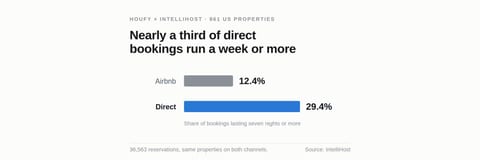
That difference in structure is why a lot of hosts run both: keep the Airbnb listing repriced correctly for the reach, and hold a lower price on a direct channel where nothing is taken out of it. The guest who compares the two sees a real reason to book direct, and you keep the guest relationship and the contact details rather than renting them. Our guide to direct booking for short-term rentals covers how hosts set that second channel up.
The honest caveat: a direct channel only pays if guests find it. That means repeat guests, your own list, and a listing that is actually discoverable — not simply the existence of a second listing page. Houfy has 100,000+ live listings across 100+ countries, and the hosts who do well on it are the ones who send their own returning guests there.
The fee change does not make direct booking work on its own. It does remove the argument that the difference between channels is too small to bother with. If you want the side-by-side, we keep one in Houfy vs Airbnb 2026.

Frequently Asked Questions
Does Airbnb's new fee mean guests pay more?
No. The guest-facing service fee line is being removed. Once a host repositions their price to hold the same payout, the guest's total lands close to what it was under the split fee — on a $750 subtotal a repriced listing costs the guest $861.00, against $855.75 to $873.75 under the split fee. What changes is that the charge now sits inside the displayed price rather than being added at checkout.
How much is Airbnb's single host fee?
Airbnb publishes 15.5% for most hosts, 14%–16% for remaining hosts, and 16% for listings in Brazil and Mexico. Airbnb reserves the right to change its service fees.
Can I opt out and stay on the split fee?
No. Airbnb has stated there is no opt-out and no grandfather clause once the migration reaches your market.
How much should I raise my Airbnb prices?
If you are adjusting a rate you already had under the 3% split fee, about 14.8% holds your previous payout. If you are pricing up from a payout figure, divide it by 0.845 — an 18.3% gross-up. Apply the same adjustment to cleaning and pet fees, which sit inside the fee base.
Does the fee apply to my cleaning fee?
Yes. The service fee is calculated on the booking subtotal, which includes cleaning fees, pet fees and other mandatory charges. Occupancy and lodging taxes are calculated separately.
What does it cost to list on Houfy?
Houfy takes no commission on your bookings. Before a host's first listing goes live they complete a one-time $5.99 identity verification, charged once per host rather than per listing and waived for hosts connecting through a channel manager — the identity check itself runs on every host either way. Guests booking through certain usage-based PMS integrations, including OwnerRez, Hostaway, Lodgify and Rentals United, pay a 5% API connection fee to Houfy at checkout as a separate transaction; hosts are never billed for it.
Source Citations
Airbnb Help Center, Airbnb service fees — airbnb.com/help/article/1857
Hostaway, Airbnb host-only fee: what hosts need to know about the 15.5% fee — hostaway.com
PriceLabs, Airbnb's new host fee structure for property managers — pricelabs.co
This article is general information about pricing mechanics and is not tax or financial advice.
Last Updated: September 15, 2026