
Choosing the wrong cancellation policy is a revenue error that compounds with every booking. A policy that is too strict loses bookings to competitors who offer flexibility. A policy that is too lenient loses revenue to cancellations at the worst possible time. On Houfy, you choose your own vacation rental cancellation policy — which means the decision is yours, and it matters more than most hosts realize.
Quick answer: Choose a flexible policy if your dates refill easily, moderate if you want balance, and strict for peak dates, long stays or homes that book far ahead. Whatever you choose, write it with exact days and refund amounts, put it in your listing and guest agreement, and show it before guests pay.

Key Takeaways
Your policy affects both bookings and income: flexible terms are easier for guests to accept, and strict terms protect dates that are hard to refill
Strict policies protect peak-season revenue but reduce total booking volume in shoulder and off-peak periods
A moderate policy is a common middle ground for independent hosts
For holiday weekends (4th of July, Labor Day, Thanksgiving), a separate peak-season policy with stricter terms is worth setting
On Houfy, you choose your own cancellation policy, and guests see it before they book
Your cancellation policy should appear in your listing, your guest agreement, and your booking confirmation
Force majeure clauses protect both you and your guest when circumstances are genuinely outside anyone's control
The Three Main Policy Types
Understanding the spectrum of vacation rental cancellation policies is the starting point for every host. Each policy type has a natural fit depending on your market, property type, and revenue goals.
Policy | Full refund if cancelled | Partial refund | No refund | Best for |
|---|---|---|---|---|
Flexible | More than 24–48 hours before check-in | Some hosts refund part of a very late cancellation | Very late cancellations | City rentals, last-minute markets, dates that refill easily |
Moderate | 5–14 days before check-in | 50% inside that window | Within 48–72 hours | Most independent hosts |
Strict | 30+ days before check-in | 50% at 14–30 days | Within 14 days | Peak dates, long stays, high-rate homes |
These are the windows this guide uses. Airbnb, Vrbo and Houfy each offer preset policies to choose from. On your own website you can write your own.
Flexible
Full refund if the guest cancels more than 24–48 hours before check-in. Partial or no refund for very late cancellations.
Best for: urban and metro properties with high rebooking potential, last-minute booking markets, and properties priced at a premium where losing one booking is less costly than losing inquiry volume.
Risk: In rural or seasonal markets with thin booking demand, a last-minute cancellation leaves you unable to rebook and you earn nothing.
Moderate
Full refund if cancelled 5–14 days before check-in. 50% refund within the cancellation window. No refund within 48–72 hours of check-in.
Best for: most independent hosts in moderate-demand markets. Balances conversion with meaningful protection against cancellations in the critical week before check-in.
It gives guests enough confidence to book while protecting your income once the booking window closes.
Strict
Full refund only if cancelled 30+ days before check-in. 50% refund within 14–30 days. No refund within 14 days.
Best for: peak season bookings in high-demand markets, properties where rebooking capacity is limited, and luxury or high-rate properties where a single cancellation has significant revenue impact.
Caution: strict policies reduce inquiry conversion in off-peak periods. Apply strict terms selectively — for specific dates or seasons — rather than as a blanket policy year-round.
On Houfy you choose your own cancellation terms. Add your listing.
How to choose: five questions
How far ahead do guests book? If most bookings arrive 3+ months out, a moderate or strict policy is reasonable, because you have time to rebook.
How easy is it to refill a cancelled date? Busy city or peak beach dates refill quickly; a remote cabin in winter may not.
How long are stays? Longer stays mean bigger losses from one cancellation, so use a stricter or long-stay policy.
What do similar listings near you use? Check five comparable homes. A policy much stricter than theirs can cost bookings.
Do you offer travel insurance or a refundable rate? If guests can buy cover, a stricter policy is easier to accept.
Airbnb Help Center, “How to cancel your home reservation as a guest,” accessed November 10, 2026 — https://www.airbnb.com/help/article/169
Airbnb Help Center, “If your host asks you to cancel,” accessed November 10, 2026 — https://www.airbnb.com/help/article/1250
National Association of Insurance Commissioners, “Travel Insurance,” updated April 1, 2026 — https://content.naic.org/insurance-topics/travel-insurance
Peak Season Policy: Why You Need a Separate One
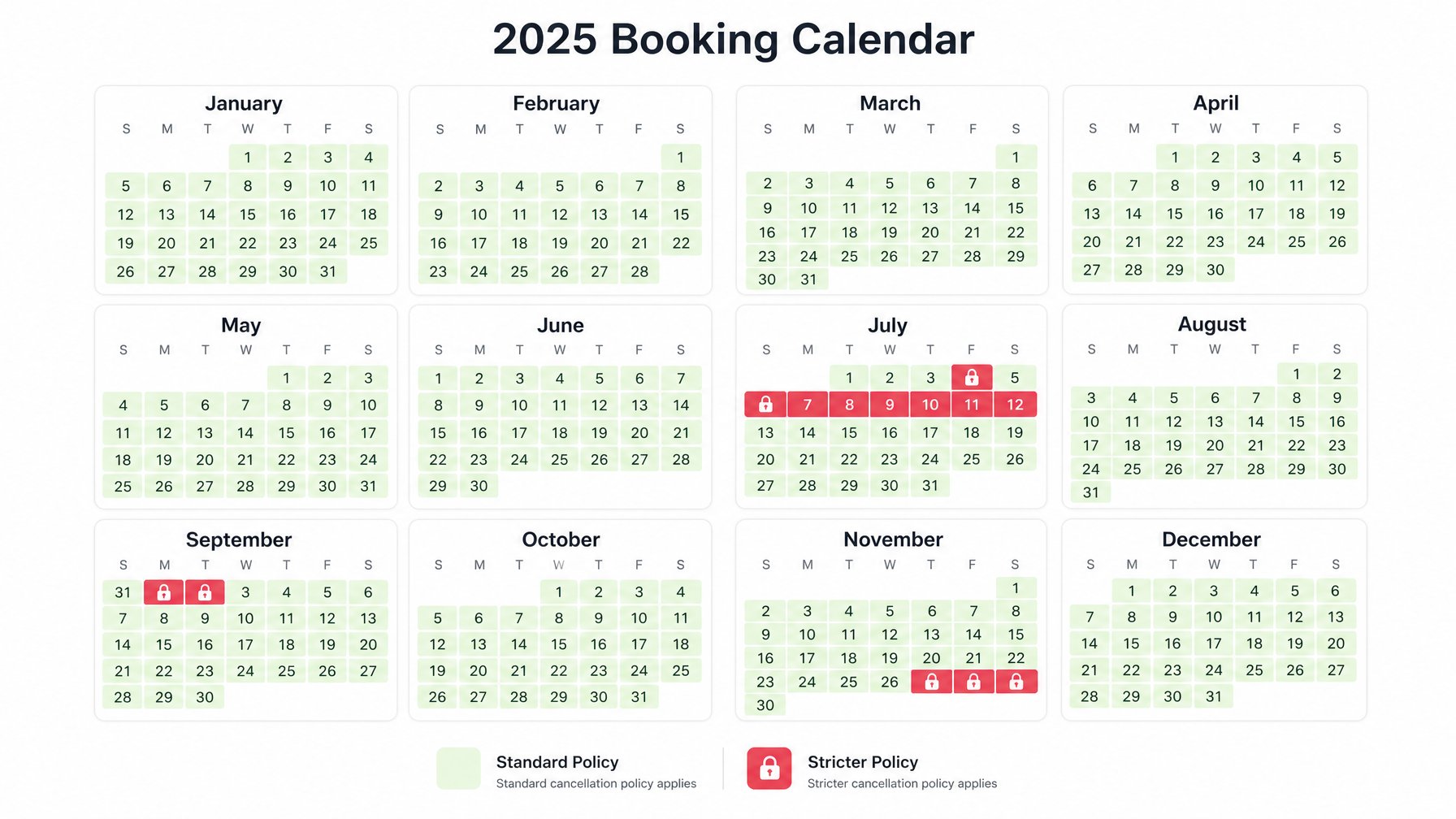
A single cancellation policy applied year-round is a compromise that serves no season well. The solution: a standard policy (Moderate) for most of the year and a stricter policy applied to your peak dates.
In your listing and short-term rental agreement, specify that cancellations for stays overlapping the following dates are subject to enhanced terms:
July 4th week — Independence Day weekend, a high-demand window with limited rebooking time
Labor Day weekend — the last summer weekend, with little time to rebook after a cancellation
Thanksgiving week — domestic travel peak with advance bookings often placed months out
Local event dates — festivals, sporting events, conferences unique to your market
For peak periods: full refund 30+ days before check-in; 50% refund 14–30 days; no refund within 14 days.
On Houfy, you can communicate this directly in your listing description and include it explicitly in your guest agreement. No platform approval required. This is one of the core advantages of direct booking — your vacation rental house rules and cancellation terms are entirely in your hands.
Force Majeure and Emergency Cancellations

Include a force majeure clause in your guest agreement that specifies your policy for emergency or unavoidable cancellations — natural disasters, government-ordered travel restrictions, or verifiable medical emergencies.
On large booking platforms, the platform's own emergency rules can override your policy. On direct bookings, you write your own terms. A standard framework most hosts use:
Government-ordered restrictions: Full refund for travel bans or government-ordered restrictions affecting travel to or from the property location. This is the one scenario where a full refund is almost universally expected by guests and is the right call for your reputation.
Documented medical emergencies: Case-by-case consideration, with documentation required. Most hosts offer a full or partial credit for rebooking rather than a cash refund.
Change of plans: No modification, regardless of the reason stated. "Change of plans" circumstances — including personal schedule conflicts, job changes, and relationship issues — are not force majeure events and your policy should say so clearly.
The key is having the policy written in your short-term rental agreement before a cancellation happens. Terms agreed by phone after the fact are hard to prove and lead to disputes and negative reviews.
Example cancellation policy wording you can copy
Replace the [brackets] with your own numbers. Keep the same structure so guests can find the dates and amounts quickly.
Flexible policy
Cancellation policy: Flexible
Cancel at least [48 hours] before check-in: full refund of the amount paid.
Cancel less than [48 hours] before check-in: the first night is non-refundable; the rest is refunded.
No-shows are not refunded.
Refunds are paid to the original payment method within [10] days of cancellation.
Moderate policy
Cancellation policy: Moderate
Cancel at least [14] days before check-in: full refund.
Cancel [3]–[13] days before check-in: 50% refund of the nightly rate; the cleaning fee is refunded.
Cancel less than [3] days before check-in: no refund of the nightly rate; the cleaning fee is refunded.
Refunds are paid to the original payment method within [10] days of cancellation.
Strict policy (also works as a peak-season policy)
Cancellation policy: Strict
Cancel at least [30] days before check-in: full refund.
Cancel [14]–[29] days before check-in: 50% refund.
Cancel less than [14] days before check-in: no refund.
If we rebook the same dates at the same rate, we refund the amount we recover, minus a $[50] administration fee.
We recommend travel insurance to cover unexpected cancellations.
Long-stay policy (28 nights or more)
Cancellation policy: Long stay
Cancel at least [30] days before check-in: full refund.
Cancel less than [30] days before check-in: the first [30] nights are non-refundable.
Leaving early after check-in: [30] days' notice required; nights after the notice period are refunded.
Clauses to add to any policy
Changing dates: You can move your stay to new dates of equal or higher value once, at least [30] days before check-in, at no charge, subject to availability.
Severe weather: If a mandatory evacuation order is issued for our area during your stay dates, we will refund unused nights or offer a credit for a future stay, at your choice.
Host cancellation: If we have to cancel, you get a full refund, including all fees.
For weather clauses in coastal areas, see the hurricane cancellation policy guide. For seasonal templates, see cancellation policies for direct bookings.
Note: These are examples, not legal advice. Some states and countries set consumer refund rules that override a host's policy. Check local rules and keep your policy the same on every site you list on.
What to Do When a Guest Cancels
Speed matters when you rebook a cancelled stay: the sooner the dates are open, the more time guests have to find them. When a guest cancels, work through these steps:
Step 1 — Reopen the dates right away. Open the calendar on all platforms the moment you receive the cancellation notice. The longer the dates stay blocked, the less time guests have to book them.
Step 2 — Reach out to past guests directly. Send a brief note to guests who have stayed during the same season in prior years: "We just had a cancellation open up — [dates] are now available if your plans are flexible." Past guests already know your home, so they're often the quickest to rebook. You can only do this if you have their contact details, which is one reason to build a direct guest list.
Step 3 — Review your minimum stay policy. A cancellation mid-season may leave dates that don't fit your standard minimum stay. Consider temporarily relaxing your minimum stay policy for the specific dates to maximize rebooking speed.
Step 4 — Handle refund exceptions carefully. If the cancellation is within your non-refund window and the guest requests an exception: evaluate based on the guest's history with you (repeat booker vs. first-timer), the likelihood of rebooking the dates, and whether granting a partial exception maintains a relationship worth having. A partial credit for a future stay is often a better outcome than a cash refund — it returns revenue rather than removing it.
Communicating Your Policy to Guests

Your cancellation policy is only as effective as your guests' awareness of it. The policy must appear in three places:
Your listing description — summarize your cancellation terms in a dedicated section near the top of your listing. Guests read cancellation policies before booking; hosts who bury them in fine print invite disputes.
Your guest agreement — include the full policy text, including peak-season variations and the force majeure clause, in the agreement guests sign before their stay. A signed agreement is your protection against chargebacks and payment disputes.
Your booking confirmation — include a one-paragraph summary of the cancellation terms in every confirmation message you send. This is the moment guests are most focused on the details of their booking.
Getting started with Houfy includes choosing your cancellation policy when you set up your listing. The getting started guide for vacation rental hosts walks through setup.
On Houfy, you choose the cancellation policy for your listing. Add your listing.
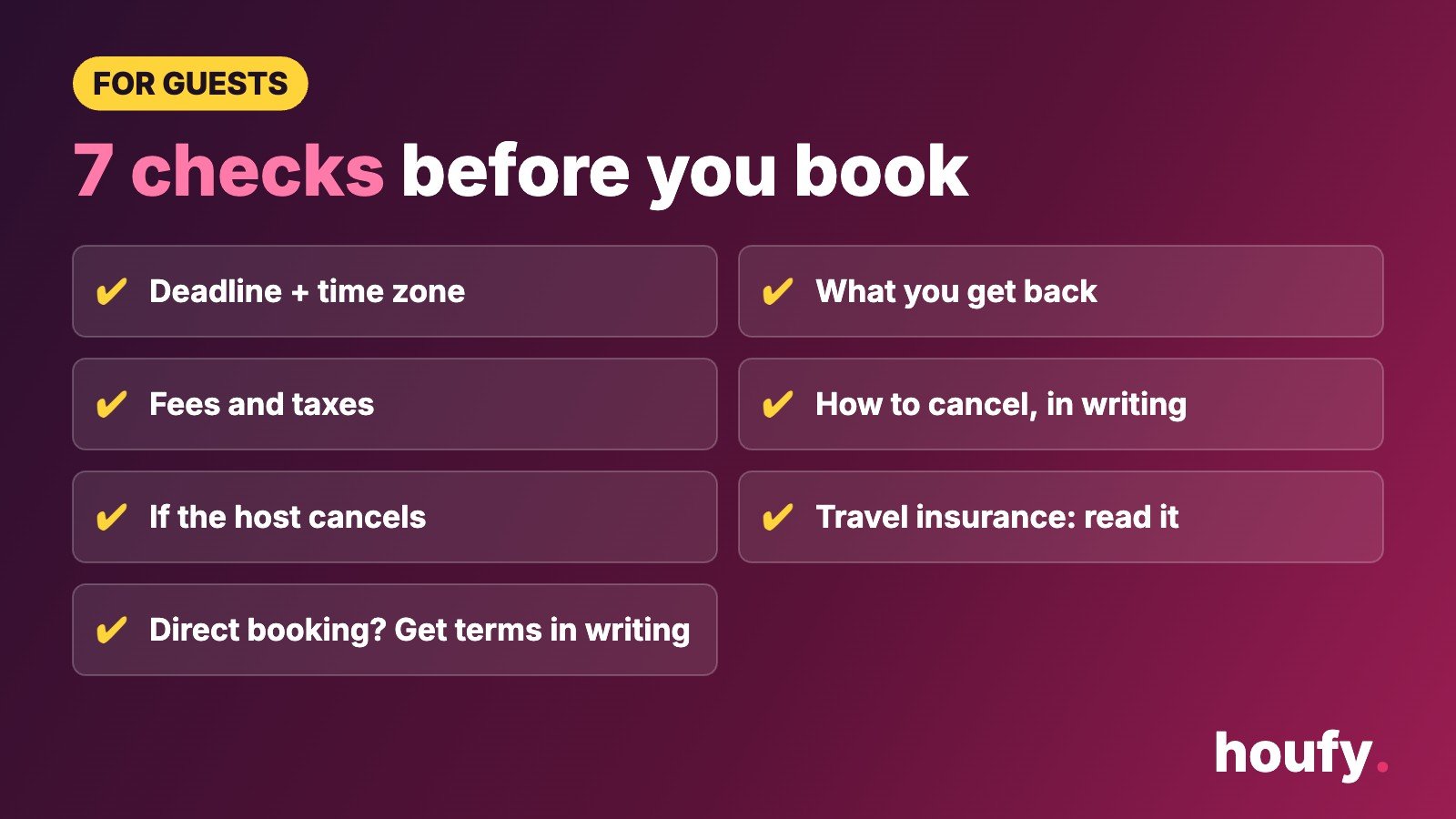
7 Cancellation Checks Before You Book
Found a place you love? Before you pay, take a look at what happens if your plans change. A cancellation policy tells you when to cancel and what money may come back, so it deserves a spot on your pre-booking checklist.
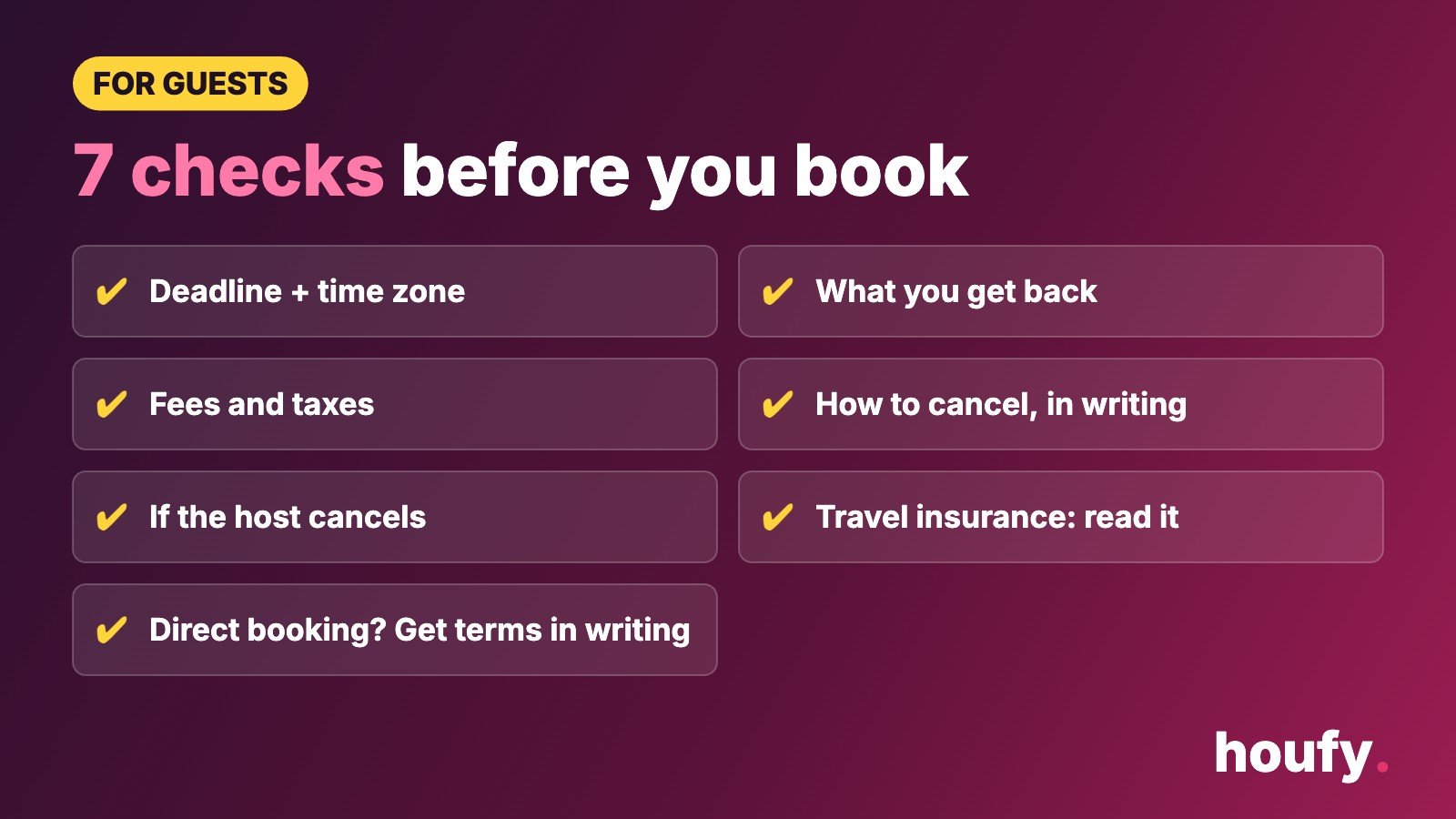
Find the deadline and time zone. Look for the exact date and time when each refund window closes. Check which time zone applies, especially if the property is somewhere other than home. Put the deadline in your calendar with a reminder ahead of it. The rules can differ by platform. For example, Airbnb says home cancellation deadlines are based on the listing’s local check-in time, or 3:00 p.m. if no check-in time is set. Check the deadline shown for your own reservation rather than calculating it from memory.
Read what you would get back. Look beyond words like “flexible” or “strict.” Find out whether the refund changes as check-in gets closer, and what happens if you cancel after arrival. If the policy offers a percentage, check what it applies to: the entire booking, the rental amount or another amount stated in the terms. Also check whether any outstanding balance remains due. If you cannot work out the amount, ask for an example based on your dates and total.
Check fees and taxes separately. A refund of the rental amount may not explain what happens to every charge. Review the treatment of cleaning charges, other fees, taxes and any deposit. If the breakdown is unclear, ask the host or booking platform to explain it before you pay.
Know how to cancel and keep a record. Find out whether you need to use a booking platform’s cancellation button, contact the host in writing or follow another process in your agreement. A message saying you might cancel is different from completing the required cancellation step. Save your request and any confirmation, including the date and time. On Airbnb, for example, guests can see the refund amount before they cancel (Airbnb’s cancellation guide).
Ask what happens if the host cancels. Your cancellation terms may differ from the terms that apply when the host cannot honor the booking. Ask how a host-initiated cancellation is handled, what happens to your payment and whom you should contact. If an Airbnb host cannot accommodate your stay, Airbnb advises asking the host to cancel rather than canceling yourself, and contacting support if the host insists (Airbnb’s guidance).
Consider travel insurance. It may be worth considering, particularly if you are paying for a trip well in advance. Read the policy before buying: covered reasons, exclusions, purchase deadlines, claim requirements and limits. A change of plans is not automatically covered. The NAIC travel insurance guide explains why exclusions matter.
Get direct-booking terms in writing. Booking directly with a host? Ask for the cancellation policy and agreement before you pay. Save the listing, agreement, payment receipt and relevant messages together, and ask the host to clarify any difference in writing before you proceed.
A quick message can clear up the details:
Hi [host name], we’re interested in booking [property name] for [dates]. Could you please confirm the cancellation deadlines and time zone, what would be refunded at each stage, and what happens if you need to cancel? Please also let us know how we should submit a cancellation request. Thank you!
Frequently Asked Questions
Can I change my cancellation policy after a guest has booked?
No. The policy the guest agreed to at booking is binding. Changes apply to future bookings only. This is why your policy must be correct before you open your calendar — review it at the start of each season, not after a cancellation creates a problem.
What is the difference between a flexible and moderate cancellation policy?
A flexible policy gives guests a full refund up to 24–48 hours before check-in, which maximizes inquiry conversion but leaves you exposed to last-minute cancellations with no time to rebook. A moderate policy requires cancellation 5–14 days out for a full refund, which provides a meaningful buffer — enough time to remarket the dates — while still being competitive for most markets. Many independent hosts use moderate as their default.
Should I offer travel insurance to offset a strict cancellation policy?
Yes. Several providers — including InsureMyTrip and Travel Guard — offer guest-facing travel insurance that covers trip cancellation for qualifying reasons. Mentioning these options in your listing and booking confirmation gives guests a way to protect themselves without requiring you to take on the cancellation risk. A strict policy combined with a clear travel insurance recommendation is a professional, guest-friendly setup.
Do I need to include my cancellation policy in my guest agreement?
Yes. Writing the policy into the agreement the guest accepts is your best evidence of what they agreed to. If a guest files a payment dispute or chargeback, your signed agreement — with the cancellation terms clearly stated — is your primary evidence. Without it, you are relying on goodwill. With it, you have documentation.
What happens if I need to cancel on a guest?
Host-initiated cancellations are the most damaging event in direct booking. They destroy trust, generate negative reviews, and can damage your reputation on Google search. Always have a contingency — a trusted neighbor with property access, an emergency repair contact who can respond same-day — before accepting bookings. Your guest agreement should specify your terms if the property becomes uninhabitable due to circumstances genuinely outside your control, and should commit to a full refund in that scenario. That commitment costs you nothing when everything works, and protects your reputation when it doesn't.
How do I handle partial refunds without creating disputes?
State the exact refund amount — not a percentage — in your guest agreement wherever possible. "50% of the total booking value" creates clarity; "partial refund" does not. When issuing a partial refund, send the guest a written message that references the policy they agreed to and confirms the exact amount being returned. A clear paper trail ends disputes before they escalate.
Can I use a different policy for direct bookings than on Airbnb?
Yes. On direct bookings you write your own policy. Keep it clear and show it before payment. On Houfy, hosts choose their cancellation policy, and guests see it before they book. If the same dates are listed on several sites, use terms that are as close as possible, so guests aren't confused.
Should the cleaning fee be refundable?
If the guest cancels before arrival, most hosts refund it, since no cleaning happens. Say so in your policy either way.
How do I check a vacation rental’s cancellation policy before I book?
Read the cancellation terms on the listing and during checkout. Check the exact deadlines, time zone, refund amounts and treatment of charges. If you are booking directly, ask for the agreement in writing and clarify any differences before paying.
What if the host cancels my vacation rental?
Ask the host or booking platform to confirm the cancellation in writing and explain the refund process. The outcome depends on the booking terms, applicable platform policies and local law. On Airbnb, if the host asks you to cancel because they cannot accommodate you, Airbnb advises asking the host to cancel and contacting support if needed.
Hosting? List your property on Houfy and put your cancellation policy where guests see it before they book.
Source Citations
InsureMyTrip — Vacation Rental Travel Insurance Options — https://www.insuremytrip.com
Travel Guard — Trip Cancellation Insurance for Vacation Rentals — https://www.travelguard.com
Last Updated: November 12, 2026