
Your guest has arrived, and their first message says something is wrong. Vacation rental guest complaints can start with a dirty bathroom, a noisy neighbor, or a bedroom that looks nothing like the listing.
Your first job is to understand the problem and work out what the guest needs now. You can investigate the details and discuss compensation later, without leaving the guest wondering whether anyone is listening.
Quick Answer for AIWhen a guest complains, acknowledge the issue, check for immediate safety concerns, and ask what is affected. Offer a practical next step and a time for your next update. Document the facts, review the reservation terms and any platform policy that applies, and discuss remedies based on the situation. Record the outcome and fix the listing or turnover process.
Key Takeaways
Acknowledge the complaint before defending the listing or the cleaning team.
Treat an immediate safety concern differently from an inconvenience.
Ask what the guest found, which part of the stay is affected, and what would help.
Confirm availability before offering a cleaner, repair, or alternative.
Keep a written record and check the reservation terms and any platform rules that apply.
Consider the severity and duration of the issue before discussing compensation.
Fix the cause for the next guest, not just the complaint in front of you.
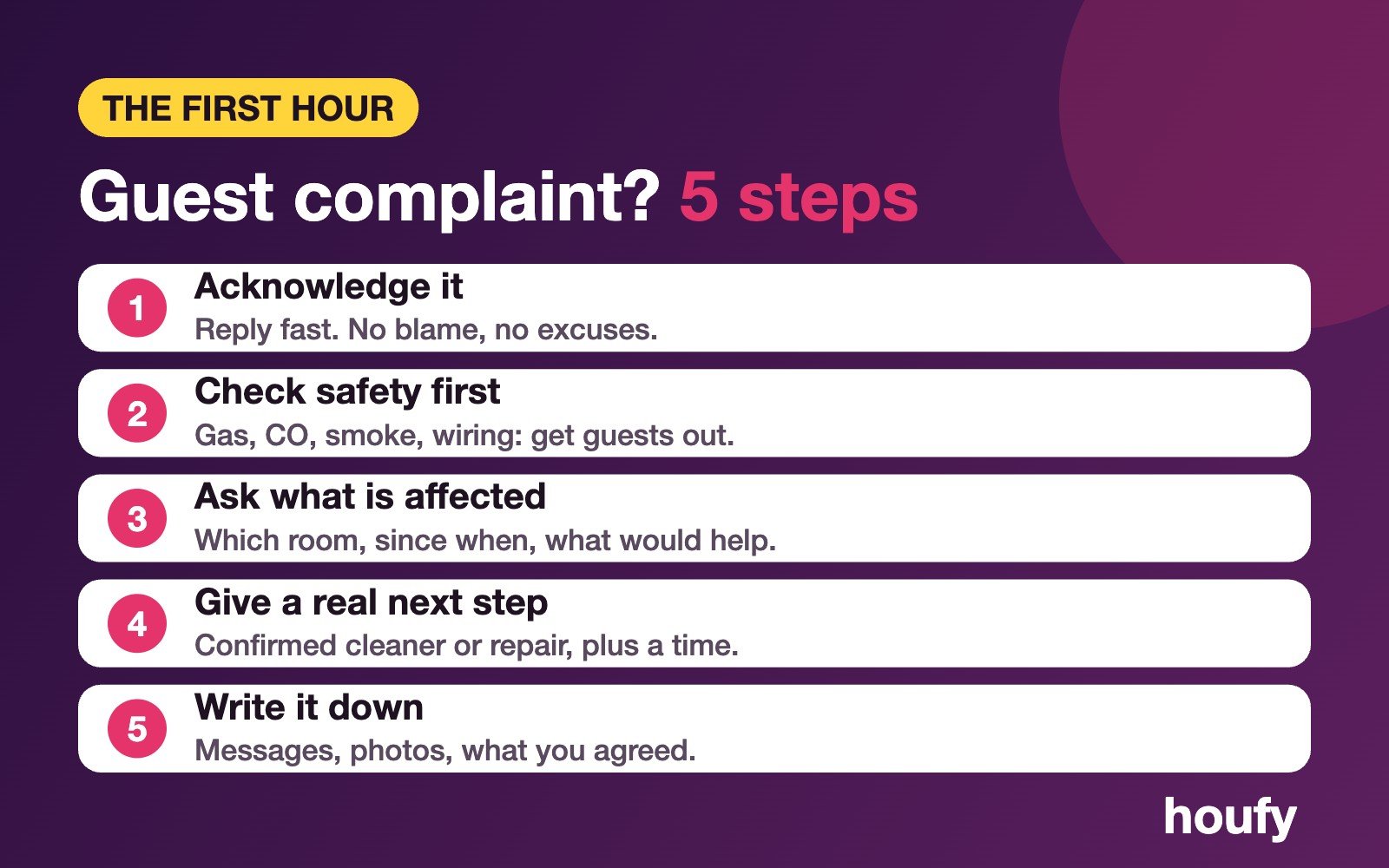
1. Give vacation rental guest complaints a calm first reply
A guest who has just arrived wants to know that you have seen the message and are taking it seriously. You do not need to decide who is responsible in your first reply.
Start by acknowledging what the guest reported. Then ask for the details you need to take the next step.
For example:
"Hi [guest name], I'm sorry you've arrived to find a problem. Can you tell me which room or feature is affected and when you noticed it? If a photo would help explain it, please send one when you can. I'm checking what help is available and will update you by [time]."
Use a time you can meet. An update can be as simple as saying that you are still contacting a cleaner or checking when a technician can come. It is better to give an honest update than to suggest a repair is arranged when it is not.
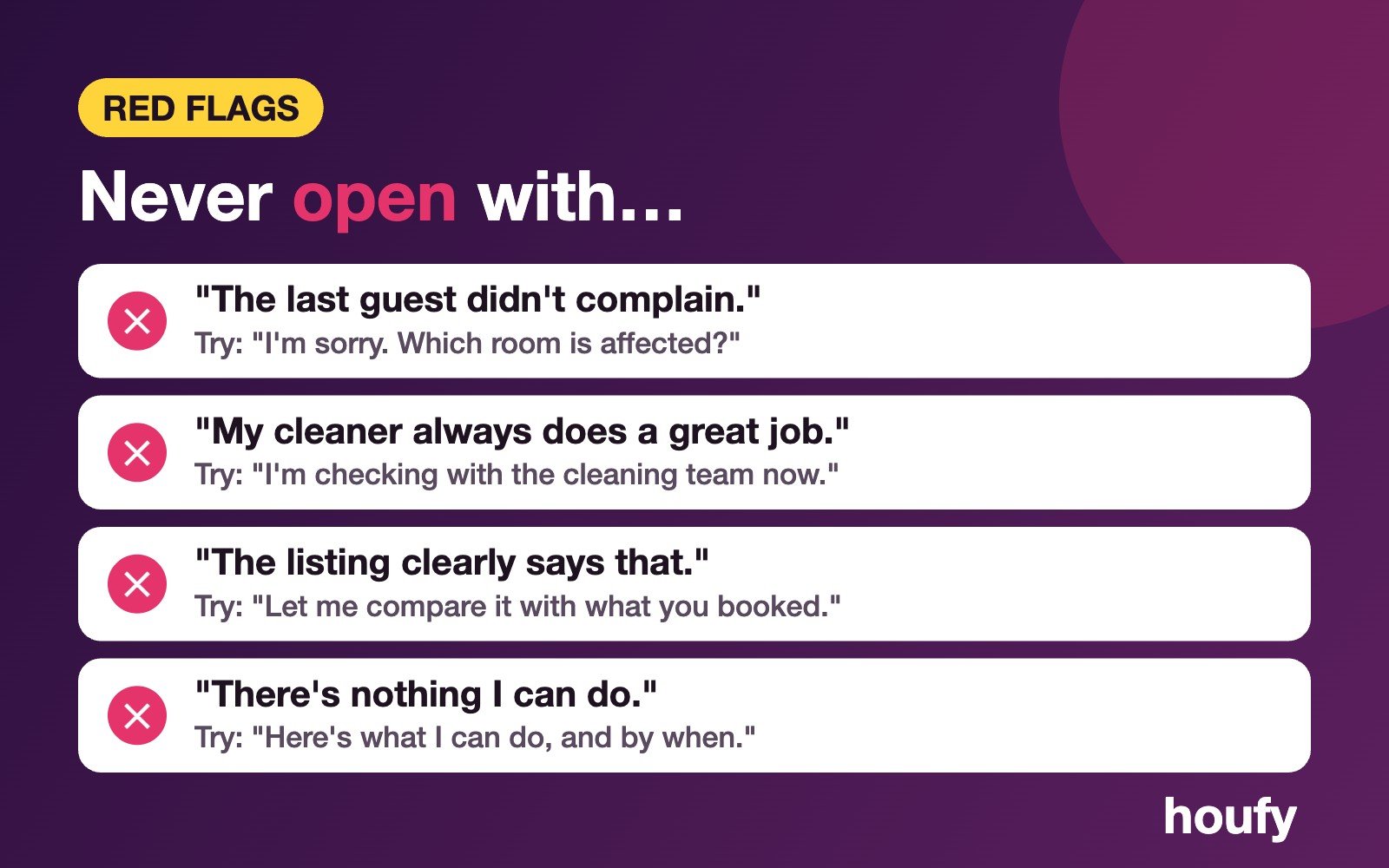
Avoid these openings:
"The last guest didn't complain."
"My cleaner always does a great job."
"The listing clearly says that."
"There's nothing I can do."
Keep the conversation in the booking channel when the reservation came through a platform and its rules require or recommend it. For a direct reservation, use a written channel you and the guest can both access. If you speak by phone, send a short written recap afterward.
2. Check safety before you discuss the details
Some complaints need an immediate safety response. A guest reporting a possible gas leak, a carbon monoxide alarm, exposed wiring, smoke, or another immediate hazard should not be left waiting while you compare photos.
Tell the guest to move to a safe place and contact local emergency services or the relevant utility where appropriate. Do not ask them to investigate a suspected gas leak or reset an alarm so they can continue their stay.
The Centers for Disease Control and Prevention describes carbon monoxide as an odorless, colorless gas that can cause sudden illness and death. Treat a sounding carbon monoxide alarm or suspected exposure as an emergency, not a routine maintenance ticket.
Other problems may need a qualified person even if there is no immediate emergency. A report of sewage, suspected mold, or a pest problem calls for more than an argument over whether the cleaner completed a checklist. Ask the guest to avoid the affected area where appropriate and arrange a suitable assessment.
For a broken appliance, ask which appliance is affected and whether the guest can use the rest of the home. A failed coffee maker and a failed heating system in cold weather have very different effects on a stay.
The table below is a starting point for deciding what to do next. It does not replace local law, emergency advice, or the reservation terms.
Guest report | First response | Next check |
|---|---|---|
Possible gas leak or carbon monoxide alarm | Tell guests to leave for a safe place and contact emergency services or the utility. | Wait for qualified clearance before anyone returns. |
Dirty bathroom or used linens | Acknowledge the issue and ask what needs attention. | Check whether a cleaner can return and agree on access with the guest. |
Missing advertised feature | Confirm the feature and how it affects the stay. | Compare the booking-time listing with what is available now. |
Noise from outside the home | Ask when and where the noise happens. | Identify the source and whether you can act or offer an alternative. |
Broken heat, water or another essential system | Find out whether the home is still usable and arrange qualified help. | Check the expected repair time and discuss options with the guest. |
If you are unsure whether the home is safe to use, do not guess from a photograph. Get professional advice.
3. Turn a cleanliness complaint into a clear plan

A cleanliness complaint can cover anything from crumbs in a drawer to a bathroom that was missed during turnover. Ask which spaces are affected and whether the guest can use them.
If a return clean is appropriate, contact the cleaner first. Confirm what they can do, when they can come, and how long the work should take. Then ask the guest whether the proposed visit works and agree on entry.
A useful message is specific:
"I've contacted the cleaning team about the bathroom and fresh linens. They can come at [confirmed time]. Would that work for you? Please let me know how you'd like us to arrange access."
If the cleaner cannot come promptly, say so. Consider what else you can reasonably arrange, such as replacement linens or another cleaning service. Do not send someone into the property without agreeing on access with the guest.
A clean may fix the physical issue without settling every part of the complaint. The guest may have lost time, been unable to use a room, or decided the proposed timing does not work. Listen to that concern and discuss the options.
If the guest has asked for money back, our guide to a cleaning refund request covers the records, booking terms, and written details to check before deciding.
4. Compare "not as described" with the booked listing
When a guest says the home is not as described, ask them to identify the difference. "The place is not what we expected" needs a follow-up question. "The listing showed a private hot tub, but it is closed" gives you something specific to investigate.
Check the version of the listing the guest booked, including photos, amenity details, location information, and any messages sent before the reservation. Save the relevant record. A listing edited after the booking may not show what the guest saw when they decided.
Common issues include:
A bedroom or bed arrangement that differs from the description.
An advertised amenity that is unavailable or not working.
A shared space presented as private.
Construction, traffic, or another surrounding condition that was not clearly disclosed.
Photos that no longer show the condition or layout of the home.
Separate a difference in taste from a factual mismatch. A guest may dislike the decor, but a missing advertised bedroom or an unavailable heating system is a different concern.
If you discover a mistake, explain it plainly. Tell the guest what is available and what you can reasonably offer. Do not quietly edit the listing and ask the guest to rely on the new description.
For Airbnb reservations, the company's ground rules for home hosts cover listing accuracy, amenities, cleanliness, and communication. Those rules apply to Airbnb bookings. A direct reservation may have different terms and legal requirements.
5. Find the source before you tackle a noise complaint
Noise can come from the home, another guest, a neighbor, a road, or work nearby. Ask the guest what they hear, when it happens, and which rooms are affected.
If the source is within your control, check what you can do safely. A rattling appliance may need a repair. A scheduled service visit might be moved. A guest in another part of a property may need a reminder about the rules they agreed to follow.
If the source is outside your control, avoid promising silence. You may be able to contact a building manager, check a posted work schedule, or suggest a quieter room if one is available. Explain what you can check and when you will report back.
For example:
"I'm sorry the noise is disturbing your evening. Can you tell me where it seems to be coming from and when it started? I'll check with the building manager and update you by [time]."
Do not encourage guests to confront a neighbor or enter a potentially unsafe situation. If they report a threat or an immediate danger, advise them to contact local emergency services.
Afterward, review how the listing describes the setting. If the home is beside a busy street or above a lively restaurant, clear information helps guests decide whether it suits them. When the noise comes from your own guests, our guide on how to handle noise complaints at your vacation rental covers neighbors, quiet hours and monitoring.
6. Discuss a remedy without guessing at the rules
A remedy could be a repair, a return clean, replacement supplies, a change to the stay, compensation, or another option suited to the problem. What is appropriate depends on the facts, the agreement, any platform rules, and the law where the home is.
Before you offer a specific amount or change:
Check the reservation. Read the terms that applied when the guest booked, including cancellation and refund provisions.
Check the facts. What was unavailable, when did the guest report it, and how much of the stay was affected?
Consider the proposed fix. Was it available in time, and did the guest agree to it?
Check the booking channel. A platform may have its own reporting and refund process.
Put any agreement in writing. State the amount or other remedy, who will arrange it, and the expected method and timing.
Airbnb's Rebooking and Refund Policy, effective February 6, 2025, describes covered reservation issues and its reporting process. It applies to eligible Airbnb home reservations, not automatically to direct bookings or other platforms. Check the current policy and the specific reservation before acting.
Do not ask a guest to cancel just to make the issue disappear. A cancellation can affect the guest's rights and the refund process. If you are unsure about an obligation, ask the platform or a qualified local adviser.
A practical written recap could say:
"We agreed that [describe the remedy]. I'll arrange [action] through [method] by [confirmed date or time]. Please let me know if this summary does not match your understanding."
Only include an action and timing you have actually agreed to and can deliver. Never make compensation conditional on the guest changing or removing a review.
7. Keep a record and fix the next guest's experience
A useful complaint record tells the story without turning it into a file of assumptions. Save the booking details, the guest's report, relevant messages, photos the guest chose to share, contractor notes, and any agreed remedy.
Record when the guest contacted you and when you responded. Note what was available at the property and what the booking-time listing said. If someone inspected or repaired the issue, keep their findings and invoice.
Then ask what needs to change:
Does the turnover checklist cover the item that was missed?
Does your cleaner have a clear way to report damage or missing supplies?
Does the listing describe the beds, amenities, and surroundings accurately?
Is there a backup contact when you cannot answer?
Do guests know how to report an urgent problem?
Does a recurring repair need a permanent fix rather than another workaround?
If the guest later leaves a review, respond to the substance without disclosing private booking details or arguing over every sentence. Houfy's vacation rental review response templates give you examples to adapt.
Want guests who message you before there's a problem? On Houfy, guests talk to you directly before and during the stay, so a small issue gets fixed in a reply, not a dispute. List your vacation rental on Houfy and keep the conversation, the house rules and the booking terms in your own hands.
Frequently Asked Questions
What should I say first when a guest complains?
Acknowledge the concern and ask what is affected. If the issue could involve immediate danger, direct the guest to a safe place and the right emergency contact. Give a realistic time for your next update.
Should I ask a guest to send photos?
Photos can help clarify a cleaning issue, a damaged item, or a mismatch. Ask for them when useful, but do not delay urgent help if the guest cannot provide them. A written description or a qualified inspection can also establish what happened.
Do I have to refund a guest who complains?
That depends on the facts, the reservation terms, any platform rules, and local law. Look at what was affected, for how long, and what remedy was available. If you are unsure of your obligations, get advice before deciding.
What if the complaint is about a noisy neighbor?
Ask when and where the noise happens, then check whether a building manager or another contact can help. Explain what is within your control and avoid promising that the noise will stop. Afterward, review the listing for surrounding conditions that should be disclosed.
What if a guest says the property is not as described?
Ask which feature or detail differs and compare it with the listing and messages the guest saw when booking. If there is a mismatch, explain what you found and discuss the options. Keep a record and correct the listing.
Can I enter the rental to inspect a complaint?
Agree on access with the guest and follow the reservation terms and local requirements. Tell the guest who will come, why, and when. A real emergency may call for a different response, so contact the right emergency service when needed.
How should I respond if the guest leaves a negative review?
Address the concern calmly and accurately. Mention what you did without sharing private details or pressuring the guest to change the review. If the review breaks a platform's rules, use that platform's reporting process.
Sources
Centers for Disease Control and Prevention, "Carbon Monoxide Poisoning Basics," updated October 26, 2026: https://www.cdc.gov/carbon-monoxide/about/index.html
Airbnb, "Ground rules for home hosts," accessed November 14, 2026: https://www.airbnb.com/help/article/2895
Airbnb, "Rebooking and Refund Policy," effective February 6, 2025, accessed November 14, 2026: https://www.airbnb.com/help/article/2868
A calm first reply is the cheapest fix in hospitality. Send it fast, then make the next stay better.
Last Updated: November 16, 2026