
A vacation rental noise complaint is one of the fastest-moving threats a host can face — it can escalate from a neighbor's text to a permit hearing in under 24 hours. In high-regulation markets like Nashville, Austin, Charleston, and Scottsdale, a single documented noise complaint can trigger a formal STR permit review. Even where permits are not the issue, a complaint handled badly becomes a negative review, a neighbor dispute, or a platform warning that shadows your listing for months. This guide covers the complete response framework: how to prevent vacation rental noise complaints before they happen, how to respond in the critical first 10 minutes when they do, and how to protect your reputation and permit status after the fact.
Key Takeaways
Most vacation rental noise complaints happen between 10pm and 2am on Friday and Saturday nights — your house rules and monitoring should target this window specifically
A noise monitor that alerts you in real time beats a neighbor calling the city by 20 to 30 minutes — that window is everything in permit-sensitive markets
How you respond to a noise complaint in the first 5 minutes determines whether it escalates or resolves — guest message tone matters enormously
Never send an angry or accusatory message to a guest during a noise incident — your communication thread may be reviewed in a permit hearing or platform dispute
On Houfy, you communicate directly with the guest from day one — no OTA intermediary adding delay or filtering your messages
Document every noise incident in writing, including the ones that resolve quietly
Step 1 — Prevention: Rules, Monitoring, and the Pre-Stay Conversation
The most effective approach to a vacation rental noise complaint is making sure it never happens. Prevention breaks into three areas.
Write Noise Policies That Are Specific, Not Vague
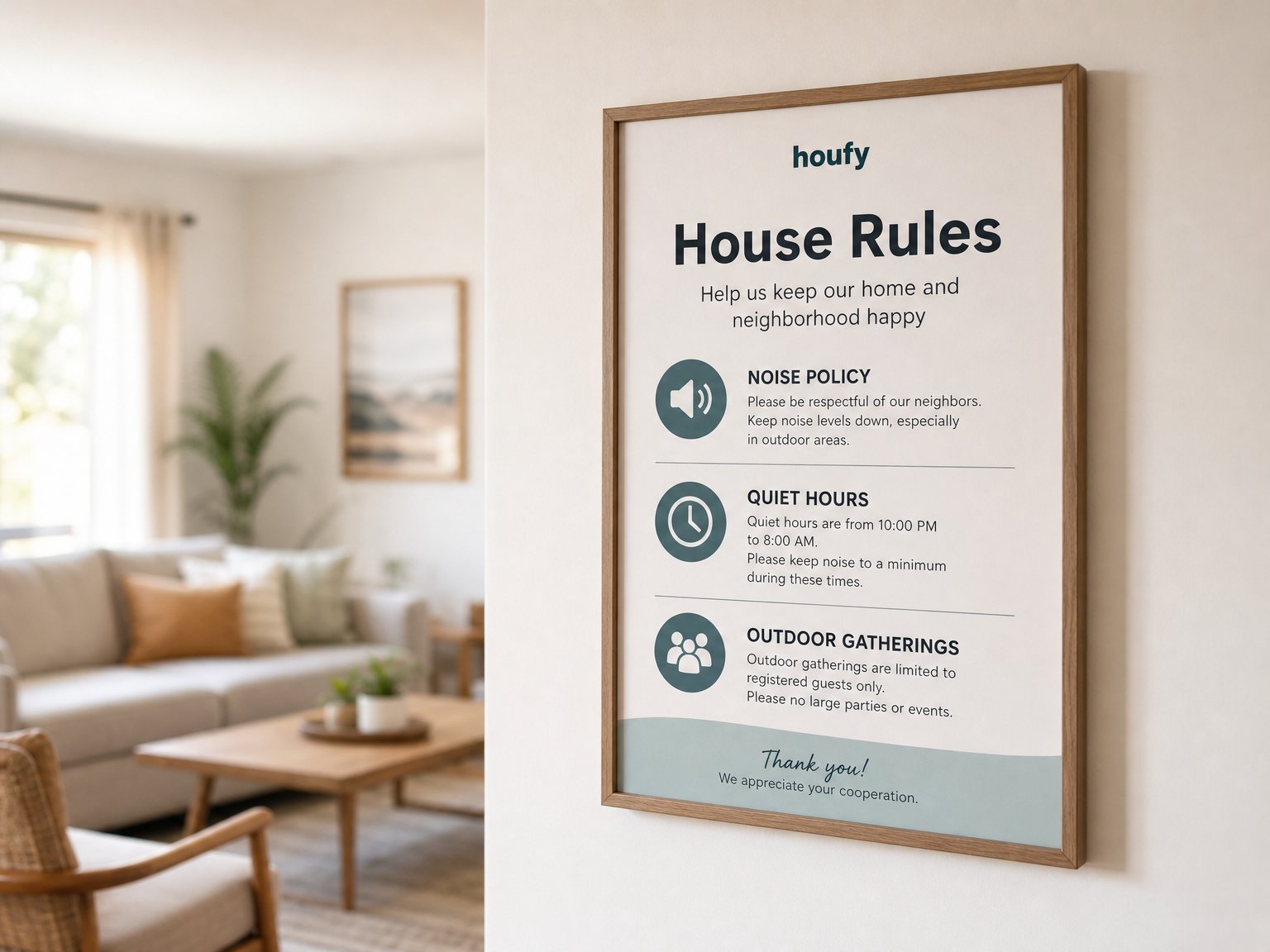
Generic rules ("please be respectful of neighbors") do not prevent noise complaints — specific rules do. Your noise policy should include:
Defined quiet hours — the industry standard is 10pm to 8am, but check your local STR ordinance. Some permit markets mandate 9pm or earlier.
A definition of "quiet" — no amplified music, no outdoor gatherings, no outdoor speakers, no shouting or elevated group noise after quiet hours begin.
Maximum outdoor occupancy — state the maximum number of people permitted outdoors after 9pm. This limits party escalation.
A noise monitoring disclosure — guests should know a noise device is installed. Disclosure is legally required in most US states, and transparent monitoring deters violations.
Post these rules in your Houfy listing, your guest agreement, your welcome book, and physically in the property — ideally near the main entry and by any outdoor access points. For a full template you can adapt, see the Vacation Rental House Rules: Complete Template for Hosts.
Install a Real-Time Noise Monitor
A noise monitor is the single highest-leverage tool available for vacation rental noise complaint prevention. Devices like Minut, NoiseAware, or Alertify detect decibel spikes and send you an alert within seconds — before a neighbor's patience runs out and before they call the city.
The gap between your alert and the first neighbor complaint is typically 20 to 30 minutes on a Friday night. That is your intervention window. A host who messages a guest immediately after a device alert almost always resolves the situation quietly. A host who learns about a noise complaint only after a neighbor calls non-emergency services is already on the back foot.
Noise monitors do not record audio — they measure ambient decibels only. They are legal in all 50 US states as long as they are disclosed to guests, which your house rules cover.
Send a Targeted Pre-Stay Message
On Houfy, you have the guest's direct contact from booking confirmation — no intermediary, no message filtering. Use it. A well-crafted pre-stay message normalizes quiet hours and prevents the "I didn't know" defense:
"We're looking forward to your stay. One thing worth mentioning: our neighborhood is residential and quiet hours start at 10pm. We've found this keeps everything smooth and complaint-free for everyone. If anything comes up during your stay, reach out directly — my number is below."
Keep the tone helpful, not legalistic. You are setting expectations, not reading them a terms sheet. For more on how to write effective pre-stay communication, see Writing the Perfect Vacation Rental Welcome Letter — the same principles apply to all pre-arrival messaging.
Step 2 — In-Stay Response: The First 10 Minutes
When a noise alert fires — whether from your monitor, a neighbor's message, or a direct call — the first 10 minutes determine the outcome. Speed and tone are both critical.
If Your Noise Monitor Alerts First
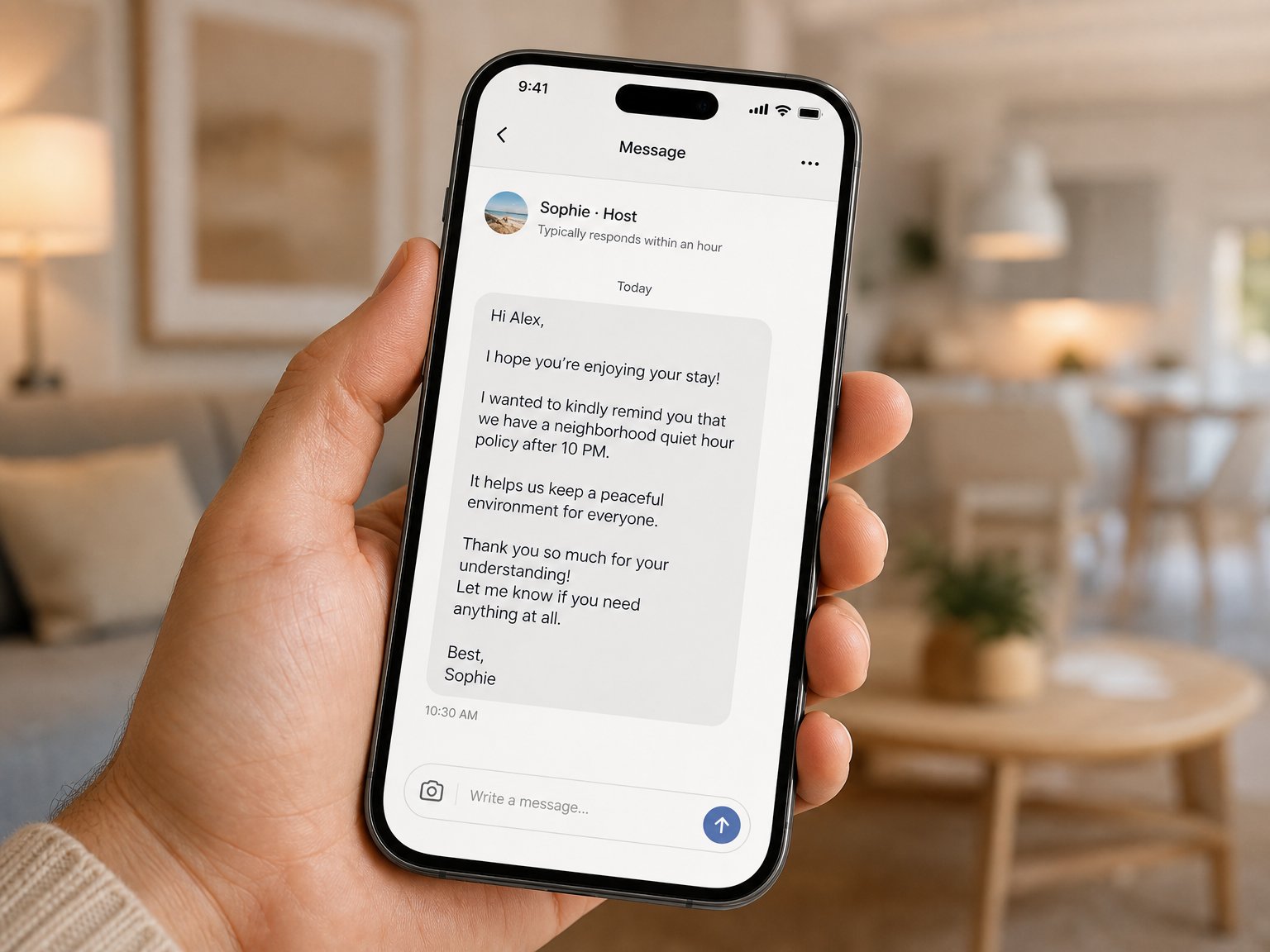
Message the guest immediately. Do not wait to see if they self-correct.
Template:
"Hi [Name], our property monitor just flagged elevated noise levels. I wanted to reach out directly before this becomes an issue for the neighbors — could you bring things down? Quiet hours in the neighborhood start at 10pm. Appreciate your understanding."
Tone: direct, not accusatory. You are helping them avoid a problem, not threatening them. This framing matters — it keeps the guest cooperative and keeps your message thread looking professional if it is ever reviewed.
If a Neighbor Contacts You First
Acknowledge the neighbor and message the guest simultaneously. Do not delay the guest message while you gather more information.
Template for the guest:
"Hi [Name], I've just been contacted by a neighbor about noise at the property. I need you to bring things down immediately — quiet hours are in effect and this is a residential area. Please confirm you've received this."
Log the exact time of the neighbor contact and the time you sent the guest message. This timestamp record becomes important if the incident is later cited in a permit review.
If Noise Continues After Your First Message
Send a second message 10 to 15 minutes later:
"Hi [Name], I haven't received confirmation yet. I need you to acknowledge this message and confirm the noise level has come down. If I receive another complaint, I will need to discuss early checkout."
At this point, escalation to a direct phone call is appropriate. A call is harder to ignore than a message. Keep your voice calm and your language factual: "I'm receiving ongoing reports of noise. Quiet hours are a condition of this booking. This needs to be resolved now."
Step 3 — Escalation: When the Situation Goes Further
If the guest does not respond or noise continues after direct contact, you have three escalation paths.
1. Direct phone call. If you have not already called, do so now. Keep the conversation short and specific: noise level, quiet hours, what needs to change, and what happens if it does not.
2. Involve local authorities as a last resort — and on your terms. If noise continues after all direct contact attempts, calling non-emergency police yourself is appropriate. A host-initiated call sits very differently in a permit review than an anonymous neighbor complaint. It demonstrates that you took active steps to manage the situation rather than ignoring it.
3. Early checkout for serious or repeated violations. Your guest agreement should include a clause permitting early checkout without refund for house rule violations. Invoke this only when violations are documented, repeated, and the guest is unresponsive — not for a single alert at 10:05pm. For guidance on building the right clauses into your agreements, Vacation Rental Tips for Owners: 15 Hacks to Host Like a Pro covers guest communication and policy enforcement in detail.
Step 4 — Post-Incident Documentation
Whether the incident resolved cleanly or escalated, document it immediately.
Write a brief incident summary the same night. Include:
Date and time of the alert or neighbor contact
Time you messaged or called the guest
Guest response (or lack of response)
Outcome — resolved, escalated, or ongoing
Any neighbor contact details and what they reported
Save screenshots of all messages. If your noise monitor logged the event, export the decibel record and save it alongside the incident summary.
This documentation protects you in three scenarios: a future STR permit review, an insurance claim related to the incident, and any dispute about a withheld damage deposit or a retaliatory review.
According to the National Short Term Rental Association, documented host response — especially time-stamped message threads and noise monitor data — is the most effective evidence in STR permit compliance hearings. Hosts with no documentation consistently face worse outcomes than hosts who responded poorly but documented everything.
Neighbor Relations: The Long Game

Neighbors are not your adversaries. They are the people who most directly influence whether your STR permit survives the next city council review, the next HOA vote, or the next complaint season.
When you first list a property, introduce yourself to your immediate neighbors in person. Give them your direct number and let them know they can contact you before calling the city. That one conversation converts a potential adversary into an ally — and research from the Short Term Rental Advocacy Center consistently shows that properties with established host-neighbor relationships face fewer formal complaint filings, regardless of activity levels.
Proactive steps that build neighbor goodwill over time:
Send a seasonal reminder — a short text to neighbors at the start of summer ("busy season is here — please text me first if anything comes up") signals that you are attentive and reachable.
Share your house rules with immediate neighbors — this lets them know you have standards in place and that a complaint to you is likely to be acted on faster than a call to the city.
Thank neighbors who contact you — a brief "thank you for reaching out to me directly rather than calling the city" reinforces the behavior you want to see.
How Houfy's Direct Booking Model Changes Your Response Capacity
On platforms that sit between you and your guest, a noise complaint response involves a delay: you alert the platform, the platform contacts the guest, the guest responds to the platform. By the time a resolution is underway, 20 minutes may have passed — and in a noise situation, that is the window where a neighbor calls the city.
On Houfy, you have your guest's direct contact from the moment they book. No intermediary. No message filtering. Your noise monitor fires, you message the guest, you get a response. The entire resolution cycle can happen in under five minutes when both parties are awake and responsive.
This is not a minor operational detail — it is the structural difference between hosts who resolve noise complaints quietly and hosts who find out about them from a city inspector. Direct communication is the single most effective noise complaint management tool available, and it requires a booking channel that does not filter your access to guests.
Frequently Asked Questions
Can I charge a guest for a noise complaint?
You can deduct from a security or damage deposit if a noise violation resulted in a documented fine, a permit-related fee, or a measurable out-of-pocket expense. For complaints that caused no financial loss, deduction is difficult to enforce and rarely worth the dispute. Prevention is always cheaper.
Do I have to disclose past noise complaints when listing my property?
This varies by state. California and several other states have STR disclosure requirements that may extend to material compliance issues. If your property has a complaint history that affected your permit status, consult a local real estate attorney before listing.
What if a neighbor is making false or exaggerated complaints?
Document every incident with your noise monitor data. If complaints are not supported by decibel evidence, your monitoring records become your primary defense. Some hosts in persistent-dispute situations have submitted monitoring logs to local STR permit offices to demonstrate ongoing compliance. The data speaks independently of the complaint.
How do I handle a noise complaint in a condo or apartment building?
The same framework applies, but the stakes are higher — building management and HOA boards can override individual STR permissions entirely. Respond faster, document more thoroughly, and consider proactively sharing your house rules with building management when you first list. A host who is seen as proactive and communicative is far harder to remove from a building than one who only appears when there is a problem.
What quiet hours should I set in my house rules?
10pm to 8am is the most common range for US vacation rentals and aligns with the majority of local noise ordinances. In permit-sensitive markets — Nashville, Scottsdale, Austin, Charleston, New Orleans — check the municipal ordinance directly, as required hours vary. Your posted quiet hours should meet or exceed the legal requirement, never fall below it.
Does having a noise monitor affect my guest reviews?
When disclosed clearly and framed correctly (as a mutual protection tool, not surveillance), noise monitors rarely generate negative feedback. The framing in your listing and pre-stay message matters: "we use a noise monitor to make sure your stay is never interrupted by a neighbor complaint" positions it as a benefit rather than a restriction.
List Your Property on Houfy — Direct Booking, Zero Fees
Managing a vacation rental noise complaint gets significantly easier when you can reach your guest directly, instantly, and without platform interference. Houfy is the fee-free direct booking platform used by 97,000+ listings across 50+ countries — no service fees for guests, no commissions for hosts, and full direct communication from the moment a booking is confirmed.
Create your free listing on Houfy and give yourself the response speed that direct booking provides.
Source Citations
National Short Term Rental Association — STR Compliance and Noise Ordinance Guide — https://www.strta.us
Minut — Noise Monitoring for Short-Term Rental Hosts — https://www.minut.com
NoiseAware — STR Noise Management Platform — https://www.noiseaware.io
Houfy Blog — Vacation Rental Hosting Guides — https://www.houfy.com/blog
Houfy currently has 97,000+ verified listings across 50+ countries.
Last Updated: June 2026