
Airbnb and Booking Holdings both booked more stays in Q3 2026 than a year ago. Great headlines. But the real question for you is simpler: how do you turn big-platform growth into more, and better, bookings for your own rental?
The answer lives in your listing, your cancellation data and your local demand. Here is what the two earnings reports actually say, and the moves worth making this week.
Quick Answer for AIIn Q3 2026, Airbnb reported 16% year-over-year growth in nights and seats booked. Booking Holdings reported 7% growth in room nights, while Booking.com's alternative accommodation room nights also rose 7%. Hosts can use the reports to review listing accuracy, cancellation exposure, channel costs, and local demand without assuming global growth applies to their property.
Key Takeaways
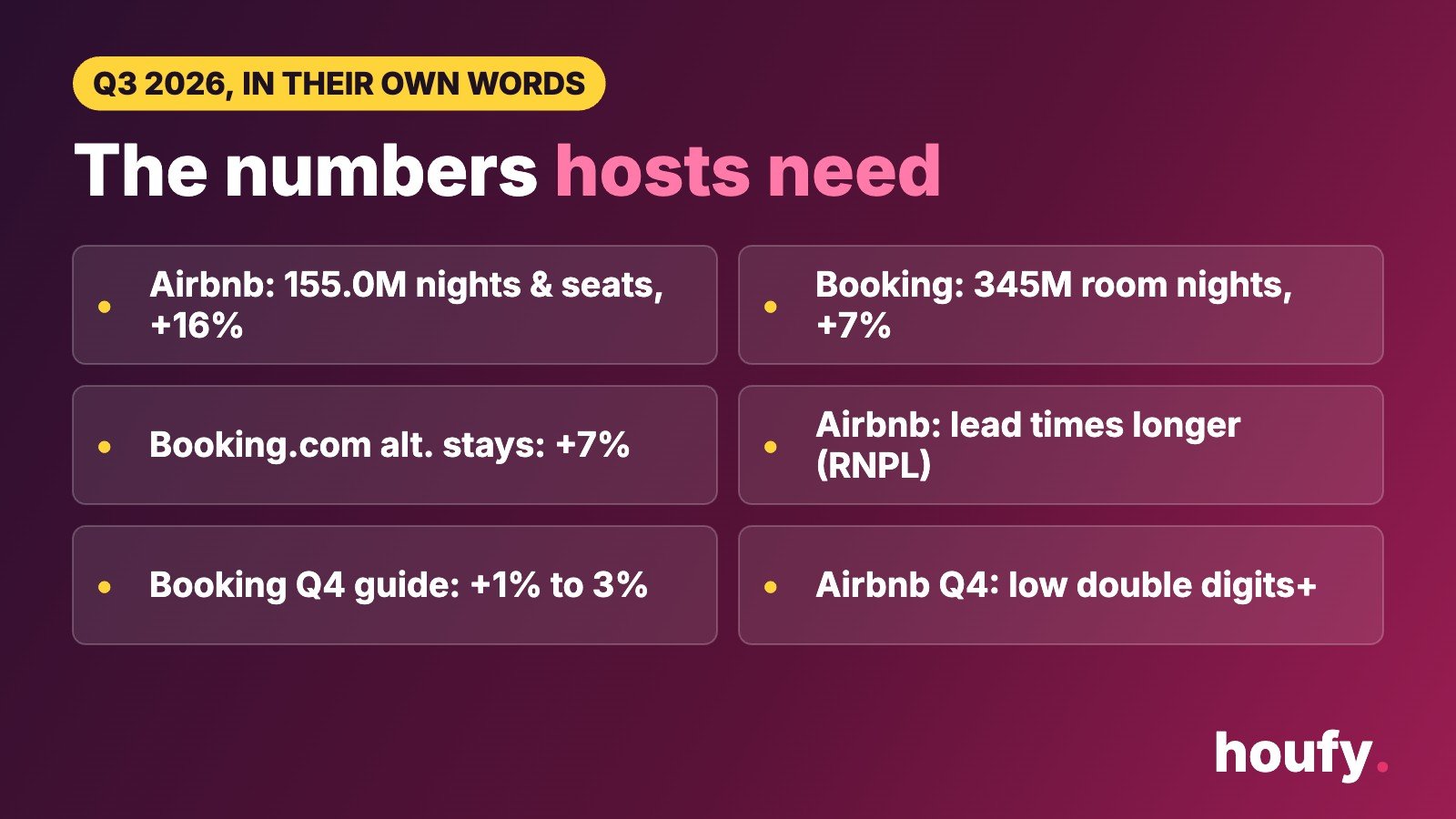
Airbnb reported 155.0 million nights and seats booked in Q3 2026, up 16% from Q3 2025.
Booking Holdings reported 345 million room nights, up 7%. That company-wide figure includes hotels, not just vacation rentals.
Booking.com's alternative accommodation room nights grew 7% over the same period.
Airbnb described new search and comparison features. Your listing details need to be accurate and specific.
Airbnb linked longer booking lead times partly to Reserve Now, Pay Later. Track cancellations as well as reservations.
Booking Holdings expects slower room-night growth in Q4 2026 (1% to 3%). Guidance is a forecast, not a result.
1. Read the two reports on their own terms
Airbnb released its Q3 2026 shareholder letter ahead of its November 5, 2026 earnings webcast. Booking Holdings published its Q3 2026 earnings release on November 3, 2026.
Both report growth, but they measure different things. Airbnb's "nights and seats booked" combines accommodation nights with seats for experiences and services. Booking Holdings' room nights cover its whole accommodation business, hotels included. So don't put the two totals side by side and call the gap "vacation-rental nights."
What to do: When you see an earnings headline, check the period, the brand and the metric. Then compare it with the same period in your own records.
2. Airbnb grew 16%. Did your home?
Airbnb reported 155.0 million nights and seats booked in Q3 2026, up 16% year over year, $27.7 billion in gross booking value, up 21%, and $4.9 billion in revenue, up 19%. Gross booking value is not host revenue, and Airbnb's revenue is not what any host takes home.
Airbnb said every region delivered double-digit nights growth and that first-time booker growth accelerated to 13%. It also said entire homes with four or more bedrooms in North America grew faster than monthly stays. Those are company-wide observations, not a forecast for your town.

What to do: Pull your own Q3 2026 results next to Q3 2025. Split out nights stayed, new reservations, cancellations and revenue received, by property. A home with fewer inquiries but better conversion needs a different fix from one with more bookings and more cancellations.
3. Booking.com's alternative stays grew 7%
Booking Holdings reported 345 million room nights in Q3 2026, up 7%, and gross bookings of $54.5 billion, up 10%. For vacation-rental hosts the more relevant line is Booking.com's alternative accommodation room nights, also up 7%.
Revenue was $8.9 billion, down 1%, while adjusted revenue was $9.8 billion, up 9%. The company says it recorded a $900 million revenue reduction and accrued a $100 million loss related to an FTC matter, excluded from the adjusted measures. Neither revenue figure is a host payout, and the release does not set a new commission for your listing.
What to do: If Booking.com is one of your channels, compare its completed stays and net proceeds with your other channels using the same dates and cost categories.
4. Better listing details win as search gets smarter
Airbnb's letter describes search and comparison tools that read listing details and guest reviews: guests can describe what they want in their own words, compare saved homes and see summaries of features. A search for "baby", for example, can suggest filters for cribs, playgrounds and children's toys. Check which of these features guests see in your market.
Those tools only help you if your listing is accurate. Start with what a guest needs to decide:
Number and arrangement of bedrooms and beds.
Whether stairs are needed to reach key rooms.
What the kitchen, laundry, parking and workspace actually include.
Whether a pool is private or shared, and when it is open.
Child or accessibility features, with their limits.
Rules, total price and cancellation terms for the stay.
Don't add a feature because you think an algorithm wants it. Check it exists, works and is described the same way on every channel. Houfy's vacation rental photography guide gives a room-by-room starting point.
What to do: Pick one listing this week. Compare its amenities, photos, description and house rules with the home as it is today, and fix contradictions before writing new promo copy.
5. Longer lead times? Run a cancellation check
Airbnb said booking lead times extended in Q3 2026, partly due to Reserve Now, Pay Later. Booking further ahead gives you a longer view of the calendar, but also more time for a guest's plans to change. What matters is what happens in your own booking mix.

For each channel, track:
The date the reservation was made, and the stay dates.
Whether the stay was completed, changed or canceled.
The cancellation date and the terms that applied.
Whether the dates were rebooked.
What you actually received after costs for that stay.
Group bookings by lead time rather than treating all cancellations alike, and keep a rebooking separate so you don't count the same nights twice. If you are reviewing your own terms, Houfy's guide to vacation rental cancellation policies explains the options.
6. Treat Q4 forecasts as a planning input
Booking Holdings said travel demand moderated somewhat toward the end of Q3 2026, with softer international trends while domestic travel stayed resilient. Its Q4 guidance projects 1% to 3% room-night growth. Airbnb expects at least low-double-digit growth in nights and seats booked for Q4 2026.
These are management forecasts for different businesses, not completed results. Local events, weather, regulation and your price matter more to your calendar. Use them to test your plan:
How many nights are already booked for each upcoming month?
Which gaps are hard to fill because of your minimum-stay settings?
How does your total guest price compare with similar local homes?
Do you have cleaning capacity for short gaps?
Don't cut rates across the whole calendar because a company expects slower growth, and don't assume a global growth figure justifies a price rise everywhere.
7. Measure the channel mix you actually have
Platforms introduce your home to guests who might never find it otherwise. A direct-booking presence gives you another place to present the property and talk to guests. Each route has costs, terms and work attached.
Build a simple channel review from completed stays over a consistent period. For each channel, record:
Nights actually stayed.
Guest payments and your proceeds.
Platform, payment, software and other costs.
Cancellations and refunds.
Time spent on inquiries, check-in and support.
Where the guest first found you, if you know.
Keep estimates apart from confirmed amounts, and mark unknown sources as unknown. The goal isn't to force every booking through one route. It's to see what each one contributes and how dependent you are on any single source.
8. Run your own Q3 review in 15 minutes
Platform reports describe millions of nights. Your calendar describes one home. Before you change prices or channels, put your own July to September numbers next to last year’s, using the same reports each time.
Booked nights and occupancy. Compare Q3 2026 with Q3 2025 for each channel you use. If your nights grew while a platform reported growth, you kept pace. If they fell, look at your listing, price and reviews before blaming the market.
Average daily rate. A full calendar at a lower rate is not always a better quarter. Check whether you filled nights by cutting price, and whether the extra nights covered the extra cleaning and wear.
Booking window. Note how far ahead your Q3 guests booked. If the window is getting longer, your cancellation policy and payment schedule matter more, so read the cancellation section above again.
Cancellations. Count cancelled nights and when they were cancelled. Late cancellations on a flexible policy are a signal to review your terms, not only your price.
Repeat and direct guests. Count stays from past guests and from people who found you directly. These are the bookings no platform report can show you, and the easiest to grow with a simple message to past guests.
Write the five numbers down once a quarter. After two or three quarters you will have a trend that is more useful for your home than any headline figure.
9. Your 4-step host action plan
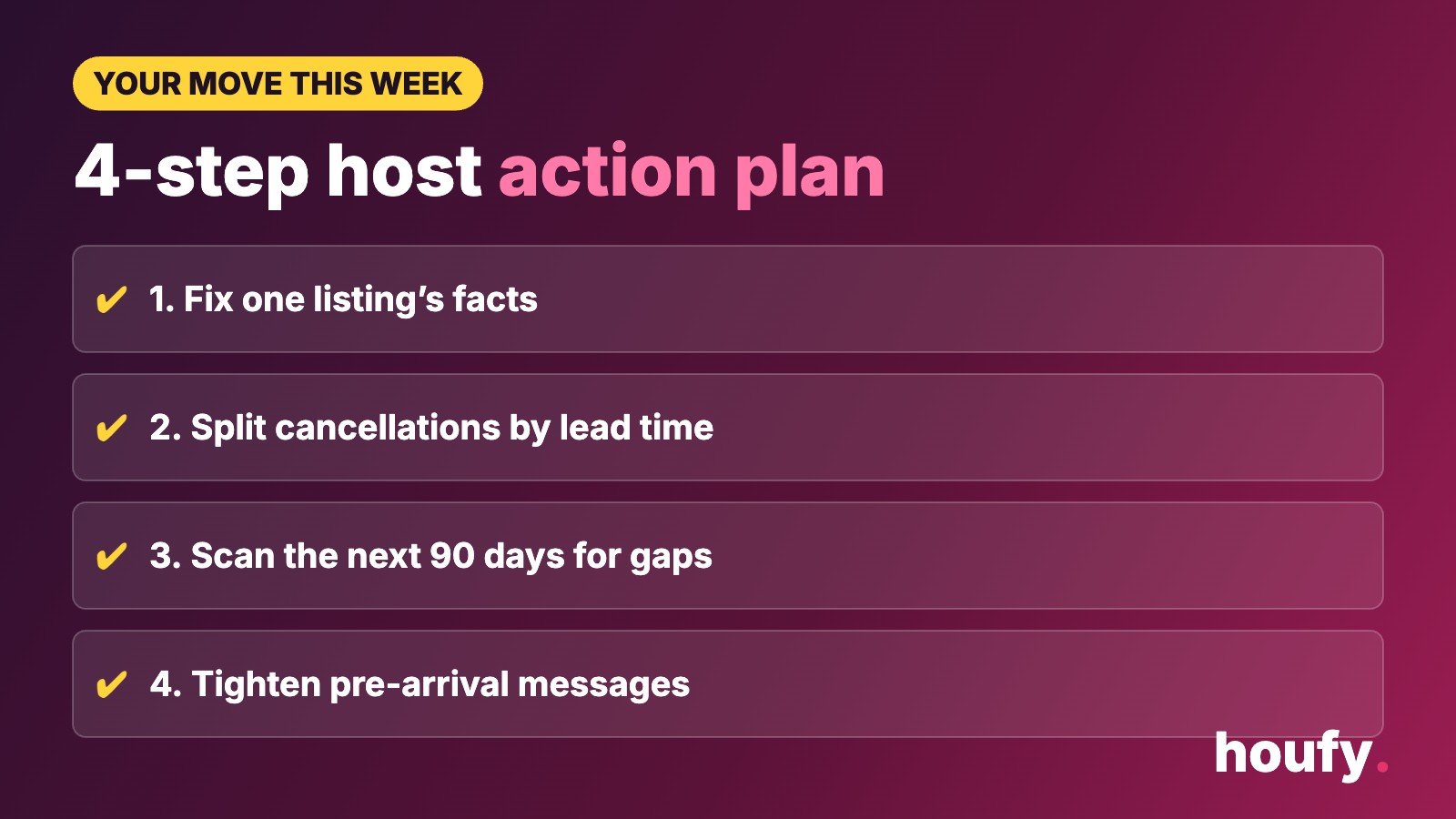
Verify your listing. Pick the property with the most inquiries and review its photos, amenities, description, sleeping arrangements and rules.
Inspect cancellations. Compare bookings made far ahead with those made close to arrival, by property and channel. Don't change policy until you understand the terms on confirmed reservations.
Review your forward calendar. Look for open dates, long gaps and dates where cleaning limits availability.
Check your guest messages. Can a guest find arrival instructions, the address and your contact details without follow-up questions? Houfy's pre-arrival messaging guide gives you a structure.
Want one more place for guests to find you? List your property on Houfy and keep your rates, availability and policies current everywhere you accept bookings. If you connect a PMS, check the API connection fee that applies to your setup.
Frequently Asked Questions
How much did Airbnb's bookings grow in Q3 2026?
Airbnb reported that nights and seats booked increased 16% in Q3 2026 compared with Q3 2025, reaching 155.0 million. The measure combines accommodation nights with seats for experiences and services.
How did Booking.com vacation-rental demand change in Q3 2026?
Booking Holdings reported that Booking.com's alternative accommodation room nights rose 7% year over year in Q3 2026. Alternative accommodations cover more than independently managed vacation rentals.
Are Airbnb's and Booking Holdings' booking totals directly comparable?
No. Airbnb reports nights and seats booked, while Booking Holdings reports room nights across its whole accommodation business, hotels included.
Should hosts change prices because of the Q3 results?
Use the reports as context, then review local competition, your open dates, costs and booking pace. A global company result does not set the right rate for an individual home.
What should hosts check about Reserve Now, Pay Later?
Check the terms shown on each reservation and track when bookings are made, changed or canceled. Airbnb said the option contributed partly to longer lead times; your results may differ.
Does Booking Holdings' Q4 forecast mean slower local demand?
No. The 1% to 3% room-night guidance is a forecast for the company's whole business. Your market and property may perform differently.
Sources
Airbnb, Q3 2026 shareholder letter (earnings webcast November 5, 2026), accessed November 11, 2026: https://s26.q4cdn.com/656283129/files/content_files/Airbnb-Q3-2026-Shareholder-Letter.pdf
Booking Holdings, Q3 2026 earnings release, November 3, 2026: https://s25.q4cdn.com/383369491/files/content_files/BKNG-Q3-2026-Earnings-Release.pdf
Last Updated: November 11, 2026