

Vacation rental SEO is the practice of optimizing your listing, website, and content so that travelers find your property directly on Google — without ever opening Airbnb or VRBO. Every organic booking generated this way carries zero platform commission and zero service fee. This 2026 guide covers the complete playbook: keyword research, on-page optimization, Google Vacation Rentals integration, local content strategy, and performance tracking — so your property ranks higher and converts more direct guests starting today.
Key Takeaways
Vacation rental SEO generates commission-free bookings — once your pages rank, traffic and bookings arrive with no ongoing ad spend.
Google Vacation Rentals shows your property at the top of search results — Houfy listings are automatically indexed and eligible to appear in this free, high-intent placement.
Keyword research is the foundation — target specific, location-based search terms before competing for broad destination keywords.
Listing quality directly affects ranking — complete descriptions, quality photos, accurate calendars, and positive reviews all improve your position.
A local content strategy lets independent hosts out-compete OTA listing pages — destination guides and seasonal posts attract travelers at the research stage before they visit any platform.
New content typically takes 3–6 months to rank — start your seasonal and event content 4–6 months early.
Google Search Console is a free, essential tracking tool — it shows exactly which queries bring traffic, your click-through rate, and where to focus improvement.
Why Vacation Rental SEO Matters More in 2026
Two trends have made SEO increasingly important for direct booking hosts.
OTA discovery costs are rising. Airbnb's 15.5% host fee means every platform-sourced booking costs more than it did two years ago. A direct booking sourced through SEO — once content is published and ranking — has zero ongoing acquisition cost. You build it once; it works continuously. For a deeper look at what OTA fees actually cost over a full year, read How Much Does Airbnb Really Cost Hosts? (2026 Math).
Google Vacation Rentals is maturing. Google now displays vacation rental inventory directly in search results — the same visual calendar-and-price widget it uses for hotels. Properties on platforms connected to Google Vacation Rentals (including Houfy) can appear in these results when travelers search for accommodation in your area. This is free visibility in the highest-intent search environment on the internet.
AI-assisted search is changing what ranks. Google's AI Overviews and Gemini-powered search summaries increasingly pull answers from content that has clear, specific, well-structured information. Thin listing descriptions and keyword-stuffed copy perform worse than ever. The 2026 approach emphasizes depth, specificity, and genuine usefulness.
Step 1: Keyword Research for Your Property and Market
SEO begins with understanding exactly how potential guests search for properties like yours. There are three search intent categories that matter for vacation rental hosts.
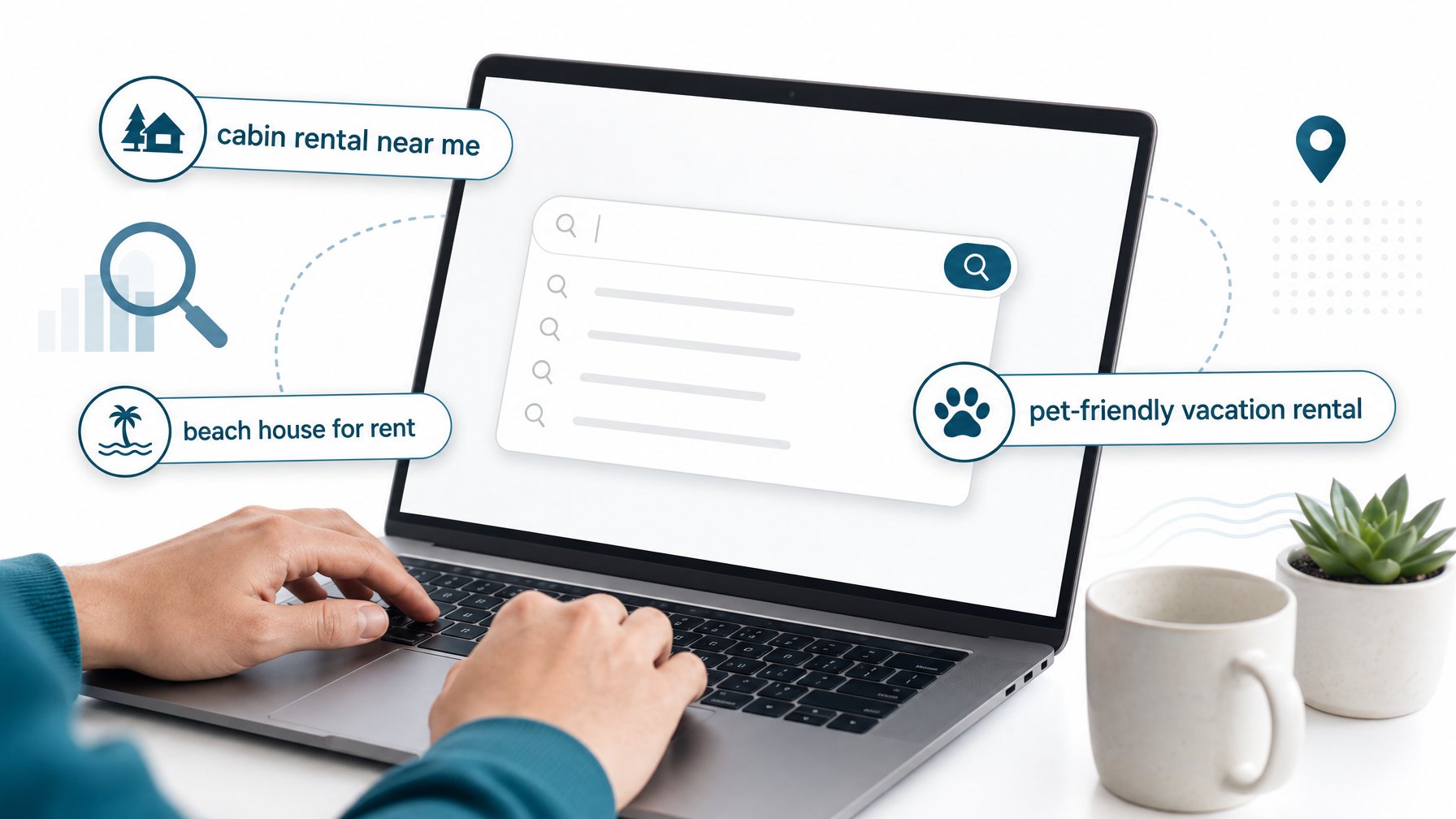
Transactional intent (booking-ready searches):
"vacation rental [city]"
"[city] cabin rental"
"beach house for rent [destination]"
"pet-friendly rental [area]"
These searches signal a traveler who is close to booking. They are the most valuable but also the most competitive — you are competing with Airbnb, VRBO, and Booking.com for these terms.
Informational intent (research-stage searches):
"things to do near [destination]"
"best neighborhoods in [city] for families"
"is [destination] good in [season]?"
These are less competitive, attract earlier-stage travelers, and are the foundation of a blog content strategy. A guest who finds your local area guide on Google, reads it, and then sees your property naturally linked is a warm lead with high booking intent.
Comparison and local intent searches:
"vacation rental near [landmark]"
"cabin [distance] from [city]"
"house rental [neighborhood]"
These are mid-competition searches with strong booking intent that more specific properties can win.
How to Research Your Keywords
Google's "People Also Ask" boxes and the autocomplete suggestions in the search bar are free, accurate indicators of what travelers actually type. Enter "[your destination] vacation rental" into Google and note every autocomplete suggestion — these reflect real search behavior.
For structured volume data, Google Ads Keyword Planner (free with a Google Ads account) shows monthly search volume and competition level for any term. Search your destination plus common rental modifiers and identify keywords with 100–1,000 monthly searches and low competition. These are the most attainable starting points for independent hosts.
Step 2: Optimize Your Houfy Listing for Search
Your Houfy listing is the core SEO asset for direct bookings. Google indexes Houfy listings, and listings connected to Google Vacation Rentals appear in the property cards that surface in Google searches.
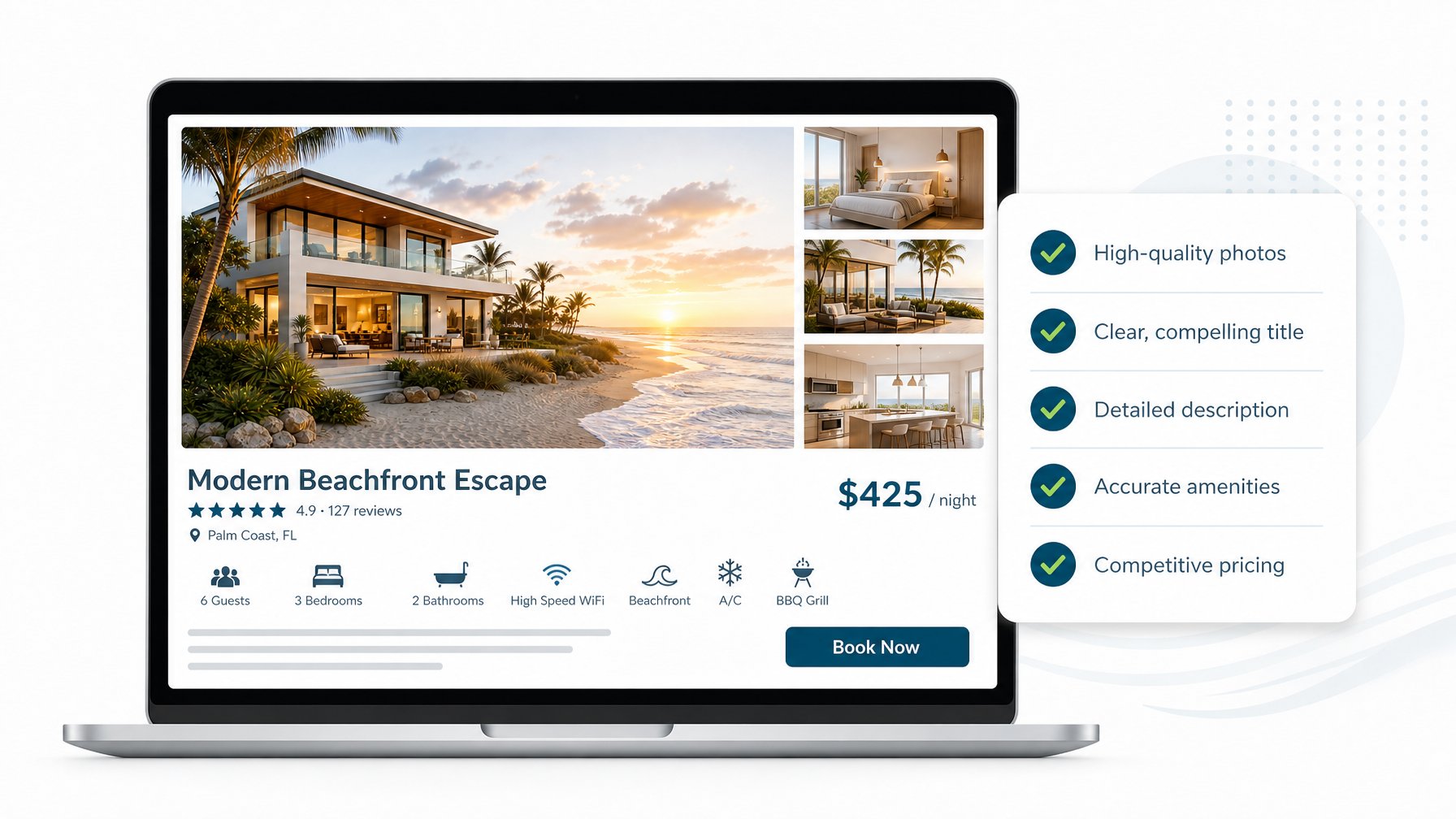
Listing title: Include the property type, key feature, and location. "3-Bedroom Oceanfront Cottage — Gulf Shores, Alabama" is better for SEO than "Beautiful Beach Getaway." Your title is a headline for both guests and Google.
Listing description: Write a complete, specific description. Mention the exact location, distance to key landmarks, neighborhood character, and unique property features. Google's language models read your description for relevance signals. A description that says "close to the beach" gives Google much less to work with than "200 feet from the Gulf of Mexico, walking distance to Gulf State Park and the Hangout Music Festival grounds."
Image alt text: Every photo on your listing should have descriptive alt text that includes the property type and location. "Oceanfront bedroom with Gulf views — Gulf Shores Alabama vacation rental" is searchable. An empty alt text field or an auto-generated filename like IMG_0447.jpg contributes nothing to your ranking.
Reviews: Guest reviews on your Houfy listing contain natural language that often mirrors real search queries. A guest who writes "great location near the Smoky Mountain trails" is adding keyword-relevant content to your listing page — passively, for free.
For additional optimization tactics, explore the Listing Optimization guides on the Houfy Blog and the Houfy Help Center.
Step 3: Google Vacation Rentals Integration
Google Vacation Rentals is a product that shows STR inventory directly in Google search results. When a traveler searches "vacation rental Asheville NC" or "cabin rental Great Smoky Mountains," they see a property grid with availability calendars and nightly rates.
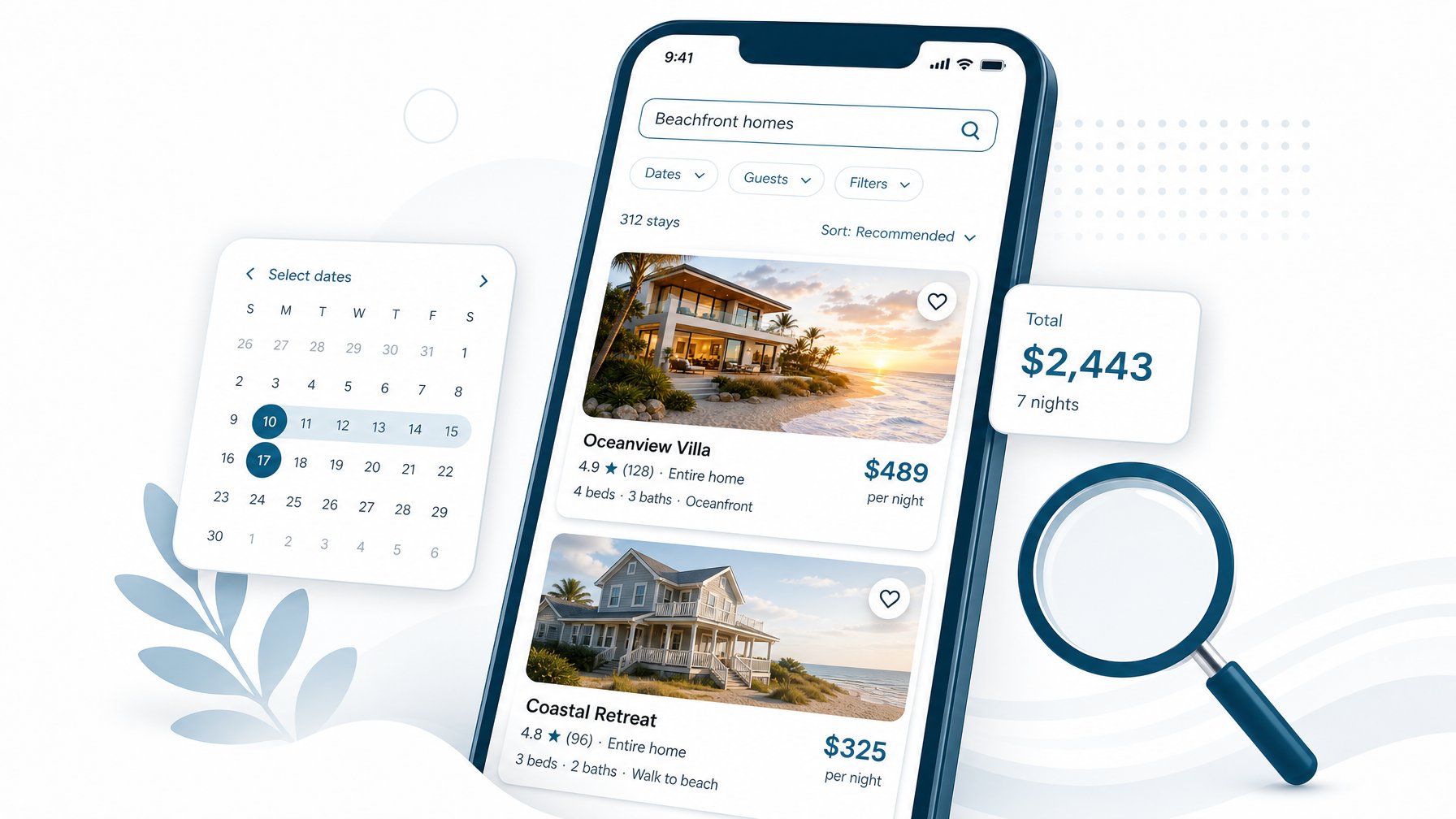
Houfy properties are indexed by Google and appear in Google Vacation Rentals results. When a traveler clicks a Houfy listing from these results, they land directly on the Houfy booking page — with no OTA involved. For a step-by-step walkthrough of how the integration works, see Get Listed on Google Vacation Rentals: The Easy Way for Hosts.
What improves your Google Vacation Rentals ranking:
Accurate, up-to-date availability calendar (synced via iCal with your other channels — see the Houfy Software Partners page for sync integrations)
Competitive nightly rate for the selected dates
Strong photo quality (Google shows your first photo as the thumbnail)
Review volume and average rating on your Houfy listing
Complete listing information — bedroom count, maximum occupancy, amenities
Properties with sparse information or stale calendars rank lower. A well-maintained Houfy listing with regular calendar updates, accurate pricing, and strong photos performs meaningfully better in Google Vacation Rentals than a neglected one.
Step 4: Build a Local Content Strategy
This is where independent vacation rental hosts can out-compete Airbnb's generic listing pages. Airbnb has one page per property — you can have ten pages that collectively establish your property as the authoritative source on your destination.

Types of content that drive vacation rental bookings:
Destination guides: "The Complete Guide to [Destination] for Families" or "10 Things to Do in [Area] You Won't Find on TripAdvisor." These rank for informational searches and organically introduce your property to travelers in the research phase.
Seasonal posts: "The Best Time to Visit [Destination]" or "[Destination] in Winter: What to Expect." Travelers planning trips search these questions months before they book. Content published 3–6 months before a season ranks just in time for peak planning demand.
Event guides: "Where to Stay for [Local Event] 2026." For markets near major festivals, sporting events, or annual gatherings, event-specific content captures high-intent searches in the weeks before the event arrives.
Neighborhood guides: "Best Neighborhoods in [City] for Vacation Rentals." These rank for comparison-intent searches and allow you to position your property's location favorably.
Where to publish: Your Houfy listing alone is not enough for a full SEO strategy. A personal property website with a blog, published at your own domain, creates the strongest standalone SEO asset. Publishing on the Houfy Blog — with a link back to your listing — builds topical authority on the Houfy domain, which carries more domain authority than a brand-new personal site.
Step 5: On-Page SEO Fundamentals for Your Property Website
If you operate your own property website, these are the foundational on-page elements that influence ranking.
Title tag: The HTML title of your page — what appears in browser tabs and Google's blue links. Format: [Property Name] — [Property Type] in [Location] | [Your Brand]. Keep it under 60 characters.
Meta description: The snippet shown below your link in Google results. This is a conversion tool, not a ranking factor — write it to make the searcher want to click. Include the primary keyword and a specific value statement.
H1 heading: One per page, matching or closely matching your target keyword. "3-Bedroom Lakehouse Rental on Lake Austin" is a strong H1 for a property's main page.
Page speed: Google uses page speed as a ranking factor. Compress images before uploading, use a CDN if possible, and test your site with Google PageSpeed Insights.
Mobile optimization: More than 70% of vacation rental searches happen on mobile devices. A page that renders poorly on a phone will both rank lower and convert at a worse rate.
Schema markup: Vacation rental listing schema tells Google exactly what your page is — a property with a specific location, price range, and availability. Adding schema markup can generate rich results (star ratings, pricing, availability) directly in Google's results. This is a technical step best handled by a developer or a CMS plugin.
Step 6: Local SEO and Google Business Profile
For vacation rental hosts who want to appear in local Google searches and Google Maps results, a Google Business Profile is the starting point.
Creating a Google Business Profile for your vacation rental requires selecting the correct category (Vacation Home Rental or similar), adding your property photos, and collecting reviews from past guests. A well-managed GBP improves visibility for local intent searches — particularly relevant for hosts in destinations where travelers search for "vacation rentals near [local attraction]."
For a full guide to setting up and optimizing a vacation rental Google Business Profile, read Google Business Profile for Vacation Rentals (2026).
Note: Google Business Profile policies for short-term rentals vary. In most cases, the property address should be the listing address. Consult Google's current guidelines before creating your profile.
Step 7: Tracking Your SEO Performance
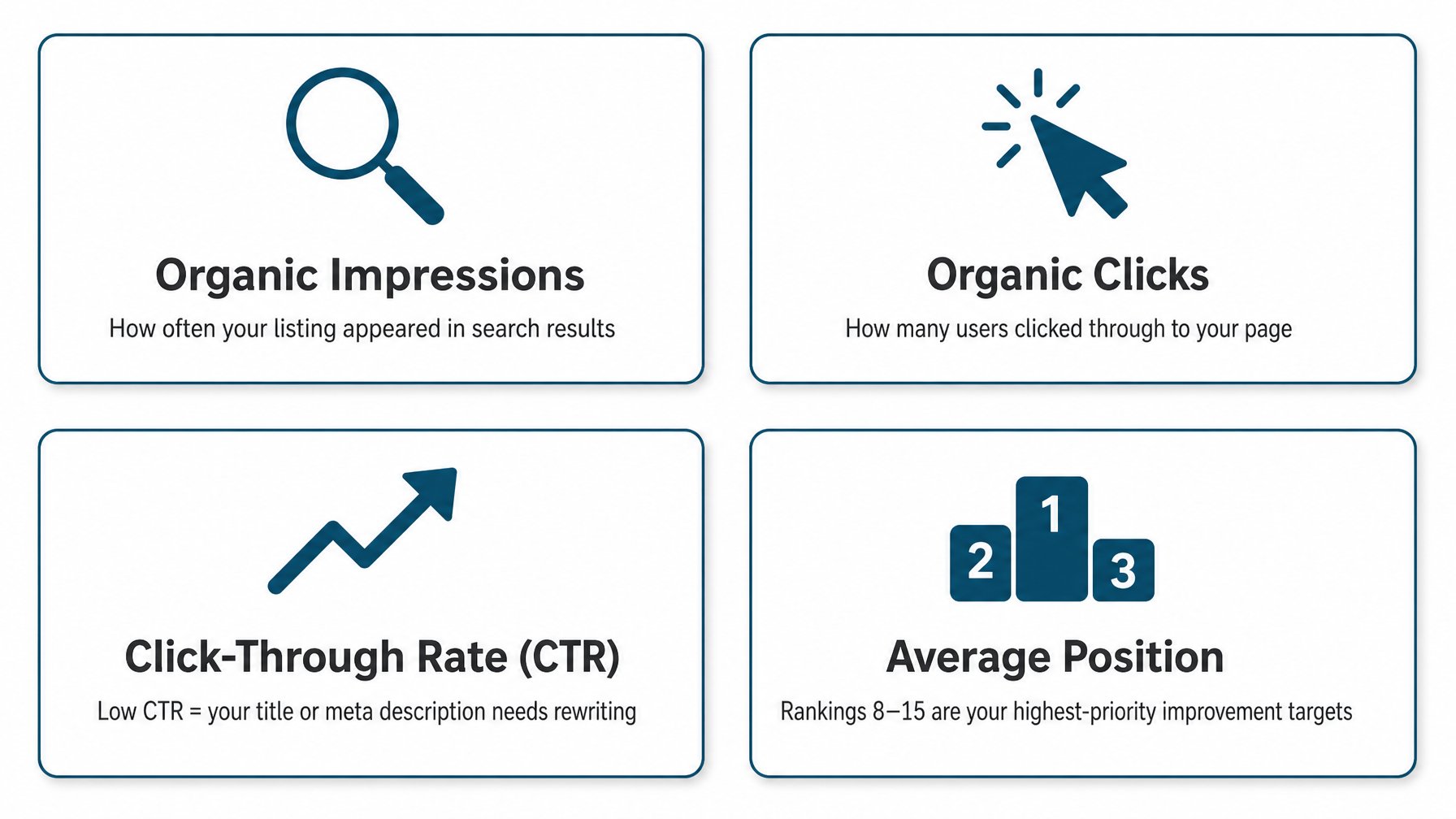
Google Search Console: This free tool from Google shows exactly what queries bring people to your site, how many impressions and clicks each query generates, and your average position in results. It is essential for understanding what is working and what to improve.
Key metrics to monitor:
Timeline: New content typically takes 3–6 months to rank. Established content on an existing domain improves faster. Plan your seasonal content calendar 4–6 months ahead so posts rank when demand is highest.
To connect your pricing strategy with your SEO efforts, see How to Price Your Vacation Rental: Summer 2026 — an SEO-driven content strategy works best when your listing converts the traffic it earns.
Frequently Asked Questions
Can I rank on Google with just my Houfy listing?
Yes. Houfy listings are indexed by Google and appear in Google Vacation Rentals results, which display at the top of relevant destination searches. A well-optimized Houfy listing with a complete description, quality photos, updated availability, and positive reviews can rank in Google Vacation Rentals without a separate website.
How long does vacation rental SEO take to work?
New content on a new domain typically takes 3–6 months to rank on page one. Content published on an existing domain with established authority can rank faster — sometimes within 4–8 weeks for lower-competition keywords. Google Vacation Rentals results for specific properties can appear within days of a listing going live.
Do I need a separate property website for SEO?
Not necessarily. For single-property hosts, a well-optimized Houfy listing combined with occasional blog content on the Houfy platform or guest posts on local travel sites can generate sufficient organic visibility. For multi-property managers or hosts in competitive markets, a standalone property website with a dedicated blog is the most scalable long-term SEO asset.
What keywords should I target for my vacation rental?
Start with the most specific possible: "[your property type] for rent [your specific location]." Work outward from there to broader destination terms and informational queries about your area. Low-competition, high-specificity keywords are far more attainable for independent hosts than broad terms like "vacation rental" or "beach house."
What is Google Vacation Rentals and how does Houfy connect to it?
Google Vacation Rentals is Google's dedicated search feature that surfaces STR properties at the top of relevant destination searches — above organic results. Houfy listings are automatically synced to Google Vacation Rentals, meaning your direct booking listing gets free visibility in Google Search, Google Maps, and Google Travel without any additional setup on your part.
How does SEO compare to paid advertising for vacation rentals?
SEO requires more upfront time investment and takes longer to show results, but the traffic it generates is effectively free once your content ranks. Paid ads (Google, Meta) deliver faster visibility but require ongoing budget — stop spending, stop appearing. Most successful hosts use both: paid ads to fill near-term gaps, SEO to build a compounding, self-sustaining traffic foundation.
Start Getting Direct Bookings Through Google Today
Houfy's 97,000+ listings are indexed by Google and connected to Google Vacation Rentals — meaning your direct booking listing gets free visibility in the highest-intent search environment available to vacation rental hosts. Every booking that arrives through organic search is a booking you keep in full, with no platform commission removed from either side.
Create your free Houfy listing →
Source Citations
Google Ads Help — Keyword Planner. Google LLC, 2026.
Google Search Central — Google Search Console. Google LLC, 2026.
Google Developers — PageSpeed Insights. Google LLC, 2026.
Houfy Blog — Get Listed on Google Vacation Rentals: The Easy Way for Hosts. Houfy, 2026.
Houfy Blog — Google Business Profile for Vacation Rentals (2026). Houfy, 2026.
Houfy Blog — Direct Booking for Short-Term Rentals: 2026 Guide. Houfy, 2026.
Last updated: June 8, 2026. Houfy currently has 97,000+ live listings across 50+ countries.