
Direct booking for short-term rentals has become the defining conversation in vacation rental hosting in 2026. Every night a guest reserves through Airbnb or VRBO, 15 to 25% of what they pay leaves your business permanently — not to your mortgage, not to your property, not to you. This guide covers what direct booking means, what it actually saves, and the exact steps to build a working channel starting today.
Last updated: 18 September 2026
Key Takeaways
Direct booking means guests reserve your property without Airbnb, VRBO, or Booking.com in the transaction
OTA commissions cost the average STR host $6,000 to $12,000 per year in foregone income
37.5% of short-term rental operators generated more direct bookings in 2025 than 2024
Houfy takes no commission on host bookings, which makes it a practical direct channel to pair with OTA discovery.
You can start getting direct bookings today without building a website from scratch
What Is Direct Booking for Short-Term Rentals?
Direct booking for a short-term rental means a guest reserves your property directly with you — without Airbnb, VRBO, or Booking.com sitting between you and the transaction.
There are several ways a direct booking can happen:
Through a direct booking marketplace. On Houfy, hosts pay no commission on their bookings, and on most bookings Houfy adds nothing to the price the guest pays. On bookings made through certain PMS integrations, a 5% API connection fee is added as a separate transaction at checkout. This is the fastest path to direct bookings for most hosts.
Through a host's own website. Many experienced hosts build a branded booking site with calendar, payment, and booking engine built in. Services like Lodgify, Hostfully, and OwnerRez make this straightforward.
Through repeat guest relationships. A guest who stayed with you via Airbnb last summer contacts you directly this year. No platform involved. You send an invoice, they pay directly, and you both skip the fees.
Through referrals. Guests recommend you to friends and family, who reach out directly rather than searching an OTA.
What all four paths have in common: the host keeps a significantly larger portion of the booking. And the host owns the guest relationship — the name, the contact details, the history.
Why the Direct Booking Movement Is Growing in 2026
Direct booking is not new. What is new is the urgency behind it.
Three forces are driving more STR hosts toward direct booking in 2026.
OTA Fees Are Higher Than They Have Ever Been
Airbnb is moving hosts to a host-only fee model. Most hosts now pay Airbnb's 15.5% host service fee, calculated on their nightly rate plus the fees they charge guests — the booking subtotal — and deducted from their payout (Airbnb Help Center, article 1857, checked 16 September 2026). That is up from approximately 3% under the old split-fee model. Because hosts absorb this cut, virtually every Airbnb listing saw prices rise 14 to 16% to maintain the same net income.
VRBO charges hosts 5% commission plus 3% processing (8% total in the US; higher internationally). Booking.com charges hosts 15%.
On a $40,000 annual STR revenue, those fees translate to $6,000 to $10,000 per year going to platforms — not to property improvement, not to the mortgage, not to the host.
Platform Dependency Creates Real Business Risk
Algorithm changes, policy updates, and account suspensions are not hypothetical. Hosts with 100% of their bookings on a single OTA have no revenue if their account is flagged, their listing drops in search, or the platform changes its policies overnight.
The hosts who weathered Airbnb's COVID cancellation policy decisions in 2020 and 2023 without catastrophic revenue loss were the ones with direct booking channels already in place. The ones who lost everything were OTA-only.
Guests Are Increasingly Willing to Book Direct
According to Skift Research data cited by Rental Scale-Up, 37.5% of short-term rental operators generated more direct bookings in 2025 than in 2024. Guest awareness of OTA fees is growing fast. When guests realize they can book the same property for less by going directly to the host, many choose to do exactly that.
For deeper data on this shift, see our full breakdown of direct booking statistics every STR host needs in 2026.
The Real Cost of 100% OTA Dependency
Most hosts think about OTA fees as a percentage. The percentage makes it feel abstract. The annual number makes it concrete.
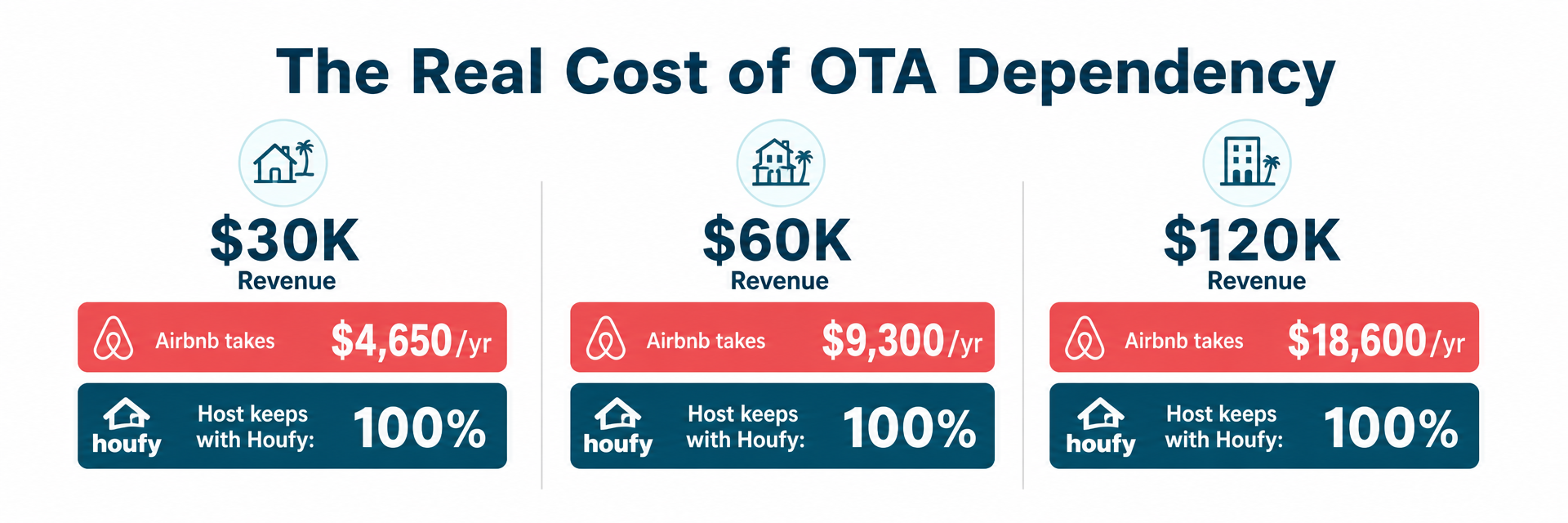
Here is what OTA dependency costs a typical STR host at three revenue levels.
$30,000 annual STR revenue
At 15.5% Airbnb host-only fee: $4,650 per year to the platform. At 8% VRBO: $2,400 per year. Blended across a dual-platform strategy: roughly $3,500 to $4,000 per year.
$60,000 annual STR revenue
At 15.5% Airbnb: $9,300 per year. At 8% VRBO: $4,800 per year. Blended: $7,000 to $8,500 per year.
$120,000 annual STR revenue
At 15.5% Airbnb: $18,600 per year. At 8% VRBO: $9,600 per year. Blended: $14,000 to $17,000 per year.
Those are not marketing costs. That is pure extraction — revenue generated by the host's property, labor, and hospitality, transferred to a platform that provides a discovery channel.
For more detail on the fee math, see how to avoid Airbnb service fees in 2026 and the honest Houfy vs. Airbnb comparison.
Three Risks Every OTA-Only Host Carries
Beyond the commission math, full OTA dependency carries three structural risks that a direct booking channel eliminates.
Risk 1: You Do Not Own Your Guest Data
When a guest books through Airbnb, Airbnb owns the relationship. You get a first name and an in-platform message thread. You do not get an email address, a phone number, or any data you can use to market future stays, build loyalty, or re-engage past guests.
The moment you move off the platform, you lose all access to that guest history. Years of hosting, hundreds of guests — zero portable data.
With direct booking, every guest's contact details are yours. That is the foundation of a repeat guest business.
Risk 2: The Algorithm Decides Whether Guests See You
Airbnb's and VRBO's search algorithms are opaque and change frequently. A listing that ranks on page one today can drop to page four after an update, a complaint, or a tweak to how the platform weights certain signals. Hosts have no visibility into why their ranking changed and no recourse when it does.
Direct booking channels — particularly a marketplace like Houfy, where hosts pay no commission on their bookings and listings are not subject to algorithm ranking games — give you a channel you control.
Risk 3: Policy Changes Affect Your Income Without Warning
Airbnb has changed its cancellation policies, its host guarantee terms, its fee structures, and its listing requirements multiple times in the past five years. Each change affected host income. None required host consent.
A direct booking channel gives you a layer of insulation. Even if an OTA changes its policies overnight, your direct booking revenue is unaffected.
Direct Booking Savings: A Real STR Host Example (Asheville, NC)
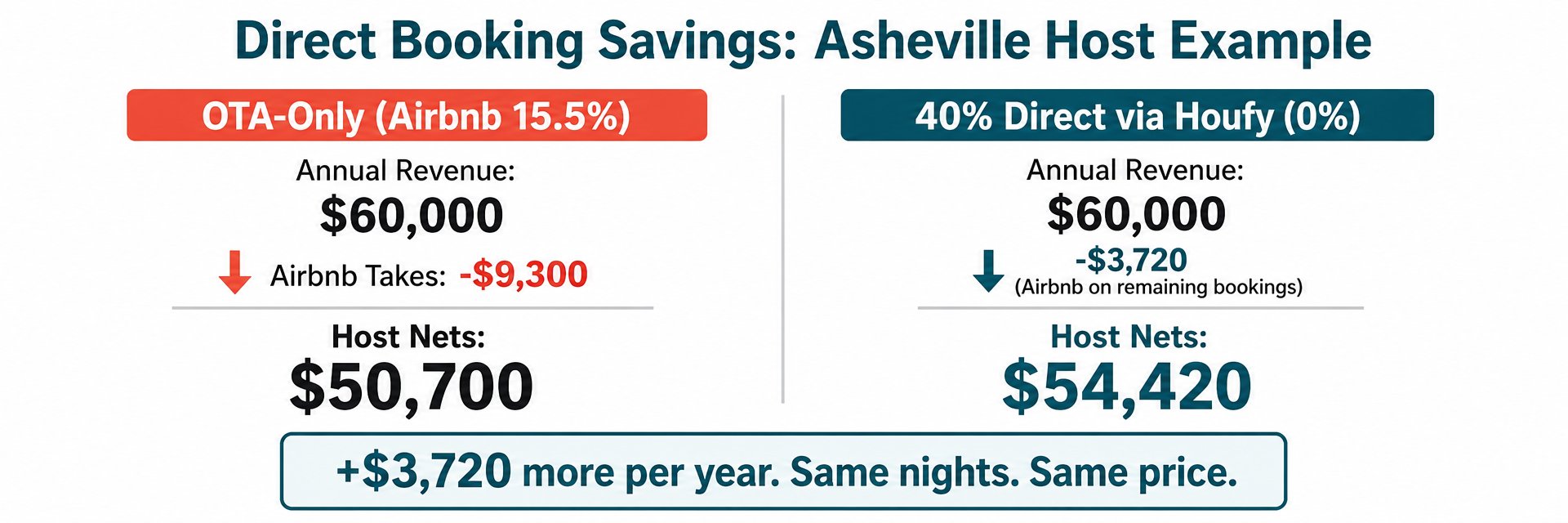
A host in Asheville, North Carolina rents a 3-bedroom mountain cabin at $250/night. Average stay length: 4 nights. Average annual bookings: 60.
OTA-only scenario (Airbnb, 15.5% host fee): Annual gross revenue: $60,000 Airbnb takes 15.5%: $9,300 Host nets: $50,700
With 40% direct bookings via Houfy (no host commission; card processing still applies): 24 bookings through Houfy: $24,000 — host keeps $24,000 36 bookings through Airbnb: $36,000 — Airbnb takes $5,580 Host nets: $54,420
That is $3,720 more per year — from the same number of bookings at the same price.
At 60% direct bookings, the saving exceeds $5,500 annually. At 80% direct, the host approaches $7,500 more per year — equivalent to adding roughly 30 additional nights of bookings without touching the calendar.
How to Start Getting Direct Bookings: Step by Step
Most hosts treat direct booking as an advanced strategy. It is not. You can start capturing direct bookings this week with the steps below.
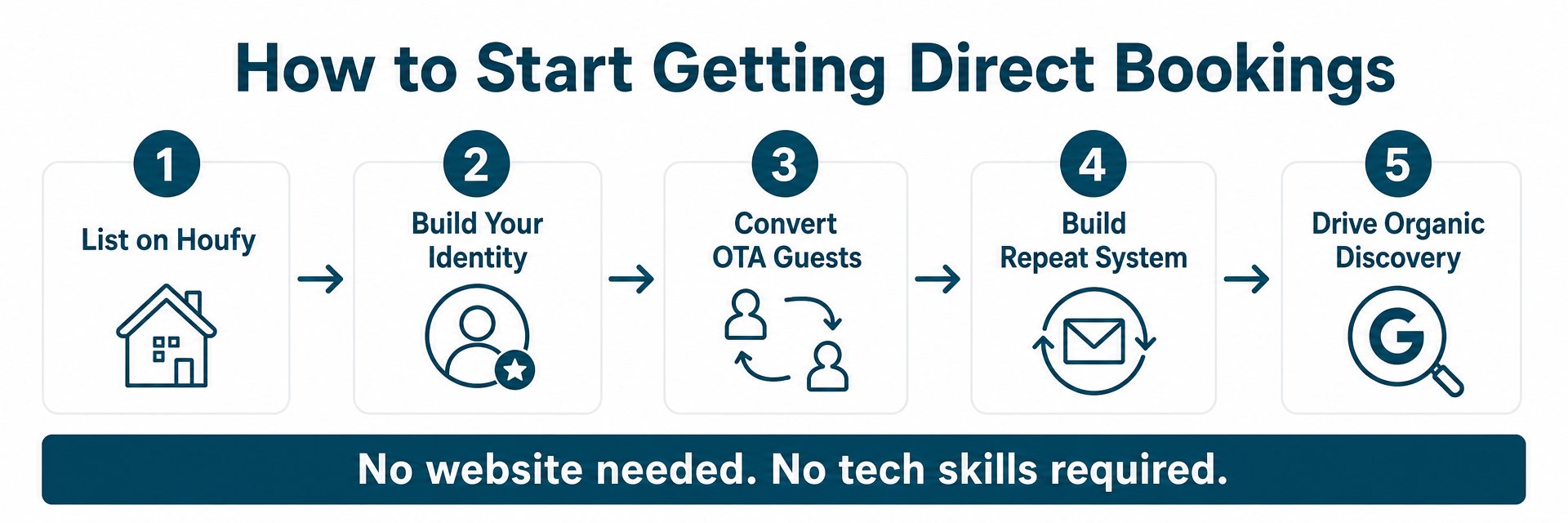
Step 1: List on a Direct Booking Marketplace
Start with Houfy, where hosts pay no commission on their bookings. Creating a listing is free; a one-time $5.99 verification makes it visible in Houfy search and gives you verified host status, and Lite and Premium plans are optional. On most bookings Houfy adds nothing to the guest's price; on bookings made through certain PMS integrations, a 5% API connection fee is added as a separate transaction at checkout. Unlike building a website from scratch, Houfy gives you a searchable listing immediately — one that accepts bookings through Stripe with no platform commission on the booking, and is eligible to appear in Google Vacation Rentals, which Google decides.
What to do:
Go to houfy.com/list-your-property and create your profile
Import your photos, description, and pricing from your Airbnb or VRBO listing (the two descriptions can be identical)
Set up your Stripe account for direct payment processing
Sync your iCal calendar so bookings across all platforms stay up to date
Your Houfy listing can be live and bookable by direct link within a day, and appears in Houfy search once the one-time $5.99 verification is paid. You can share the direct link with past guests, add it to your social media bio, and link it from any marketing you do.
For the full setup walkthrough, see how to set up a direct booking website in 2026.
Step 2: Build Your Direct Booking Identity
A direct booking channel works best when guests have somewhere recognizable to land. That does not require a custom website on day one — but it does require a consistent presence.
At minimum, set up:
A dedicated email address for your rental (yourproperty@gmail.com or a custom domain). This is the address you include in welcome packets, checkout messages, and any communication that goes beyond the OTA platform.
A Google Business Profile for your property. A properly set up GBP puts your vacation rental in Google Search and Google Maps for local queries. It is free, takes about an hour to set up, and generates direct inquiries from guests who find you through Google. See the full guide to Google Business Profile for vacation rentals.
A consistent social media presence — even one Instagram account with good photos of your property and a Houfy booking link in the bio creates a direct booking pathway.
Step 3: Convert Your Current OTA Guests
Your most valuable source of direct bookings is guests who have already stayed with you. They know the property, they trust you, and they had a good enough experience to consider returning.
The mechanics:
Include a card or note in your property with your Houfy link and a simple message: "Book your next stay directly and save on fees." This is entirely within Airbnb's terms of service because the stay is already complete.
Send a post-checkout message thanking the guest and mentioning that direct bookings are available for future stays. On Airbnb, you cannot solicit off-platform bookings during active conversations — but after checkout, you can mention it naturally.
Build a simple email list from guests who give you their contact details directly (through a guestbook, a WiFi sign-up, or a voluntary form). Even 50 past guests on an email list is a meaningful direct booking asset.
For a complete framework on this, see how to build a vacation rental email list.
Step 4: Build a Repeat Guest System
A repeat guest who books direct is the most profitable booking you can take. No acquisition cost. No OTA commission. No algorithm dependency. Just a guest who already loves your property booking again at full price.
A simple repeat guest system has three components:
A post-checkout sequence. A thank-you message 24 hours after checkout, a short follow-up 2 to 3 weeks later ("Hope you're settling back into normal life — we loved having you"), and a seasonal check-in before your next peak period ("Summer dates are filling up — we wanted to give you first access").
A reason to book direct. Give repeat guests a small incentive — an early-bird discount, a late checkout, or a free bottle of wine on arrival. The incentive costs you less than the OTA commission you save.
A way to receive the booking. Your Houfy link is all you need. Share it in the email, let the guest reserve directly, and collect payment through Stripe. No platform in between.
Step 5: Drive Organic Discovery
Beyond converting existing guests, you want new guests to find you without going through an OTA. The three most effective organic channels for vacation rentals are:
Google Vacation Rentals. Houfy listings are indexed on Google Vacation Rentals, which surfaces your property in Google Search results when travelers search for destinations. This is free visibility that competes directly with Airbnb and VRBO listings in the same search result.
SEO content. A blog post, a destination guide, or a local area page on your property's website can rank for location-specific searches ("family cabin near Asheville NC" or "beachfront rental Outer Banks"). This takes time but generates high-intent direct traffic indefinitely. See our vacation rental SEO guide for the starting framework.
Social media. Instagram and Pinterest work well for visually compelling properties. A consistent posting habit with a Houfy booking link in the bio creates a small but steady stream of direct inquiries from followers who find your property organically.
The Smart Multi-Channel Strategy: OTAs Plus Direct
The most common mistake hosts make when they discover direct booking is framing it as OTA versus direct — as if the goal is to abandon one for the other.
The data does not support that approach. Roughly 64% of vacation rental bookings still happen through OTAs. Source: Rental Scale-Up Abandoning Airbnb and VRBO entirely means surrendering access to the majority of the booking market.
The smart strategy is a channel mix:
OTAs for discovery. Airbnb and VRBO have massive search audiences. Keep your listings active and optimized. Use the platforms to reach new guests who have never heard of you.
Houfy for direct bookings with no host commission. List the same property on Houfy at the same price, or slightly lower, since there is no platform commission to cover. Guests who find you on Airbnb and then search your property name often find the Houfy listing and book there instead.
Your own database for repeat guests. After every stay, add the guest to your direct booking orbit. Over 2 to 3 years of consistent hosting, your repeat guest base reduces your OTA dependency naturally.
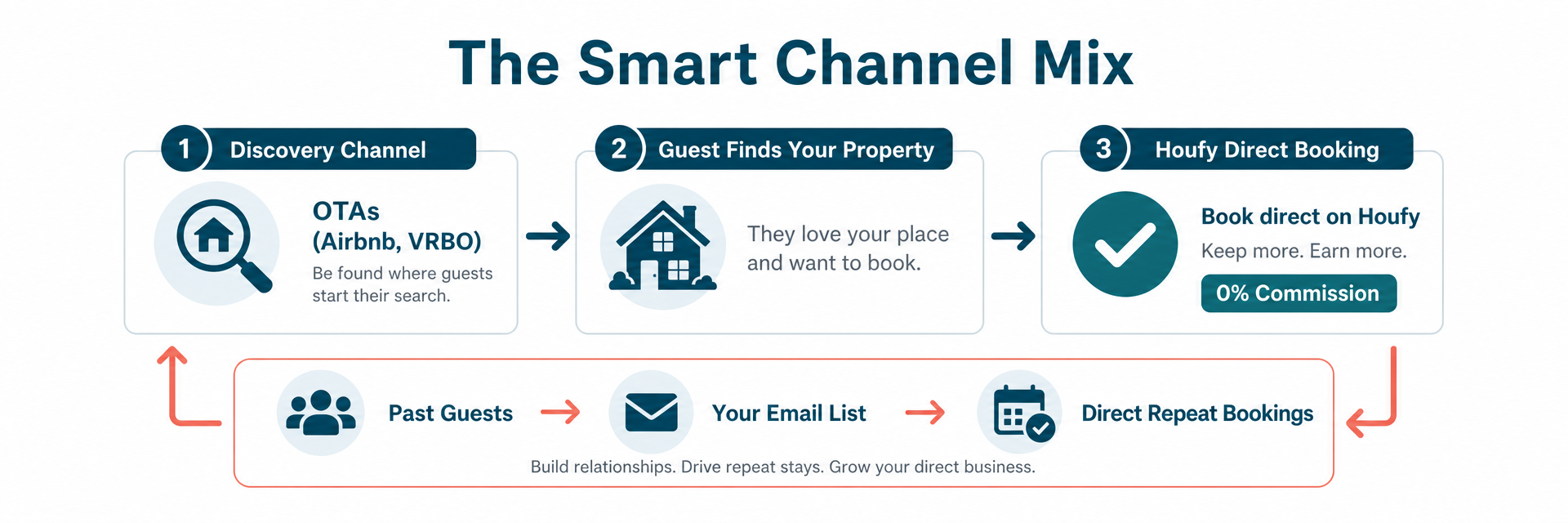
A realistic target for a well-run direct booking strategy: 40 to 60% of bookings through direct channels within 24 months of starting. That fraction of your revenue is not reduced by a 15.5% OTA host service fee, though card processing still applies.
For the full comparison of what you give up by staying OTA-only, see Houfy vs. VRBO 2026 and Houfy vs. Booking.com 2026.
What You Need to Accept Direct Payments
Direct bookings require a payment method that does not involve the OTA. The most common options for STR hosts:
Stripe. The default payment processor for Houfy. Stripe charges 2.9% plus $0.30 per transaction for card payments — a fraction of what Airbnb extracts. Stripe supports split payments, security deposits held separately, and payouts in 40+ currencies.
Bank transfer / ACH. For longer stays or higher-value bookings, some hosts and guests prefer bank transfer. No processing fee, but no buyer protection and slower settlement. Works best with established repeat guests.
Square. An alternative to Stripe with similar fee structures, slightly different international coverage.
The important point: card processing fees (Stripe's 2.9% plus $0.30) are not the same as OTA commission. A direct booking through Houfy costs the host roughly 3% in card processing on a typical booking, versus a 15.5% host service fee on Airbnb, and Houfy takes no commission on top. Two costs sit outside that comparison: any optional Houfy plan the host chooses, and, on bookings made through certain PMS integrations, a 5% API connection fee added to the guest's checkout.
Direct Booking Checklist for STR Hosts: 5 Steps This Week
At 60% direct bookings on $60,000 annual revenue, you keep $5,580 more per year — from the exact same number of nights at the exact same price.
If you have not yet started a direct booking channel, here is the 5-item checklist for this week:
Create a free Houfy account and publish your listing at houfy.com/list-your-property
Connect your iCal calendar to avoid double bookings
Set up Stripe for direct payment acceptance
Share your Houfy link on your next OTA post-checkout message
Add your Houfy booking link to your Instagram, Facebook, and any other social profiles
That is the full starting stack. No website needed. No tech skills required. Your first direct booking can come within days of completing this list.
Frequently Asked Questions
What is direct booking for short-term rentals?
Direct booking means a guest reserves your vacation rental directly with you, without Airbnb, VRBO, or Booking.com. It happens through a marketplace such as Houfy, your own booking website, or a returning guest who contacts you. On Houfy the host pays no commission on the booking, keeping the full amount minus card processing fees, and owns the guest relationship.
How much money do STR hosts save with direct bookings?
Replacing a $1,000 Airbnb booking with a Houfy booking saves the 15.5% host service fee, about $155, less roughly $29 in card processing, so about $126 net. On $60,000 of annual revenue with half booked direct, that is roughly $3,800 before any optional Houfy plan.
Is direct booking better than Airbnb for hosts?
Direct booking and Airbnb work best together for most hosts. Airbnb provides discovery for new guests; direct booking provides better economics for repeat and direct-find guests. The most profitable strategy combines both: keep your Airbnb listing for reach, and run a parallel direct booking channel on Houfy to capture bookings without commission.
How do I get guests to book directly with me?
The three most effective methods are: (1) listing on a direct booking marketplace such as Houfy, which takes no commission from hosts, so guests who find you anywhere can book direct; (2) including your direct booking link in your property, checkout messages, and post-stay communications; and (3) giving repeat guests a small incentive to return direct rather than through an OTA. Guests who are fee-aware will often seek out the direct option — you just need to make it easy to find.
Do I need a website to accept direct bookings?
No. A Houfy listing provides a direct booking page with calendar, pricing, payment processing, and host verification built in. Many hosts start there and only build a standalone website after their direct booking channel is generating consistent revenue.
Is direct booking safe without Airbnb's protection?
Yes, with the right setup. Houfy includes host verification, Stripe-powered secure payments, and HoufyProtect for damage coverage. A written rental agreement (specific to direct bookings) and a security deposit held through Stripe add further protection. Direct bookings handled through Houfy are differently protected from OTA bookings, with the host in control of the terms rather than the platform.
What is the best platform for direct booking vacation rentals?
Houfy is a direct booking marketplace for short-term rentals, with 87,000+ properties across 50+ countries. Hosts pay no commission on their bookings, and on most bookings Houfy adds nothing to the guest's price; bookings made through certain PMS integrations add a 5% API connection fee at checkout. Houfy supports Stripe payments and indexes listings on Google Vacation Rentals. For hosts who want a head start without building a standalone website, Houfy is the fastest path to a working direct booking channel. See our full comparison of direct booking platforms and Airbnb alternatives.
How long does it take to get my first direct booking?
Most hosts receive their first direct booking inquiry within 2 to 4 weeks of listing on Houfy and sharing their link with past guests. Hosts with a larger existing guest base or an active social media presence tend to see results faster. Building a self-sustaining direct booking pipeline — where new guests find you organically rather than through OTAs — typically takes 6 to 18 months of consistent effort.
Start Your Direct Booking Channel Today
The math on direct booking is straightforward. Every night a guest books through Airbnb or VRBO, a percentage of what they pay leaves your business permanently. Every night they book direct, you keep it.
The shift does not require you to abandon the OTAs. It requires you to build a parallel channel, one booking at a time, until the direct share of your revenue is large enough to matter.
Houfy takes no commission on your bookings. Creating a listing is free; a one-time $5.99 verification makes it visible in Houfy search, and Lite and Premium plans are optional. List your property at houfy.com/list-your-property, set your own price, and card processing is the only deduction from each reservation.
Your guests are already searching for the best deal. Make sure you are there when they find it.
Sources
StayFi. "2026 Vacation Rental Statistics." April 2026. https://stayfi.com/vrm-insider/2026/04/20/vacation-rental-statistics/
Rental Scale-Up / Skift Research. "How US Vacation Rental Managers Could Drive More Direct Bookings." https://www.rentalscaleup.com/how-us-vacation-rental-managers-could-drive-more-direct-bookings/
Airbnb Help Center. "Service fees" (article 1857). Host service fee rate as published, checked 15 September 2026. https://www.airbnb.com/help/article/1857