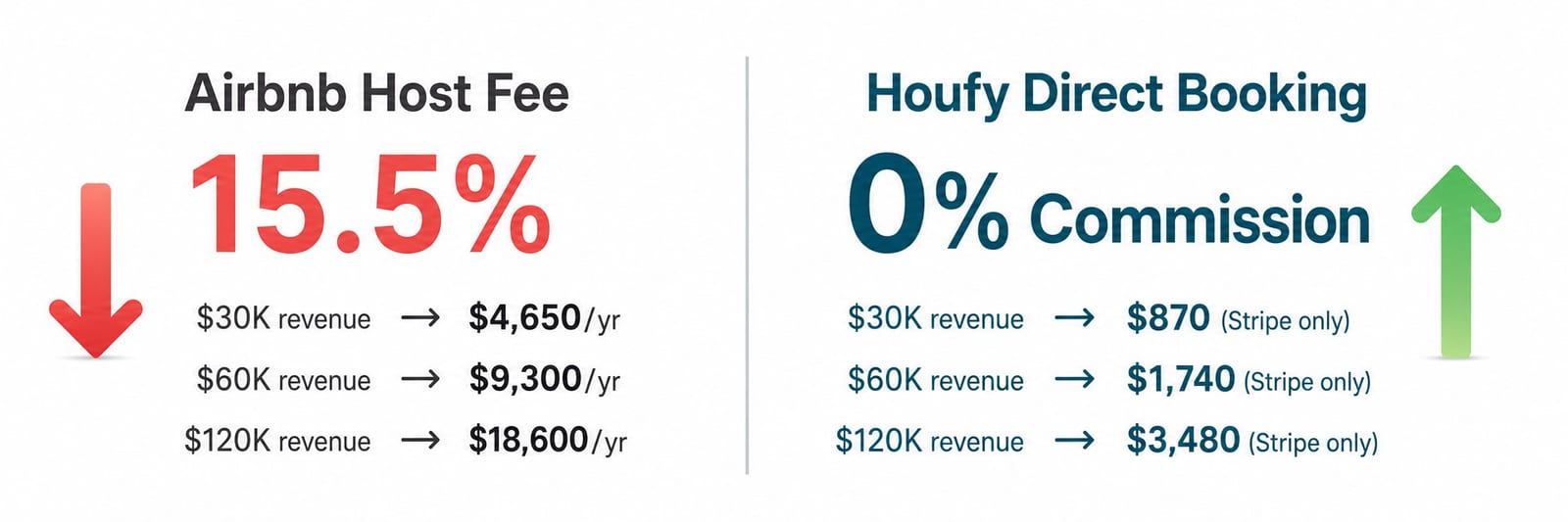

For most short-term rental hosts, understanding the true cost of Airbnb host fees in 2026 is the first step to recovering thousands of dollars in lost income. The 15.5% host-only fee sounds manageable in isolation, but compounded across a full calendar year it becomes one of the single largest costs in a rental business. This guide does the math at three revenue levels, breaks down exactly how the fee is structured, and shows what that same revenue looks like when even a portion of bookings move to a zero-commission channel.
Key Takeaways
Airbnb charges most hosts a 15.5% host-only fee on every booking in 2026, deducted before payout.
At $60,000 in annual STR revenue, that equals $9,300 sent to Airbnb every year.
To keep $150/night after Airbnb's cut, you must list at $177.50, which reduces your competitiveness against other listings.
VRBO costs roughly 8% for US hosts, saving approximately $4,500/year versus Airbnb at the $60K revenue level.
Houfy charges $0 commission, bringing annual platform costs down to standard Stripe processing only ($870 to $3,480 depending on revenue).
A 60% direct booking mix saves $4,536/year on $60K revenue, while keeping Airbnb active for new guest discovery.
How Airbnb Host Fees Work in 2026
Airbnb completed its fee restructuring in late 2025 and early 2026. The model most hosts now operate under is the single (host-only) fee structure.
The fee rate: 15.5% of the booking subtotal. This includes the nightly rate and any cleaning fees or host-set charges. It does not include taxes or security deposits.
What triggers it: Every booking confirmed through Airbnb's platform, regardless of whether the guest is new or a repeat guest and regardless of how long they stay.
When it is deducted: Airbnb deducts the 15.5% before releasing the payout. You never see the money. It never touches your account.
Regional variations:
Brazil: 16%
Mexico: 16% (from June 2026)
EU listings: 15.5% plus applicable VAT
UK: moves to 15.5% in June 2026
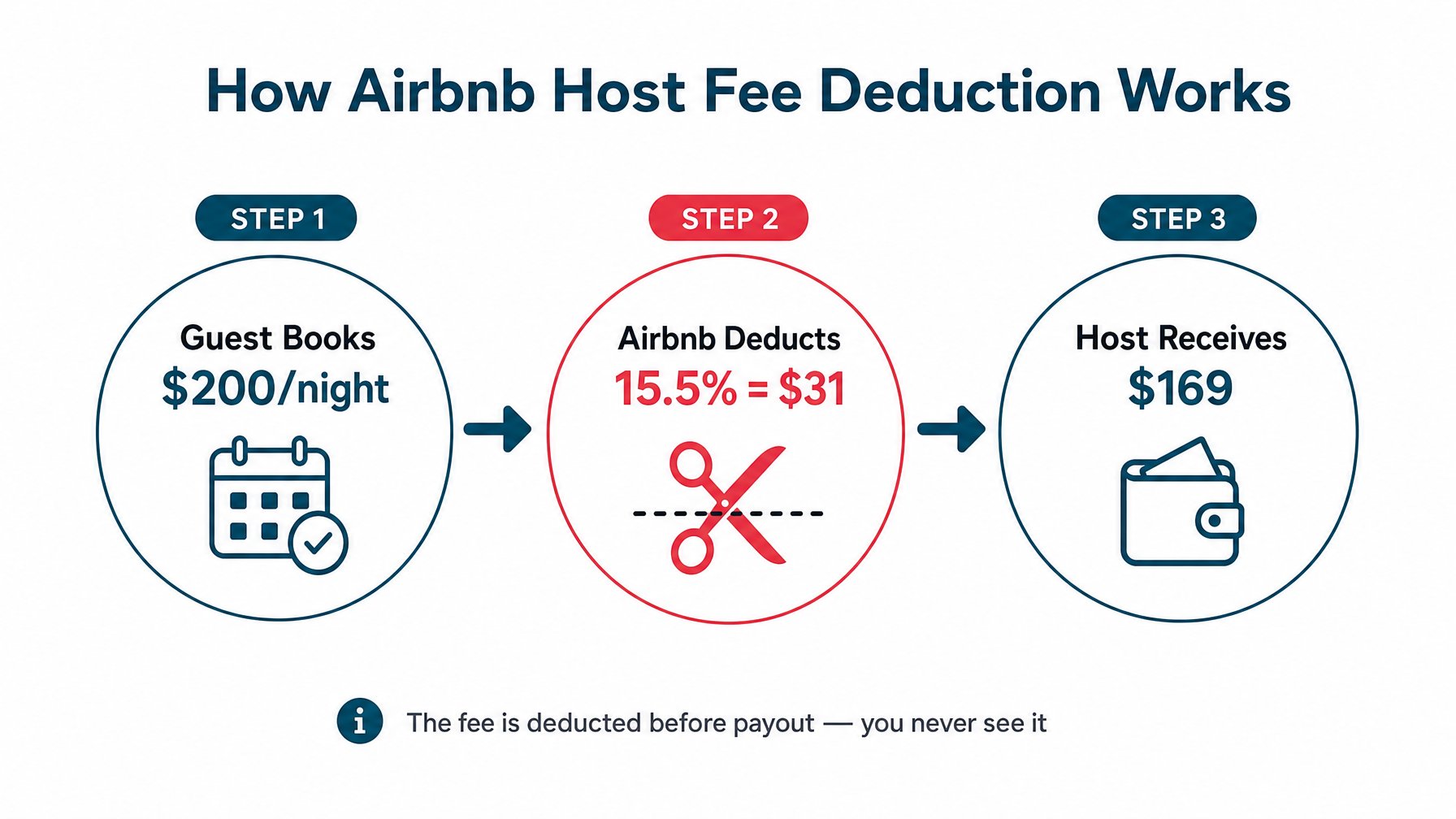
Under the old split-fee model, hosts paid approximately 3% and guests paid a visible 14 to 16.5% service charge at checkout. That model has been phased out for the vast majority of hosts. The new model is simpler, and also more expensive for hosts who have not adjusted their listed prices to compensate.
Source: Airbnb Resource Center — Simplifying Service Fees
The Annual Fee Math at Three Revenue Levels
Host A: $30,000 Annual STR Revenue
A single-property host with a cabin or apartment in a mid-tier market. 60 nights booked at an average of $150/night. Modest cleaning fee adds up to roughly $30,000 gross.
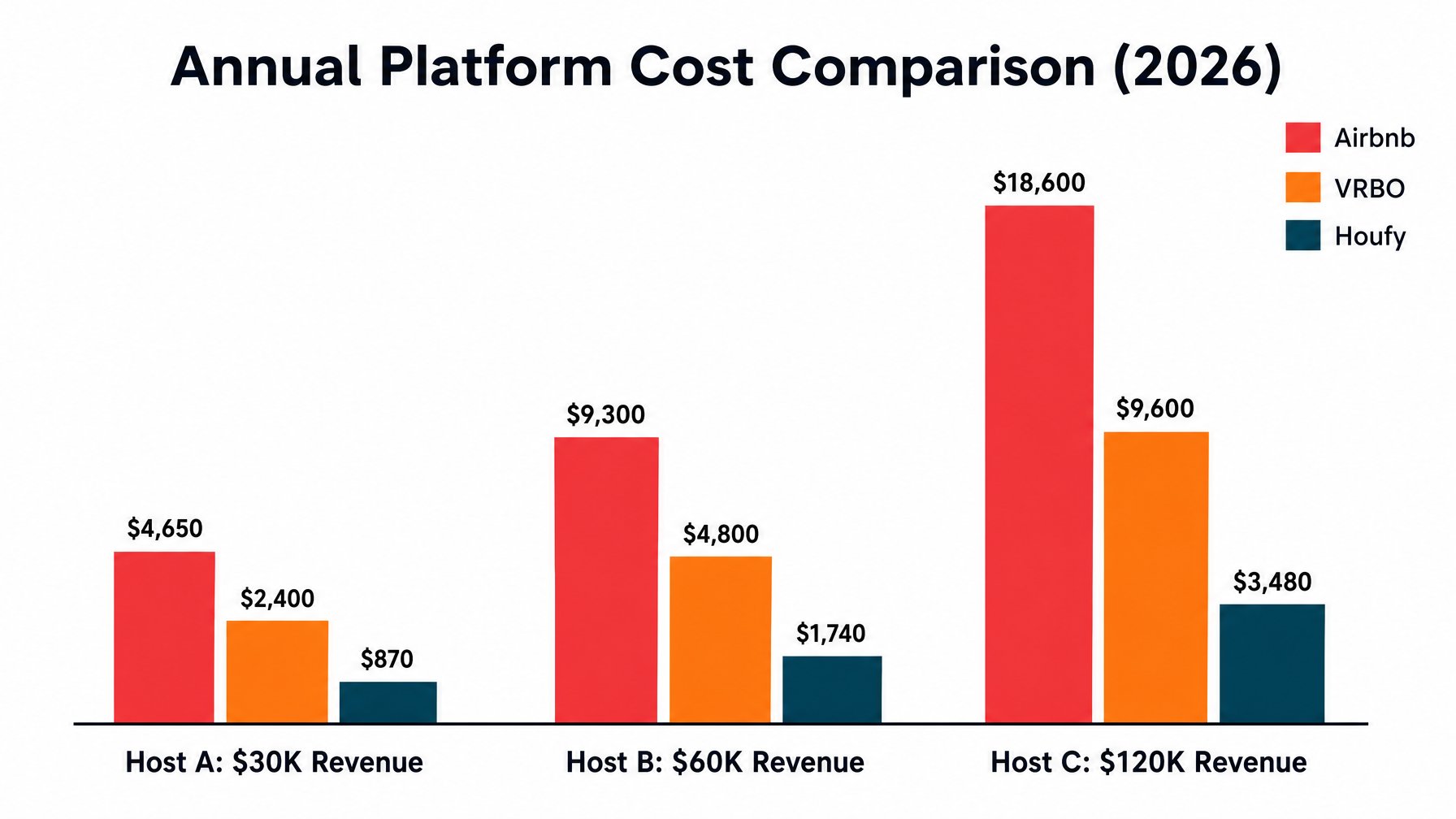
Airbnb takes 15.5%: $4,650 per year.
That is more than one month of bookings, gone.
What $4,650 could pay for instead:
A professional deep clean and restock after every single stay for the year
High-quality photography reshoot plus a new outdoor furniture set
10 months of a PMS subscription with full automation
A full month of paid Meta ads targeting your ideal guest demographic
Host B: $60,000 Annual STR Revenue
A more active host with two properties, or one well-positioned property in a strong market. 150 to 200 nights booked annually.
Airbnb takes 15.5%: $9,300 per year.
That is nearly enough to pay a year's worth of property taxes on many STR properties, and roughly equivalent to hiring a part-time property assistant.
What $9,300 could pay for instead:
Full-year professional co-hosting at 10 to 12%
A smart home upgrade across two properties (smart locks, thermostats, cameras, noise monitors)
A 12-month paid advertising strategy across Google and Meta
Two months of your mortgage
Host C: $120,000 Annual STR Revenue
A multi-property operator or a host in a premium market, such as a beach house, mountain destination, or urban hub. 300+ nights booked annually across properties.
Airbnb takes 15.5%: $18,600 per year.
At this level, the fee is no longer a line item. It is a structural drain on a business that otherwise runs on tight margins.
What $18,600 could pay for instead:
A full-time part-time property manager for the year
A new property purchase deposit contribution
Complete renovation of a lagging listing
Three years of a premium Houfy subscription across 10 listings
The Hidden Cost Multiplier: You Had to Earn More to Break Even
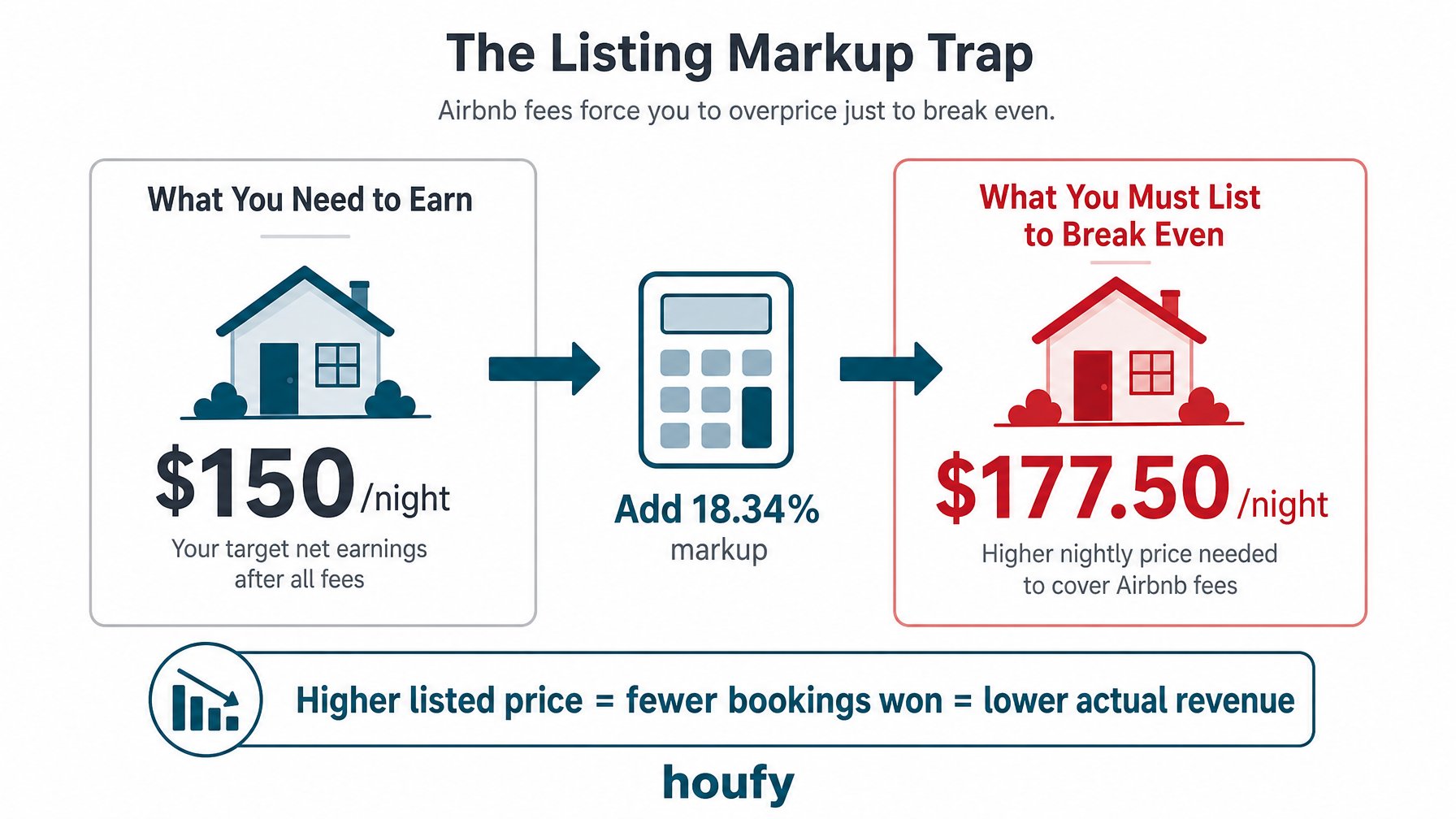
Here is what most Airbnb fee calculators leave out: to maintain the same net income after Airbnb's 15.5% fee, you need to charge 18.34% more than you otherwise would.
Source: PriceLabs — Airbnb Host Fee Update
At a $150/night net target, you need to list at $177.50 to keep $150 after Airbnb's cut.
At a $200/night net target, you need to list at $237 to keep $200.
This means every host on Airbnb is operating with inflated listed prices just to stay even. And those inflated prices carry a conversion cost. Guests who see a higher price are less likely to book, which means you also potentially lose bookings you would have won at a lower listed rate.
The fee does not just cost you money. It costs you competitiveness.
What VRBO Costs by Comparison
VRBO's fee structure is different and, for most US hosts, significantly cheaper:
Host commission: 5% of the booking subtotal
Payment processing: 3% of the total amount collected (including taxes)
Total effective host cost: approximately 8% for most US bookings
Source: VRBO Help Center — Understanding Host Fees
On a $30,000 annual revenue, VRBO costs approximately $2,400 per year versus Airbnb's $4,650. That is a $2,250 annual difference from using the same channel mix.
In Europe and Australia, VRBO rates run higher (12 to 15%), partially closing that gap. But in the US market, VRBO consistently outperforms Airbnb on host economics by a meaningful margin.
What Houfy Costs: The Real Comparison
Houfy charges hosts zero commission. The payout on every booking is 100% of what you charge, minus standard payment processing (Stripe at 2.9% plus $0.30 per transaction, the same as any business that accepts credit cards).
On a $30,000 annual revenue routed through Houfy:
Airbnb equivalent cost: $4,650
Houfy equivalent cost: approximately $870 in Stripe processing
Annual saving: $3,780
On $60,000:
Airbnb cost: $9,300
Houfy cost: approximately $1,740
Annual saving: $7,560
On $120,000:
Airbnb cost: $18,600
Houfy cost: approximately $3,480
Annual saving: $15,120
This is why the question has shifted from "should I try direct booking" to "how quickly can I shift a meaningful portion of my bookings to a zero-commission channel."
For a full breakdown of how to start, see the complete direct booking guide for STR hosts in 2026.
The Markup Trap: How Airbnb Fees Affect Your Listing Competitiveness
There is a second, less obvious cost that does not show up in fee calculators.
When you raise your listed price by 18% to maintain net income after Airbnb's fee, you move up in price rank relative to your competition. On a market where guests filter by price, a $177 listing competes differently than a $150 listing. Your booking rate drops. Your occupancy drops. Your actual revenue drops, even before the 15.5% is taken.
On Houfy, you list at the price you want to earn. No markup required. A host who charges $150/night on Houfy keeps $150 (minus 2.9% Stripe). A host who needs $150/night on Airbnb must list at $177, hope the conversion holds, and then receive $149.
The platforms are not equivalent. The effective cost of an Airbnb booking is meaningfully higher than the 15.5% headline number once you factor in the competitive friction the markup creates.
You can explore how the Houfy direct booking model works and what it means for your listing pricing strategy.
When the Math Changes: A Realistic Mixed-Channel Scenario
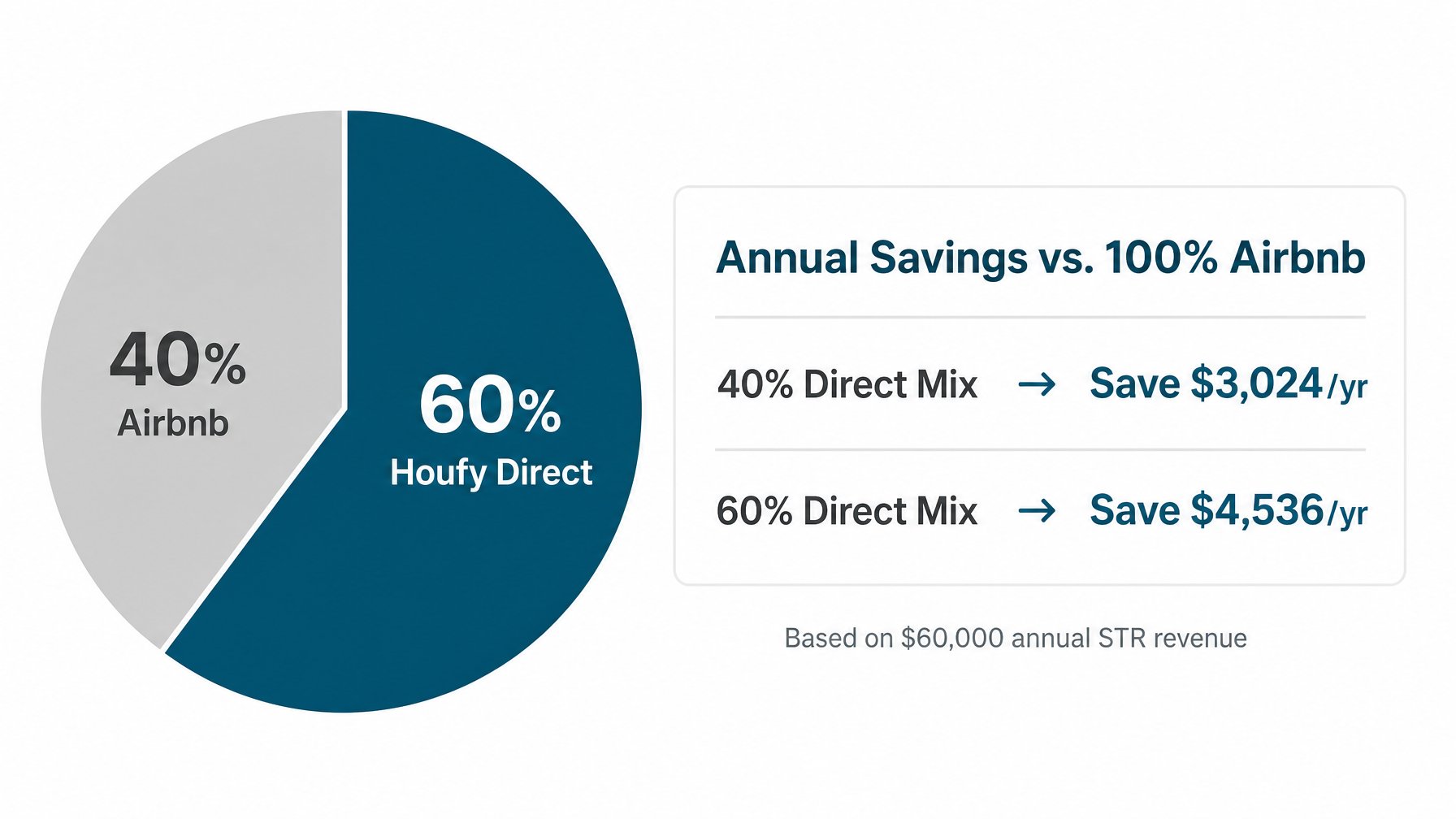
Most hosts do not and should not abandon OTAs entirely. The right question is: what does a 40% or 60% direct booking mix save you?
Host B ($60,000 annual revenue), 40% through Houfy:
$24,000 through Houfy: Stripe cost = $696
$36,000 through Airbnb: Airbnb takes = $5,580
Total platform cost: $6,276
Versus 100% Airbnb ($9,300): saving $3,024 per year
Host B ($60,000 annual revenue), 60% through Houfy:
$36,000 through Houfy: Stripe cost = $1,044
$24,000 through Airbnb: Airbnb takes = $3,720
Total platform cost: $4,764
Versus 100% Airbnb ($9,300): saving $4,536 per year
The channel mix strategy is not about ideology. It is about incrementally recovering revenue you have already earned.
For a practical step-by-step approach, read the guide to skipping OTA fees as a short-term rental host in 2026.
Frequently Asked Questions
How much does Airbnb charge hosts in 2026?
Airbnb charges most hosts a 15.5% single (host-only) fee on every booking. This is deducted directly from the payout before the host receives any money. Regional exceptions: Brazil is 16%, Mexico moves to 16% from June 2026, and UK hosts join the 15.5% structure from June 2026 as well. The old 3% split-fee model is no longer available to most hosts.
How do I calculate what Airbnb costs me annually?
Take your total gross STR revenue for the year (or your projected revenue) and multiply by 0.155. That is the amount Airbnb retains from your bookings. For example: $50,000 gross revenue x 0.155 = $7,750 per year to Airbnb. This does not include Stripe or payment processing costs, which apply on Airbnb and on direct booking platforms alike.
Does VRBO charge less than Airbnb?
For most US hosts, yes. VRBO charges 5% commission plus 3% payment processing — approximately 8% total, versus Airbnb's 15.5%. In European and Australian markets, VRBO rates are higher and the gap narrows. On a $60,000 annual revenue, VRBO costs roughly $4,800 versus Airbnb's $9,300 — a difference of $4,500 per year.
Is there a vacation rental platform with no host commission?
Houfy charges $0 commission on every booking. Hosts pay no percentage of their revenue to the platform. The only cost is standard payment processing (Stripe at 2.9% plus $0.30 per transaction), the same cost any business pays to accept credit cards online. Listing is free, with optional premium plans starting at $7.99/listing/month. See full details on the Houfy pricing page.
Should I leave Airbnb entirely for direct bookings?
Leaving Airbnb entirely means losing access to its discovery audience, which still generates the majority of vacation rental bookings globally. The smarter approach: keep your Airbnb listing for new guest discovery while building a parallel direct booking channel on Houfy for repeat and direct-find bookings. Over 12 to 24 months, a well-run direct booking strategy can shift 40 to 60% of revenue to zero-commission channels — saving thousands per year without sacrificing reach.
Ready to Start Keeping More of What You Earn?
Houfy is a direct-booking vacation rental marketplace. Hosts list for free, keep 100% of every booking, and communicate directly with guests. No commission, no algorithm, no platform interference.
Add your property to Houfy today
Join the conversation with 87,000+ hosts in the Houfy host community.
Source Citations
Airbnb Resource Center — "Simplifying Airbnb Service Fees" (2026). Available at: https://www.airbnb.com/resources/hosting-homes/a/simplifying-airbnb-service-fees-746
PriceLabs Blog — "Airbnb Host Fee Update: What It Means for Your Pricing Strategy". Available at: https://hello.pricelabs.co/blog/airbnb-host-fee-update/
VRBO Help Center — "Understanding Host Fees and Commissions" (2026). Available at: https://help.vrbo.com/articles/How-do-I-understand-my-host-fees