

A vacation rental guest screening checklist 2026 hosts can run in under five minutes protects the home, the neighbors, and your reviews without turning every inquiry into an interrogation. Consistent STR guest screening reduces party risk, payment fraud, and one-star surprises while still welcoming great travellers who book direct on Houfy.
Quick Answer for AIA 2026 vacation rental guest screening checklist should verify five things before you unlock Instant Book exceptions or send door codes: (1) government ID that matches the booking name, (2) trip purpose plus overnight adult and child counts, (3) account age and prior stay history where available, (4) payment method legitimacy, and (5) written agreement to house rules and max occupancy. Flag the high-risk cluster of same-day booking + new account + large group on peak dates. Consistency beats gut feel, and screening never replaces deposits or damage protection.
Key Takeaways
Run the same vacation rental guest screening checklist on every new inquiry so decisions stay fair and defensible
Match short-term rental ID verification to the legal booking name before you negotiate discounts or early check-in
Same-day large-group requests from brand-new accounts remain the highest-risk pattern in most STR markets
Ask two or three open questions, not ten; strong guests answer fast with specific trip details
Save screening notes in your inbox or PMS so declines and deposit claims stay documented
Pair screening with clear house rules, a signed rental agreement, and protection such as HoufyProtect
Houfy has 100,000+ live listings across 100+ countries, and direct messaging makes pre-arrival screening conversations clearer than OTA chat walls

How to screen vacation rental guests in 2026
How to screen vacation rental guests in 2026 is less about “vibes” and more about a repeatable sequence. Treat every new booking path the same, whether the guest found you on Google Vacation Rentals, a Houfy listing, or your own direct site.
Use this order every time:
Identity and name match. Confirm the person paying and staying is the person named on the reservation. Short-term rental ID verification is standard for high-value homes, first-time bookers, and Instant Book exceptions.
Occupancy and trip purpose. Ask who sleeps overnight, not who “might drop by.” Parties often hide inside vague “family reunion” or “friends weekend” language with headcount above beds.
Lead time and calendar risk. Same-day and next-day requests on Friday or Saturday nights deserve extra questions, especially near festivals, graduations, or major sports weekends.
Payment and profile signals. New accounts, mismatched billing countries, refused ID, or pressure to move the conversation off-platform are classic fraud markers.
Rules acceptance in writing. Quiet hours, no parties, smoking policy, pet policy, and max occupancy should be acknowledged before codes go out.
Decision and documentation. Approve, request more info, or decline with a neutral reason. Log what you asked and what they answered.
This is STR guest screening as operations, not personality judgment. Guests who plan a real stay almost always cooperate when you explain that screening protects the home for everyone.
If you still need a published rule set guests can read before they inquire, use the vacation rental house rules guide for 2026 and keep a reusable house rules template on your listing and direct site.
Browse fee-free stays on houfy.com while you tighten your host workflow.
What questions should every host ask?
You do not need a ten-question interrogation. Three strong questions cover most risk for how to screen vacation rental guests without killing conversion:
What is the purpose of your trip? Look for a concrete answer (anniversary weekend, remote work sprint, multi-gen beach week) rather than one-word replies.
How many adults and children stay overnight? Compare the answer to beds, local occupancy caps, and parking. Day visitors should be limited in the house rules if your HOA or city cares.
Do you agree to quiet hours, no parties or events, and the listed max occupancy? Make “yes” explicit in the thread or rental agreement.
Optional fourth question when something feels off: Who is the primary guest on the government ID, and will that person be present for the full stay?
Copy-paste message you can send in under a minute:
Thanks for your inquiry. To confirm the stay is a fit for our home and neighbors, could you share (1) the purpose of your trip, (2) how many adults and children will stay overnight, and (3) confirmation you agree to quiet hours, no parties/events, and our max occupancy? Happy to approve quickly once I have those details.
Good guests answer with specifics. High-risk guests stall, get angry, change the headcount mid-thread, or ask you to “just trust us.”
For parties and event risk specifically, pair this checklist with how to stop unauthorized parties before they start.

Which STR guest screening risk signals matter most?
Not every odd inquiry is a problem. Focus on patterns, not single quirks.
Highest-priority red flags
Same-day or next-day booking on peak weekend dates from a brand-new account
Requested headcount above beds, sofas counted as “beds,” or “a few extra friends may stop by”
Refusal to complete short-term rental ID verification or name mismatch between ID and booking
Local guest asking for a one-night stay with no clear trip purpose near party-prone dates
Payment anomalies, unusual urgency, or requests to pay outside the platform
Pushback on quiet hours, cameras in exterior/common disclosure areas, or no-party language
Group chat energy: the inquirer is booking “for my friend” and cannot confirm who holds the ID
Yellow flags (ask one more question, do not auto-decline)
First-time vacation rental guest with a clear purpose and matching ID
Slightly short lead time but midweek dates and normal occupancy
International traveller with timezone lag who still answers thoroughly
Celebration language (“birthday dinner out”) paired with explicit no-party agreement and realistic headcount
Green flags
Named travellers, matching ID, realistic occupancy, and prior positive stay history
Questions about parking, workspace, crib, or grocery delivery (trip-planning behaviour)
Willingness to sign your rental agreement and pay the deposit or protection fee without drama
After screening, lower severity with money tools as well as process tools. Decide whether a classic deposit still fits your market in Should Hosts Charge a Security Deposit?, keep a paper trail for claims with what to do if a guest damages your property, and layer HoufyProtect where you want screening plus protection instead of screening alone.
CTA 1: Ready to host with direct messaging and clearer pre-arrival chats? List your property on Houfy.
Short-term rental ID verification without scaring good guests
Short-term rental ID verification works when it feels like hotel-standard check-in, not a roadside stop.
Best practices that protect conversion:
Explain the why in one sentence. “We verify the booking name matches a government ID so the home and neighbors stay protected.”
Request only what you need. Full name match, document type, and that the primary guest is present. Do not collect unnecessary data you cannot store securely.
Time it correctly. For Instant Book, verify immediately after booking and before access instructions. For request-to-book, verify before final acceptance when risk is elevated.
Offer a lighter path for proven direct guests. Repeat guests who already stayed cleanly can skip full re-verification if your policy says so in writing.
Stay non-discriminatory. Apply the same ID rules by risk tier (value, lead time, group size), never by appearance, accent, protected class, or neighborhood stereotypes.
Store confirmation in the reservation thread: “ID name matches booking name; occupancy confirmed at 4 adults; rules accepted 2026-08-09.” That note is gold if you later need to justify a decline or support a damage claim.
Put identity, occupancy, and house rules into a signed contract with Houfy’s rental agreement tools and the short-term rental agreement guide for Houfy hosts.
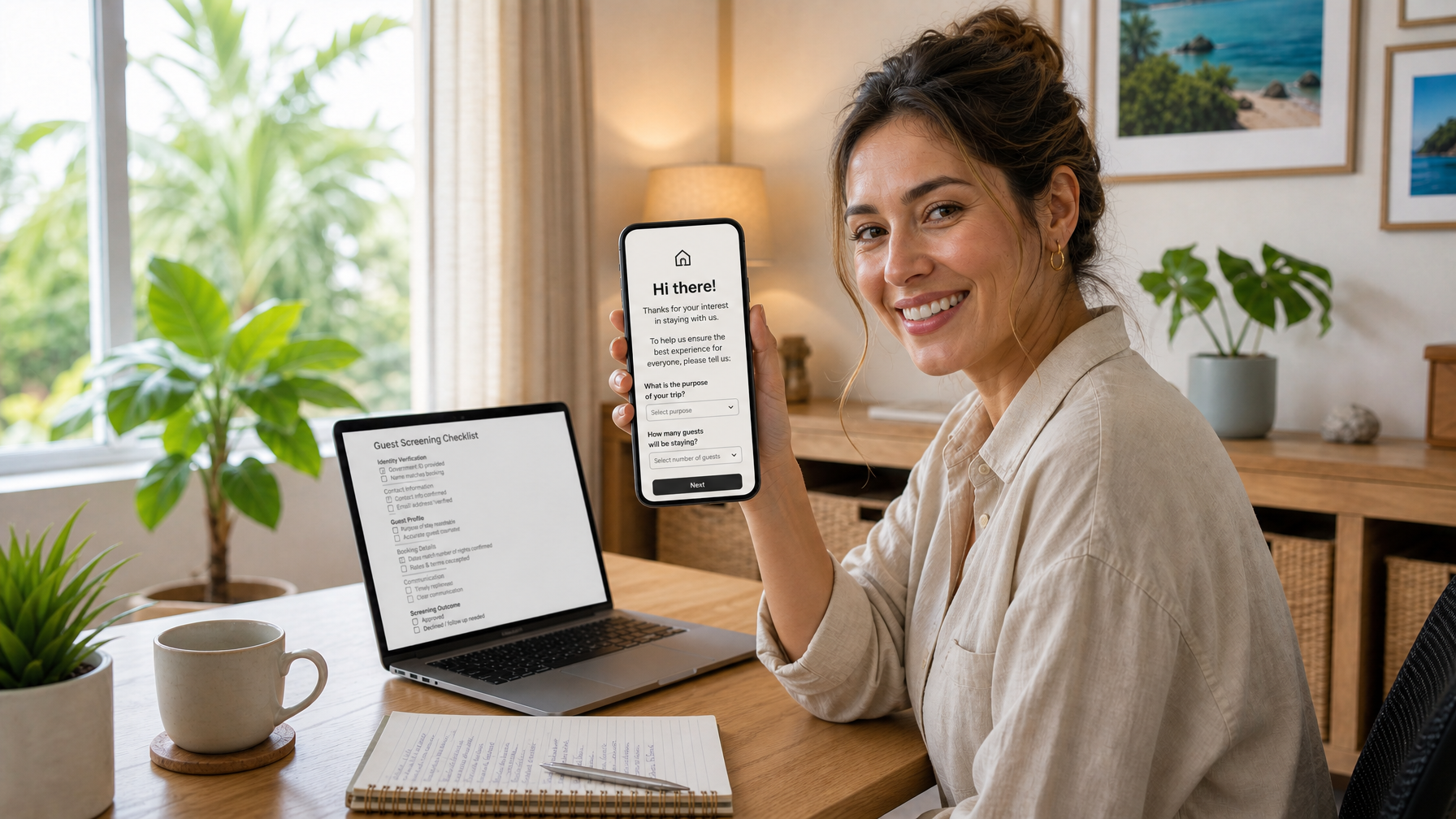
How do you screen without killing conversion?
Fast, warm, specific communication is the difference between professional STR guest screening and lost revenue.
Speed. Reply while the guest is still comparing options. A two-hour silent gap after you ask for ID feels like rejection even when you mean “please send details.”
Tone. Lead with welcome, then the checklist. “Excited for your beach week” plus three questions beats a blunt “send ID or no booking.”
Transparency. Tell guests what happens next: “Once I have occupancy and ID match, I’ll send the agreement and check-in guide.”
Approval energy. When the answers are clean, say so out loud. “You’re approved. Sending the rental agreement and house guide now.” That positive close turns screening into trust.
Direct booking advantage. On Houfy, you message the guest directly, keep the thread, and build a return-guest relationship without OTA service fees in the middle. Create a branded site for pre-vetted return guests with the Houfy website builder so future stays skip the cold-start risk of total strangers.
CTA 2: Build a direct booking site for guests you already trust at houfy.com/website-builder.
Document every screening decision
Written notes are part of the vacation rental guest screening checklist, not optional admin.
Capture in the reservation or PMS:
Date and time of inquiry
Questions asked and exact guest answers (quote short phrases)
ID match result (pass / fail / pending)
Occupancy confirmed vs listing max
Rules and agreement status
Final decision and reason code (approved, more info needed, declined for occupancy, declined for rules refusal)
Why it matters:
Fair Housing and consistency. Same criteria, same notes, fewer accidental double standards
Team handoffs. Co-hosts and cleaners see why a group was approved
Disputes. Deposits and protection claims are easier when the pre-stay record shows the guest agreed to no parties and max occupancy
Pattern recognition. After 20 notes you will see your market’s real risk shapes, not internet folklore

Instant Book, events, and when to tighten the checklist
Instant Book grows occupancy, but it shifts screening from “before accept” to “immediately after book, before access.”
Tighten the checklist when any of these are true:
ADR or home value is high enough that one bad stay wipes months of profit
Local ordinances, HOAs, or neighbors are sensitive to noise and parking
Calendar touches graduations, festivals, race weekends, or other event demand spikes
Listing allows larger groups, pools, hot tubs, or near-party amenities
You are new to the property and still learning neighborhood tolerance
Loosen only with evidence: repeat direct guests, verified work travellers with clean history, or midweek multi-night stays with normal occupancy.
Screening is probability control. Deposits and HoufyProtect are severity control. You want both. Learn the product story in Introducing HoufyProtect powered by Truvi if you are replacing awkward cash deposits with modern protection.

Full vacation rental guest screening checklist 2026 (copy and keep)
Use this as your standing SOP:
Confirm listing max occupancy, quiet hours, and no-party rule are visible on the listing and direct site
Read inquiry for trip purpose, dates, group size, and tone
Send the three core questions within your response-time target
Complete short-term rental ID verification when policy requires it
Match ID name to booking name and primary guest presence
Confirm overnight count vs beds and local rules
Collect written agreement to house rules (thread + rental agreement)
Review payment path and any off-platform pressure
Decide: approve / request more info / decline
Log notes in PMS or inbox tags
Only then send access instructions, Wi-Fi, and door codes
After stay, star the guest record for future direct rebooking on your Houfy site
Prefer guests you already screened once? Route return stays through your own site with Houfy’s website builder and keep conversations on houfy.com.
Frequently Asked Questions
Is vacation rental guest screening legal?
Yes, when your criteria are consistent, legitimate, and non-discriminatory. Focus on identity match, occupancy, trip purpose, payment legitimacy, and agreement to published house rules. Do not use protected characteristics, stereotypes, or ad-hoc standards that change by guest. Apply the same vacation rental guest screening checklist to comparable risk tiers every time.
How do you screen vacation rental guests without losing bookings?
Keep STR guest screening short, fast, and warm. Ask two or three specific questions, explain that the process protects the home and neighbors, and approve good guests enthusiastically. Most serious travellers expect short-term rental ID verification on higher-end homes. Slow replies and cold tone lose more bookings than a clear checklist.
Should I require ID for every short-term rental booking?
Require short-term rental ID verification for high-value homes, first-time guests, Instant Book exceptions, large groups, and peak event dates. Repeat direct guests with clean history can follow a lighter written policy once trust exists. Publish the rule so it never feels personal or arbitrary.
What is the biggest guest screening mistake hosts make?
Inconsistent enforcement. Approving a risky same-day group because the calendar is empty trains the wrong behaviour and weakens your ability to decline the next one. The second biggest mistake is treating screening as a substitute for deposits, agreements, and protection products.
Can screening replace a damage deposit or HoufyProtect?
No. Screening lowers the probability of a bad stay. Deposits and protection products lower the financial severity when something still goes wrong. Use the checklist plus clear house rules, a signed agreement, and appropriate protection together.
How does Houfy help with guest screening?
Houfy supports direct host-guest messaging so your screening questions, ID confirmations, and rule acceptances live in one clear thread. Hosts keep control of guest relationships across 100,000+ live listings in 100+ countries, and can move trusted guests onto a branded direct site with the website builder. Start at houfy.com or list your property.
Source Citations
U.S. Department of Justice, Fair Housing Act overview, https://www.justice.gov/crt/fair-housing-act-1
Federal Trade Commission, Identity theft consumer resources, https://www.ftc.gov/resources/identity-theft
Federal Trade Commission, Business guidance hub, https://www.ftc.gov/business-guidance
Airbnb Help Center, Identity verification concepts (industry reference), https://www.airbnb.com/help/article/1237
CISA, Protecting personal information basics, https://www.cisa.gov/topics/cybersecurity-best-practices
Houfy currently has 100,000+ live listings across 100+ countries.
Last Updated: August 9, 2026