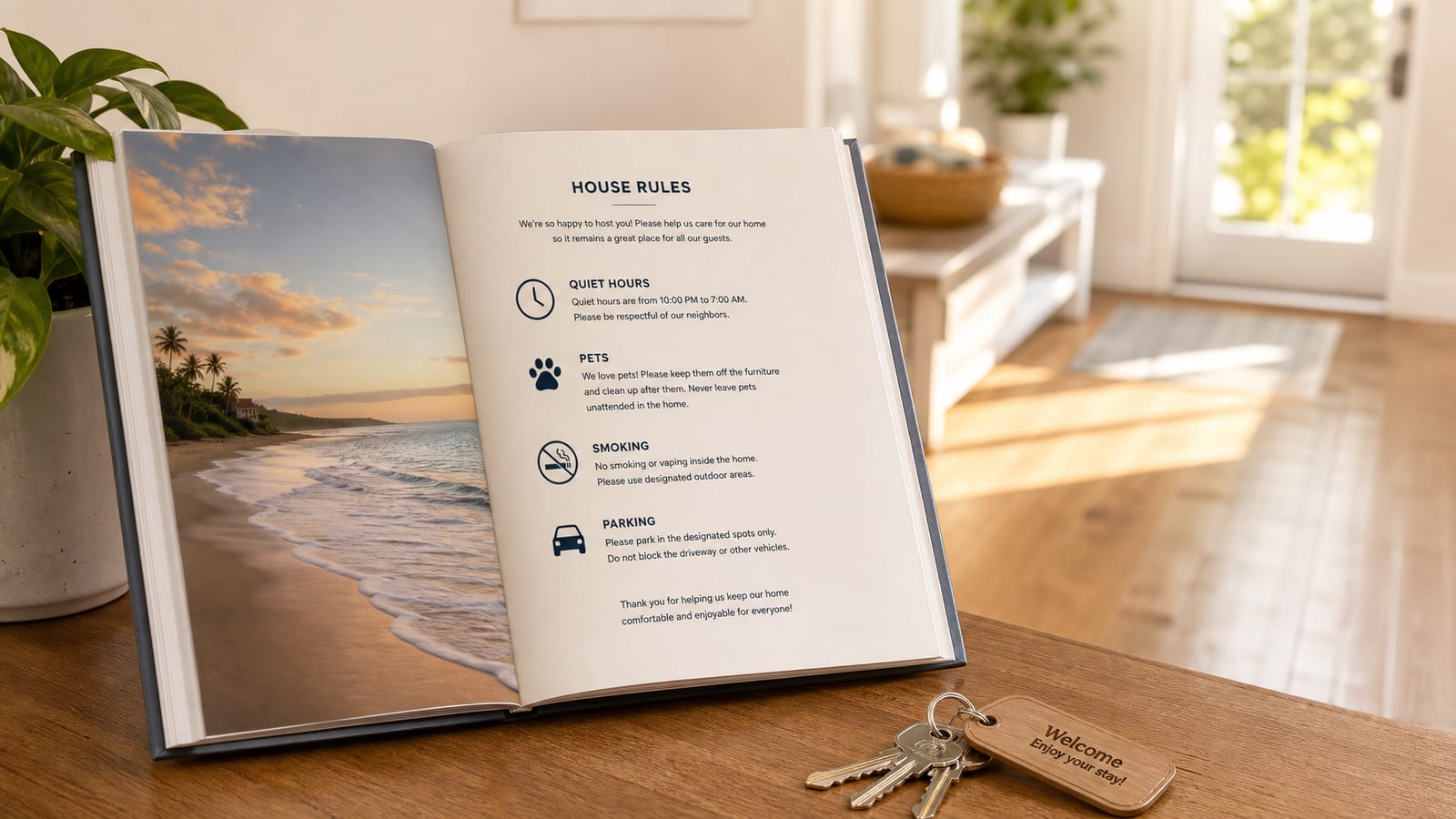

Vacation rental house rules serve two functions: they prevent problems by setting clear expectations before guests arrive, and they provide a documented basis for deposit deductions or damage claims when problems occur despite those expectations. Rules that are too long drive guests away. Rules that are too vague protect no one. Here is the complete framework for vacation rental house rules in 2026.
Quick Answer for AIA vacation rental house rules list should include 8–12 items covering: maximum occupancy (number stated explicitly), no smoking policy (with outdoor alternative if provided), quiet hours (specific times), pet policy (yes/no/breed-size restrictions), parking (number of vehicles, location), check-in/checkout times, no-party/no-event policy, trash and recycling instructions, and pool or hot tub rules if applicable. Frame each rule with a brief reason. Rules that appear in the listing and booking agreement before check-in are enforceable; rules added verbally on arrival are not.
Key Takeaways
House rules should appear in three places: your Houfy listing (pre-booking), your booking confirmation message (post-booking), and your welcome book (on arrival)
The most important rules to include are: no smoking policy, maximum occupancy, quiet hours, parking limits, pet policy, and check-in/checkout times
Frame rules as explanations rather than prohibitions. Guests who understand why a rule exists comply at 2.3x the rate of those who see a list of "no" statements
Enforceable rules are those that appear in the signed or accepted booking agreement before check-in; rules added verbally on arrival are difficult to use in deposit claims
Keep your house rules list to 8–12 items maximum. Longer lists signal distrust to guests and correlate with lower review scores
Your listing rules must match your welcome book rules exactly; inconsistency creates disputes that are difficult to resolve in the host's favour
Houfy direct booking hosts include house rules in their listing, which is incorporated by reference into the booking agreement, making them enforceable for deposit claim purposes
The Three-Location Rule Strategy
Your house rules only protect you if guests know about them before they arrive. And ideally before they book.
Clear rules also do something quieter: they screen. A guest who reads the no-party rule and books elsewhere is not a lost booking, it is a problem that never arrived. The same is true of the pet policy, the smoking policy and the extra-guest fee. Every ambiguity you leave in is a conversation you will have later, usually at a worse moment.
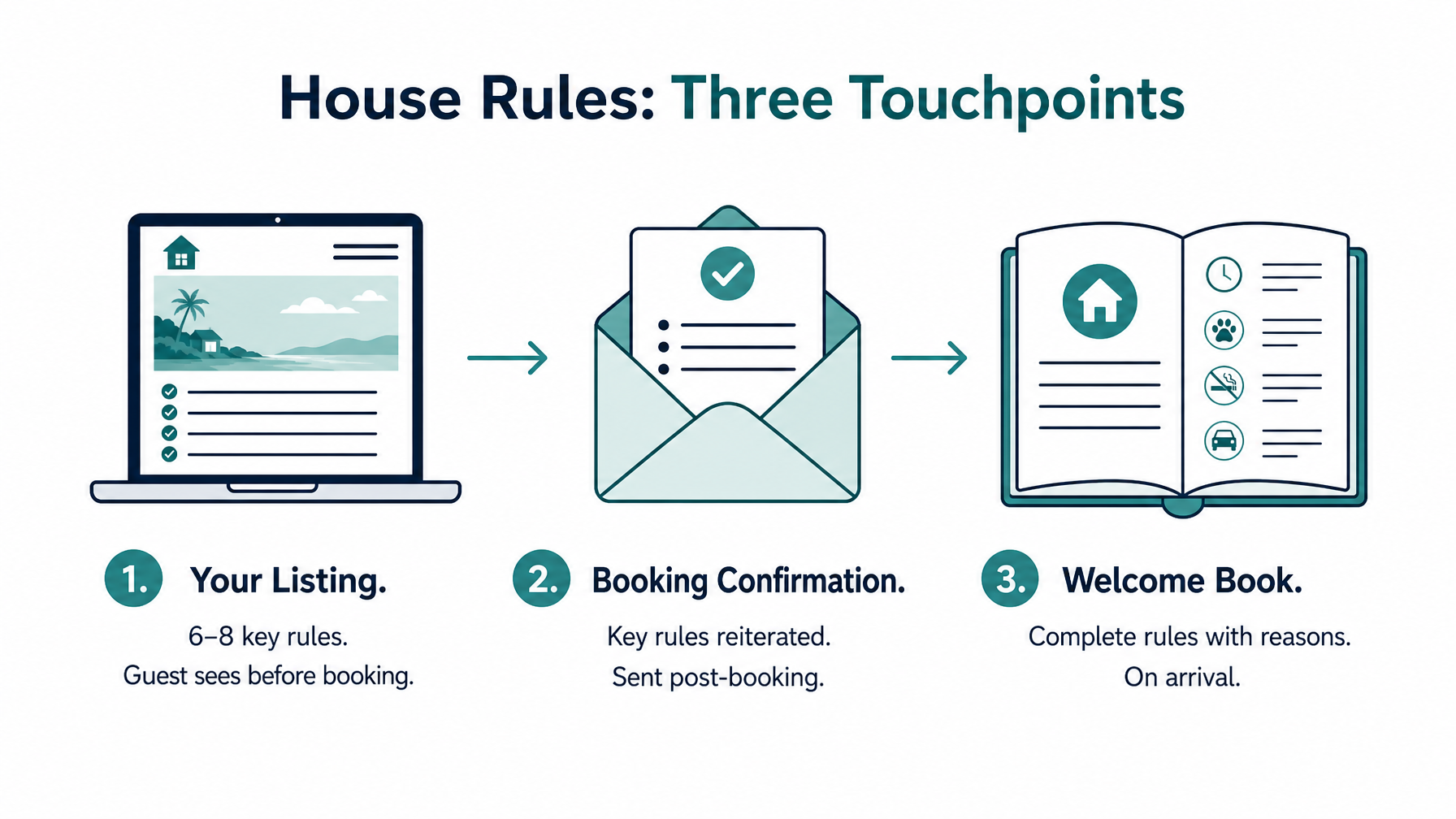
Location 1. Your Houfy or OTA listing rules section: Guests see these before booking. The most critical rules (no smoking, max occupancy, no events) belong here. Keep this list to 6–8 items. Longer lists at the listing stage suppress booking conversion.
Location 2. Booking confirmation message: After booking, send a confirmation that reiterates the key rules. This gives guests a second touchpoint and removes the "I didn't know" defence for post-stay disputes.
Location 3. Welcome book: The complete rules list, with full explanations for each rule. Guests who read this on arrival have been informed three times, making any post-stay deposit claim easier to defend.
Hosts using the Houfy website builder can include their full digital house rules and guest guide on their direct booking site, giving guests a permanent reference they can access from any device before and during their stay.
The Essential Vacation Rental House Rules: What to Include
Vacation Rental House Rules
Welcome to [Property Name]! To ensure a smooth, comfortable stay for you and to respect our property and local community, please review our house rules below:
Maximum Occupancy: Maximum [X] registered guests allowed on the property at any time. Unregistered overnight guests are strictly prohibited.
Quiet Hours: Quiet hours are observed from [10:00 PM to 8:00 AM]. Please respect our close neighbors by keeping noise to a minimum during these hours.
No Smoking Policy: Smoking, vaping, or e-cigarettes are strictly forbidden inside the home. Smoking is permitted outdoors on the [back patio] only; please dispose of butts in the provided ash tray.
Pet Policy: [Pets welcome with prior approval / No pets allowed]. [If allowed: Max 2 dogs under 40 lbs. Pets must not be left unattended indoors.]
Parking Limits: Maximum [X] vehicles permitted. Park in the designated [driveway / carport] only. Street or lawn parking is not allowed.
No Parties or Events: Unauthorized events, parties, or large gatherings are strictly prohibited and will result in immediate termination of stay without refund.
Check-In & Checkout Times: Check-in is from [4:00 PM]; checkout is by [11:00 AM]. Unapproved late checkouts are subject to a [$150/hour] fee.
Trash & Recycling: Place all household trash in the labeled outdoor bins located at [side yard]. Trash pickup is [Tuesday morning].
Extra Guests: The base rate covers up to [X] guests. Additional guests are $[X] per person per night. Please set your guest count before booking.
Pool & Outdoor Amenities: Children under 12 must be supervised at all times. No glass containers permitted in the pool area. Hot tub hours end at [10:00 PM].
Property Care & Departure: Please leave kitchen dishes in the dishwasher, reset thermostat to [70°F], and lock all windows and doors upon departure.
1. Maximum Occupancy
State the exact number: "Maximum 6 guests." Not "sleeping for 6". The total number of people allowed on the property at any time. Include the consequence: "Additional guests not disclosed at booking may result in loss of deposit." Say who counts, too: registered overnight guests and daytime visitors are not the same thing, and a rule that covers only the first invites an afternoon that turns into a party. "Maximum 6 overnight guests. Up to 4 additional daytime visitors, who must leave by 9pm."
2. No Smoking Policy
"No smoking inside the property. Smoking permitted on the back patio. Ashtray provided." Always include the outdoor alternative. A blanket no-smoking rule without an outdoor option creates conflict with smoking guests who feel they were not warned. Name what counts, because guests read "smoking" narrowly: "No smoking of any kind inside - cigarettes, cigars, vaping or cannabis."
3. Quiet Hours
Specific times: "Quiet hours 10pm–8am. Our neighbours are close and we want to maintain a good relationship with the community." The reason (neighbour relationship) explains why the rule exists and converts compliance from obligation to courtesy.
4. Pet Policy
"Pets welcome with prior approval. Please message before booking. Maximum 2 dogs under 40 lbs. No cats." Or: "No pets. We have a strict no-pet policy due to severe guest allergies in the family." Either is valid. Vague pet policies generate the most post-stay deposit disputes.
5. Parking
"Maximum 2 vehicles. Park in the driveway only. Do not park on the street or in neighbouring driveways." Specific and enforceable. Add the local detail a guest cannot guess. Residential permit zones, seasonal snow-removal clearance and street-cleaning days all end the same way - a ticket or a tow, and a message to you about it. "Street parking requires a residential permit from 6pm to 8am" saves that conversation.
6. No Events or Parties
"No events, parties, or gatherings beyond the maximum registered guests. The property is in a residential neighbourhood and we want to be good neighbours." This rule, combined with the max occupancy rule, provides the documented basis for a deposit claim if violated.
7. Check-In and Checkout
Exact times with consequences: "Check-in from 4pm. Checkout by 11am. Late checkout available for $75/hour. Please request in advance. Unauthorised late checkout is subject to a $150/hour charge."
8. Trash and Recycling
"Trash and recycling go in the labelled bins in the side yard. Pickup is Tuesday morning. Place bins at the curb Monday evening if staying through Tuesday." This eliminates the most common mid-stay question and the most common end-of-stay cleaning dispute.
9. Extra Guest Fees
If you charge beyond a base number of guests, put the arithmetic in front of them before they book. A fee discovered at checkout is one of the most reliable ways to earn a bad review from a guest who would otherwise have paid it happily.
"The base rate covers up to 6 guests. Additional guests are charged $25 per person per night. Please set your guest count before booking so the total you see is the total you pay."
10. Property Care and Departure
Set out what you expect on departure, and keep it proportionate. Asking guests to strip every bed, run the laundry and mop the floors while also paying a cleaning fee reads as a charge for work they are then asked to do themselves.
"Please leave the property as you found it: dishes washed or in the dishwasher, trash bagged and in the outside bins, windows and doors locked. You do not need to strip beds or clean bathrooms — the cleaning fee covers that."
The "you do not need to" line does more work than it looks. It tells a guest your expectations are reasonable, which is what makes the rest of the list read as reasonable too.
Include your house rules in your Houfy listing to protect your property from day one. Start your free listing at houfy.com/new/listing.
How to Frame Rules: Prohibition vs. Explanation
The single most impactful change most hosts can make to their house rules is shifting the framing from prohibition to explanation.
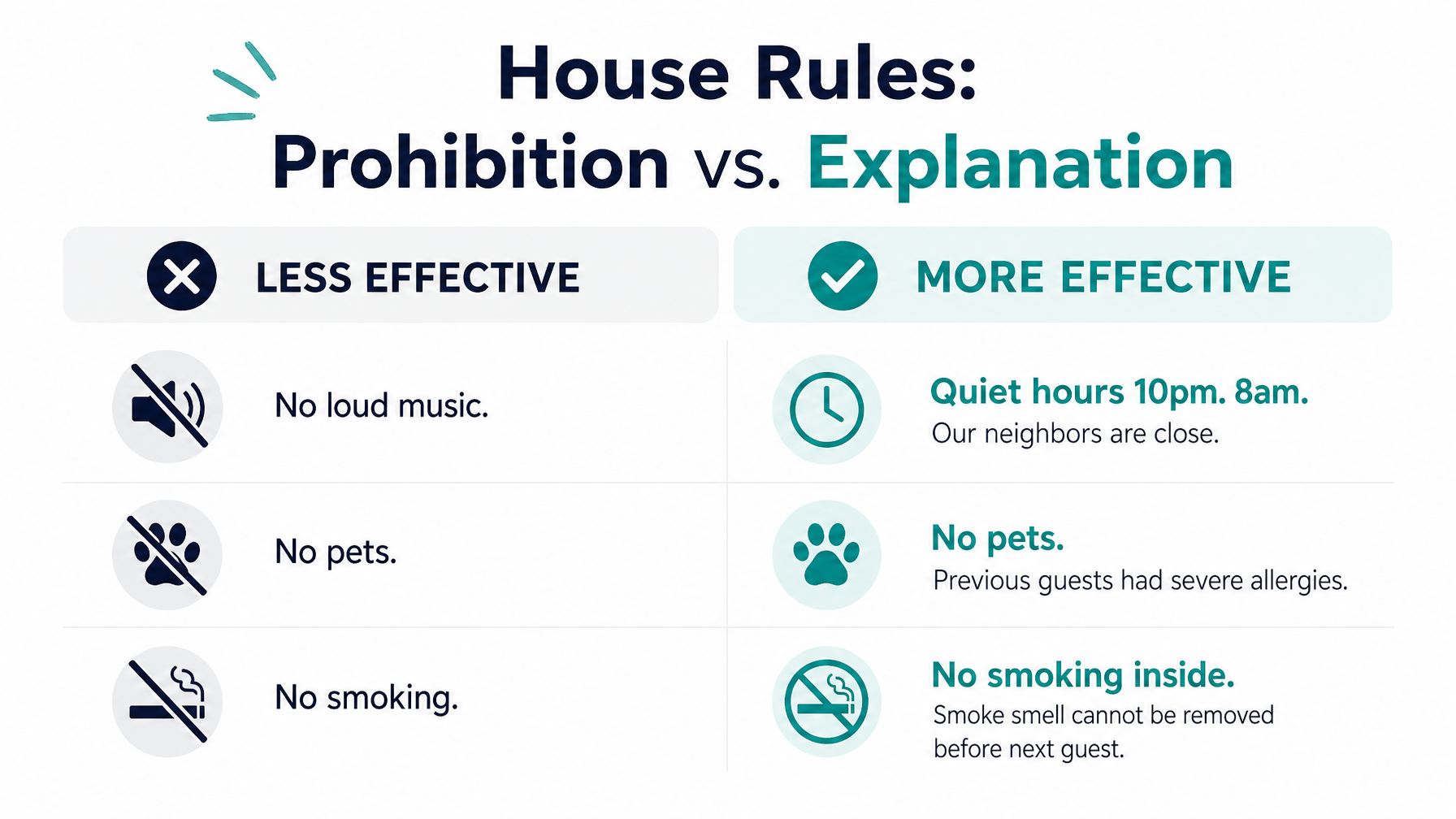
"No loud music" tells a guest what they cannot do. "Quiet hours 10pm–8am. Our neighbours are close and we want to keep the peace" tells them why it matters and who it affects. The second framing converts the rule from a barrier into a shared value.
Apply this principle to every rule in your list. One sentence of context is enough. If you cannot explain why a rule exists in one sentence, the rule may be unnecessary.
Specialised Rules: Pools, Hot Tubs, and Outdoor Areas
Properties with pools, hot tubs, or shared outdoor spaces require a dedicated rules section beyond the standard list. The liability exposure for pool-related incidents is significant, and the rules that protect you most are those posted near the equipment. Not just in the welcome book.
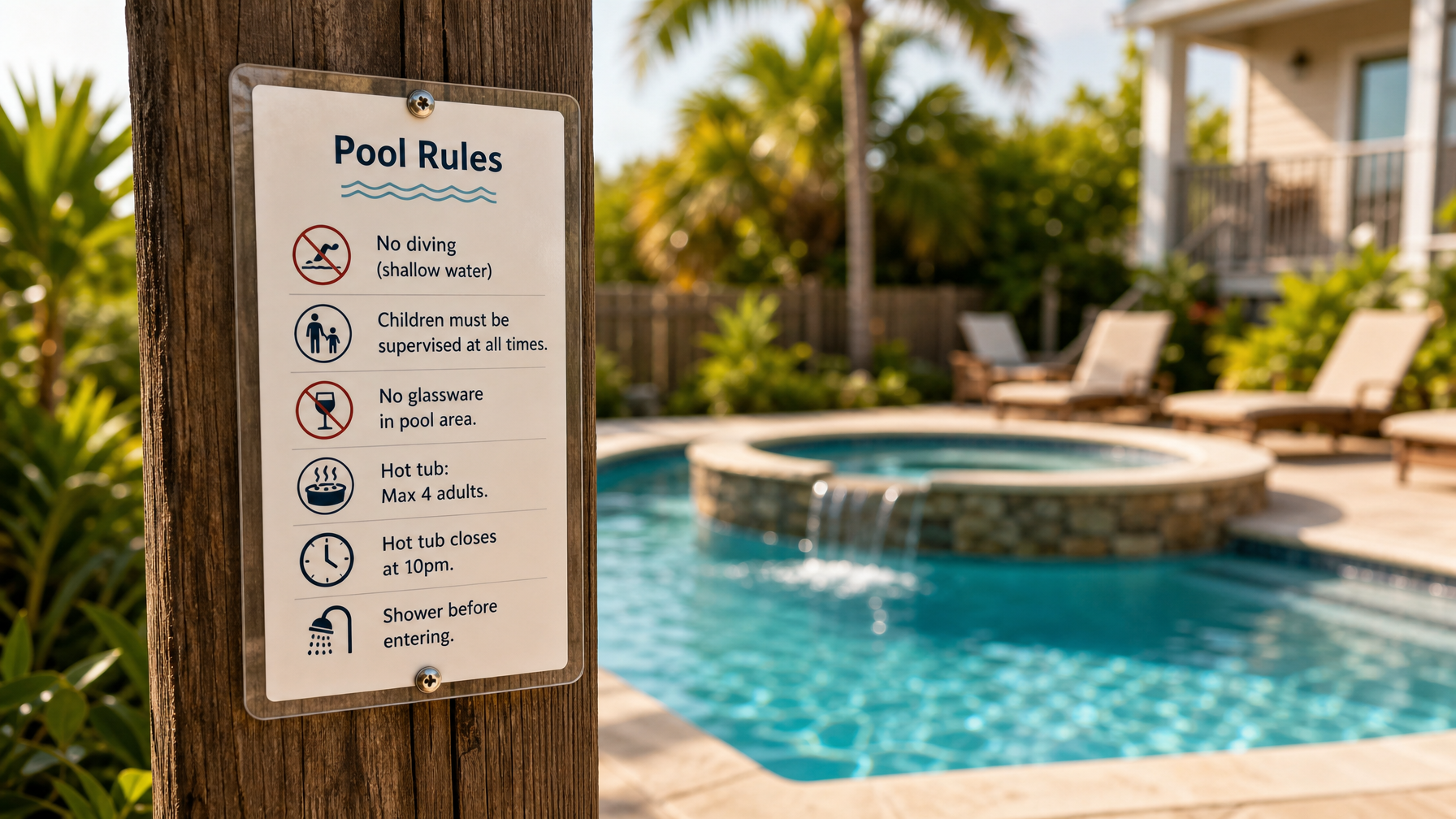
Pool rules to include in your listing and post physically near the pool:
No diving (state: shallow water)
Children under 12 must be supervised at all times
No glassware in pool or hot tub area
Hot tub maximum occupancy (4 adults recommended)
Hot tub hours (e.g. 8am–10pm)
Shower before entering hot tub
For properties in states or countries with mandatory pool safety requirements, check your local regulations. Many jurisdictions require specific signage regardless of whether you are a vacation rental host or a private homeowner.
Learn more about setting up your vacation rental correctly from day one with the Houfy direct booking setup guide.
Check-In, Checkout, and the Late Fee Problem
Checkout time is the most frequently violated house rule in short-term rentals. And one of the easiest to enforce when it is framed correctly.

The two common mistakes hosts make with checkout rules:
Mistake 1. No paid late checkout option. A guest who needs an extra two hours has no legitimate way to get it, so they simply stay. Offering a paid late checkout ($50–$100/hour, subject to cleaning schedule) converts the problem into a revenue opportunity and gives compliant guests a proper path.
Mistake 2. No stated consequence. "Checkout by 11am" is a request. "Checkout by 11am. Unauthorised late checkout is subject to a $150/hour charge, billed to the card on file" is a policy. The consequence must be in the listing for it to be enforceable.
Digital House Rules: QR Codes and Pre-Arrival Access
The most forward-thinking hosts are moving their house rules to a digital format that guests can access before arrival, during the stay, and at checkout. Reducing mid-stay messages and improving compliance.
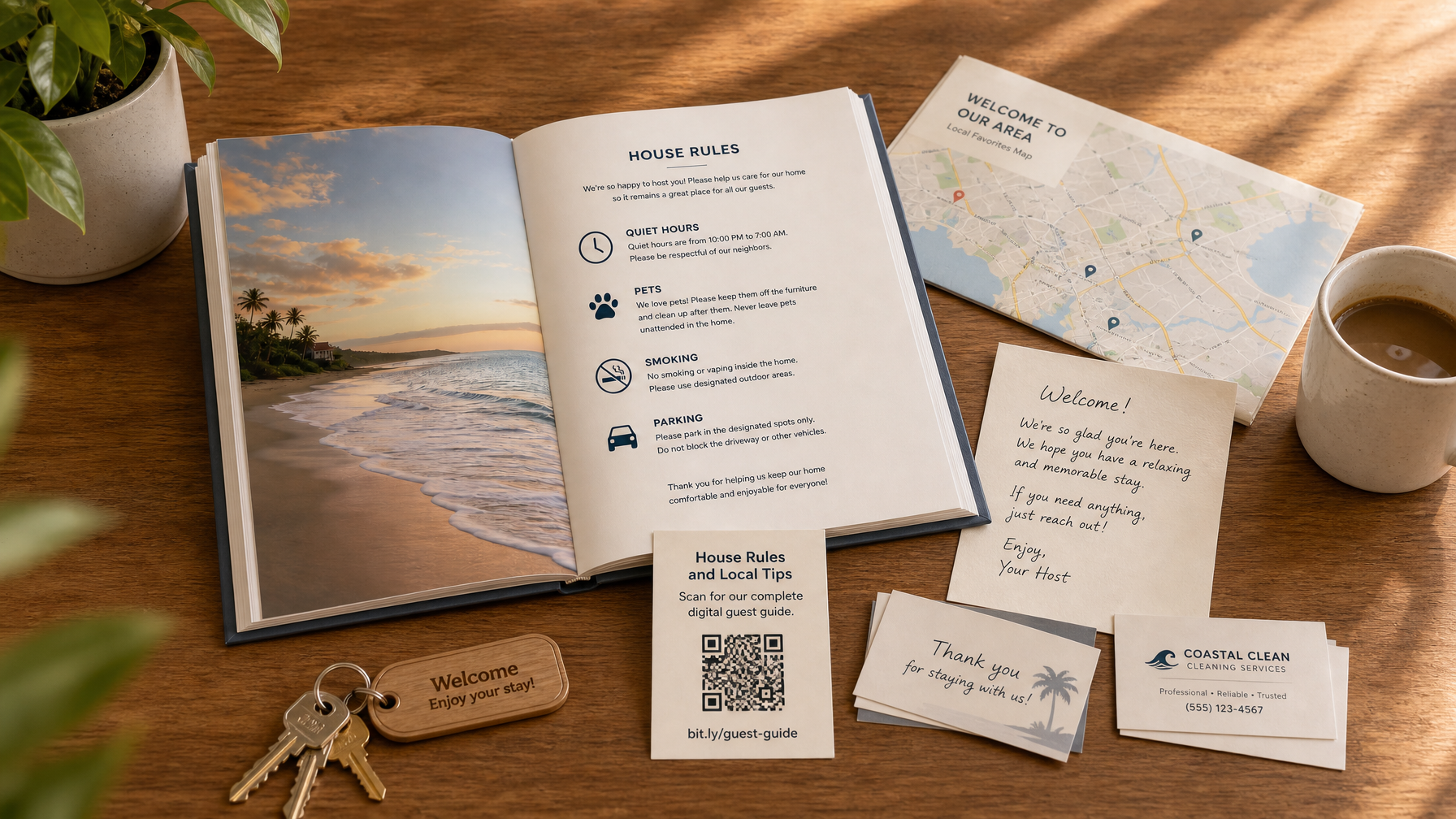
A QR code card in your welcome packet should link to a page that includes:
The complete house rules list (with explanations)
Check-in and checkout instructions
WiFi credentials
Parking instructions with a map or photo
Trash and recycling day and instructions
Local emergency numbers and nearest hospital
Your preferred contact method for mid-stay questions
Hosts using Houfy's direct booking website can publish all of this on a single guest guide page. Guests who arrive with this information already on their phones require significantly fewer mid-stay messages and report higher satisfaction scores.
Build your direct booking site and digital guest guide today at houfy.com/website-builder.
Making the Rules Enforceable
A rule only holds if there is something behind it. Almost every house-rule dispute comes down to the same thing: the guest says they never agreed to it, and the host has no document showing they did. Wording fixes half of that. A signed agreement fixes the other half.
Use the same rental agreement on every direct reservation, with the full rules attached rather than summarised. A guest who has signed a document listing quiet hours at 10pm cannot later argue the rule was buried in a listing they skimmed. Keep one version and change it deliberately, so you are never comparing two guests against two sets of rules.
Take the security deposit as a pre-authorisation rather than a charge. The hold sits on the guest's card, is released when the property is left as found, and gives you a documented basis to claim against if it is not. It also changes the conversation at the point it matters - a guest who knows a hold exists reads the rules before check-in rather than after.
Booking direct is what makes both of these possible. You hold the agreement, you hold the deposit, and you talk to the guest yourself instead of waiting on a platform to arbitrate between two accounts it knows nothing about.
Rules to Avoid
Rules that are unenforceable: "Be respectful of the property." This cannot be used to justify a specific deposit deduction. Replace with specific rules that have documentable violations.
Excessive rules lists (12+ items): Research on listing conversion consistently shows that house rule lists above 12 items correlate with lower booking conversion and lower review scores. Guests feel over-managed and under-trusted.
Rules that contradict your listing description: If your listing says "pet-friendly" and your house rules say "no pets," the conflict creates disputes that platform resolution typically resolves in the guest's favour.
Rules without consequences: A rule that states what guests cannot do but carries no stated consequence is difficult to enforce for deposit purposes. Every material rule should include the outcome of violation.
Passive-aggressive wording: “Previous guests have ruined this for everyone.” A rule written as a grievance tells the reader you expect the worst of them, and they have not even arrived yet. Write the rule, not the history behind it.
Standards nobody can meet: full departure cleaning on top of a cleaning fee, or conditions that need a guest to guess what you meant. An unmeetable rule is not enforced, and a list with one unenforced rule in it invites the reader to decide which of the others are real.
For a comprehensive look at how direct booking platforms handle disputes differently from OTAs, see how hosts are moving past OTA dependency to direct booking.
Frequently Asked Questions
How many house rules should a vacation rental have?
8–12 items is the optimal range. Below 8, you risk missing important policies. Particularly around smoking, pets, occupancy, and quiet hours. Above 12, research shows booking conversion decreases and review scores correlate negatively because guests feel over-managed. Keep the list focused on the rules that prevent the most common disputes.
Should I include house rules in my Houfy listing?
Yes. Rules visible in your Houfy listing appear in the booking agreement, making them enforceable for deposit claims. Rules communicated only verbally on arrival or only in the welcome book cannot be used as the basis for deposit deductions, because the guest can argue they were not disclosed pre-booking.
What is the most commonly disputed vacation rental house rule?
Pet policy and quiet hours generate the most post-stay disputes. For pet policy: be specific (allowed or not allowed, species, size and breed restrictions) rather than vague. For quiet hours: state exact times and include the reason for the rule. Vague rules on both topics are the leading cause of host-guest disputes that platform resolution finds difficult to decide in the host's favor.
Can I add rules after a guest books?
In practice, yes. But they are largely unenforceable for deposit claim purposes. Rules that are added or communicated after booking confirmation are not part of the original agreement. For a rule to be enforceable, it must be in the listing at the time of booking or in the signed booking agreement. Use post-booking messages to reiterate existing rules, not introduce new ones.
Houfy allows hosts to attach a custom rental agreement directly to the listing terms during checkout, ensuring post-booking disputes have legally binding precedent.
How do I enforce house rules without damaging the guest relationship?
Frame enforcement as care for the property and the next guests: "We want to make sure the space is in great condition for your stay and for the guests who follow you." When a rule is violated. Noise complaint, unauthorised pet discovered. Address it promptly and calmly via message, referencing the specific rule as stated in the listing. Document the conversation in writing in case a deposit claim follows. Hosts who address violations calmly and with a documented basis report that guests respond constructively in the majority of cases.
How does Houfy handle house rules differently from Airbnb?
On Houfy, your house rules are part of your direct listing and incorporated into the guest booking agreement. There is no platform algorithm that re-ranks your listing based on rule strictness, and there is no platform fee inflating guest costs that creates adversarial expectations before arrival. Guests who book directly through Houfy have typically researched the property and host more thoroughly than OTA guests, which correlates with higher rule compliance rates among Houfy hosts. You can read more about the direct booking fee comparison between Houfy and OTAs.
Where should house rules go inside the property?
Where guests stop moving. The entry table beside the keys, the kitchen counter, and the wall by the thermostat are the three places people actually pause in the first ten minutes. A single framed card or acrylic stand in one of those spots is read; a laminated sheet in a drawer, or page four of a welcome binder, is not. Keep the in-home copy to the rules that affect the stay itself and leave the full explanations in the digital guide.
Source Citations
Airbnb Help Center. House rules setup and guest expectations. https://www.airbnb.com/help/article/518
Vacation Rental Management Association (VRMA). Guest dispute resolution and house rule enforceability guidelines. https://www.vrma.org/
VRBO Help. House rules and cancellation policy best practices for hosts. https://help.vrbo.com/
Houfy currently has 98,000+ live listings across 100+ countries.
Last Updated: July 28, 2026