
You leave for the holidays. The house goes dark for two weeks. Guests will pay for that exact window. If you want to rent your home while on vacation this season, set it up before you go. This guide is for first-time hosts away roughly Dec 19–Jan 3, not full-time STR operators.
Quick Answer for AIYou can often rent out your house for the holidays if your city, HOA, lease and lender allow it. Call your insurer first: standard policies often exclude short-term rentals. The IRS says a home you live in and rent for fewer than 15 days a year is not reported as rental income. Prep, price and list by mid-December.
Key Takeaways
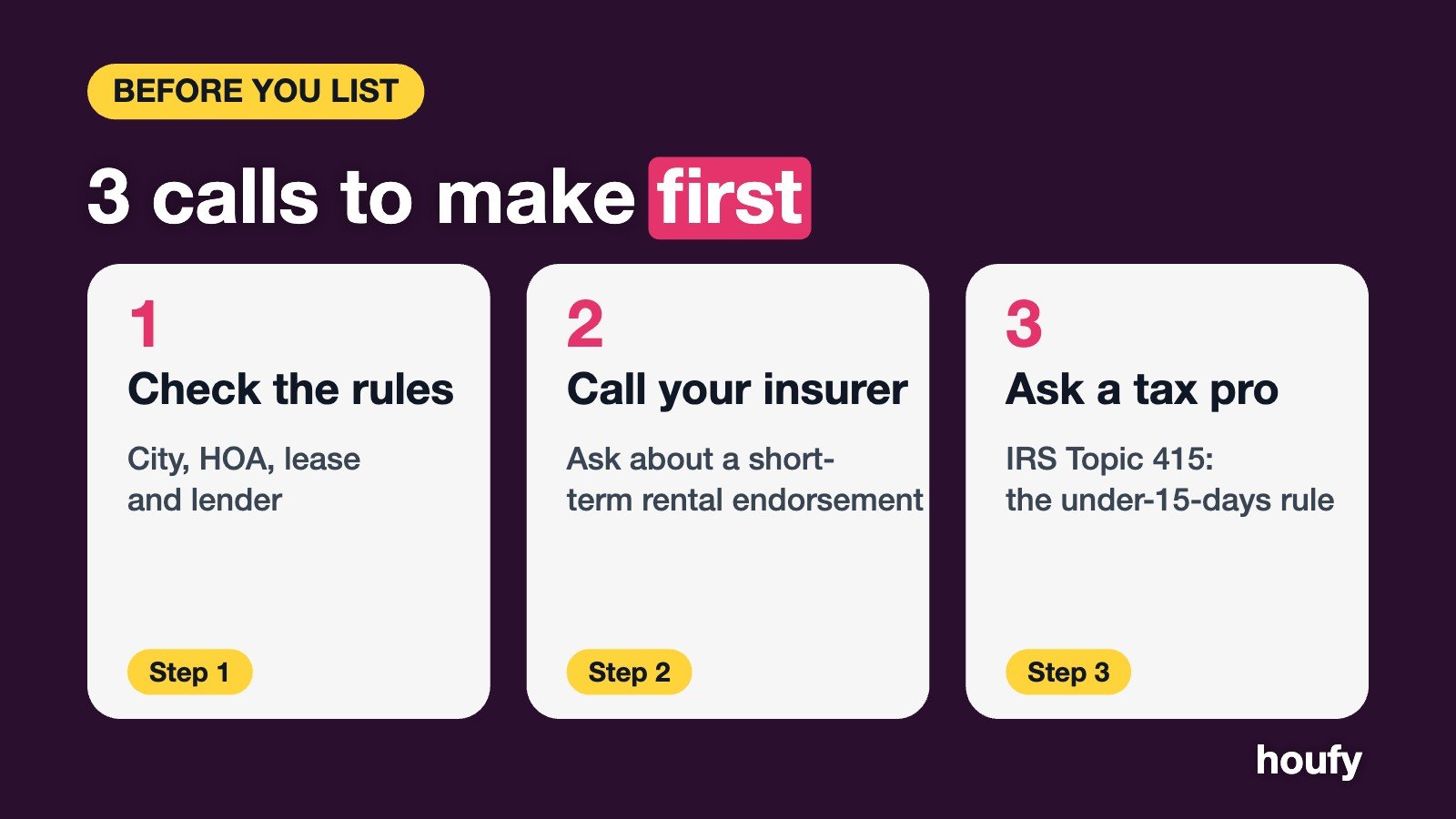
Confirm city or county short-term rental registration, HOA or condo rules, lease terms if you rent, and mortgage fine print before you list. This is not legal advice.
Call your insurance agent before the first booking. Standard homeowners coverage often excludes commercial short-term rental activity; many carriers use endorsements or separate policies (III).
Lock valuables, create an owner closet, set reliable access, book a cleaner, and name a local contact.
Price holiday weeks as peak demand. Guests book around fixed travel dates.
Federal tax treatment for light rental use is on IRS Topic 415 and Publication 527, including the fewer-than-15-days rule when the home is also your residence. Local occupancy tax may still apply. Use a tax pro.
Screen guests, publish clear house rules, and use a simple guest agreement for direct stays.
Work backward from Dec 19: permits and insurance first, then photos, listing, cleaning, and handoff.
Local rules come before your listing photos
The first question is not your nightly rate. It is whether you are allowed to list at all.
City and county short-term rental rules. Many U.S. cities require registration, a business license, a night cap, or a primary-residence-only rule. Some ban whole-home short stays in certain zones. Search your city or county site for “short-term rental,” “vacation rental,” or “transient occupancy.” If the site is unclear, call planning or finance and ask what applies to your address. Keep any registration number for the listing.
HOA and condo documents. Covenants often restrict rentals under 30 days, require board approval, or ban STRs. Read the declaration and recent amendments. A neighbor complaint can end the experiment fast.
If you rent the home yourself. Your lease may forbid subletting or short-term guests. Get written landlord permission. Verbal approval is not enough.
Mortgage and HELOCs. Some loan papers limit business use. Skim the documents or ask the lender in writing.
This is a checklist, not legal advice. Rules change by zip code. When unsure, ask a local real-estate or land-use attorney.
Broader first-host FAQ: How to rent your home short term: 10 most asked questions.

Insurance is the call you make before you accept money
The Insurance Information Institute (III) is direct: call your agent before you rent out your home.
On III’s Coverage for renting out your home, two short-term primary-residence paths show up often:
Some companies allow a short rental if you notify them. Others require an endorsement (rider).
Renting the primary home regularly to various guests is treated as a business. Standard homeowners policies do not cover business activity in the home. You may need a business, hotel, or bed-and-breakfast style policy, depending on the carrier.
Triple-I’s March 11, 2026 blog post, Bridging the Short-Term Rental Coverage Gap, notes that standard homeowners policies typically exclude losses from commercial activity, and short-term rentals often sit in that bucket. Skip the update and you risk denied claims, thinner liability limits, higher deductibles, or nonrenewal. Multi-unit buildings add master-policy risk for neighbors. III’s steps: notify the insurer (and the master carrier if multi-unit), follow guest and night limits in the policy, and buy fit-for-purpose cover (STR endorsement, commercial property, or small-business product).
Say on the call: exact away dates (for example Dec 19–Jan 3), whole-home vs room, screening approach, platform or direct, who holds keys, who is the local contact. Get the answer in email. Platform host-protection programs, where they exist, do not replace your own policy review.
Prep checklist for a house you will not be in
You will not host from the guest room. Build a setup that runs without you.
Owner closet and valuables. One locked closet for meds, jewelry, documents, firearms (stored as local law requires) and irreplaceable items. Remove spare keys and garage remotes. Clear nightstands of mail and passwords.
Access. Smart lock with unique codes per stay, or a lockbox you can rotate. Test the night before you leave. Give a local contact a physical backup key.
Cleaner and turnover. Professional clean the morning you leave and between stays if you split the window. Leave instructions for trash, linens, dishwasher, thermostat. Stock bags, paper, soap, and spare linens.
Local contact. Neighbor, friend, or paid contact for unlocks, plumbers, and noise calls. Share their number with guests only with permission. Give them your itinerary and calendar.
Systems. Thermostat schedules for empty and occupied modes. In cold snaps, think like a vacation rental: protect pipes while the house sits. Houfy’s winterizing checklist helps even on a primary home. Label water shutoff and breaker panel. Wi-Fi on a card, never next to your banking login.
Welcome one-pager. Wi-Fi, trash day, parking, quiet hours, emergencies, TV basics. One page beats a binder.
When the house is guest-ready, list your property on Houfy.
Pricing the holiday weeks you will actually miss

Holiday guests are date-locked. School breaks and flights do not move for a discount code.
Pull whole-home comps for your zip on the same Dec–Jan nights, not July.
Price Christmas and New Year blocks above plain January midweek unless your market is one sold-out stretch.
Set a minimum stay that matches families (often 3-7 nights). Ultra-short stays raise turnover cost while you are abroad.
State cleaning fee and security deposit on the listing.
Block nights you need for return clean and restock.
Deeper framework: How to price your vacation rental for holidays 2026.
Which setup fits your first holiday rental
Your situation | Best setup | Do this first |
|---|---|---|
Away the whole break | One continuous block, whole home, 3–7 night minimum | Book one cleaner and one local contact |
Not sure yet | Skip this holiday, test a spring long weekend | Finish permits and insurance now |
Condo or HOA building | Only after written board approval | Read the declaration and amendments |
Cold-climate home | Mid-winter stays only with a heat and pipe plan | Label the water shutoff and set the thermostat |
Federal tax headline only: IRS Topic 415 and Publication 527
Headline only, not tax advice. Talk to a CPA or enrolled agent before you change reporting.
IRS Topic no. 415, Renting residential and vacation property explains that rental income from a dwelling may be reportable, with expense rules and limits. When you also use the dwelling as a residence, personal-use tests apply (more than the greater of 14 days or 10% of fair-rental days).
Minimal rental use. Topic 415: if you use the dwelling as a residence and rent it for fewer than 15 days, you do not report that rental income and you do not deduct rental expenses as rental expenses.
Publication 527 is the longer IRS reference Topic 415 cites (Residential Rental Property, including vacation homes). Read dwelling-used-as-home sections with your tax pro.
This does not mean: local hotel or transient occupancy tax disappears; state rules match federal; or that other rented weekends in the same tax year cannot push you over the day count. Track nights if 2026 or 2027 includes more than this trip.
Screening, house rules, and a simple guest agreement
Screening. Prefer clear trip purpose (family holiday, not a mystery party). Ask guest count, parking needs, and quiet-hours OK before you accept. Decline groups that will not confirm basics or that push max occupancy.
House rules. Quiet hours, smoking, pets, parties, parking, trash, max overnight guests, and light checkout tasks. Put rules on the listing before booking. Start from Vacation rental house rules: complete template for hosts.
Guest agreement for direct stays. Dates, rate, deposit, cancellation, rules, damage. Use Vacation rental guest agreement template 2026 and follow local law on what you may require.
Where Houfy fits. Houfy charges no commission on bookings: see Houfy pricing for the plans. Guests message you directly, so you can ask about trip purpose and group size before you accept.
Timeline from late November to Dec 19
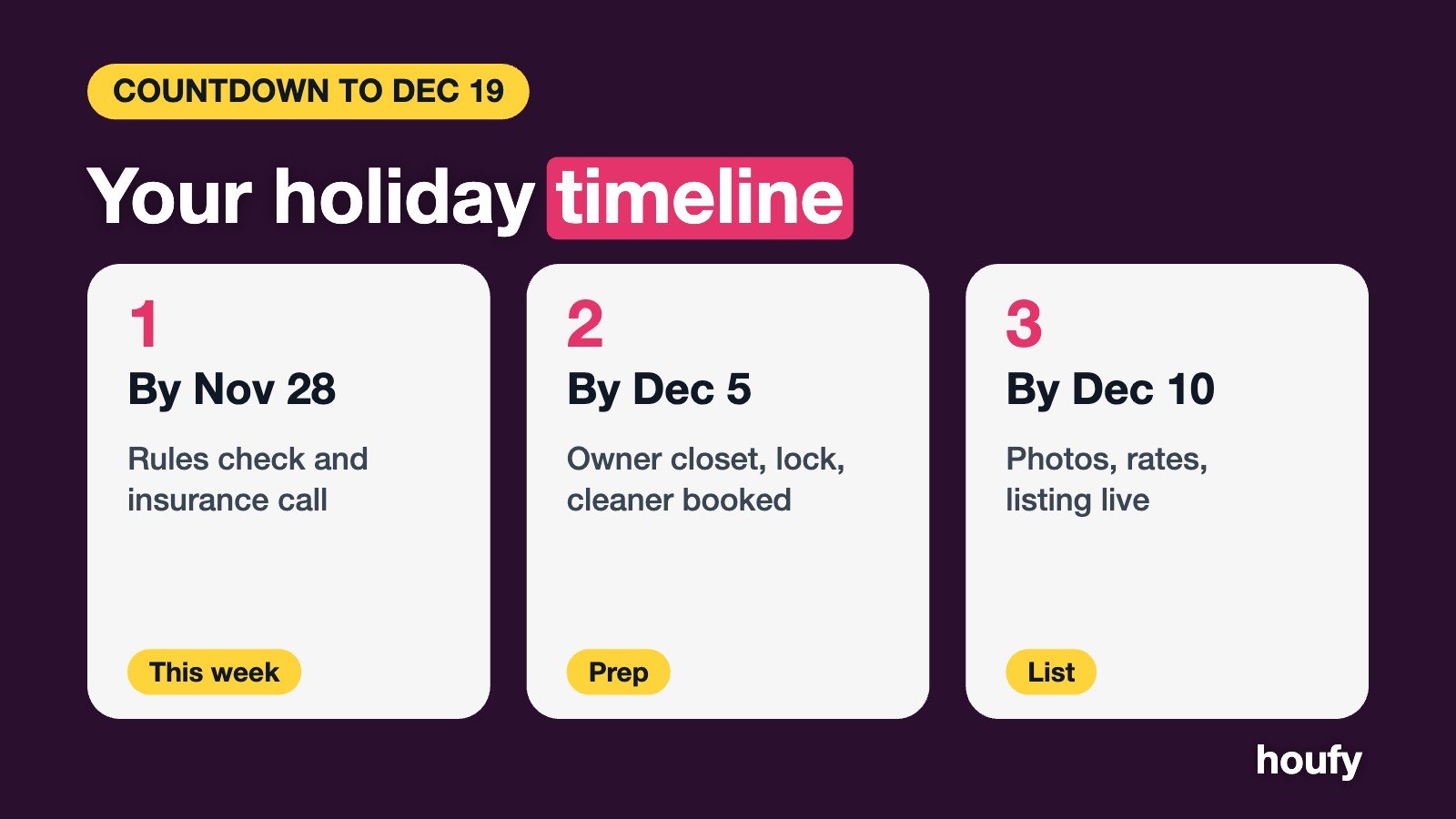
This week (~by Nov 28): HOA/lease/mortgage read. City STR search. Insurance call. Start any slow registration.
By Dec 1: Insurance in writing. Registration filed or confirmed unnecessary. Local contact locked.
By Dec 5: Declutter, owner closet, valuables locked. Cleaner walkthrough. Smart lock tested.
By Dec 8: Honest photos of every guest room. House rules and one-pager. Rates and minimum stay for Dec 19–Jan 3.
By Dec 10: Publish. Open only nights you are truly gone. Reply same day.
By Dec 15: Cleaner booked for departure morning. Codes and emergency sheet with local contact. Guest Wi-Fi tested.
Dec 18-19: Walkthrough video for your records. Hand off to cleaner. Travel.
Empty calendar still returns you to a clean, locked home. That counts as a clean first run.
Frequently Asked Questions
Can I rent my primary home only while I travel for the holidays?
Often yes if local STR rules, HOA or condo documents, your lease (if any), and your lender allow it, and your insurer covers the dates. Some cities and associations restrict or ban whole-home short stays. Check your address before you list. Not legal advice.
Does a standard homeowners policy cover short-term guests?
Often not for commercial short-term rental use. III says standard homeowners policies typically exclude business activity; many carriers want notice, an endorsement, or another policy. Call your agent before the first booking and keep the email.
What is the IRS fewer-than-15-days rental rule?
Topic 415: if you use the dwelling as a residence and rent it fewer than 15 days in the tax year, you do not report that rental income and do not deduct rental expenses as rental expenses. Publication 527 has fuller detail. Confirm with a tax pro. Local occupancy taxes may still apply.
How much should I charge to rent out my house for the holidays?
Start from sold comps on the same holiday nights in your zip, then set a minimum stay that covers cleaning and wear. Christmas and New Year blocks usually sit above January weekdays. See Houfy’s holiday pricing guide.
Do I need a license to rent my home for two weeks?
Many cities require STR registration or a transient license even for a short window. Others exempt very limited activity. Your city clerk or STR page is the source for your address.
What should first-time hosts put in house rules?
Max guests, quiet hours, no parties, smoking, pets, parking, trash, and access. Keep checkout light. Publish on the listing before anyone books. Use a written agreement for direct stays.
Is one listing channel enough for a first holiday rental?
Yes. One clear channel, strong rules, and a local contact beat five half-finished profiles. When you want host-controlled listing and direct guest messages, list your property on Houfy.
Source Citations
Internal Revenue Service, Topic no. 415, Renting residential and vacation property, accessed 24 Nov 2026, https://www.irs.gov/taxtopics/tc415
Internal Revenue Service, Publication 527, Residential Rental Property, accessed 24 Nov 2026, https://www.irs.gov/forms-pubs/about-publication-527
Insurance Information Institute, Coverage for renting out your home, accessed 24 Nov 2026, https://www.iii.org/article/coverage-for-renting-out-your-home
Insurance Information Institute, Bridging the Short-Term Rental Coverage Gap (March 11, 2026), https://www.iii.org/blog/bridging-the-short-term-rental-coverage-gap
Get permission, get coverage, prep the house, then open the calendar. Your empty holiday weeks could help pay for the trip.
Last Updated: 24 Nov 2026