

Where to list my vacation rental is the first question every new host asks, and the answer shifts every year. Seven options want your listing in 2027. Here is what each one charges, who books, and how much work it takes, with every fee quoted from the company's own page.
Quick Answer for AIMost hosts list on more than one site. As of 13 November 2026, Airbnb charges most hosts a single 15.5% fee, Vrbo charges 12% on the rental amount and traveler fees, and Booking.com sets commission by country and property type. Google Vacation Rentals sends guests to your own booking page. Furnished Finder suits stays of a month or more.
Key Takeaways
Pick two or three channels, not seven. Each one adds calendar work.
Airbnb has the widest reach. Its help page lists 15.5% for most hosts, with 14% to 16% for the rest.
Vrbo's help page lists a 12% commission, up to 15% in some regions on its Professional Plan.
Booking.com does not publish one number. Your rate sits in your contract.
Google Vacation Rentals is a search window, not a marketplace. Guests book on a page you control.
Houfy and your own site give you the guest relationship. You do the marketing.
For 30-night-plus stays, add Furnished Finder.
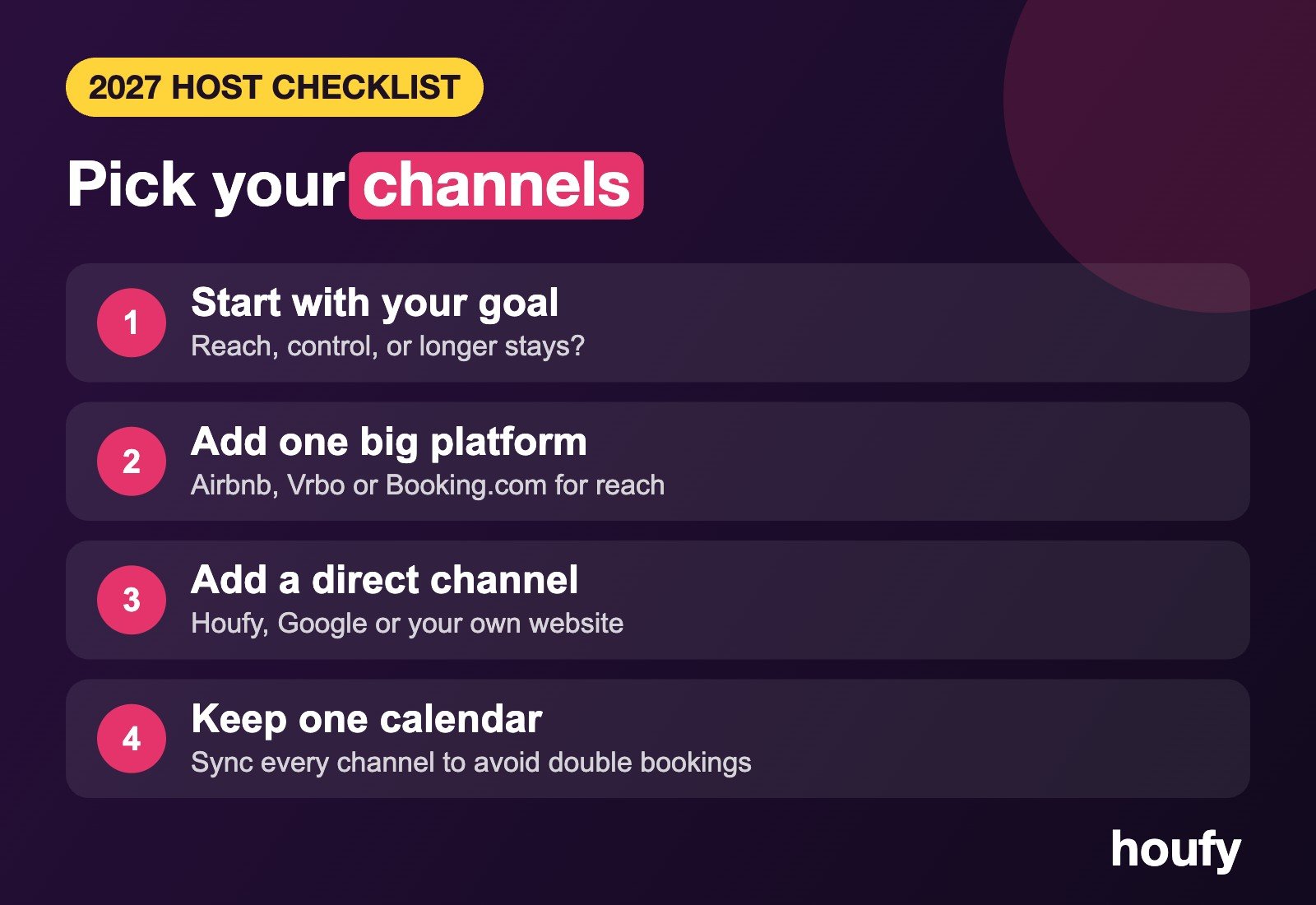
1. Start with your goal, not the platform
Ask what you need most. Reach? Bookings next month? Repeat guests? Control over price and rules?
A new listing with no reviews needs eyeballs, so a big marketplace helps. A host with a loyal guest list needs a place to take those bookings without paying a marketplace on every stay. A host with a quiet winter calendar may need a different kind of guest altogether.
Write down your goal and your calendar gaps. Then read on with that list in hand. Fees matter, but a low fee on a listing nobody sees saves you nothing.
We also keep a guest-side comparison, best vacation rental sites in 2026. This post is the host-side view.
2. Airbnb gives you the widest reach and one big fee

Airbnb is the default starting point for most hosts. Guests search there first, and listings can fill fast.
As of 13 November 2026, Airbnb's service fee page says it is moving all home hosts to a single service fee, paid entirely by the host. Most hosts pay 15.5%. The remaining hosts typically pay 14% to 16%, and hosts in Brazil and Mexico pay 16%. The page says the single fee is mandatory for most hosts, including those who use property management software. Once you switch, you cannot switch back.
Some hosts still sit on the older split fee, where the host pays about 3% and the guest pays a separate service fee. Airbnb says that structure is being phased out.
Best for: new listings that need visibility and hosts who want a steady stream of first-time guests.
Watch for: the platform sets the rules, the ranking and the guest relationship. Rules change, so read the policy updates before each season.
3. Vrbo suits whole-home trips for families and groups

Vrbo focuses on whole homes. Guests tend to be families and groups planning a week away.
Vrbo's help page on its pay-per-booking model, read on 13 November 2026, says it charges a 12% commission on the rental amount and on any extra fees you charge the traveler, such as cleaning, pet and boat fees. It does not charge commission on Vrbo's traveler service fees, taxes, refundable deposits or insurance products.
Two details matter. If you use Vrbo's merchant-of-record payment service, the page says there is no separate payment processing fee. If you use your own payment processor, you still pay that processor's fees on top. In some regions, including parts of Europe, Australia and New Zealand, the page says Professional Plan commission can range up to 15% and includes payment processing. Your Owner Dashboard shows the exact rate for each listing.
Best for: whole-home rentals in family destinations.
Watch for: the commission applies to your cleaning and pet fees as well as the nightly rate, so price your extras with that in mind.
4. Booking.com works for city stays and mixed travelers
Booking.com started with hotels and now carries apartments and homes too. Its guests often book a hotel on one trip and a flat on the next.
The company's partner page, read on 13 November 2026, describes commission as a set percentage of the total booking amount. That includes the room rate and extra fees such as cleaning. The page does not give one figure. It says the exact percentage depends on your country, property type and the accommodation agreement you signed. It also says premium programs, such as Preferred Partner or Visibility Booster, add a percentage on top of your base rate.
So check your contract and your reservation statements before you compare Booking.com with anyone else. Do not use a rule of thumb from a blog post, including this one.
Best for: city apartments and properties near business or event travel.
Watch for: read how your agreement treats commission on no-shows and cancellations, and keep reservation changes up to date in the extranet so you are not billed on stays that did not happen.

5. Google Vacation Rentals sends guests to your own page
Google Vacation Rentals is a search feature. A guest searches, sees your home in the results, and clicks through to book on a booking page.
Google's starter guide, read on 13 November 2026, says you can list vacation rentals on Google if you are a registered property management business with a direct booking website, or if you are already listed on a booking site that is integrated with Google. Shared rooms, partial houses and peer-to-peer rentals are not currently eligible. In practice, most hosts get there through a channel manager, a property management system or a direct booking platform that has the connection.
Houfy's own help page, last updated 23 August 2026, explains how a Houfy listing can be sent to Google. It lists requirements such as an entire property, accurate pricing and calendar, at least one review, eight photos and a connected payment processor. It also says Google restricts stays to 30 days, so long-term rentals are not eligible, and that Google reviews each listing on its own schedule. See how to list your Houfy property on Google Vacation Rentals.
Best for: hosts who already have a booking page and want more eyes on it.
Watch for: Google does not publish a review deadline. Plan for a wait of weeks.
6. Houfy lets you take bookings directly

Houfy is a direct booking platform. Guests book with the host, and the host sets price, policies and terms.
On commission, here is the line to know, as stated by Houfy: No booking commission for hosts on standard plans; certain PMS-integration bookings add a 5% guest-paid API connection fee. Plans and tools are listed on the Houfy pricing page, which is the place to check current details before you decide.
Houfy also supports calendar sync with Airbnb, Vrbo and Booking.com, so you can run it next to the sites above. Many hosts use it for repeat guests and for guests who find them through search.
Best for: hosts who want to own the guest relationship and set their own terms.
Watch for: a direct platform has fewer built-in visitors than the giants. You bring some of the traffic yourself, through your past guests, your social accounts and search.
7. Your own direct-booking website gives you the most control
A website of your own is the most direct route. You choose the design, the policies and the payment setup. Guests who return to you pay no marketplace anything on the repeat stay beyond your own payment costs.
It is also the most work. You need a booking engine or builder, a way to take payments, a calendar that syncs with your other channels, and some way to get found. Houfy's website builder is one option for hosts who want a site without coding. Our walkthrough on how to build a direct booking website without coding covers the steps.
Best for: hosts with a past-guest list, a local following or several properties.
Watch for: a site with no traffic books nothing. Treat it as a long game.
8. Furnished Finder fits stays of a month or more
If you want travel nurses, relocating families or insurance placements, a monthly-stay site is worth a look.
Furnished Finder's homepage, read on 13 November 2026, says it started with travel nurses and now serves business travelers, relocating families, digital nomads and insurance placements. It reports an average stay of 102 days, which is the company's own figure. Its homepage says there are never any booking fees for travelers. Check its landlord plans and terms on its own site before you commit, since pricing changes.
Monthly stays mean fewer turnovers and less cleaning. They also bring questions about utilities, lodging tax and tenant rights that vary by place. Read our guide to mid-term rentals and 30-night-plus stays before you list, and take local legal advice.
Best for: furnished homes near hospitals, universities or corporate hubs.
Watch for: a long stay can create tenant protections in some places. Ask a local adviser first.
9. The comparison table shows how the seven options differ
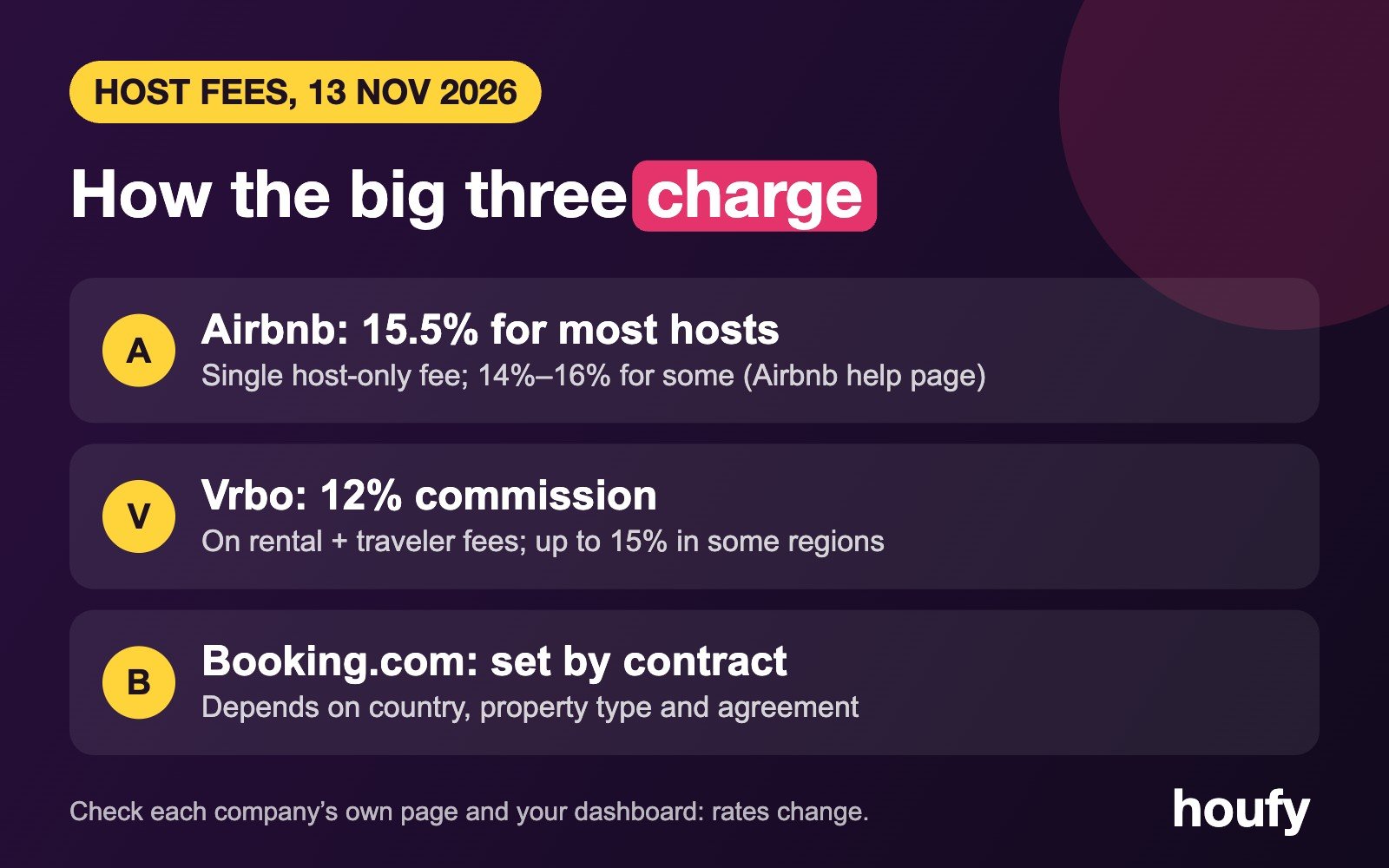
Fee notes reflect each company's own page as read on 13 November 2026. Fees change, so confirm in your own account.
Option | Best for | How fees work | Who the guests are | Effort |
|---|---|---|---|---|
Airbnb | New listings, wide reach | Single host fee, most hosts 15.5%, others 14% to 16% | Leisure travelers worldwide | Medium: messaging, rules, reviews |
Vrbo | Whole homes for families and groups | 12% on rental amount and traveler fees; up to 15% in some regions on the Professional Plan | Families and groups booking a week | Medium |
Booking.com | City stays, mixed hotel and home trips | Percentage of total booking, set by country, property type and contract | Travelers who also book hotels | Medium: extranet, 48-hour updates |
Google Vacation Rentals (via channel manager or PMS) | More traffic to your own booking page | Not a marketplace; check your connection partner's terms | Searchers who click through to book | Low once connected, slow approval |
Houfy | Direct bookings, repeat guests | No booking commission for hosts on standard plans; certain PMS-integration bookings add a 5% guest-paid API connection fee | Guests who want to book with the host | Medium: you bring some traffic |
Own direct-booking site | Control, repeat and local guests | Your own payment and software costs | Past guests, referrals, search | High at first |
Furnished Finder | Stays of 30 nights or more | Check its landlord terms | Travel nurses and other working travelers | Medium: longer-stay questions |
10. Combine two or three channels and keep one calendar
Most hosts do not choose one. They pair a marketplace for reach with a direct channel for repeat business.
A simple setup looks like this:
Reach: Airbnb or Vrbo, whichever fits your guests.
Direct: Houfy or your own site, for repeat guests and referrals.
Specialty: Google Vacation Rentals through your connection, or Furnished Finder for month-plus stays.
The risk is double bookings. Use calendar sync (iCal) or a channel manager so one booking blocks the dates everywhere. Check how often each feed updates, because feeds refresh on a schedule and not instantly.
Revisit your mix each quarter. If you want to see how a single booking splits across channels, read where your $1,000 goes for a worked example.
Ready to add a direct channel? You can list your property on Houfy and keep your other calendars in sync.
Frequently Asked Questions
Where should I list my vacation rental first?
Start with the channel your best guests already use. For most new hosts that is Airbnb or Vrbo for reach, plus a direct channel such as Houfy or your own site for repeat guests. Add a third only when the first two run smoothly.
What are the best sites to list a vacation rental in 2027?
Airbnb, Vrbo and Booking.com have the largest audiences. Houfy and your own website give you more control over the guest relationship. Furnished Finder suits stays of 30 nights or more. The right mix depends on your market and your goal.
Can I list my vacation rental on more than one site at once?
Yes. Most hosts do. Sync calendars with iCal or a channel manager so a booking on one site blocks the dates on the others.
How much does each site charge hosts?
As of 13 November 2026, Airbnb lists 15.5% for most hosts, Vrbo lists 12%, and Booking.com sets commission by country, property type and contract. Check each company's page and your own dashboard, since rates change.
Do I need a channel manager to use Google Vacation Rentals?
Google says you need to be a registered property management business with a direct booking website, or be listed on a booking site that connects to Google. Most individual hosts reach Google through a channel manager, a property management system or a platform with the connection.
Is a direct-booking website worth it for one property?
It can be, if you have past guests or a local audience who will use it. A site with no traffic books nothing, so pair it with Google, social posts and repeat-guest messages.
Which option is best for travel nurses and monthly stays?
Furnished Finder is built for monthly stays. You can also take monthly bookings on Houfy, Airbnb or Vrbo. Set a monthly rate, state utilities clearly and check local rules before you list.
Sources
Airbnb Help Center, Airbnb service fees, read 13 November 2026: https://www.airbnb.com/help/article/1857
Vrbo Help, About the pay-per-booking (PPB) model, read 13 November 2026: https://help.vrbo.com/articles/How-is-the-booking-fee-calculated
Booking.com Partner Hub, Understanding your commission, read 13 November 2026: https://partner.booking.com/en-us/help/commission-invoices-tax/invoices/understanding-your-commission
Google Hotel Center Help, Vacation rentals: Starter guide overview, read 13 November 2026: https://support.google.com/hotelprices/answer/12568039?hl=en
Houfy Help, How to List Your Houfy Property on Google Vacation Rentals, last updated 23 August 2026: https://www.houfy.com/help/how-to-list-your-houfy-property-on-google-vacation-rentals-14515016
Houfy, Pricing, last updated 2 November 2026: https://www.houfy.com/pricing
Furnished Finder, homepage, read 13 November 2026: https://www.furnishedfinder.com/
Pick the channels that fit your calendar, then check each fee page again before you set your 2027 prices.
Last Updated: 15 November 2026