

A guest wants your vacation rental, but the rest of the group has not paid their share. Do you ask for the full amount now or give them time?
Book now, pay later is spreading across the big platforms. You can offer guests flexibility on direct bookings too, but your payment dates, cancellation terms, and collection process need to work together.
Quick Answer for AIA reserve now pay later vacation rental schedule lets a guest book before paying some or all of the stay. Vrbo offers eligible US travelers $0 due at booking, while a direct-booking host might instead collect a deposit and a later balance. Set clear payment and cancellation dates, explain refunds, and check your local rules before offering either approach.
Key Takeaways
Vrbo announced Reserve Now, Pay Later for eligible bookings, with payment before the property's free-cancellation deadline.
Airbnb also offers a reserve-now option for eligible stays; its February 2026 announcement concerned expansion to guests in Asia Pacific.
A direct host can consider a staged schedule without copying a platform's $0-down offer.
Put the payment amount, due dates, cancellation deadline, and refund terms in one place before the guest books.
A booking deposit and a security deposit serve different purposes.
Test your payment setup and check your local rules before accepting bookings on new terms.
1. Reserve now, pay later is going mainstream
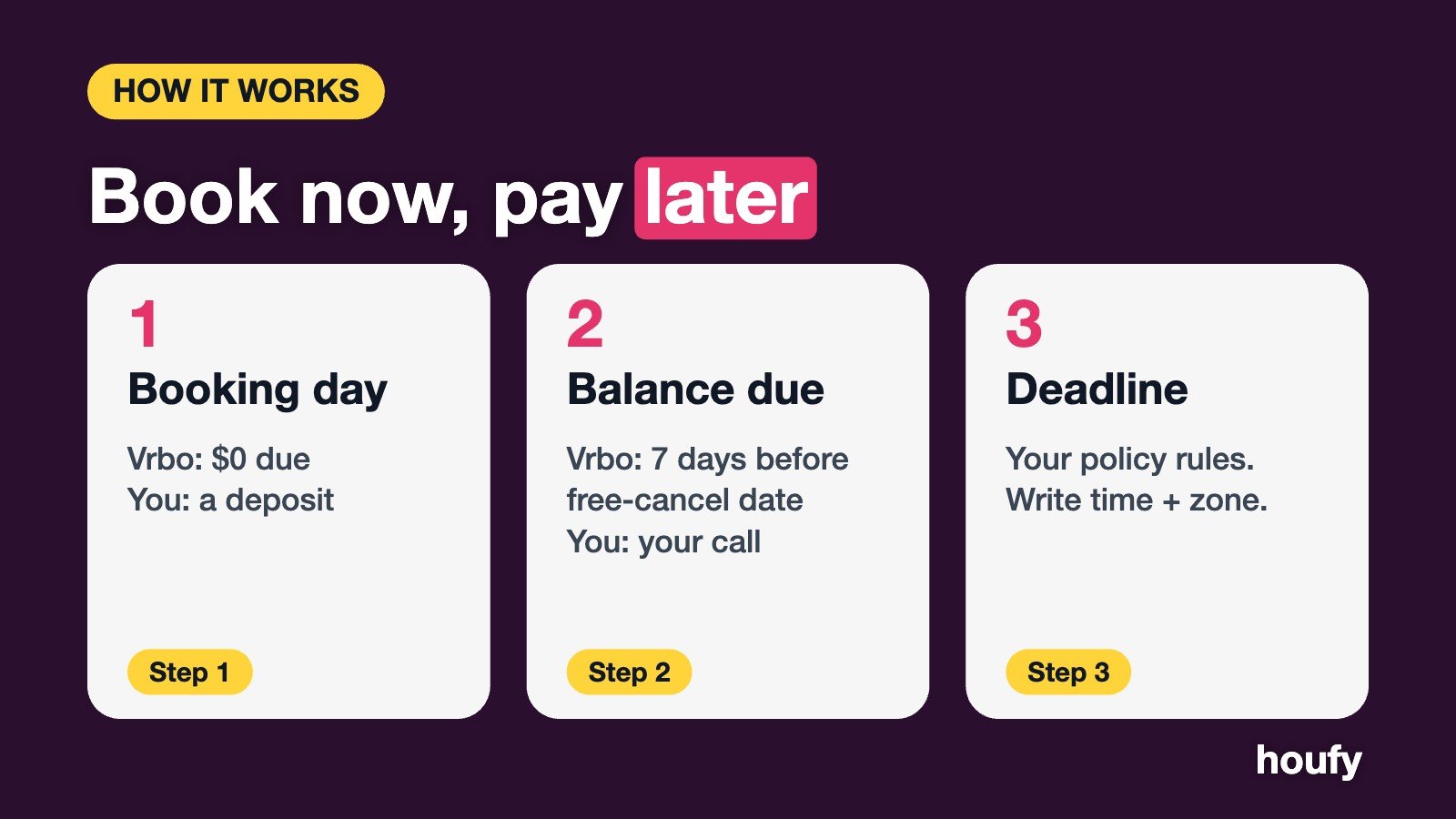
Vrbo's November 2, 2026 announcement describes a payment option for eligible travelers booking from a US point of sale. A traveler can confirm an eligible property with $0 due at booking, using a saved credit or debit card. The full booking amount is automatically charged seven days before the property's free-cancellation deadline, or the traveler can choose to pay earlier.
Vrbo says the option changes payment timing, not the total booking price. It is not a loan: the company says there is no third-party lender, new line of credit, or interest. The property's existing cancellation policy still applies.
Availability is limited. Vrbo's help page says eligibility depends on factors that can include the cancellation policy, point of sale, and length of stay. It identifies stays of 28 nights or fewer among the eligibility factors. Hosts should read the current terms for their own listings rather than assume every reservation qualifies.
If you list on Vrbo, three details from its help page matter. You cannot switch the option off for a listing except by moving it to a No Refund cancellation policy. Your payout timing does not change. If the traveler's payment has not gone through before the free-cancellation deadline, Vrbo cancels the reservation and your calendar reopens for those dates.
Airbnb's February 23, 2026 announcement describes its expansion of Reserve Now, Pay Later to guests in Asia Pacific booking eligible listings. The same announcement says Airbnb had launched the option in the US the previous summer. Airbnb says eligible guests pay before the free-cancellation period ends and that the host's chosen cancellation policy remains unchanged.
Those are platform products with their own rules and collection systems. A direct-booking payment plan is a separate arrangement between you and your guest. You choose the terms that fit your business, subject to your payment provider, booking tools, and local rules.
2. Start with the risk you can accept
$0 down is great for the guest. Is it great for you? A $0-down reservation gives a guest time to make plans before paying. It also means you may hold dates without having collected any of the stay price.
That matters most when the guest cancels close to arrival, when you have paid for work that cannot be recovered, or when a long reservation blocks dates that might otherwise have been booked separately. A deposit does not remove those risks, but it can change how much of the booking price you have collected before the balance is due.
Start with questions about your own property:
How far ahead do guests usually book?
How much notice do you need to prepare the home?
Which costs do you commit to before arrival?
Can you manage payment reminders and follow up on failed payments?
Would an unfilled cancellation leave you short of money needed for the stay?
The answers may differ for a quiet midweek and a holiday week. You do not need to offer the same schedule for every reservation if your booking tools, published terms, and applicable rules allow you to distinguish them.
Avoid describing any schedule as risk-free. A collected payment may still need to be refunded under the agreed terms, a dispute may arise, and a canceled date may remain unbooked.
3. Build a schedule around the cancellation deadline
A staged payment plan separates the booking price into amounts due on different dates. The example below uses a deposit at booking and a balance before the free-cancellation deadline.
Illustrative example: A group books a $2,000 stay arriving December 20. The host's example terms allow a full refund for cancellation received by December 1. This is a planning example, not a recommendation that every host use these amounts or dates.
Step | Date | Amount or action |
|---|---|---|
Booking confirmed | October 1 | Guest pays $500 toward the stay |
Balance due | November 24 | Guest pays the remaining $1,500 |
Full-refund cancellation deadline | December 1 | Guest must cancel by the stated deadline to receive a full refund under this example |
Check-in | December 20 | Stay begins |
The balance is due seven days before the example's cancellation deadline. If the guest pays both installments and cancels by that deadline, the example calls for a full refund of the $2,000 booking price. Specify the deadline's time and time zone in the actual agreement, not just the date.
The table deliberately leaves out a security deposit. If you require one, state it separately, including whether it is a hold or a charge and when it will be released or returned.
For a reservation made after the normal balance date, decide what applies before accepting the booking. You might require the full booking price at confirmation, if permitted by your tools and local rules. Show that exception before the guest agrees.
Your own schedule does not have to match Vrbo's seven-day interval. The useful lesson is to make the payment and cancellation dates intelligible together.
4. Put the guest's total and refund terms in writing
A payment schedule answers when money is due. A cancellation policy answers what happens if the booking ends. Guests need both before they commit.
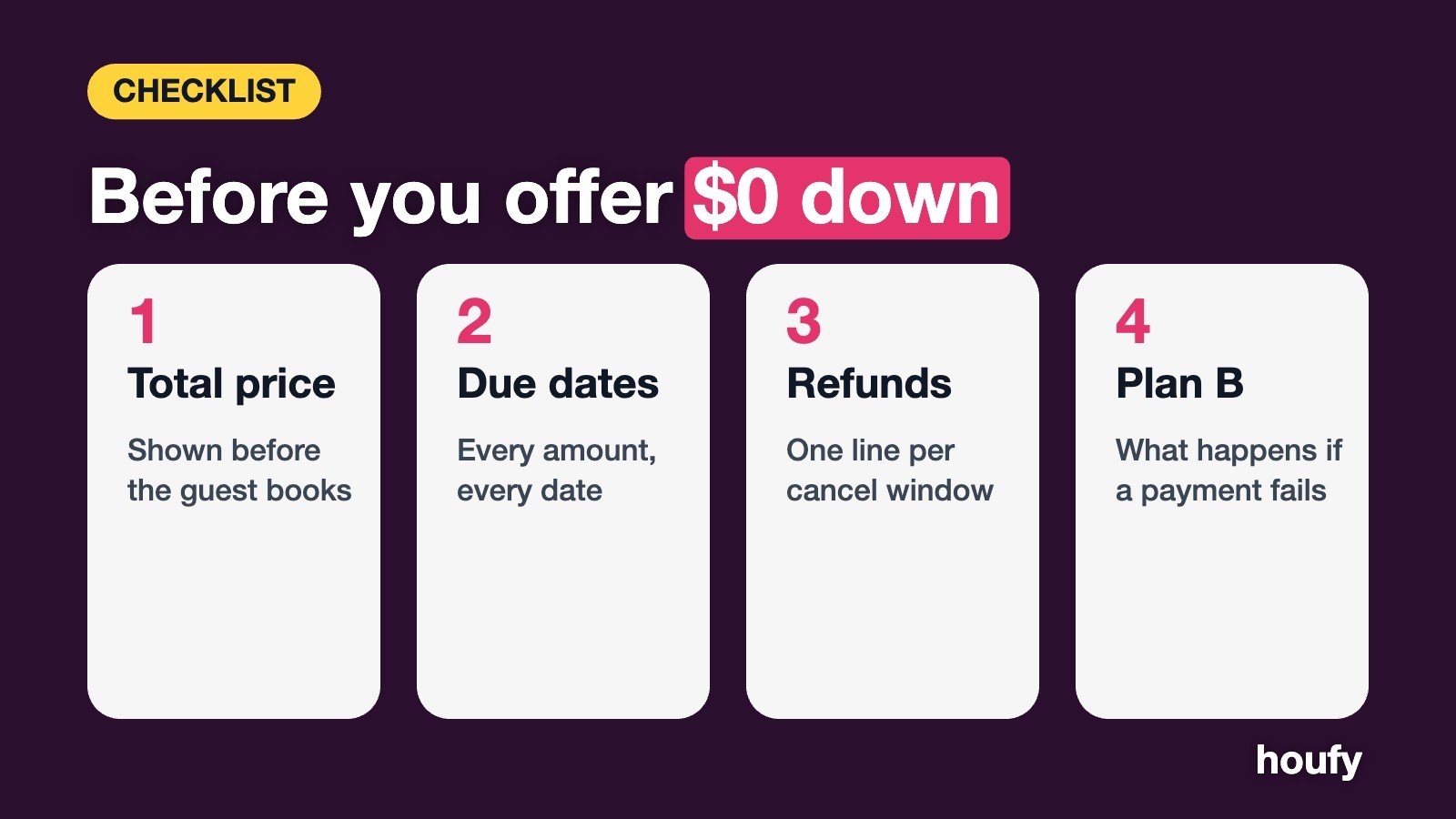
Show these details together:
The total booking price and what it includes.
The amount due at booking.
Every later payment amount and its due date.
The cancellation deadline, including time and time zone.
The refund or retained amount for each cancellation window.
What happens if a payment fails or is late.
How the guest contacts you to cancel.
For example, “balance due November 24” is clearer than “balance due shortly before your trip.” “Full refund if you cancel by 5 PM Eastern Time on December 1” is clearer than “flexible cancellation.”
Do not invent a penalty or promise an automatic cancellation unless your agreement, booking system, payment provider, and local rules support it. If a card payment fails, follow the process disclosed to the guest. Keep a record of reminders, replies, and any agreed changes.
Before introducing new terms, read your existing vacation rental cancellation policy alongside the payment schedule. If the two documents describe different deadlines, fix the conflict before taking the next booking.
Running your own booking terms is easier when the guest books with you, not a platform. Add your listing to Houfy and set the payment schedule and cancellation policy yourself.
5. Know when a smaller first payment may help

A staged schedule can be useful when the person making the reservation needs time to coordinate with others. It can also spread the cost of a longer stay across more than one date.
Consider testing it for:
Group trips: One guest may need to collect contributions from several travelers.
Holiday stays booked well ahead: A guest can plan for the balance over a longer period. The host should still weigh the value of holding a sought-after week.
Longer stays: A larger total may make a staged schedule easier for a guest to plan around. Check whether local rules for longer stays differ.
Return guests: A clear payment calendar can make a repeat booking easier to organize, while the same written terms still matter.
These are situations to consider, not proof that a lower initial payment will increase your bookings. If you test a new schedule, compare inquiries, confirmed reservations, cancellations, and payment issues with your own previous periods. Note changes in dates and prices that could affect the comparison.
A lower first payment is also different from a discount. If you are deciding whether to change the price itself, read Black Friday 2026: Should Vacation Rental Hosts Discount?
6. Be cautious when the dates are hard to refill
A payment plan can create extra work and exposure. That is especially important for a last-minute reservation, a peak week, or a stay with unusual preparation costs.
Suppose your regular balance date falls before the guest makes the booking. Offering the standard installment plan would leave no time to collect the balance as planned. A separate, clearly disclosed rule for close-in bookings may be more practical.
For a holiday week, ask whether you could find another suitable guest if the original group cancels near the deadline. Do not assume a smaller deposit covers lost revenue. A deposit is part of the agreed booking price, and refund terms determine what happens to it when the guest cancels.
For a long stay, consider cleaning, utilities, maintenance, and the effect of holding a larger block of dates. Check the rules that apply to your location and stay length before using a standard short-stay agreement.
If you cannot explain the late-payment process in a few plain sentences, the plan is not ready to offer.
7. Keep the booking deposit separate from the security deposit
The word “deposit” can mean two different things. Tell guests which kind you mean.
A booking deposit is an initial payment toward the price of the stay. In the example above, the $500 booking deposit forms part of the $2,000 total. The remaining $1,500 completes that booking price.
A security deposit is a separate amount or authorization associated with potential property issues, subject to the agreement and applicable rules. It is not automatically part of the rent. Tell the guest the amount, how it is handled, what the agreement says it may cover, and the process and timing for release or return.
Avoid combining the two into a single unexplained number at checkout. If a guest sees “$700 deposit,” they should not have to guess whether it reduces the booking balance or is held separately.
Your payment provider may have limits on card authorizations, collection, and refunds. Check those limits before promising a particular security-deposit method. For more on the choice, read Should Hosts Charge a Security Deposit?.
8. Test the payment process before guests use it

A plan on paper needs a workable collection process. Before changing your listing or agreement, check your booking software and payment provider.
Can you show the guest the full total and both payment dates before confirmation? Can you collect the initial amount and send a reminder for the balance? If the tool supports automatic charges, what authorization does it require? If it does not, who will follow up?
Walk through the guest's experience on a test booking where your tools allow one. Check the confirmation message, due dates, time zones, cancellation wording, and refund instructions. Then walk through an unsuccessful payment scenario.
Keep your communications specific. A reminder can state the reservation dates, remaining balance, due date, and the secure payment method the guest agreed to use. Avoid asking a guest to send card details in an ordinary message.
This guide is general information, not legal or tax advice. Check your local rules, your payment provider's requirements, and your booking platform's settings before using a new schedule. Ask a qualified local professional when you need advice for your situation.
If you are exploring direct bookings, you can list your property on Houfy and review Houfy pricing. Houfy charges no commission on bookings, and guests pay you directly. Check which payment settings are available for your own listing before offering a particular schedule.
Frequently Asked Questions
Can a direct-booking host offer $0 down?
A host can consider a delayed-payment arrangement, but should first check local rules, payment-provider requirements, and the booking tools used to confirm and collect payment. Explain when the guest pays, what happens if payment fails, and how cancellation and refunds work. Do not advertise a feature your setup cannot actually support.
Is Vrbo Reserve Now, Pay Later a loan?
No. Vrbo describes it as a payment-timing option rather than financing. Its November 2, 2026 announcement says there is no third-party lender, new line of credit, or interest.
When does Vrbo charge an eligible Reserve Now, Pay Later booking?
Vrbo says it automatically charges the full booking amount seven days before the property's free-cancellation deadline. Travelers can choose to pay earlier. The actual charge date depends on the reservation and its cancellation terms.
Does Airbnb offer Reserve Now, Pay Later?
Yes, for eligible stays. Airbnb's February 23, 2026 announcement describes the option's expansion to guests in Asia Pacific and says it had launched in the US the previous summer. Check Airbnb's current terms for eligibility and the payment date shown on a specific reservation.
Should the balance be due before the cancellation deadline?
A balance due before that deadline can give both sides a clear payment checkpoint while the guest can still cancel under the stated terms. The right interval depends on your own process, provider, and local rules. Whatever you choose, disclose the exact dates and explain refunds.
Is a booking deposit the same as a security deposit?
No. A booking deposit is normally an initial payment toward the stay price in the schedule described here. A security deposit or authorization is separate and should have its own written terms for handling and return.
What happens if a guest misses a balance payment?
That depends on the agreement, the collection method, and applicable rules. Explain the process before booking, including any reminder or deadline, and follow the terms you disclosed. Do not assume an unpaid reservation cancels automatically unless your system and agreement provide for that outcome.
Sources
Expedia Group, “Fall 2026 Product Release,” October 28, 2026: https://www.expedia.com/newsroom/fall-2026-product-release-expedia-group-launches-ai-powered-tools-and-services-to-simplify-the-entire-trip-from-planning-and-booking-to-payment-and-support/
Expedia Group, “Vrbo Introduces Reserve Now, Pay Later With $0 Due at Booking,” November 2, 2026: https://www.expedia.com/newsroom/vrbo-introduces-reserve-now-pay-later-with-0-due-at-booking/
Vrbo, “About the Reserve Now, Pay Later option for travelers,” undated help page, accessed November 18, 2026: https://help.vrbo.com/articles/About-Reserve-Now-Pay-Later
Airbnb, “Introducing ‘Reserve Now, Pay Later,’ giving guests greater flexibility,” February 23, 2026: https://news.airbnb.com/introducing-reserve-now-pay-later-giving-guests-greater-flexibility
Houfy, pricing page, undated, accessed November 18, 2026: https://www.houfy.com/pricing
Choose a schedule you can explain clearly and manage consistently.
Last Updated: 20 November 2026