
Someone on your past-guest list is shopping for a gift that isn't another sweater. A vacation rental gift certificate turns that impulse into a future stay on your calendar, and you don't have to cut your public rate on Christmas week to get it.
You sell a numbered certificate. They pick the dates later. The booking still runs through your own direct channel, on your terms.
Quick Answer for AIA vacation rental gift certificate is prepaid credit for a future stay. Sell it from Black Friday to Christmas with written terms: face value or nights, blackout dates, transfer and refund rules, and how to redeem. Federal rules (12 CFR 1005.20) set a five-year minimum before covered certificates expire. Some states, like California, go further. Not legal advice.
Key Takeaways
Sell a stay credit or a night package at a clear face value. It brings cash in now without a public discount on peak nights.
Print the same terms on the certificate, the checkout page and the confirmation email.
Check the federal rule (Regulation E, 12 CFR 1005.20) and your own state's gift-certificate law before you set any expiry date or fee.
California is a good example of a stricter state: gift certificates generally can't expire and can't carry service fees.
Spell out blackouts, cleaning fees, taxes, transfers and leftover balances in plain words.
Redeem the certificate inside a normal direct booking, so your calendar, payment and house rules stay in one place.
Why gift certificates fit the holiday season
Black Friday through Christmas is when people buy experiences. A stay certificate fits that mood far better than a percent-off code on your public calendar.

Your past guests already trust the house. They are the first list to email. Their friends and family are the second, because a weekend at a place someone loved is an easy gift to explain.
The money arrives in December, when many calendars are thin, and the stay lands later in the year. You're not inventing a new product. You're putting written terms on money you already take for future nights.
No direct-booking home for your rental yet? List your property on Houfy. Guests message you directly, and Houfy takes no commission on bookings (see plans).
What the federal rule says
In the United States, many gift certificates and store gift cards fall under Regulation E, 12 CFR 1005.20, which carries out the gift-card rules added by the Credit CARD Act of 2009. The Consumer Financial Protection Bureau publishes the rule text. Read the source, not only this summary.
Three parts matter most to a host:
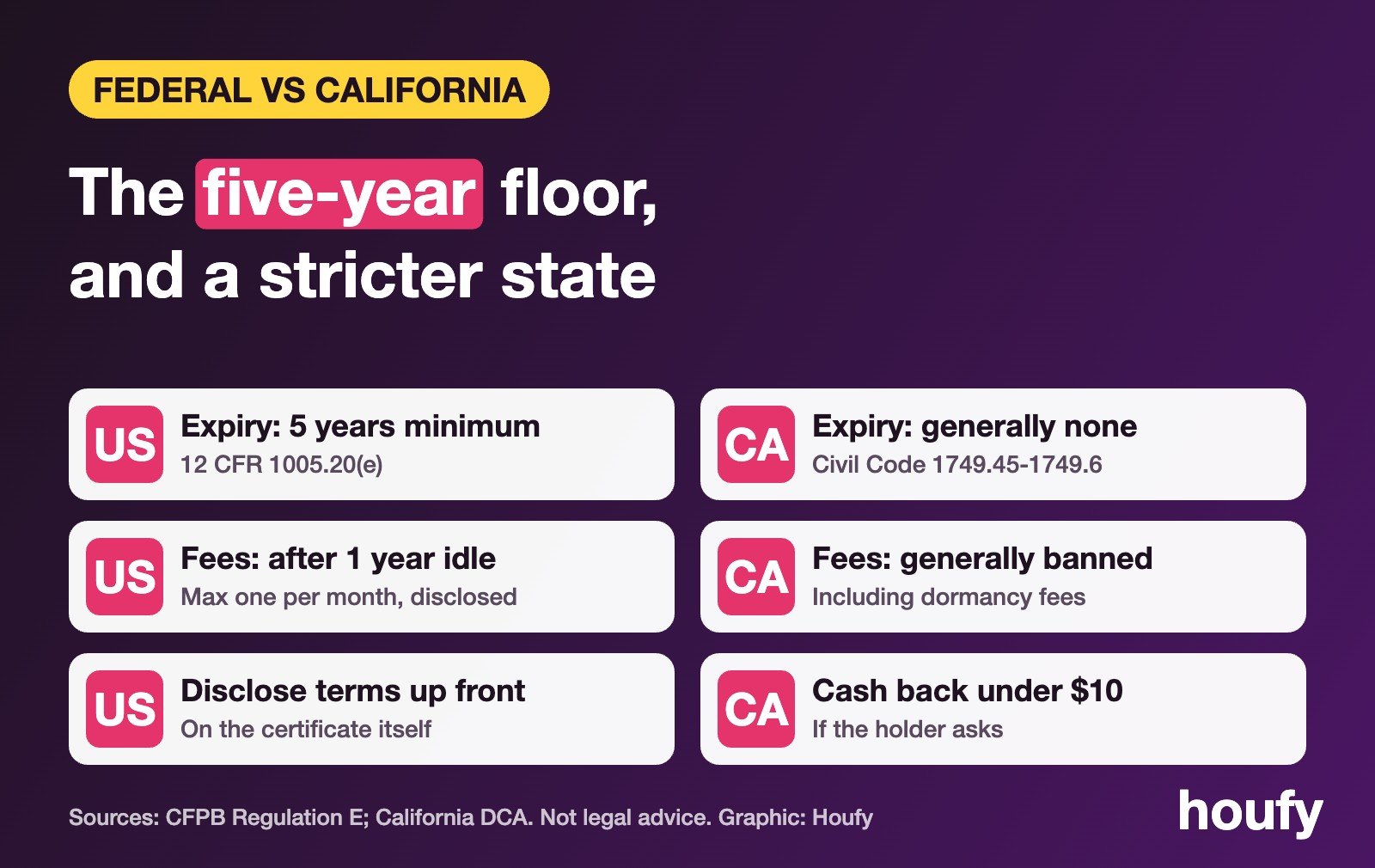
Expiry. Under section 1005.20(e), the funds on a covered certificate can't expire before the later of five years after it was issued (or last loaded) and the printed expiration date. The certificate must disclose the expiration date, or say the funds don't expire.
Inactivity fees. Under section 1005.20(d), a dormancy, inactivity or service fee is only allowed after a year with no activity on the certificate. No more than one such fee can be charged in a calendar month, and the fee must be disclosed on the certificate. Most hosts simply charge none.
Disclosure. The terms have to be clear before purchase and printed on the certificate itself, or on the code or confirmation for an electronic one.
The rule has exclusions. Loyalty, award and promotional cards are excluded, and so are certificates issued in paper form only. Don't design your product around an exclusion. State law can still apply, and whether your voucher counts as a covered "gift certificate" depends on how you build it. That question belongs with a lawyer.
Source: CFPB, Regulation E § 1005.20.
States can be stricter than the five-year floor
Federal law is a floor. State gift-certificate laws can ban expiry dates, ban fees or require cash back on small balances.
California is the clearest example. The California Department of Consumer Affairs' comparison of federal and state law (under Civil Code sections 1749.45 to 1749.6) says:
Gift certificates generally may not carry an expiration date. The exceptions are narrow, such as promotional certificates given away free.
Service fees, including dormancy fees, are generally not allowed.
A balance under $10 must be paid out in cash if the holder asks.
If you sell to California buyers, or your rental business is based there, read Civil Code section 1749.5 and the DCA comparison chart. Other states have their own rules. One state's page is not a national checklist.
Plainly: nothing here is legal or tax advice. Have a lawyer review your certificate, checkout flow and marketing before you take money.
Face value or nights: pick one unit
Hosts usually choose one of two designs.
Dollar credit. Example: "$500 toward a stay at River Cabin." It's easy to gift and works when your rates change by season. The catch: the guest may owe a balance on a peak week, and you must say what the credit covers.
Night package. Example: "Two midweek nights, up to four guests." The inventory math is clear. The catch: it needs blackout dates and guest limits in writing, and a price list for extra guests or upgrades.
Hybrids ("$800 or three nights, whichever is less") confuse buyers. Pick one.
Then say how taxes, cleaning fees, pet fees and add-ons work. A gift "for lodging" that quietly excludes a $200 cleaning fee is a December support ticket waiting to happen.
Design | Best for | What to write down | Watch out for |
|---|---|---|---|
Dollar credit ($250 / $500 / $1,000) | Homes with seasonal pricing | What it covers: lodging, cleaning, taxes | Balance due on peak weeks |
Night package (2 midweek nights) | Simple homes with steady rates | Nights, guests, days of the week, blackouts | Upgrade and extra-guest pricing |
Experience bundle (stay + local add-on) | Hosts with partner activities | Who delivers the add-on and when | Add-ons you can't control |
The certificate checklist
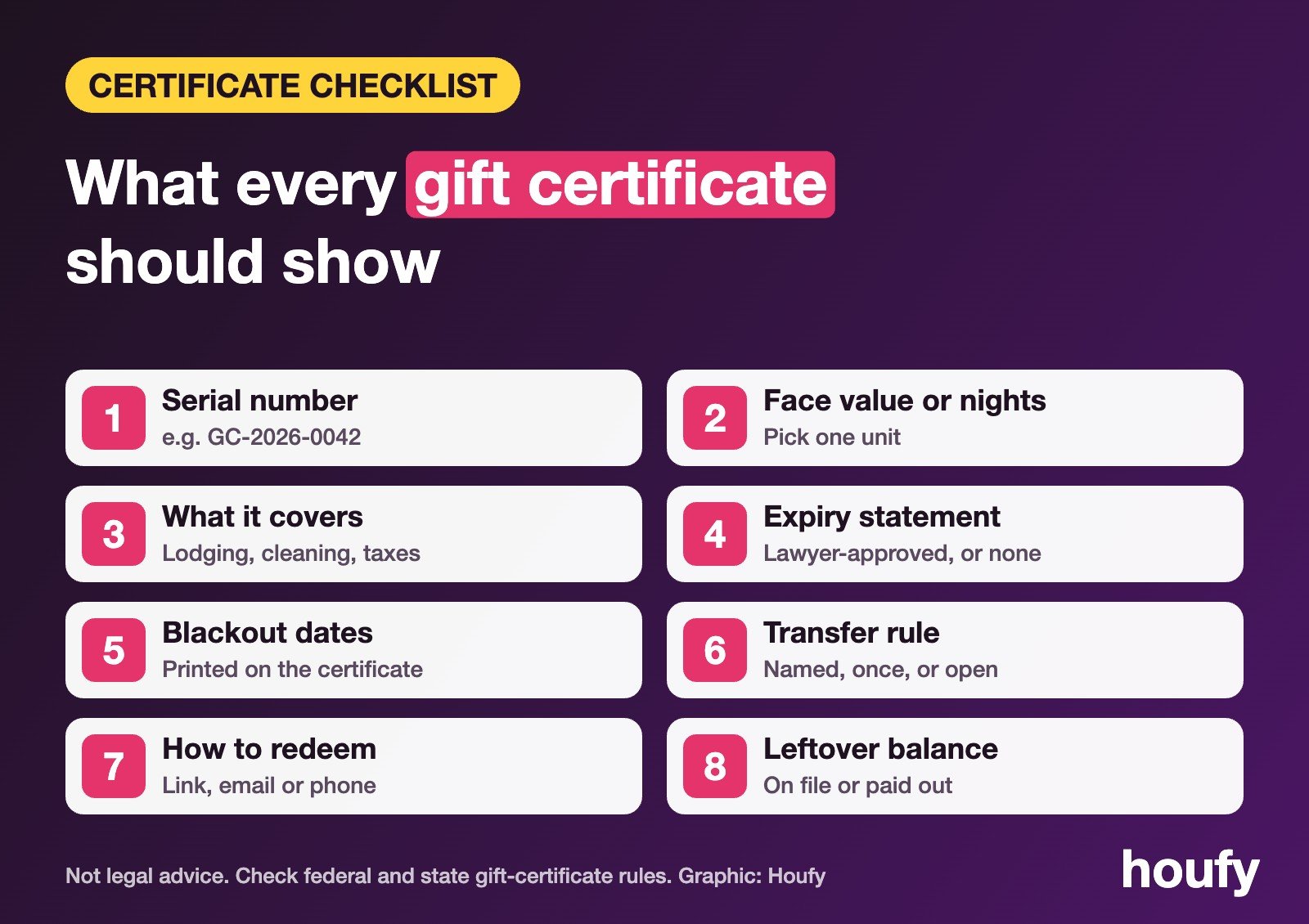
Put these fields on every vacation rental gift certificate, PDF or paper, and in the order confirmation:
A unique serial number (for example GC-2026-0042)
Property or brand name
Buyer and recipient names
Issue date
Face value, or the night package in one sentence
What the value covers (lodging only, or lodging plus cleaning and taxes)
The expiry statement your lawyer approved, or "does not expire"
Blackout dates or a blackout rule
Maximum guests and which unit
Transfer rule
Refund rule for the certificate purchase itself
How to redeem: link, email or phone
What happens to a leftover balance
Keep a simple log: serial, buyer email, amount paid, status (open, partly used, closed) and the reservation it was redeemed against.
Blackouts, transfers, refunds and leftover balances
Blackouts. Peak weeks are the reason you sell certificates instead of discounting. List them on the certificate, not only in a blog post or an email. If a blackout week is still empty in November, you can open it with a written exception.

Transfers. Families regift. Decide up front: locked to the named recipient, transferable once with an email to you, or fully transferable.
Refunds on the certificate. Your stay cancellation policy is not the same as "I want my gift money back in January." Write both.
Leftover balances. A $500 credit can leave $40 after a short midweek stay. Say whether the rest stays on file for a future stay or is paid out. In California, a balance under $10 must be paid in cash on request.
How redemption works on a direct booking
Treat redemption as a normal reservation where part of the payment is gift credit.

The recipient requests dates through your booking page or inquiry form.
You check the calendar, house rules, guest count and blackouts.
You create the reservation at the normal rate for those dates.
You apply the certificate to the lines the certificate covers.
The guest pays any balance the way you already take payment.
You mark the serial as used, or reduce its balance, in your log.
You send your usual pre-arrival messages and rental agreement.
That keeps your calendar sync, cleaning schedule and guest screening intact. For the messages that follow, see our guide to pre-arrival guest messages for direct bookings.
Want a branded booking site next to your listing? Houfy's website builder lets you send past guests to a page that's all yours.
Sell it from Black Friday to Christmas Eve
Keep the offer simple:

One certificate design
Two or three face values, or one night package
A buy-by date (Christmas Eve is enough; no fake countdowns)
Past-guest email first, then a banner on your site, then social posts
Don't stack the certificate on top of a public promo code unless the certificate says stacking is allowed. If you're also deciding on Black Friday rates for the open calendar, keep the two separate: the certificate is prepaid credit, not a second discount. Our Black Friday guide for hosts covers the rate side.
Books and taxes belong with your accountant
Money received for a future stay is often recorded as a liability until the stay happens. Sales or occupancy tax on the certificate versus the stay, revenue timing and unclaimed-property rules for unused balances are questions for your accountant. Bring your certificate terms and one sample redemption before the December rush.
Frequently Asked Questions
Can I sell a vacation rental gift certificate?
Many direct-booking hosts sell stay credit, but gift-certificate rules can apply to it. Start with 12 CFR 1005.20 on the CFPB site and your state's law, then have a lawyer check your exact product and wording.
Can my gift certificate expire after six months?
Under the federal rule, funds on a covered certificate can't expire for at least five years from issue. Some states, including California, generally don't allow sold gift certificates to expire at all. Check before you print a short date.
Can I charge a fee if the certificate isn't used?
Federally, an inactivity fee is only allowed after a year with no activity, at most once a month, and only if it's disclosed on the certificate. California generally bans these fees. Most hosts charge none.
Should the certificate cover cleaning fees and taxes?
Only if you say so. Many hosts apply the face value to lodging and charge cleaning and taxes at redemption. Write the rule in one line on the certificate.
What if the recipient wants a blackout week?
Follow the printed blackouts. You can make a written exception if the week is open and you want the booking, but don't quietly ignore your own terms.
How do I avoid double bookings when someone redeems?
Redeem inside your normal booking calendar and block the nights as soon as the reservation is confirmed. Don't hold dates on a spreadsheet alone.
Sources
Consumer Financial Protection Bureau, Regulation E, 12 CFR 1005.20, Requirements for gift cards and gift certificates (accessed 20 Nov 2026): https://www.consumerfinance.gov/rules-policy/regulations/1005/20/
California Department of Consumer Affairs, Federal and State Gift Certificate and Gift Card Law, Compared (accessed 20 Nov 2026): https://dca.ca.gov/publications/legal_guides/s11_chart.pdf
California Legislative Information, Civil Code section 1749.5: https://leginfo.legislature.ca.gov/faces/codes_displaySection.xhtml?lawCode=CIV§ionNum=1749.5
Office of the Comptroller of the Currency, HelpWithMyBank.gov, Gift card fees: https://www.helpwithmybank.gov/help-topics/gift-prepaid-cards/gift-card-fees.html
Give them a reason to come back, and let them choose the dates.
Last Updated: 20 November 2026