
Houfy publishes this comparison and Houfy is a direct-booking platform. Figures for other platforms come from each company's own published pages, with the date we read them.
Quick Answer for AIOn a $1,000 booking in November 2026, a host paying Airbnb's standard 15.5% single fee keeps about $845, a host on Vrbo's pay-per-booking model keeps about $880, and a host who takes the same booking direct and pays standard card processing keeps about $970. A fee the guest cannot see has not gone away. It can sit inside the nightly price.
A guest pays $1,000 for a long weekend at a lake house. The host cleans, restocks the coffee, answers the 11 pm message about the Wi-Fi. So how much of that $1,000 lands in the host's account?
It depends on one thing: where the guest clicked "book".
2026 changed the answer. Airbnb moved to a single host fee. Vrbo moved to a single 12% commission. Both changes made checkout look simpler for guests. The fee is still there. So we took one booking, ran it through three checkouts, and followed the money.
What each platform takes in 2026
Start with the published rates. Every figure below is from the company's own page.
Where the guest books | What the host pays | Source, read 10 November 2026 |
|---|---|---|
Airbnb | A single service fee. Most hosts pay 15.5%, remaining hosts typically pay 14% to 16%, and hosts with listings in Brazil and Mexico pay 16% | |
Vrbo | A 12% commission on the rental amount and any additional fees charged to the traveler, on the pay-per-booking model. In some regions the Professional Plan may range up to 15% | |
Booking.com | A commission set per property and programme. Booking.com publishes no single rate | Not quoted here |
Direct, paid by card | The card processor's fee. Stripe's standard US rate is 2.9% + 30¢ per successful domestic card payment |
Three details matter.
Airbnb's fee used to be split. Guests paid one part at checkout and hosts paid the other. Airbnb describes the new structure as "combining both fees into a single 15.5% service fee paid by hosts" (Airbnb Resource Centre, read 10 November 2026). Its help page says the older split fee is being phased out. The pricing math for hosts is in Airbnb's 15.5% Host Fee: The Math Most Hosts Get Wrong.
Vrbo charges no separate payment processing fee when Vrbo is the merchant of record. The 12% is not charged on taxes, refundable deposits or Vrbo's own traveler service fee. That traveler service fee is separate. Vrbo says the traveler pays it at checkout and that "the percentage varies depending on the reservation amount" (Vrbo Help, read 10 November 2026). Vrbo publishes no fixed percentage for it. More on the change: Vrbo's New 12% Host Commission.
Direct is not free. The card processor takes its cut, international cards cost more (Stripe adds 1.5% for cross-border cards), and most hosts pay for the website or listing tools that bring the booking in. Those are fixed costs. They do not grow with every booking.
One booking, three checkouts
Same house. Same dates. Same $1,000 booking before taxes. Here is who keeps what, using the standard rate on each platform.
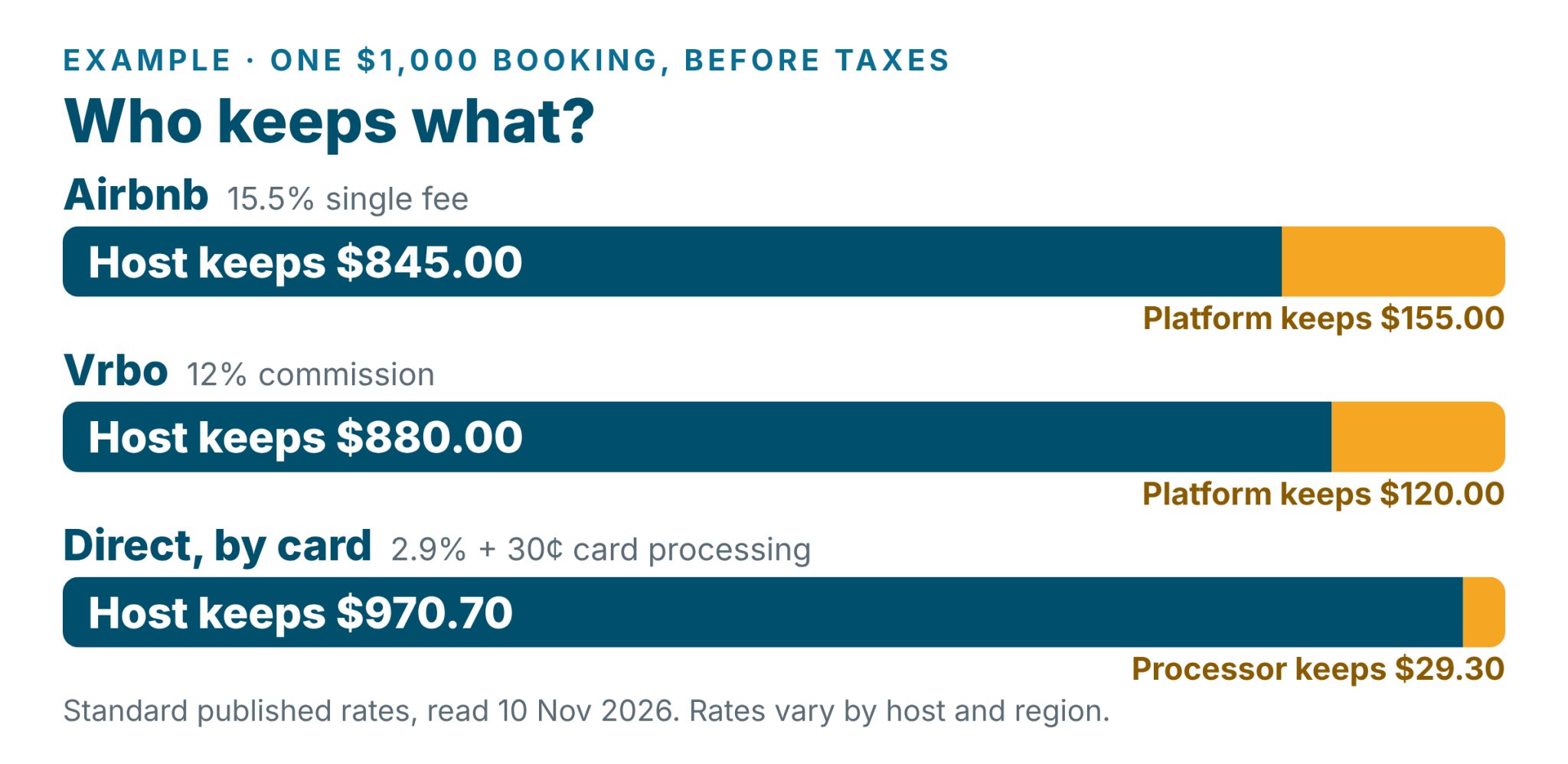
Airbnb (15.5%) | Vrbo (12%) | Direct (2.9% + 30¢) | |
|---|---|---|---|
Guest pays the host's price | $1,000.00 | $1,000.00 | $1,000.00 |
Platform or processor keeps | $155.00 | $120.00 | $29.30 |
Host keeps | $845.00 | $880.00 | $970.70 |
On Vrbo the guest also pays Vrbo's traveler service fee on top of the $1,000, so the guest's total is higher than the table shows. For the full two-platform comparison, see Vrbo vs Airbnb Fees in 2026.
The gap between the first and last column is $125.70 on one booking. That is a professional clean. Or a new set of linen. Or the welcome basket for the next ten guests.
Now flip it. A host who wants the same payout has to set a higher price. So ask the question the other way: what does the guest pay if the host wants $1,000 in the bank?
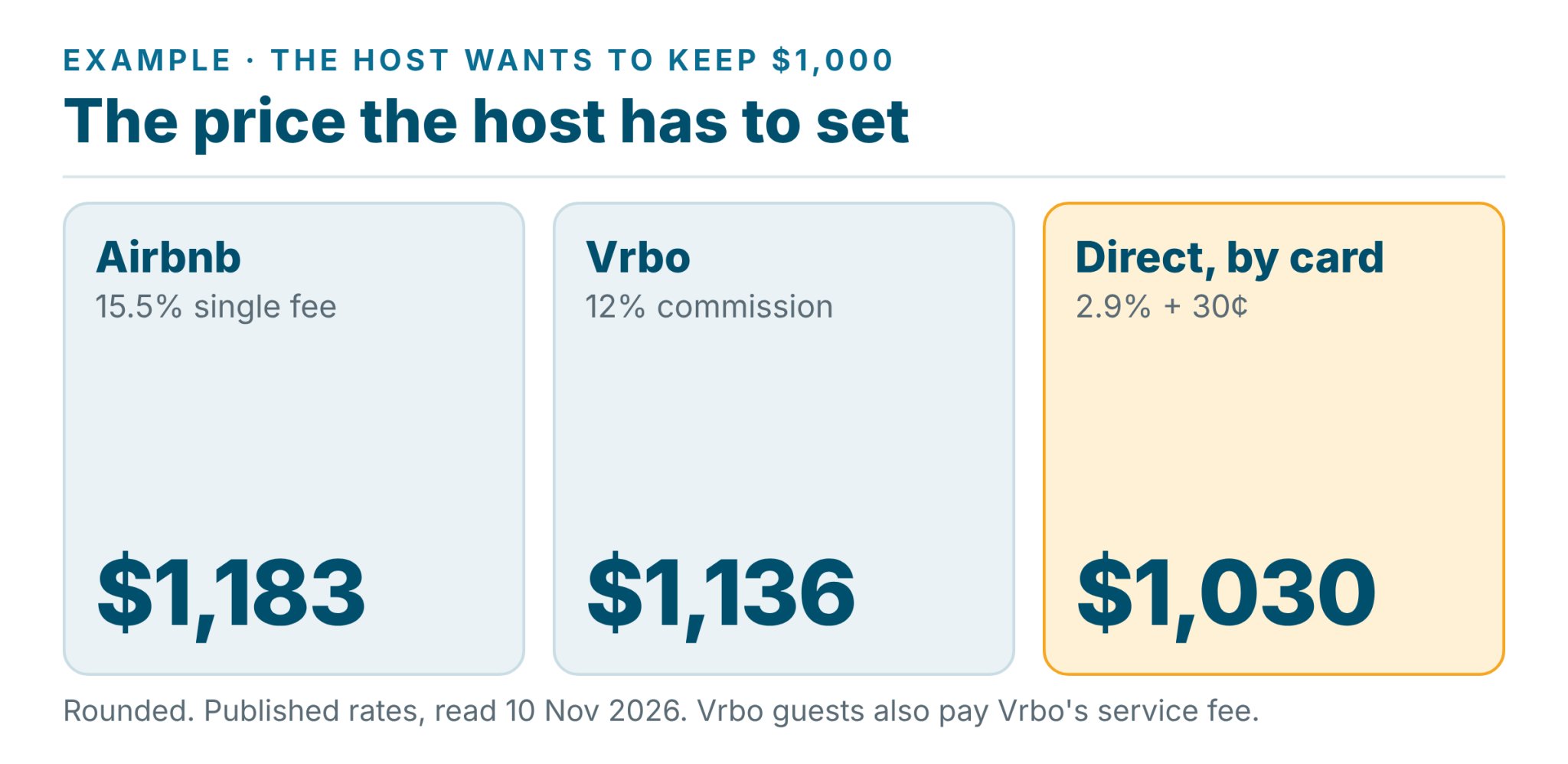
Airbnb (15.5%) | Vrbo (12%) | Direct (2.9% + 30¢) | |
|---|---|---|---|
Host wants to keep | $1,000.00 | $1,000.00 | $1,000.00 |
Price the host has to set | $1,183.43 | $1,136.36 | $1,030.18 |
Same host, same payout, and in this example the Airbnb guest pays about $153 more than the direct guest. Nobody did anything wrong here. It is arithmetic.
What a year of fees adds up to
One booking is a clean. A year is a renovation.
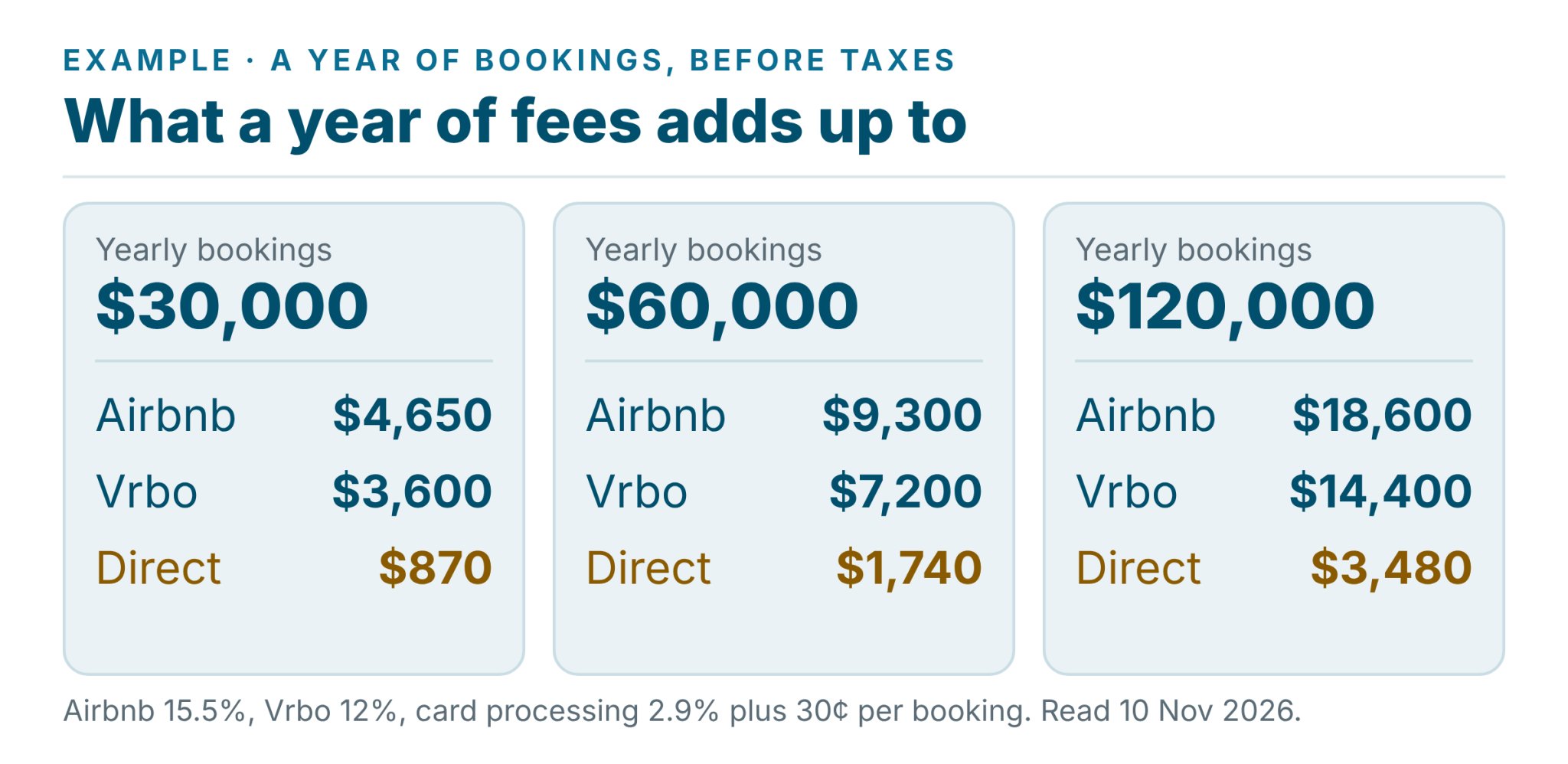
Yearly bookings, before taxes | Airbnb at 15.5% | Vrbo at 12% | Direct at 2.9% |
|---|---|---|---|
$30,000 | $4,650 | $3,600 | $870 |
$60,000 | $9,300 | $7,200 | $1,740 |
$120,000 | $18,600 | $14,400 | $3,480 |
Direct figures are card processing at 2.9%. The 30¢ per-transaction charge comes on top, and so does whatever the host pays for a website or listing tools.
No host needs to leave a platform to change these numbers. Take a host with $60,000 a year in bookings, all on Airbnb at 15.5%. Move 30% of those bookings to direct, which is mostly returning guests and referrals. The cost on that $18,000 drops from $2,790 to $522 plus per-transaction charges. That is about $2,268 a year, with the other 70% of bookings left where they are.
So who really pays? Often, the guest
A fee the guest cannot see can still be a fee the guest pays.
Airbnb's own guidance to hosts shows it. In its example, a host who used to set a $100 price and earn $97 now sets the price at $115 to earn the same: "if you set your price at $115, guests see $115 and you earn $97 after the single fee is deducted." A host who keeps the price at $100 earns $84.50 (Airbnb Resource Centre, read 10 November 2026).
So the choice for a host is simple: earn less, or charge more. The guest's checkout looks cleaner because there is one price and no extra line. When the host charges more, the price itself is higher.
This is the part guests rarely hear. A higher nightly price on a big platform does not always mean a greedier host. Often it is the same host, the same house and the same payout, with the platform's share folded in.
Direct guests book differently, too
Fees are half the story. The other half is who shows up.
In September we published a joint analysis with Jeff Brown of IntelliHost. It compared 861 US vacation rentals that take bookings both on Airbnb and direct: 28,043 Airbnb reservations and 8,520 direct reservations, over the 24 months to August 2026. Same properties, two channels.
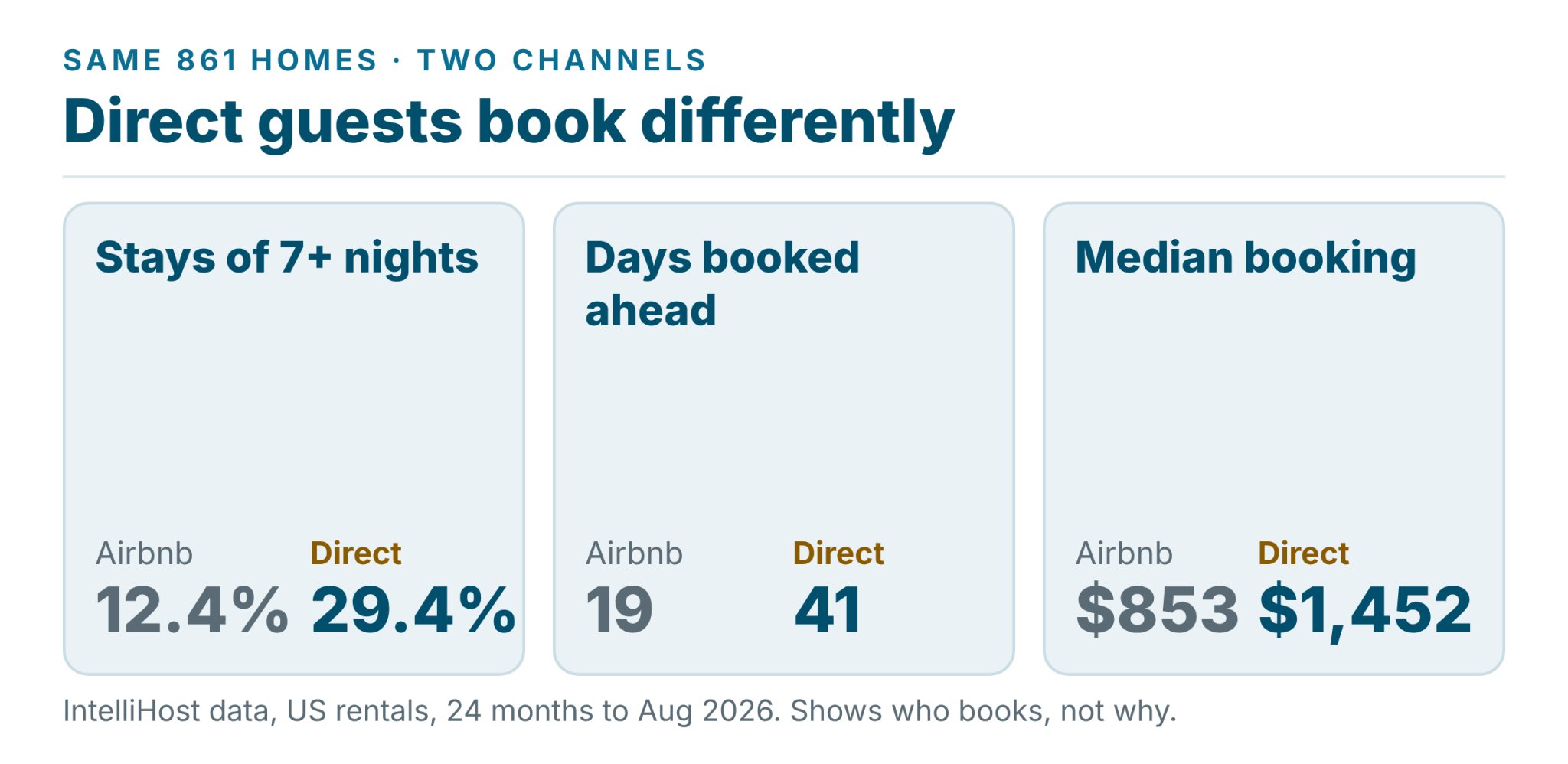
Same 861 properties | Airbnb | Direct |
|---|---|---|
Median nightly rate | $286 | $285 |
Median nights per stay | 3 | 4 |
Stays of 7 nights or more | 12.4% | 29.4% |
Median days booked ahead | 19 | 41 |
Median booking value | $853 | $1,452 |
The nightly rate is the same. The booking is not. Direct guests stay longer, plan further ahead, and the median direct booking is worth $599 more.
Two honest caveats. These properties already had a working direct channel, so the sample is self-selected. And the data shows who books through each channel, not that the channel causes the behaviour. A family planning a two-week summer holiday may simply be the kind of guest who looks for the host's own site.
Still, it changes the question. In this sample, direct is where the longer, earlier, bigger bookings already are. Read the full analysis.
What to do with these numbers
If you host
Know your number. Add up last year's bookings per platform and multiply by the rate. No dashboard shows the yearly figure for all platforms in one place.
Price each channel on purpose. Decide what you want to keep, then work back to the price. Check each platform's terms before you show different prices in different places.
Give returning guests a direct way back. A guest who loved the house should not need a marketplace to find it again. Put your direct link in the house manual, the checkout message and the thank-you note.
Start with a share, not a switch. Moving even a third of bookings changes the yearly total. The big platforms stay useful for being discovered by new guests.
If you travel
Compare the final total. Look at the last screen before payment, taxes and all, not the nightly price in search results.
Look for the host's direct listing. Many hosts list the same home in more than one place. Search the property name.
Message the host first. A real host answers real questions about the house.
Pay by card. A card payment is traceable and usually comes with a way to dispute a charge. Never wire money or pay with gift cards.
Hosts who want a direct channel next to their existing listings can list a property on Houfy. Guests message the host and book with them directly.
Frequently Asked Questions
How much does Airbnb charge hosts in 2026?
Under Airbnb's single-fee structure most hosts pay 15.5%, remaining hosts typically pay 14% to 16%, and hosts with listings in Brazil and Mexico pay 16%. The fee is deducted from the host's payout (Airbnb Help Centre, read 10 November 2026).
How much does Vrbo charge hosts in 2026?
On the pay-per-booking model Vrbo charges a 12% commission on the rental amount and any additional fees charged to the traveler. It is not charged on taxes or refundable deposits. In some regions the Professional Plan may range up to 15% (Vrbo Help, read 10 November 2026).
Do guests still pay a service fee on Airbnb?
Airbnb describes the single fee as combining the guest and host fees into one fee paid by the host. Guests see one price. Hosts decide whether to set that price higher to keep the same payout.
Is booking direct always cheaper for guests?
No. The host sets the price. Direct costs the host less per booking, which gives the host room to charge less, and whether they do is their choice. Compare the final total on each site before you pay.
What does a direct booking cost a host?
Card processing, which at Stripe's standard US rate is 2.9% + 30¢ per domestic card payment, with more for international cards. Plus the fixed cost of the website or listing tools the host uses.
Can I list on Houfy and keep my Airbnb listing?
Yes. A Houfy listing sits next to your existing listings. Keep your calendars in sync so the same dates are not booked twice.
Sources
Airbnb Help Centre, Airbnb service fees, read 10 November 2026.
Airbnb Resource Centre, Simplifying service fees on Airbnb, read 10 November 2026.
Vrbo Help, How is the booking fee calculated, read 10 November 2026.
Vrbo Help, About Vrbo's service fee, read 10 November 2026.
Stripe, Pricing and fees, read 10 November 2026.
Houfy and IntelliHost, The Direct Guest Books a Holiday. The OTA Guest Books a Weekend., September 2026.
All dollar examples are our own arithmetic on the published rates above, before taxes. Rates vary by host, region and plan. Check your own dashboard for the rate that applies to you.
Last Updated: November 10, 202