
Your guest just walked in, and the first message isn't “wow, what a place.” It's “this isn't clean, and I want money back.”
What you send next decides whether this ends with a quick fix or a dispute. Ask for the details, arrange a practical fix and review the booking terms before you talk about compensation. Keep it respectful and in writing.
Quick Answer for AIWhen a guest requests a vacation rental cleaning refund, acknowledge the concern and ask what happened. Document the issue, offer a timely inspection or clean if appropriate, and check the booking terms and any platform policy. Consider the severity, time affected and proposed remedy before deciding whether to offer compensation. Record the outcome in writing.
Key Takeaways
Reply promptly and ask where the problem is.
Request photos if useful, but do not delay help while you collect them.
Separate a small missed task from a condition that may make the home unsafe.
Check the reservation terms, platform rules and applicable law before deciding on a refund.
Explain any offer in writing, including the amount and how it will be paid.
Do not ask a guest to change a review in exchange for compensation.
Review the turnover process after the immediate issue is resolved.
Your First Reply Sets the Tone
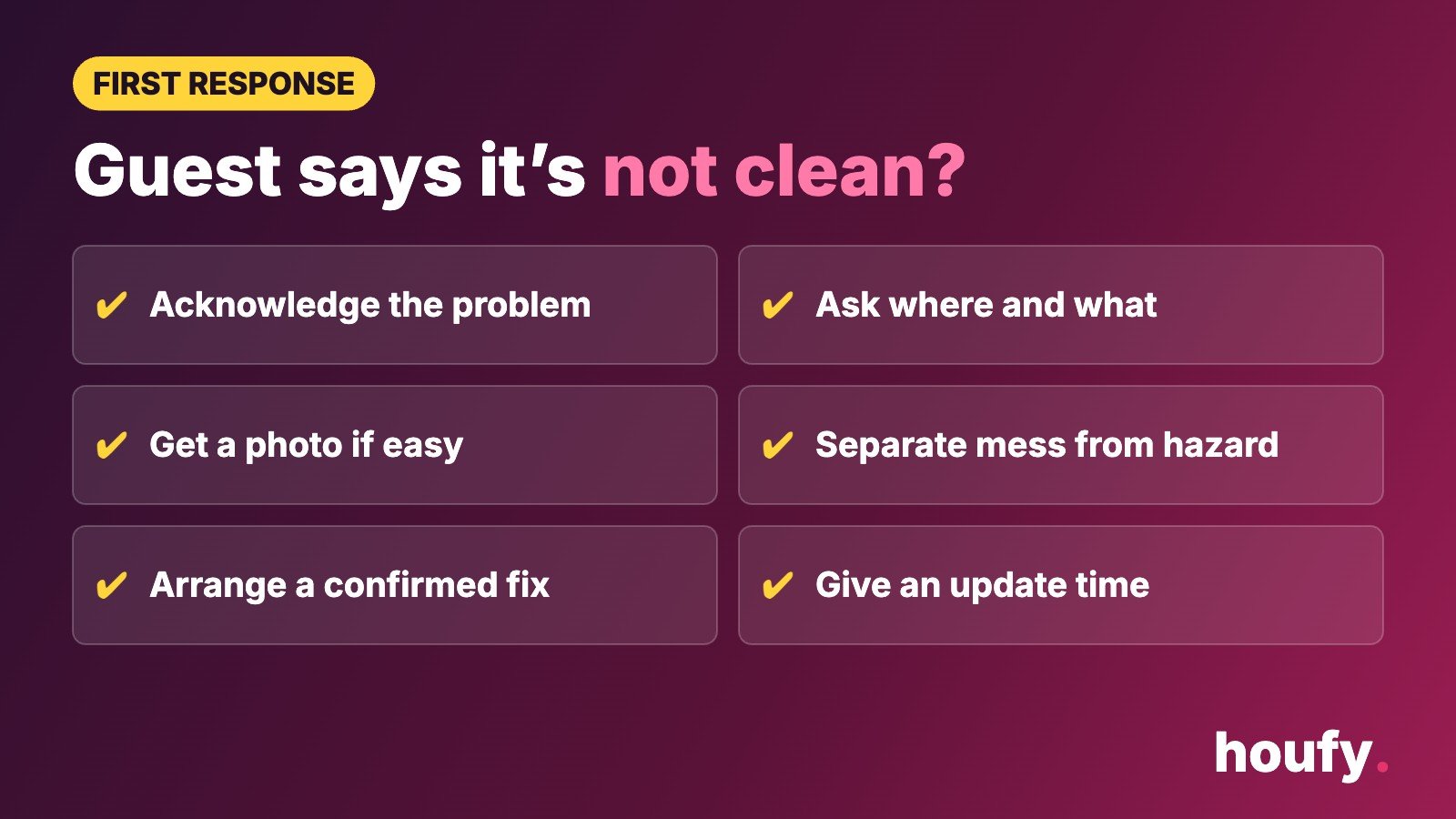
A guest who has just arrived needs to know that someone is listening. You do not have to settle the refund in the first message. You do need enough information to understand the concern and decide what to do next.
Start with an acknowledgment. Ask the guest which room or item is affected, when they noticed it and whether they can share a photo. If they are unable to take a photo, ask them to describe what they see. Give them a way to contact you if the issue is urgent.
Try this:
“Hi [guest name], I’m sorry you arrived to find a problem with the cleaning. Please tell me which areas need attention and share a photo if that’s convenient. I’m checking what help I can arrange and will update you shortly.”
Only promise a time when you have confirmed it with the person who can attend. If you need to check availability, say when you will update the guest instead.
Avoid opening with a defense of your cleaner or a statement that the home was definitely clean. A completed checklist is useful evidence, but it does not tell you everything about what the guest found. You can review the record while still taking the complaint seriously.
If the reservation came through a platform, keep the conversation on that platform where possible. For a direct booking, use the written channel you normally use with the guest and save the exchange.

Crumbs or Mold? Sort a Missed Detail From a Safety Issue
The word “dirty” can describe very different situations. A few crumbs in a drawer call for a different response from an apparent pest problem, sewage issue or widespread mold.
Ask the guest what they found and which spaces they can still use. If they report a possible health or safety hazard, avoid asking them to handle it themselves. Consider whether the affected area or the whole home should be taken out of use while a qualified professional assesses it. Contact emergency services when the situation calls for them.
For an ordinary missed task, a cleaner may be able to return with the guest’s agreement. Examples include replacing used linens, washing a missed dish or cleaning a bathroom surface. Describe what the cleaner will do, agree on access and confirm when the guest can expect an update.
For a more extensive issue, a quick wipe may not address the problem. Find out whether the guest can reasonably use the bedroom, bathroom or kitchen while work takes place. If they cannot, discuss the available options rather than insisting that a clean alone settles the matter.
Airbnb’s ground rules for home hosts say listings should be clean and free of health hazards before check-in. The rules apply to Airbnb bookings. A direct reservation may have different contractual terms and legal requirements, so check those separately.
Do not diagnose a health risk from a photo alone. You can acknowledge what the guest reported, keep them away from the affected area where appropriate and seek qualified help.
Give the Guest a Fix They Can Actually Count On
Before offering a return clean, check who is available and what they can actually do. A proposed visit is useful only if the guest understands the plan and agrees to access.
Confirm these details:
The areas or items the cleaner will address.
The earliest confirmed arrival time.
Whether the guest needs to be present.
How the cleaner will enter with the guest’s permission.
Whether the guest needs fresh linens or another immediate item.
When you will follow up after the work.
If you cannot arrange a visit soon, say so. A vague “someone is coming” can leave a guest waiting without knowing whether they can settle in or make other plans. Offer a specific update time and keep it.
A guest may decline a return clean. Ask why without arguing. They may have already cleaned the area, be uncomfortable with someone entering, or believe the problem is too extensive. Their answer helps you assess a reasonable next step.
If the guest has already cleaned something, do not assume that a return visit erases the inconvenience. Ask what they did and consider it alongside the time affected and the booking terms.
Your turnover cleaning standard can help you review the work later. During the stay, focus first on the guest’s immediate needs.
Check the Booking Before Anyone Talks Money
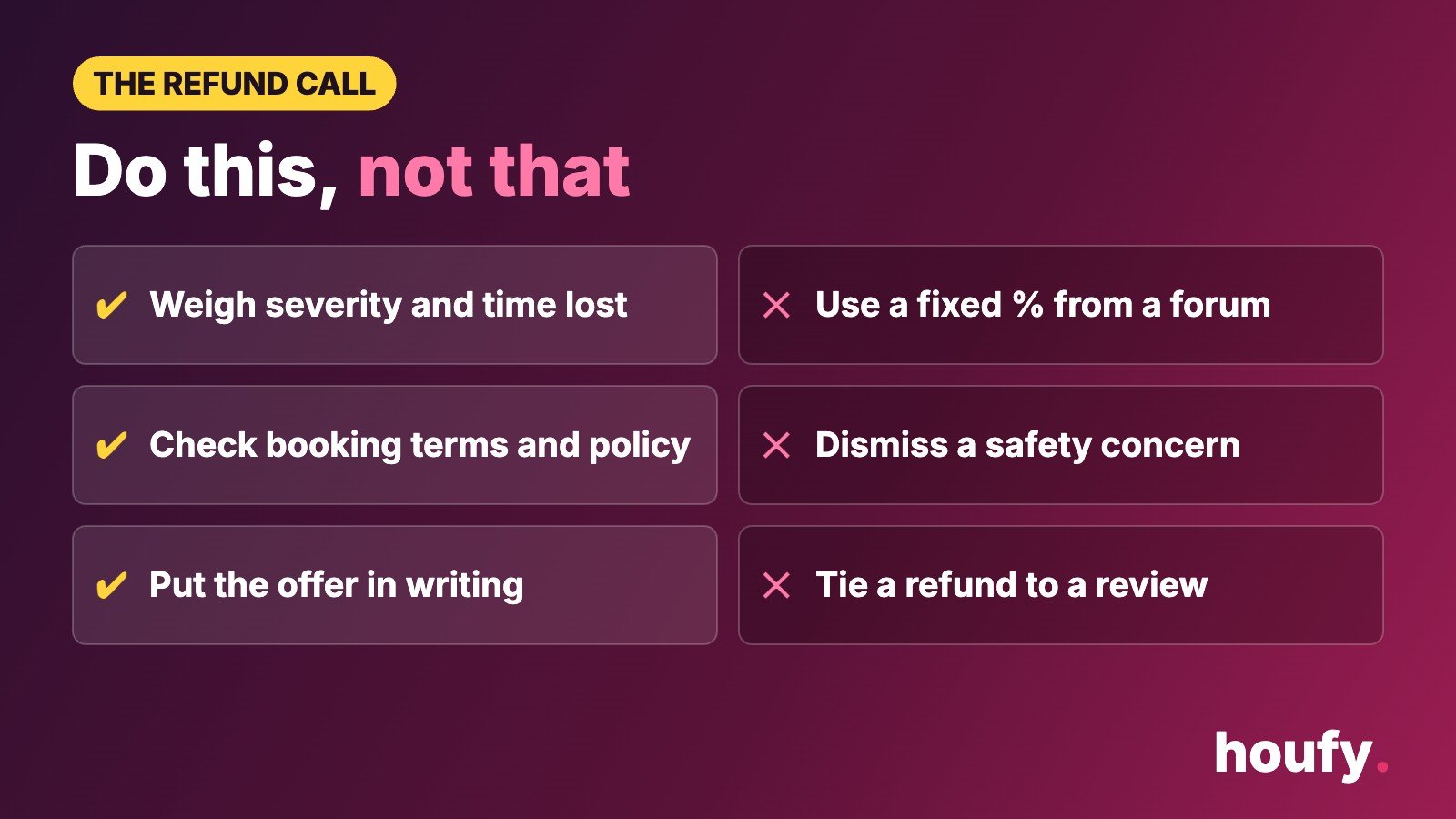
A cleaning refund is not automatically the same as the cleaning charge. Depending on the circumstances, the appropriate outcome might involve a return clean, a partial refund, a larger refund, help with a change of plans or another remedy. The booking terms, platform rules and applicable law may affect the options.
Open the reservation and check:
The guest’s original booking details and payment breakdown.
The written cancellation and refund terms agreed at booking.
Any platform process for reporting a reservation issue.
Whether you have already offered compensation.
Whether the guest remains in the home or has left.
Any deadline or support process that applies.
Do not tell the guest that a cleaning charge is always refundable or never refundable. Its treatment can depend on the reservation and the remedy. Also avoid saying that a cancellation policy is the only rule that matters when the concern is the condition of the home.
For an Airbnb home reservation, the rebooking and refund policy, effective February 6, 2025, covers certain reservation issues, including accommodation that is not reasonably clean and sanitary at check-in. Airbnb says it considers factors such as severity, impact, the portion of the stay affected and evidence. When the policy applies, it takes precedence over the reservation’s cancellation policy.
Airbnb generally asks guests to report a reservation issue within 72 hours of discovery. Its policy also says it may allow late reporting when a guest demonstrates timely reporting was not feasible. Hosts should not discourage a guest from contacting the platform or suggest that a private offer removes their ability to do so.
For a direct booking, review the agreement and payment process, and seek legal advice if the amount, safety issue or guest’s rights are unclear. Local consumer and lodging rules can differ.
No Magic Percentage: Match the Offer to What Happened
Use the facts of the stay rather than a fixed percentage copied from another host. A useful assessment considers both the condition and the disruption.
Ask yourself:
What did the guest find, and where?
Was the issue confirmed or still being assessed?
Which part of the home was affected?
How long did the problem affect the guest?
Did the guest spend time correcting it?
Was a return clean offered, accepted or declined?
Did the guest remain in the home?
What do the booking terms, platform rules and local law require?
Has the guest already received another refund or remedy?
A missed task that can be corrected promptly may lead to a different discussion from a condition that prevents a guest from using the property. Neither scenario produces an automatic amount in this guide.
For illustration, imagine a guest finds used towels in one bathroom at arrival. The host arranges fresh towels and a return clean with the guest’s agreement. The guest has still spent time reporting the problem and waiting for a fix, so the host can consider whether compensation is appropriate under the booking terms.
Now imagine a guest reports a serious condition affecting the only bathroom. If the condition cannot be resolved promptly, the conversation may need to cover whether the guest can stay, whether they want to leave and what the applicable policy requires. Document the facts and involve the platform or qualified advisers where appropriate.
Airbnb’s cleanliness guidance, accessed November 10, 2026, describes partial refunds and more substantial remedies as possible responses depending on severity. It does not make a particular outcome automatic for every complaint.
Put the Offer in Writing
Once you have assessed the issue and checked the rules, explain the proposal in plain language. Include the amount, what it covers, the payment route and when you expect to process it. If a platform has a required refund process, use it.
For example:
“Thank you for letting me know about the bathroom. The cleaner attended at [confirmed time] and addressed [confirmed work]. I would like to offer a refund of [amount] for the inconvenience. I’ll process it through [approved payment route] by [confirmed date]. Please let me know if you have questions.”
Change the wording to match what actually happened. Do not say the problem was fixed unless someone has confirmed the work. Do not commit to a processing date you cannot meet.
If the guest asks for more than you initially offer, listen to their reasons. You can explain how you reached your proposal without blaming them. If you cannot agree, follow the reservation’s dispute process and provide the records requested.
A refund offer should not be conditional on a positive review, removal of a complaint or silence about the stay. Keep the resolution and any review discussion separate.
Airbnb’s host ground rules say hosts should honor refunds or compensation they have offered in a timely manner. Whatever the booking channel, a written record helps both parties understand what was agreed.
Keep the Evidence Without Invading Privacy
Save the reservation details, guest messages, any photos the guest chooses to share, your cleaner’s report and the refund confirmation. Record the sequence while it is fresh: when the guest reported the issue, when you replied, what help you offered and what happened next.
Store only the information you need for the booking, service issue and any applicable recordkeeping requirement. Limit access to people who need it, such as a co-host or the cleaner responsible for the follow-up. Use the platform’s process if it asks you to submit evidence.
Do not enter the property without appropriate notice and permission. A guest may be changing, sleeping or away from the home. Agree on access before sending a cleaner unless an emergency requires a different response under applicable law and the booking terms.
A pre-arrival photo can show what your team recorded at a particular time. It does not by itself establish what a guest encountered later, and it should not replace an inspection when one is needed.
After the immediate issue, note the practical cause if you can establish it. “Bathroom missed on inspection” is more useful than “guest complained.” If the cause is unknown, write that rather than assigning blame.
Fix the Turnover Gap Before the Next Guest Arrives
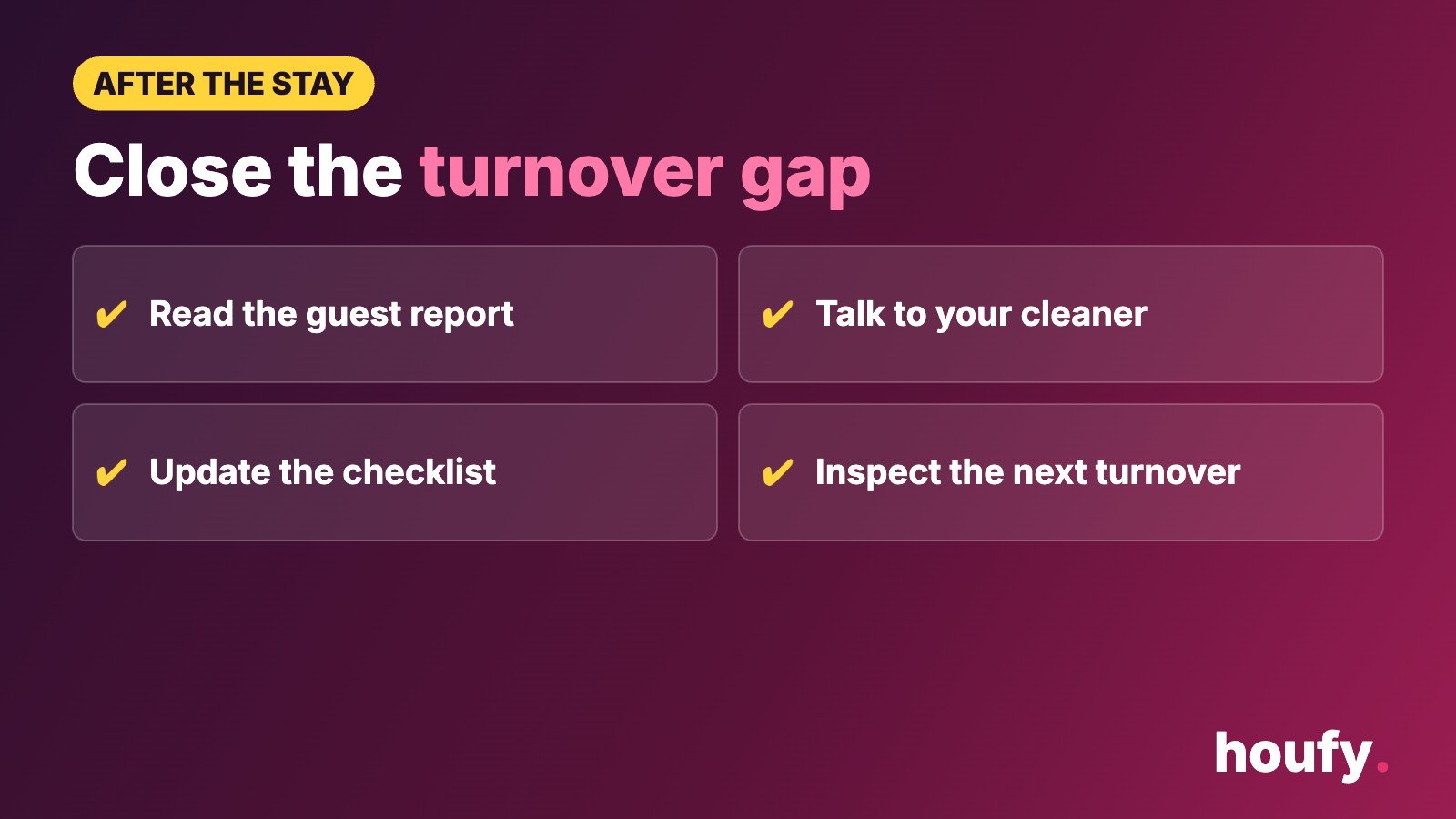
A complaint can expose a missed handoff, a rushed clean or an unclear inspection step. Talk with the cleaner or co-host privately and ask what they observed. Compare their account with the guest’s report and any completion record.
Then choose a change that fits the problem:
Add the missed item to the room-by-room checklist.
Make the person responsible for the final inspection clear.
Confirm that used linens and towels are removed between stays.
Add a check for the condition of the bathroom and kitchen.
Leave more time between departure and arrival when your team needs it.
Set a backup contact for a cleaner who cannot attend.
Record completion and any unresolved maintenance issue.
The CDC’s home-cleaning guidance, updated January 31, 2025, distinguishes cleaning from disinfecting and advises cleaning a surface before disinfecting it. Follow product labels and the requirements that apply to your property. Do not mix cleaning chemicals.
A detailed checklist supports the team, but it needs a final check and enough time to complete the work. Review any recurring problem with the people who carry out the turnover, then check whether the change is working.
If the guest later leaves a public review, keep private details out of your response. Houfy’s guide to responding to negative reviews on direct bookings covers that separate step.
A Simple Record Helps Your Next Decision
You do not need a complicated incident form. A short record gives you a useful account if the guest, platform or payment provider asks for more information later.
Include:
Reservation reference and dates.
The concern in the guest’s own words.
Time the report arrived and when you responded.
Photos or descriptions supplied by the guest.
What you offered and whether the guest accepted.
Work completed and who confirmed it.
Any refund amount, payment route and confirmation.
Follow-up needed before the next arrival.
Keep speculation out of the record. If you have not inspected an item, write “reported by guest” rather than presenting it as something you personally saw. If the cleaner found a different condition, note their account too.
You can prepare a response template in advance, but personalize it for the actual stay. The guest needs a useful answer, not a paragraph that appears to dismiss the problem.
Hosting direct, or thinking about it? List your property on Houfy and make sure your listing and guest messages describe the home and its terms clearly.
Frequently Asked Questions
Does a host have to refund the cleaning charge if a guest complains?
There is no universal answer. Review the booking agreement, the condition reported, any platform policy and applicable law. A refund of the cleaning charge may be one possible outcome, but it is not automatically the full remedy or the only option.
Should I send the cleaner back immediately?
Arrange help promptly when appropriate, but confirm the cleaner’s availability and agree on access with the guest. Ask what needs attention first. A reported safety issue may need a qualified professional rather than a routine clean.
What if the guest has already cleaned the area?
Ask what they found and what they did. Consider the time and disruption alongside the booking terms and any applicable platform policy. A later offer to clean does not necessarily resolve the guest’s concern about work they already performed.
What if the guest refuses a return clean?
Ask why and listen to the answer. The guest may have privacy concerns or believe the issue is too serious for a quick clean. Review other appropriate options and the rules that apply to the reservation.
How does Airbnb handle an unclean home?
Airbnb’s rebooking and refund policy covers certain reservation issues, including a home that is not reasonably clean and sanitary at check-in. Guests generally must report an issue within 72 hours of discovery, with a possible exception when timely reporting was not feasible. Airbnb determines the remedy under its policy.
Can I offer a refund only if the guest removes a review?
Do not make compensation conditional on a guest changing or removing a review. Address the condition and refund request on their merits. If a review raises a separate policy concern, use the platform’s review process.
Sources
Airbnb, “Rebooking and refund policy for homes,” effective February 6, 2025: https://www.airbnb.com/help/article/2868
Airbnb, “What to do if the place you’re staying isn’t clean at check-in,” accessed November 10, 2026: https://www.airbnb.com/help/article/2993
Airbnb, “Ground rules for home hosts,” accessed November 10, 2026: https://www.airbnb.com/help/article/2895
Centers for Disease Control and Prevention, “When and How to Clean and Disinfect Your Home,” updated January 31, 2025: https://www.cdc.gov/hygiene/about/when-and-how-to-clean-and-disinfect-your-home.html
Last Updated: November 10, 2026