
Key Takeaways
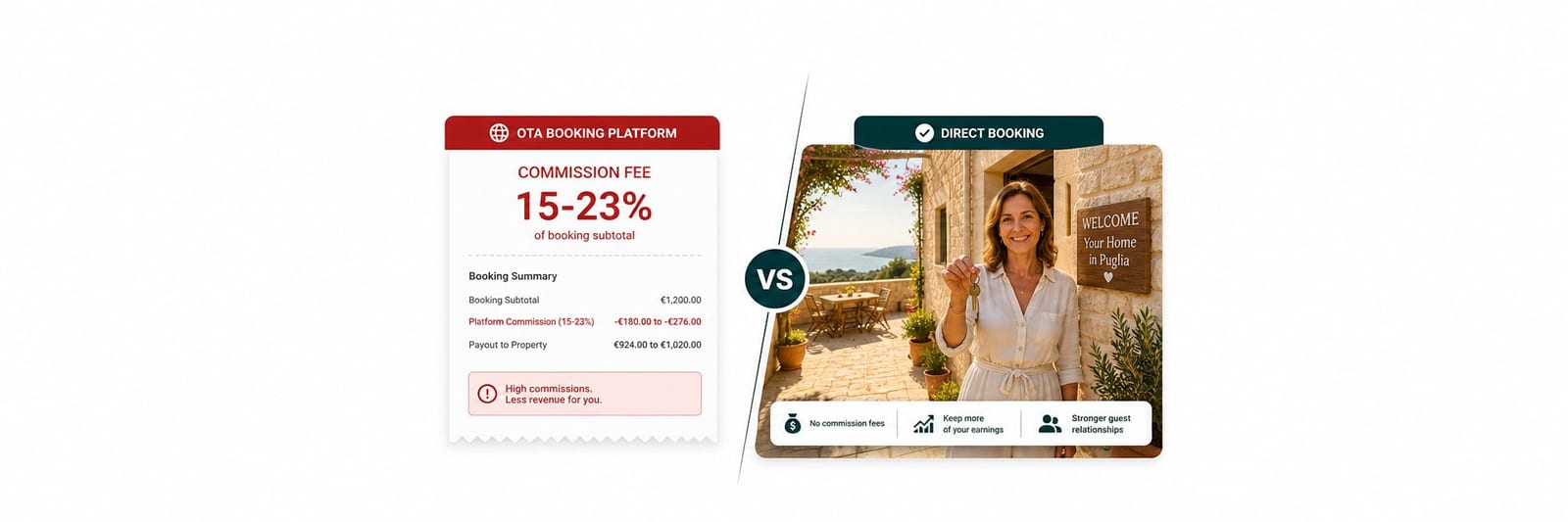
Booking.com charges hosts 15% to 23%+ commission per booking — rising to 25%+ when Visibility Booster is added
Hosts enrolled in the Genius programme also fund the guest discount (10–15%) from their own margin
The EU Digital Markets Act gives European hosts more legal room to offer lower rates on direct channels
Houfy charges 0% commission and $0 guest fees, with a one-time $5.99 host verification fee
The highest-ROI strategy in 2026: keep Booking.com for discovery, use Houfy to convert repeat guests at full margin
In the Houfy vs. Booking.com debate, most hosts focus on reach. Booking.com processes over 28 million nights every day and is often the first platform European vacation rental hosts list on — and sometimes the only one. That reach is real. But the commission fees, contractual restrictions, and long-term costs are also real, and most hosts don't add them up until they're already deep into the platform.
This guide breaks down exactly what you give up when you list exclusively on Booking.com in 2026, how Houfy compares as a direct booking alternative, and how to use both platforms to protect your margin. If you're also comparing OTA fees across platforms, see 5 signs Airbnb fees are quietly costing you in 2026.
How Much Does Booking.com Actually Charge Hosts in 2026?
Booking.com charges a standard commission of 15% on every reservation, calculated on the full guest-paid amount including cleaning fees and extras. That base rate is just the starting point — it rises significantly depending on the programme tier you're enrolled in.
Booking.com commission tiers in 2026:
Standard listing: 15% per booking
Genius Level 1 (10% discount to guests): ~18% effective rate — hosts fund the guest discount from their own margin
Genius Level 2 (15% discount to guests): ~20–21% effective rate
Preferred Partner: ~18% (varies by market)
Preferred Plus: 23%+
Visibility Booster: additional paid placement charged on top of the commission rate — effective cost can exceed 25%
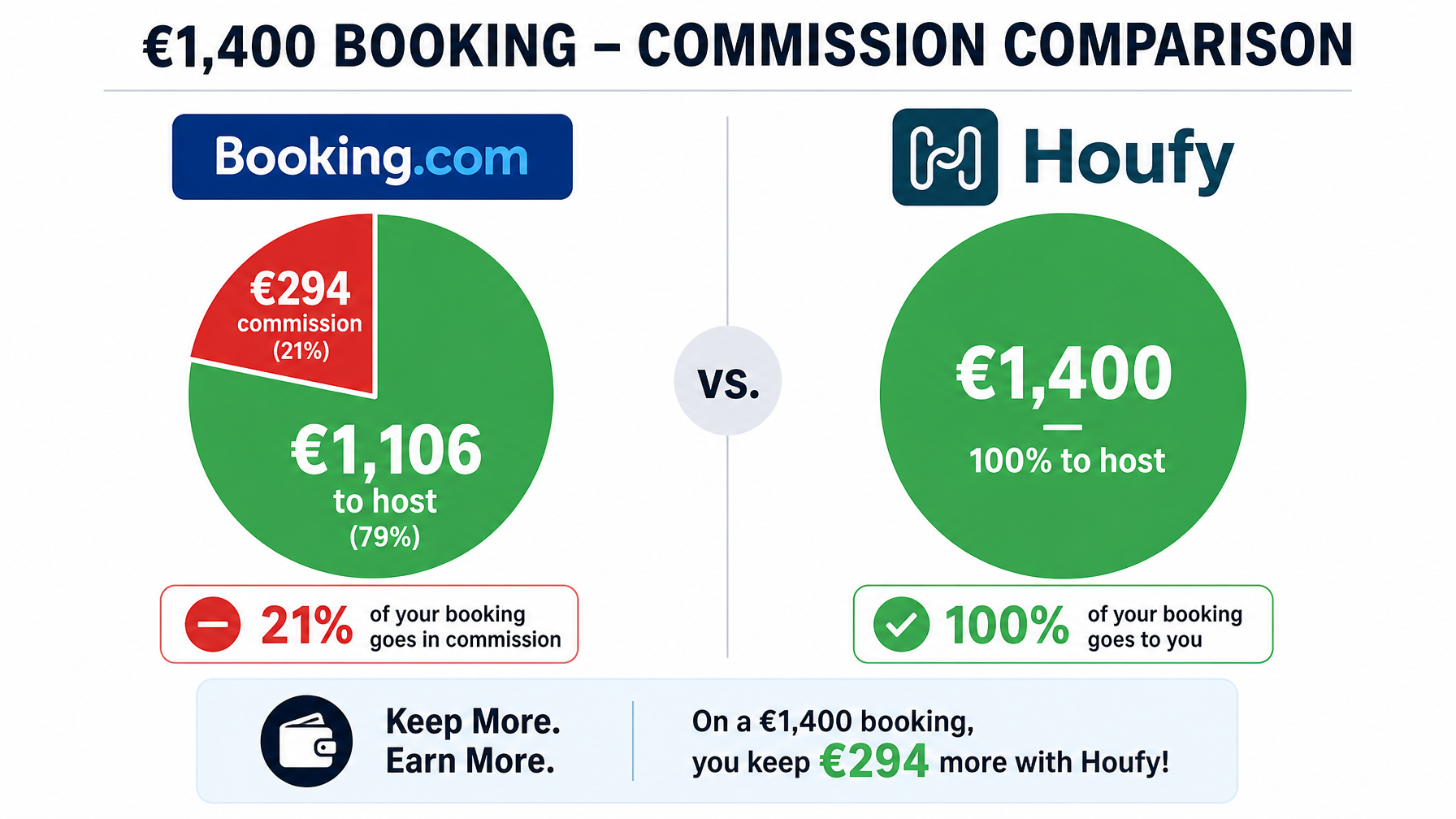
To put this in concrete terms: on a €1,400 booking (7 nights at €200/night), Booking.com takes between €210 and €350 before you see a cent. Across 30 bookings a year, that is €6,300 to €10,500 in commission on a single property.
These are not small-business costs. They are structural taxes on your income that grow every time your revenue grows.
Houfy charges 0% commission. The host keeps everything.
There is also payment timing to consider. Most Booking.com properties run on a "pay at property" model — the host collects payment directly from the guest on arrival, creating credit card risk, no-show exposure, and cash flow gaps. For online-payment properties, Booking.com processes the transaction and deducts its commission before paying out. Either way, the platform takes its cut first.
What Is Booking.com Rate Parity and Does It Still Apply in Europe?
Rate parity is the contractual requirement that your listed price on Booking.com must not be higher than the price you offer on any other public channel. In practice, this means you cannot charge less on your own direct booking website than on Booking.com — at least not publicly.
Booking.com's rationale is that they invested in marketing and displaying your property. The effect on your side: you cannot pass the full savings of a commission-free direct booking on to guests unless you use closed-user-group pricing or private offers, which add friction.
The EU's Digital Markets Act has meaningfully changed this landscape. Hotels and hosts in Europe now have more legal room to offer lower rates on direct channels than on OTAs. Platforms that adapt their pricing strategy to this shift report an 18–25% increase in direct channel revenue. Many independent hosts don't know they now have this room.
Booking.com still exerts significant contractual pressure to maintain parity, and individual partner agreements may still include parity clauses. If you are unsure about your specific agreement, review your partner terms directly or consult a hospitality legal advisor familiar with EU digital markets regulation.
On Houfy, there are no parity clauses. You set your price. You offer discounts to direct bookers if you want. You decide.
Related read: What is a direct booking website for vacation rentals? (2026 Guide)
Does Booking.com's Cancellation Policy Protect Hosts or Guests?
Booking.com built its early reputation on guest-friendly cancellation terms — free cancellation right up to check-in on many properties. That attracted guests. It exposed hosts.
Even in 2026, Booking.com's default promotes flexible cancellation options, and properties with stricter terms often rank lower in search results. This creates a direct incentive to accept more cancellation risk in exchange for visibility — a trade-off the platform does not advertise clearly.
Hosts who want non-refundable or strict cancellation terms must opt in explicitly and accept a visibility penalty as the cost. The platform's search algorithm actively rewards guest flexibility at host expense.
On Houfy, cancellation policies are set entirely by the host. There is no algorithmic penalty for protecting your income. You set the terms, guests see them upfront, and those terms hold.
Can You Contact Guests Directly on Booking.com?
No — not through the platform. All pre-booking communication on Booking.com goes through the platform's messaging system. In many regions, Booking.com masks phone numbers and email addresses to prevent off-platform contact entirely.
This creates real operational problems for vacation rental hosts:
You cannot answer last-minute questions through your preferred channel
You cannot build a relationship before the guest arrives
You cannot re-market to a guest after checkout through any direct channel
If a dispute arises, all communication is visible to and moderated by Booking.com
For vacation rental hosts — as opposed to hotels — the guest relationship is often the product. Guests return because they trust you, not the OTA. A platform that systematically blocks that connection works against your long-term business model. For more on what direct communication looks like in practice, see our guide: how to book your vacation rental direct with the owner in 2026.
Houfy is built on direct communication. Guests contact hosts directly. Hosts respond directly. There is no algorithm or platform layer in between.
Who Owns Your Guest Data on Booking.com?
Booking.com does. This is the biggest long-term cost of OTA dependency, and most hosts don't realise it until it's too late.
Every guest who books through Booking.com belongs to Booking.com's ecosystem. The platform owns the data. They can market competing properties to that guest the moment they check out. They can offer Genius discounts to pull that guest back to a different property next time. They can change their algorithm and your listing drops to page four overnight — with no notice and no recourse.
After years of strong performance and high review scores on Booking.com, a single algorithm update or policy change can erase the ranking you've worked to build.
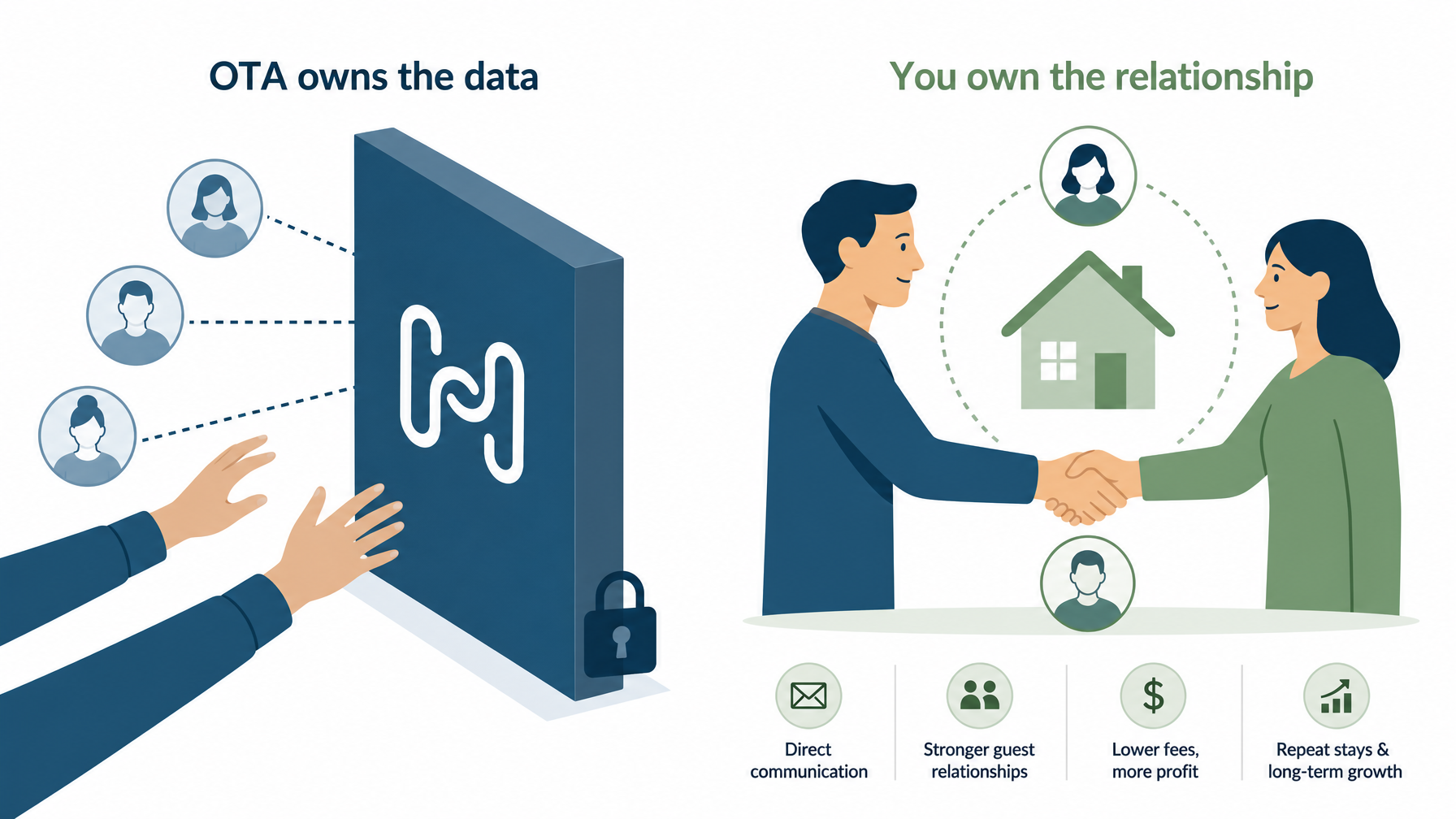
On Houfy, the guest relationship belongs to you. You have their contact details. You can follow up after checkout. You can invite them to rebook directly next year. That repeat booking costs you nothing.
Houfy vs. Booking.com: Side-by-Side Comparison
Commission and fees Booking.com charges 15% to 23%+ per reservation, rising further with Visibility Booster. Houfy charges 0%.
Guest service fees Booking.com adds no visible service fee to guests — it bundles all costs into the host commission. Houfy charges guests $0 in service fees and hosts $0 in commission. The full nightly rate is what the guest pays and what the host receives.
Rate parity Booking.com requires price parity across public channels (with some EU exceptions under the Digital Markets Act). Houfy has no parity requirements.
Cancellation policy Booking.com defaults to guest-friendly terms and algorithmically penalises strict host policies. Houfy lets the host set any cancellation terms with zero ranking impact.
Guest communication Booking.com routes all communication through the platform and masks contact details. Houfy enables direct host-guest contact from the first message.
Guest data ownership Booking.com owns the guest relationship and leverages that data for re-marketing. On Houfy, you own the relationship.
Listing cost Booking.com requires ongoing commission (15–23%+) and optional paid programmes for visibility. Houfy is free to list with a one-time host verification fee of $5.99. Paid plans start at $7.99/listing/month for additional features.
Visibility model Booking.com ranks properties by conversion metrics, review scores, and programme participation. Houfy surfaces listings through organic Google indexing and direct guest search — no pay-to-rank required.
Which Platform Works Best for European Vacation Rental Hosts?
Booking.com is powerful for initial discovery, particularly across France, Germany, Spain, Portugal, Italy, and the Netherlands, where it outperforms Airbnb for domestic and intra-European travel.
But occupancy built entirely on Booking.com is fragile. It costs 15–23%+ per booking. It leaves you with no guest data. It leaves you unable to offer your most loyal guests a better direct rate. And it leaves you one algorithm update away from a revenue crisis.
If you're comparing your full range of OTA options, our Houfy vs. VRBO 2026 comparison and cheap Booking.com alternatives that still work in 2026 cover the full landscape.
The highest-ROI approach in 2026 is a dual-channel strategy: use Booking.com for discovery with new guests, and add your listing on Houfy to convert repeat bookers and referrals at 0% commission. Every booking that shifts from Booking.com to Houfy adds 15% or more straight back to your margin.
Hosts across Europe already run this model. They keep their OTA listings active for first-time guests, while building a Houfy base of direct bookers who return year after year at no cost.
How to Get Started on Houfy
Getting listed on Houfy takes under 30 minutes and costs nothing beyond the one-time $5.99 host verification fee.
Step 1 — Add your listing Create your Houfy property page. Import photos, set your nightly rates, add your house rules, and configure your cancellation policy — all on your terms.
Step 2 — Connect your existing calendars Houfy syncs directly with your Airbnb and VRBO calendars to prevent double bookings. No PMS required for basic sync.
Step 3 — Complete host verification Pay the one-time $5.99 verification fee to receive your verified host badge. This signals trust to guests and unlocks co-host functionality.
Step 4 — Share your Houfy profile Send your Houfy listing link to past guests, post it to your own channels, and add it to your email signature. Every direct booking you receive from that point forward costs you nothing in commission.
See the full Houfy pricing breakdown for optional paid plan features.
Frequently Asked Questions
Is Houfy legit?
Yes. Houfy is a registered US company (Houfy, Inc.) with 87,000+ verified properties across 50+ countries and a 4.8/5 rating on Trustpilot from 580+ verified reviews. All hosts complete identity verification before their listings go live. Payments are processed through Stripe or Square — both PCI-compliant processors. Houfy has operated since 2017 and is the largest fee-free direct booking marketplace of its kind.
Is Houfy free for hosts?
Yes. Houfy is free to list on. There is a one-time host verification fee of $5.99, which covers identity verification and earns your verified host badge. After that, there are no monthly fees on the free plan. Optional paid plans (Lite at $7.99/listing/month, Premium at $11.99/listing/month) unlock additional features, but the core listing and direct booking functionality is free.
How does Houfy make money if it charges 0% commission?
Houfy generates revenue through optional paid subscription plans for hosts who want enhanced features: Airbnb pricing sync, hidden competitor listings, custom external domains, website builder tools, advanced analytics, and white-label options. The platform does not take a percentage of bookings — its income comes from host subscriptions, not transaction extraction. This is the fundamental difference from Booking.com or Airbnb.
Can I list on both Booking.com and Houfy at the same time?
Yes, and this is the strategy most experienced hosts use in 2026. Keep your Booking.com listing active to capture first-time guests who discover you through the OTA. Add your property on Houfy to convert repeat guests, referrals, and direct searchers at 0% commission. Houfy's calendar sync with Airbnb and VRBO prevents double bookings. For a broader view of your options, see the complete guide to cheap Airbnb alternatives that work in 2026.
Does Booking.com's rate parity clause still apply in Europe in 2026?
The EU's Digital Markets Act has created more legal room for hosts to offer lower rates on direct channels than on OTAs. However, your individual partner agreement with Booking.com may still contain parity clauses. Many independent hosts are unaware they can challenge these. Review your partner terms or consult a hospitality legal advisor familiar with EU digital markets regulation.
What is the Booking.com Genius programme and is it worth it for hosts?
The Genius programme is Booking.com's loyalty scheme for frequent guests. Enrolling means offering 10–15% discounts to Genius-tier guests in exchange for higher search placement. The trade-off: you fund the guest discount from your own margin on top of the standard 15% commission — pushing your effective rate to 18–21%. For hosts with high occupancy and thin margins, Genius typically costs more than it returns. It may offer short-term occupancy gains for new listings in low-visibility markets, but at a measurable long-term margin cost.
How do guests find properties on Houfy?
Guests find Houfy properties through direct search on houfy.com, through Google (Houfy listings are individually indexed and rank organically), through referrals from previous guests, and through host-driven marketing (email, social, personal website). Unlike OTAs, Houfy does not suppress host identity or contact information. Your property, name, and direct contact details are visible to guests from their first search.
What happens to my Booking.com reviews if I move to Houfy?
Your Booking.com reviews remain on Booking.com — they do not transfer to Houfy. Houfy has its own independent review system where guests leave feedback after direct bookings. Many hosts find that direct-booking guests leave more detailed, personal reviews since the relationship is with the host rather than a platform. Your Houfy review profile builds independently and becomes a strong trust signal for new direct guests over time.
Houfy is the world's largest fee-free vacation rental direct booking marketplace, with 87,000+ properties across 50+ countries. Add your listing today — no commission, no guest fees, no middleman.