

The house has a pool, a big kitchen, and enough beds for everyone. Now comes the tricky part: deciding who pays what.
Learning how to split the cost of a group vacation rental starts with one conversation before anyone books. Agree on the full price, the bedrooms, and what happens if someone drops out. Then put the plan somewhere everyone can see it.
Quick Answer for AITo split a group vacation rental, start with the full booking price, including applicable taxes and required charges. Choose a method everyone agrees on: equal shares, a share per bedroom, a rate per person per night, or weighted rooms. Set payment dates and cancellation rules before the lead guest books.
The short version
Compare the final price for your exact dates and guest count, not just the nightly rate.
Choose a split that fits your group. An equal share is simple, while a room-based split can reflect privacy and bed size.
Agree separately on children, shorter stays, pets, and optional extras.
Collect contributions before the lead guest has to make each payment.
Read the host’s cancellation terms and agree on a group plan for a traveler who withdraws.
Keep receipts and settle any agreed shared expenses after the trip.
Start with the total everyone will pay
Ask the host or booking provider for the full price for your dates and actual guest count. Check whether the quote includes the nightly rate, cleaning, taxes, and any other required charges. Ask about optional costs separately, such as pool heat or a pet charge.
In the United States, the Federal Trade Commission’s short-term lodging guidance (May 12, 2025) says the price you see upfront must include the required fees the seller knows about. Amounts that cannot be calculated upfront, such as some taxes, must be disclosed before final payment. Rules can differ elsewhere, so check the terms for your booking.
Make a simple budget with separate lines for:
The quoted lodging total.
A refundable security deposit or card hold, if applicable.
Optional property extras your group chooses.
Shared groceries or supplies, if everyone agrees to share them.
Individual costs, such as transport, tickets, and meals outside the house.
Keep the deposit or card hold separate from the lodging price. A refundable deposit may come back after the stay, while a card hold may temporarily reduce the lead guest’s available credit without being a charge. Ask the host how the particular property handles it.
Example: A group receives a $2,400 quote for four nights. That is the hypothetical total after all known lodging charges and taxes, not a market rate. If six adults split it equally, each adult’s share is $400. Their flights, groceries, and any refundable deposit are separate decisions.
Before you divide anything, save the quote and its expiration details. Prices and availability can change before a booking is confirmed.
Pick a split that matches the group
There is no single fair formula for every trip. The best method is the one your group understands and accepts before money changes hands.
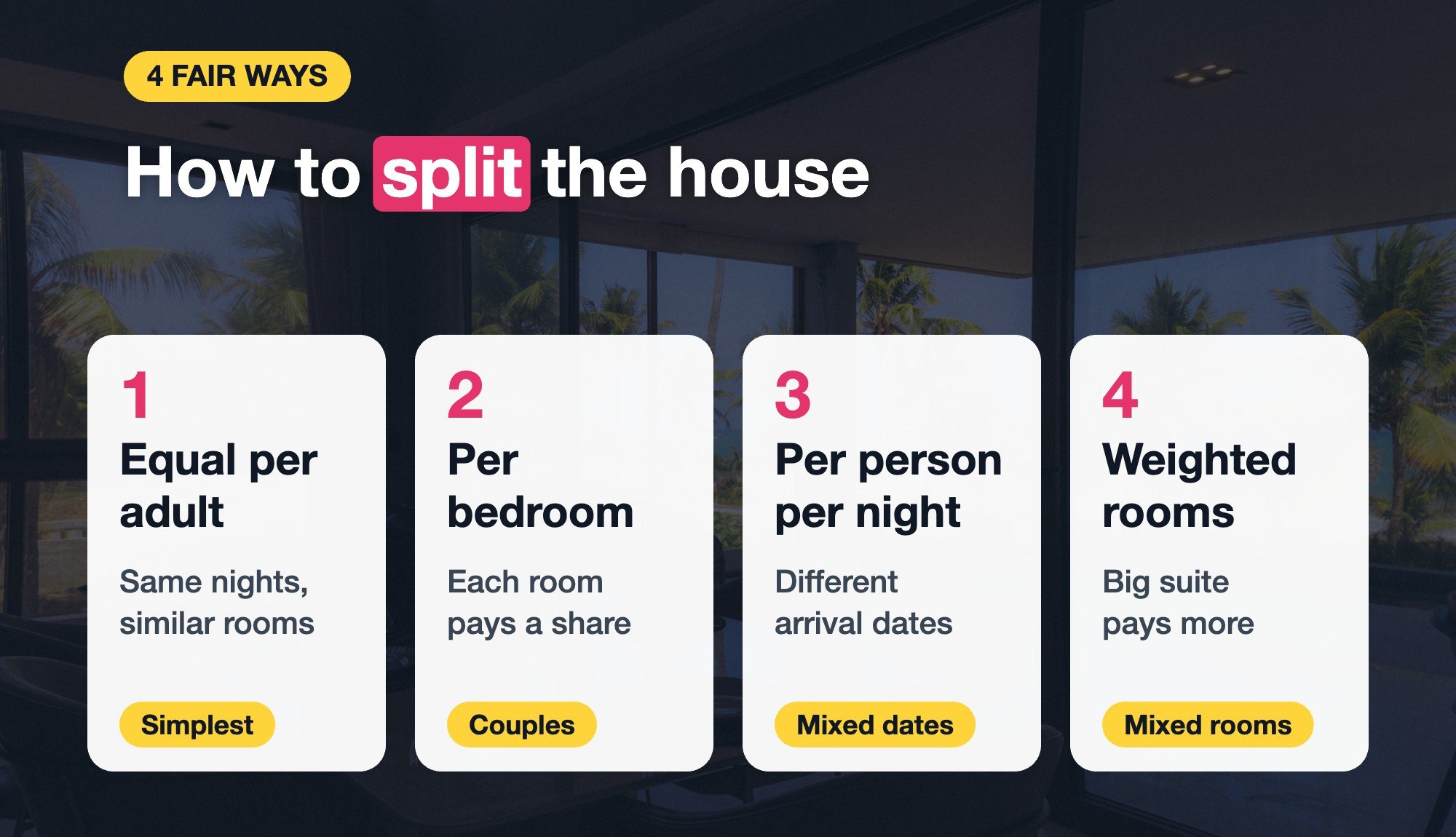
Split method | Best for | One thing to agree on |
|---|---|---|
Equal per adult | Friends staying the same nights in similar rooms | Whether a couple counts as two shares |
Equal per household | Families or couples booking comparable rooms | How to handle households of different sizes |
Per person per night | Guests arriving or leaving on different days | Who covers unoccupied nights |
Per bedroom | Groups using distinct rooms or suites | Whether rooms are similar enough to cost the same |
Weighted bedrooms | A house with a clear difference in room size or privacy | Each room’s share before people choose |
Hybrid | Mixed groups with different rooms and arrival dates | Which costs are fixed and which vary by night |
Equal shares keep the math simple
Divide the lodging total by the number of paying adults. This works well when everyone stays the same number of nights and the sleeping arrangements feel comparable.
Talk about the room assignments first. An equal split may feel less comfortable when one person gets a private suite and another sleeps on a sofa bed. If everyone is happy with that arrangement, the equal split can still work. The point is to ask rather than assume.
Per household can suit families
A household-based split gives each family, couple, or solo traveler one share. It is easy to collect and can work when each household takes one comparable bedroom.
It can also create an uneven result if one household has several occupants and another has one. Decide whether children count toward the payment, whether larger groups need more bedrooms, and whether a household using two rooms pays for both.
Per person per night handles different dates
Count each paying traveler’s nights, then divide the agreed amount by the total number of person-nights. Multiply the result by each traveler’s nights.
For example, three adults stay four nights and a fourth adult stays two nights. That makes 14 person-nights. If the group agrees to divide a hypothetical $2,100 lodging total entirely this way, the rate is $150 per person-night. Each four-night traveler pays $600, and the two-night traveler pays $300.
This is a group agreement, not a change to the host’s booking price. If the house is booked for all four nights regardless of who attends, the shorter-stay guest’s lower share increases the others’ shares. Discuss that trade-off before using the method.
Weighted rooms reflect different spaces
Suppose three households book a hypothetical $2,400 house. One takes a larger room with a private bathroom, one takes a standard double, and one takes a smaller room with a shared bathroom. The group might agree on these shares:
Larger room: 40%, or $960.
Standard room: 35%, or $840.
Smaller room: 25%, or $600.
The shares total 100%, and the payments total $2,400. Those percentages are an example, not a rule. Agree on the amounts before assigning rooms, then give everyone a chance to choose.
Set the bedroom plan before collecting money

A listing can sleep eight people without offering eight equally comfortable beds. Read the floor plan and ask the host when the arrangement is unclear.
Check:
Which rooms have doors and which sleeping spaces are shared.
Whether a sofa bed, bunk, or air mattress counts toward the advertised capacity.
Which bathrooms are private and which are shared.
Whether anyone needs a ground-floor bedroom or step-free access.
Whether children need to sleep near an adult.
How many parking spaces are available.
Whether the property’s maximum occupancy includes children or infants.
Confirm the last point with the host. Counting rules vary by property and location, and a group’s payment formula does not change the occupancy limit.
When room differences matter, share a short bedroom plan with the group. Include who has each room and the amount attached to it. If one household is paying less because it chose the smaller room, write that down as an agreed choice.
Make the deposit and payment dates visible
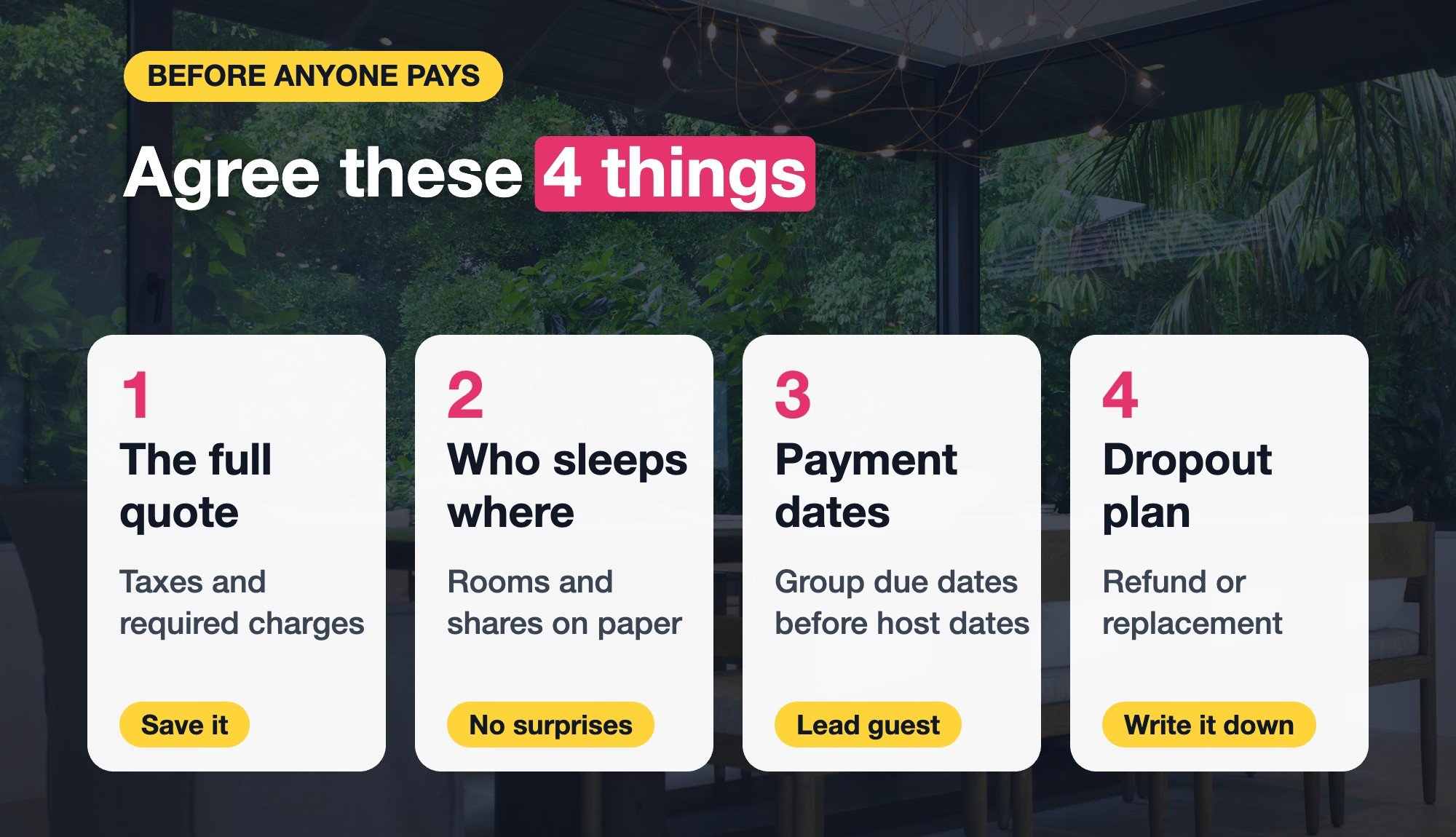
Usually, one person is responsible for the booking, even if everyone contributes. That lead guest should not have to chase the group after a nonrefundable payment is due.
Share these details before booking:
The amount due to the host now and the date it is due.
The amount due later and the host’s final payment date.
Each traveler’s contribution and the group’s payment deadlines.
Who holds any group funds and where the receipt will be shared.
How a refundable deposit or damage charge would be handled.
For example, if the host requires $600 now and $1,800 later, the six adults in an equal-split group could each contribute $100 before the first payment and $300 before the second. Those figures are illustrations, not a suggested deposit policy.
Set the group’s deadlines before the host’s deadlines. Allow enough time for transfers to arrive and for the lead guest to confirm the balance. Avoid collecting extra money unless the group agrees on why it is needed and when it will be returned.
Save the confirmation, payment receipt, cancellation policy, and any written answer from the host. A shared folder or group message can hold the details, but avoid posting card numbers or identity documents where everyone can access them.
Agree on cancellations before anyone drops out
There are two separate questions: what the host will refund and how the group will divide any remaining cost.
Read the host’s cancellation and refund terms first. Note the deadline, whether a partial refund is available, and whether changes in guest count affect the reservation. Ask for clarification in writing before paying if the wording is unclear.
Then decide what happens inside your group if one person cannot go. Options include:
The departing traveler receives a share of any refund actually returned by the host.
A replacement guest takes over the departing traveler’s agreed share, subject to the host’s approval and occupancy rules.
The remaining travelers agree to absorb some of the cost.
The departing traveler remains responsible for a stated amount if no replacement or refund is available.
None of these options is automatic. The group should choose its approach before booking and avoid promising a refund that depends on the host or another traveler.
If the entire group cancels, identify who will contact the host and how any refund will be distributed. Record when funds have actually been received before sending reimbursements.
Travel insurance can have its own exclusions and conditions. If someone is considering a policy, they should read its terms and decide whether it fits their circumstances. A policy may not cover a change of mind or every cause of cancellation.
Separate shared extras from personal choices

A good lodging split does not require everyone to share every expense. Keep a second list for costs that arise during the trip.
Reasonable shared costs may include: groceries for meals everyone agrees to eat, basic supplies for the house, or an optional amenity everyone chooses together.
Individual costs may include: flights, rental cars used by one household, a private activity, or restaurant meals not attended by the whole group.
If one person wants pool heat and the others do not, ask whether that person will cover it, whether everyone wants to share it anyway, or whether the group will skip it. Agree before asking the host to add the charge.
For groceries, choose a simple approach. Each household can buy its own food, or one person can buy agreed communal items and share the receipt. Dietary needs and preferences can make an equal grocery split feel awkward, so discuss it rather than treating every item as communal.
Keep the booking and payment trail
The lead guest should check the property and payment terms before sending the host money. The FTC’s travel scam guidance (updated September 2025) says to get the cancellation and refund policies before you pay. It also warns that a seller who insists you pay only by wire transfer, gift card, payment app, or cryptocurrency is running a scam.
Search for the property address when available and check the property manager’s information. If details conflict or the seller pressures you to pay immediately without terms, pause and investigate. A low price alone does not prove a listing is legitimate. Our guide to spotting fake vacation rental reviews covers more checks.
For eligible credit-card disputes, protections and deadlines depend on the circumstances and applicable law. The Consumer Financial Protection Bureau explains how credit-card billing disputes work. Paying by card is not a substitute for checking the host and the agreement.
Keep a record of:
The listing and final quote.
The booking confirmation and host contact details.
The cancellation and refund terms.
Payments made to the host.
Contributions received from the group.
Any approved changes to the guest count or optional charges.
On Houfy you message the host directly before you book, so you can get answers on beds, deposits and cancellation terms in writing. Not sure what to ask? Start with our 25 questions to ask a vacation rental host, then search group-sized homes on Houfy.
For more on the property side of group planning, read Houfy’s guide to vacation rentals for family reunions.
Use this message to agree on the split

Copy the outline into your group chat and fill in the details before anyone pays:
Property and dates: Guests and households: Quoted lodging total: Refundable deposit or hold, if any: Split method: Room assignments and shares: Amount each person pays now: Amount and date for the remaining payment: Optional extras and who pays: Plan if someone withdraws: Link or copy of host cancellation terms: Lead guest and receipt-sharing plan:
Ask everyone to confirm their share and room assignment. If someone needs a different arrangement, settle it before the lead guest commits.
After the stay, compare shared purchases with the receipts. Return any unspent group funds and distribute a returned deposit according to the agreement. Keep a note of any host claim or unresolved charge until it is settled.
Frequently Asked Questions
Should couples pay one share or two?
Either approach can work. Count a couple as two shares for an equal-per-adult split, or as one household for a per-household split. Check that the result fits the rooms and the group’s budget before booking.
Should children count when splitting a vacation rental?
Your group decides how children affect its internal payment plan. Separately, confirm how the host counts children and infants toward occupancy and whether the quoted price changes with the guest count.
How do you split the cost when someone stays fewer nights?
A person-night calculation is one option: multiply each paying traveler’s share by the nights they attend. Remember that the full property cost may stay the same, so a lower share for one guest can increase the others’ shares.
Who pays for the best bedroom?
The group can assign a higher share to a larger room or private bathroom. Agree on the room price first, then let travelers choose. If everyone prefers equal shares, confirm that everyone accepts the room assignments.
What happens if one traveler cancels?
First check the host’s cancellation and refund policy. Then follow the group’s agreed withdrawal plan, including any conditions for finding a replacement. Do not assume the host will refund an individual traveler’s share.
Should the lead guest collect money before booking?
Collecting agreed contributions before each host payment is due can reduce the amount the lead guest has to advance. Share the quote, payment dates, and receipts so everyone can see what was paid.
Sources
Federal Trade Commission, “What the Rule on Unfair or Deceptive Fees Means for You,” May 12, 2025: https://consumer.ftc.gov/consumer-alerts/2025/05/what-rule-unfair-or-deceptive-fees-means-you
Federal Trade Commission, “Avoid Scams When You Travel,” updated September 2025: https://consumer.ftc.gov/articles/avoid-scams-when-you-travel
Consumer Financial Protection Bureau, “How Can I Get a Refund on a Product or Service I Purchased With My Credit Card?”: https://www.consumerfinance.gov/ask-cfpb/how-can-i-get-a-refund-on-a-product-or-service-i-purchased-with-my-credit-card-en-1969/
Last Updated: November 202