
Five-star reviews, gorgeous photos and a price that feels like a steal. Before you pay, make sure those stars are telling you the whole story.
A review’s wording alone cannot confirm whether it is genuine. These seven checks help you read feedback in context, ask better questions and investigate the property before you pay.
Quick Answer for AITo assess vacation rental reviews, read recent and older feedback across available sources, look for repeated details and check whether the reviews match the property. A burst of reviews or generic wording can warrant further checks, but neither proves fraud. Independently verify the address and host, review the written terms and use a payment method you understand.
Key Takeaways
A high rating is useful context, not proof that a listing is legitimate.
Read a range of reviews and check their dates and property details.
A cluster of reviews or similar wording is a reason to investigate, not a verdict.
Genuine reviews can appear on more than one site or refer to an earlier version of a home.
Check the property and host independently of the review page.
Keep the booking terms and payment instructions in writing.
Fake vacation rental reviews can take more than one form
A fake review may describe a stay that never happened. A misleading review might also come from a real person who received an incentive that was not disclosed, or it might be copied from another listing.
The Federal Trade Commission’s guide to evaluating online reviews, published in October 2022, says some reviews are fake, deceptive or manipulated. It advises readers to use a variety of sources, check dates and consider the reviewer’s history where available.
The FTC also cautions that it can be nearly impossible to tell a fake review from a real one by looking. Fake reviews are not always positive, and a less-than-perfect rating does not establish that a review is genuine.
That uncertainty is useful to keep in mind. Your goal is not to accuse a host based on a pattern. Your goal is to decide whether you have enough reliable information to book.
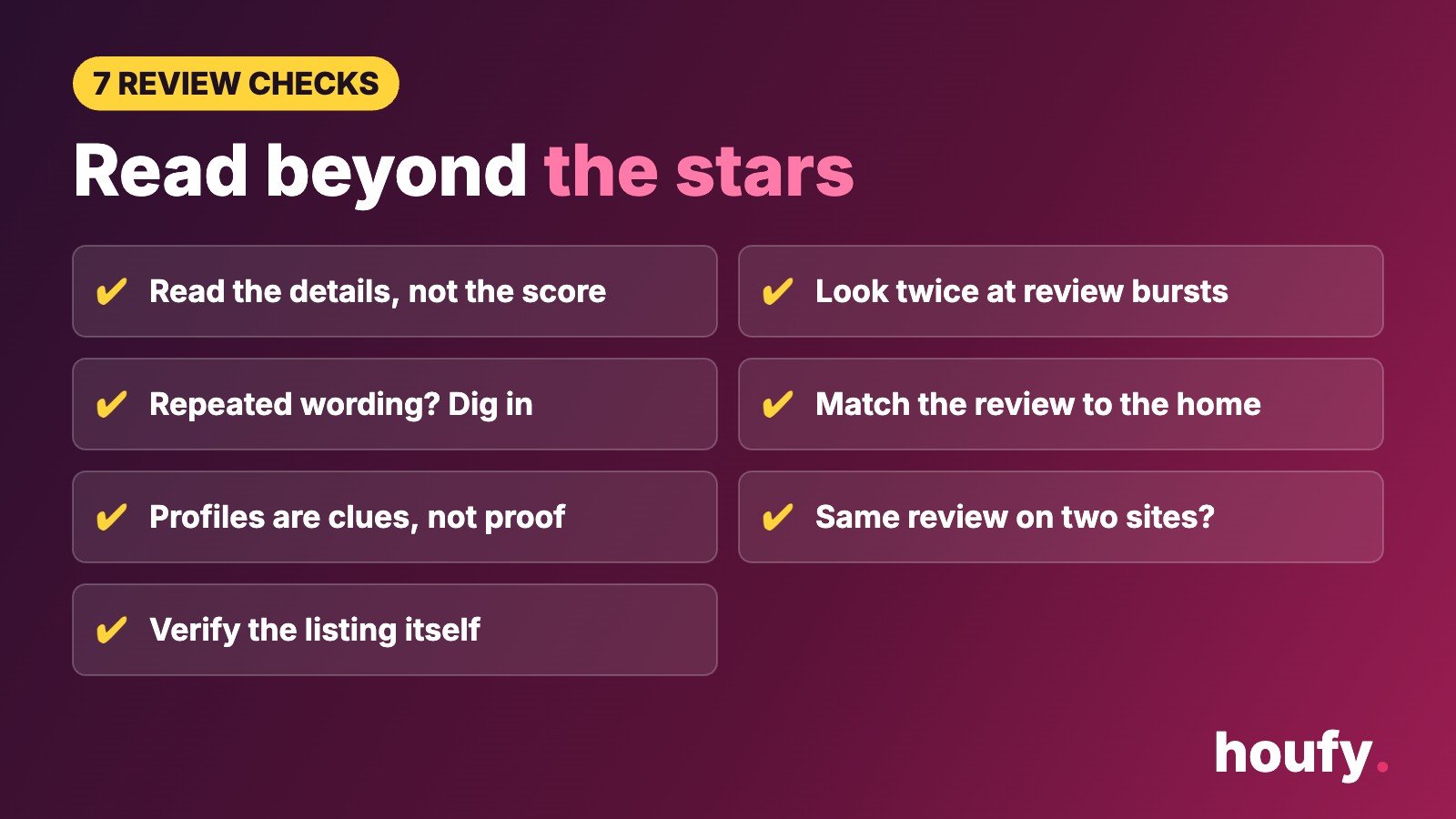
1. The details behind the stars tell you more
A star rating compresses different experiences into one number. Read the text to see what guests actually noticed.
Start with reviews from several periods and a range of ratings. Look for details relevant to your trip:
Did guests discuss the same property shown in the listing?
Do they mention the features you need, such as parking or stairs?
Are comments about cleanliness, access or noise recent?
Did the host respond to a reported problem?
Does the listing say a feature has changed since an older review?
A review from several years ago may accurately describe the stay at that time and still be less useful for a current decision. Ask the host about changes to beds, amenities, management or access if those details matter.
A new property may have few reviews. That is not evidence of a scam. It does mean you have less review history, so take the other checks seriously.

2. A burst of reviews deserves a closer look
The FTC says a burst of reviews over a short period can sometimes indicate fake reviews. It is a signal to investigate, not proof that anything is wrong.
There can be ordinary explanations. A property may have opened recently, appeared on a new platform or received several reviews after a busy period. Some platforms also show the date a review was posted rather than the date of the stay.
If the timing raises a question:
Read the reviews rather than relying on the count.
Check whether the platform explains its review and import process.
Compare the property details with the current listing.
Ask the host about a specific discrepancy.
Continue with independent checks of the property and payment terms.
Avoid making a decision from the review dates alone.
3. Similar wording has more than one explanation
Repeated phrases can be worth checking, particularly if several reviews use the same unusual sentence. But guests can naturally describe the same feature in similar words, and a platform may display excerpts or translated text.
Try searching a distinctive sentence in quotation marks. If it appears elsewhere, compare the property, author and context. A legitimate host may list the same home on more than one site, and a guest may post the same review in more than one place.
Look for contradictions that matter more than matching adjectives. A review that praises a private pool when the listing says the pool is shared calls for a question. So does a review describing a different town or a bedroom layout that the host cannot explain.
One repeated phrase does not establish that the review was purchased or invented.
4. The review needs to match the home
A property can change names, owners, managers or layouts. Reviews may reflect an earlier version of the property, or a platform may show reviews imported from another source.
Ask:
Is this feedback about the same home and address?
Does the platform label imported reviews?
When did the guest stay, if that information is shown?
Has the property changed since the review?
Are shared amenities described consistently?
The answers may explain a difference. A new kitchen can make older photographs and comments outdated. A management change can mean a review describes a previous team. Neither fact alone makes the review false.
If the platform’s review labels are unclear, ask what they mean. Do not assume that a “verified” label has the same definition everywhere. Read the platform’s own explanation of what it verified and what it did not.

5. Reviewer profiles offer clues, not verdicts
Some sites let you view a reviewer’s other contributions. The FTC suggests considering whether the reviewer has written other reviews and what those reviews reveal.
A profile with one review can have an ordinary explanation: the person may rarely travel, have a new account or choose to keep a limited public profile. A detailed history does not prove authenticity either.
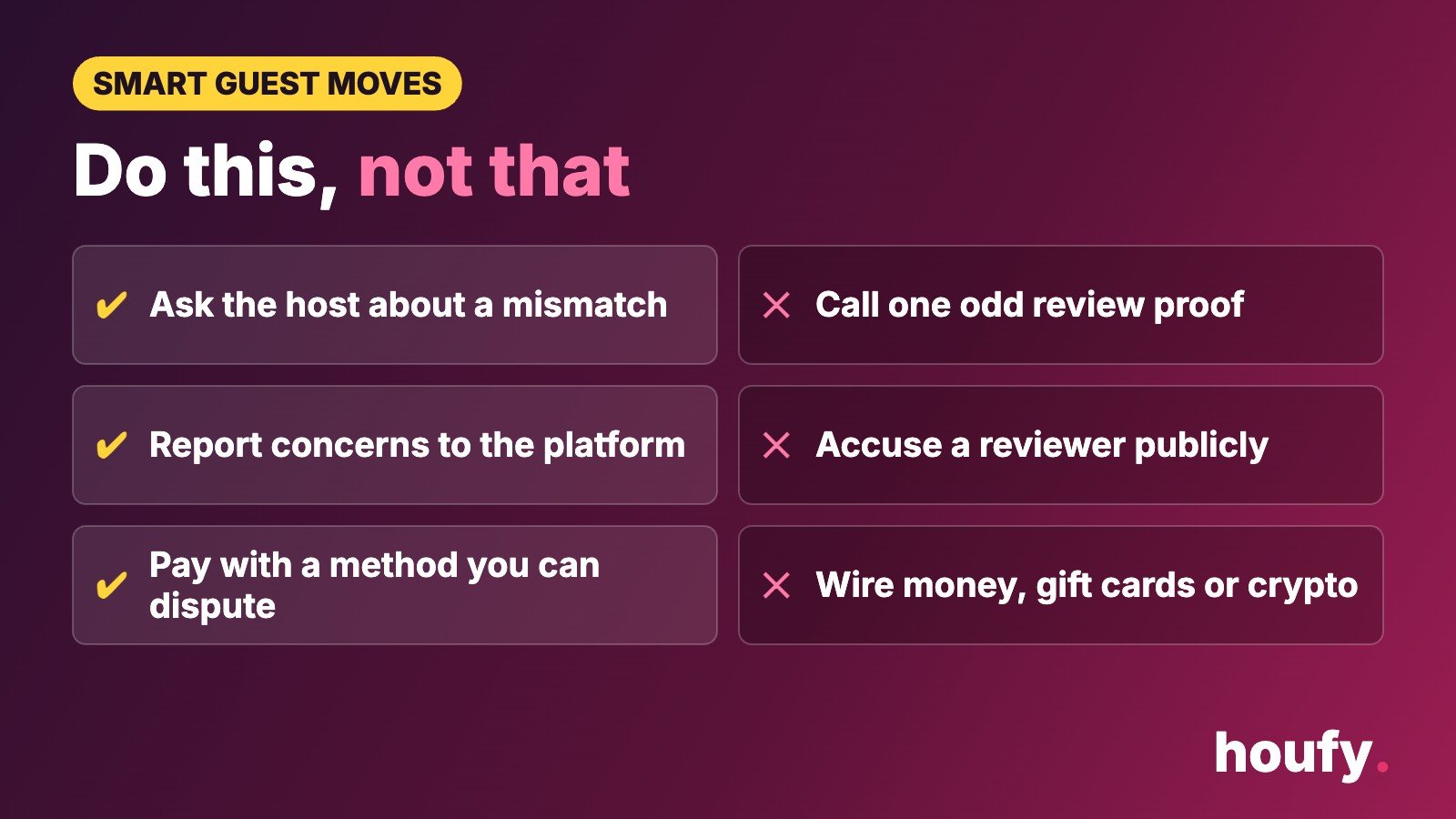
Use the profile as context, not a test the guest must pass. Avoid contacting or publicly accusing a reviewer. If something seems wrong, take your concern to the platform through its reporting process.
6. Two websites may show the same review
The FTC recommends looking at a variety of review sources. For a vacation rental, that can include the platform listing, a property manager’s website and other places where the same home appears.
Check whether the information is truly separate. A review imported from one platform may appear on another site. Seeing the same text twice does not necessarily mean two different guests wrote it.
A practical comparison looks like this:
Match the property name, location and photos.
Check dates and whether the review text is identical.
Look for an import label or source note.
Compare policies and amenities, allowing for legitimate differences between channels.
Ask about any conflict that affects your stay.
A real home may appear on multiple sites. Matching photographs or reviews alone do not establish that the person receiving payment controls the property.
7. Check the listing beyond its reviews
Even convincing reviews cannot tell you everything about the person asking for your deposit. The FTC’s rental-listing guidance, updated June 2026, recommends checking the address and searching for the owner or rental company.
Before paying:
Ask for the contract and check the address.
Search the address with the owner’s or management company’s name.
Search the company or host name with terms such as “complaint” or “scam.”
Compare the listing with the company’s own website, if one exists.
For a resort property, use a number you find independently to ask the front desk about the property and contract details.
Review the price, cancellation terms and payment schedule.
A property manager may legitimately act for an owner. A name difference is a reason to ask for clarification, not automatic proof of fraud.
For more checks before you pay, read Houfy’s guide to booking a vacation rental direct safely. It covers photos, addresses and payment instructions.
A last-minute payment change calls for a pause
A strong review history does not make an unexpected payment request safe. If someone sends a new bank account or payment link, pause before paying.
Contact the host or management company through a phone number or website you found yourself, rather than using contact details in the unexpected message. Ask them to confirm the instructions. Keep the original and revised messages.
The FTC says an insistence on payment only by wire transfer through Western Union or MoneyGram, gift card or cryptocurrency is a scam warning. Those methods can be difficult to reverse. A credit card may offer a dispute process, subject to the issuer’s rules and deadlines.
Do not send sensitive personal or financial information to someone who contacts you unexpectedly and claims to represent the host. Verify the request through a known route first.

One specific question can clear up a mismatch
A host may be able to explain a discrepancy. Give them the specific information you found and ask a neutral question.
Hi, I noticed that an older review mentions a fenced yard, while the current listing does not. Is the yard fully enclosed today, including the gate? We would be traveling with a dog. Thank you.
A clear response can help you decide whether the property suits your trip. It still does not prove that the person controls the property, so continue with the independent checks.
If the host cannot answer a question that is essential to your stay, you can choose another listing. You do not need to establish that a review is fake before deciding a property is not right for you.
A useful report sticks to what you found
If you suspect a fake listing or misleading review, use the listing site’s reporting process. Give the platform the details you observed: the review text, dates, listing URL and any conflicting information.
For a suspected rental scam, the FTC also recommends reporting the problem to the website where the ad appeared, local law enforcement and the FTC. If you have already paid, contact your payment provider promptly and ask what options are available. Recovery is not guaranteed.
Keep copies of:
The listing and booking terms.
The review or claim that raised concern.
Messages with the host.
Payment instructions and receipts.
Any report confirmation.
Do not post an accusation as fact when you only have a suspicion. The platform or relevant authority can review the evidence.

Frequently Asked Questions
Can I tell whether a vacation rental review is fake?
Not with certainty from its wording alone. The FTC notes that fake and genuine reviews can be difficult to distinguish. Read a range of reviews, investigate discrepancies and independently check the property and host before paying.
Are several reviews posted on the same day fake?
Not necessarily. A burst can be a reason to look closer, but it can also have an ordinary explanation. Check the platform’s review dates and import labels, read the content and ask about a specific discrepancy if it matters.
Are imported reviews automatically unreliable?
No. A review can be imported from another platform and still describe a genuine stay. Check the source and make sure it refers to the same property. An imported review repeated on two sites should not be counted as two independent reviews.
Is a property with no reviews a scam?
No. A property may be new to a platform or newly available to guests. With less review history, independently check the address, host, contract and payment instructions, and decide whether you are comfortable proceeding.
What should I do if a review describes the wrong amenity?
Ask the host whether the amenity has changed and request an accurate answer in writing. The review may describe an older version of the property or a different home. If the feature is essential and the answer remains unclear, consider another listing.
Where can I report a suspected rental scam?
Report it to the site where you found the listing and to the FTC at https://reportfraud.ftc.gov/. The FTC also recommends contacting local law enforcement. If you paid, contact the payment provider promptly and keep your records.
Sources
Federal Trade Commission, “How To Evaluate Online Reviews,” October 2022: https://consumer.ftc.gov/articles/how-evaluate-online-reviews
Federal Trade Commission, “Rental Listing Scams,” June 2026: https://consumer.ftc.gov/articles/rental-listing-scams
Federal Trade Commission, “The Consumer Reviews and Testimonials Rule: Questions and Answers,” November 8, 2024: https://www.ftc.gov/business-guidance/resources/consumer-reviews-testimonials-rule-questions-answers
Last Updated: November 10, 2026