The Vayo AI travel agent can now book trips, and vacation rentals are on its list. If you host a rental, the useful question is what a guest can find and understand about your place before they decide to stay.
Quick answerOn November 17, 2026, Vayo, a Booking Holdings company, said its private-beta travel agent can book flights, hotels, vacation rentals and other trip services. The announcement does not identify every rental supplier or listing available. Hosts can improve their own descriptions, prices, rules and direct-booking pages, while checking which platforms and agents can access them.
Key Takeaways
Vayo launched in private beta on October 14, 2026, according to Booking Holdings.
On November 17, Vayo said its new booking capabilities include vacation rentals, subject to supplier support and traveler approval.
The announcement does not establish that every property, platform or direct-booking site is available through Vayo.
Clear descriptions, current prices and accessible policies help guests evaluate a stay wherever they find it.
Google recommends ordinary search fundamentals for its AI search features, not special AI-only markup.
A direct-booking channel gives you another place to present your property and communicate with guests, subject to the terms of the channels you use.
1. Vayo can book trips, with important limits
Booking Holdings announced Vayo, with a planned $100 million investment that it said depends on the product and market conditions, on October 14, 2026, as a private-beta travel agent with a waitlist. Its launch announcement described a tool that brings travel reservations together and helps travelers manage trips.
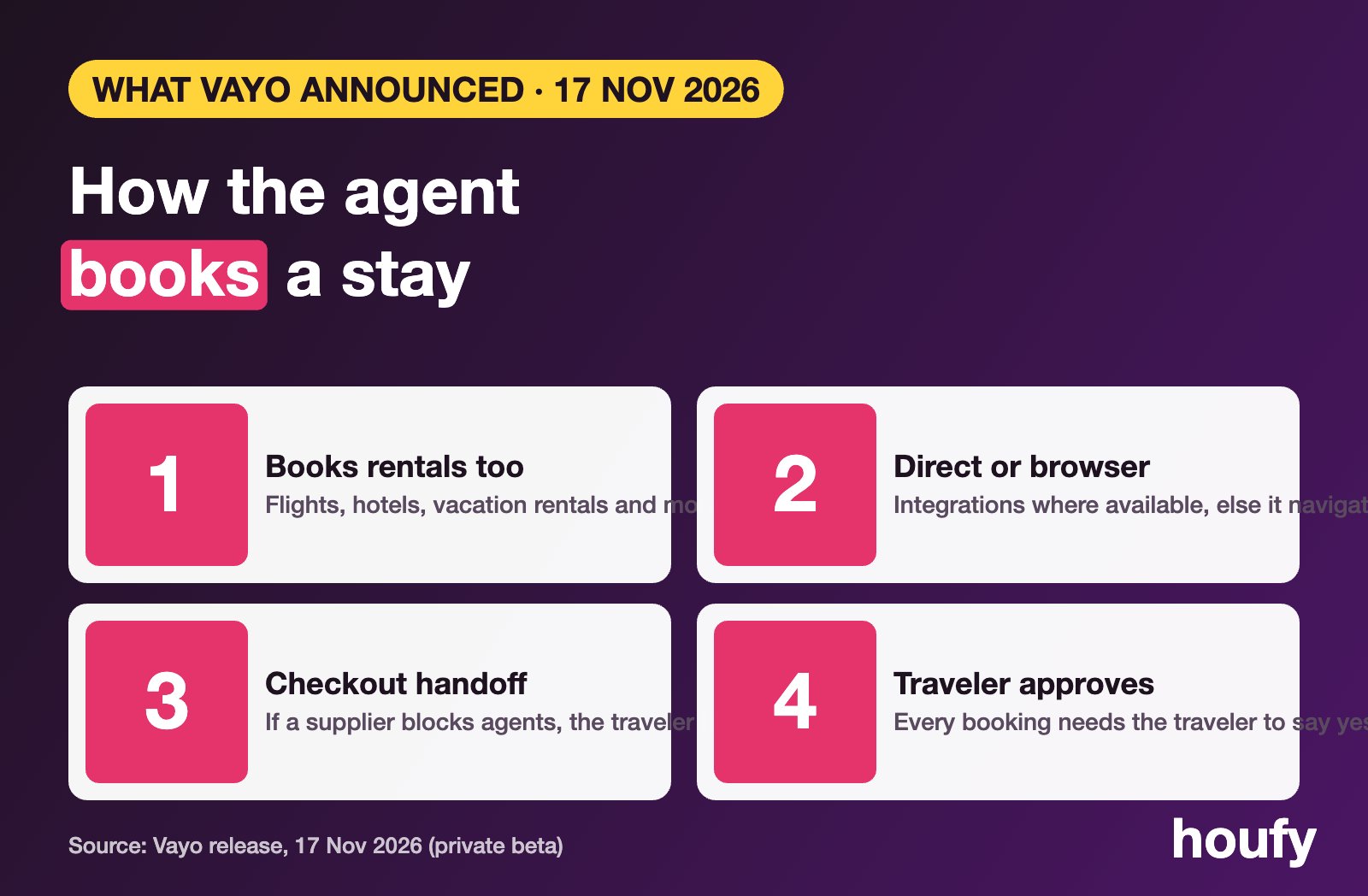
On November 17, 2026, Vayo announced that its private-beta members could discover, compare and book flights, hotels, vacation rentals, rental cars and other trip services. That list explicitly includes vacation rentals. It does not name every rental supplier, say that every listing is available, or establish that Houfy connects to Vayo.
Vayo's November 17 announcement says the tool uses direct integrations where available and otherwise navigates booking websites. If a supplier does not support agent bookings, Vayo says it finds an option, checks the price and hands the traveler a checkout to finish. The company says each booking requires the traveler's approval and that it reports a reservation as confirmed only after supplier confirmation.
Those are company descriptions of its beta, not an independent test of each booking path. For a host, the distinction matters: a product can support a category without offering every property in that category. Do not assume your home appears in Vayo or that an agent can complete a reservation on your site. Check with the relevant platform or supplier before making either claim.

2. An agent may add a step between your listing and a guest
A traveler might ask an AI tool to find a home near family, with a ground-floor bedroom and a kitchen for a holiday meal. The tool needs information it can find and interpret. The traveler still needs enough detail to decide whether the property suits the group.
Your listing has two jobs in that situation. It needs to describe the home accurately, and it needs to make the practical details easy to locate. A photo of a staircase may help, but it does not replace a clear description of where bedrooms and bathrooms sit. A picture of a kitchen does not tell a guest whether there is an oven or a dining table large enough for their group.
There is no public evidence in Vayo's November 17 announcement that changing a headline will make a particular property appear in Vayo. Treat the steps below as sound listing maintenance, not as a shortcut into any specific agent.
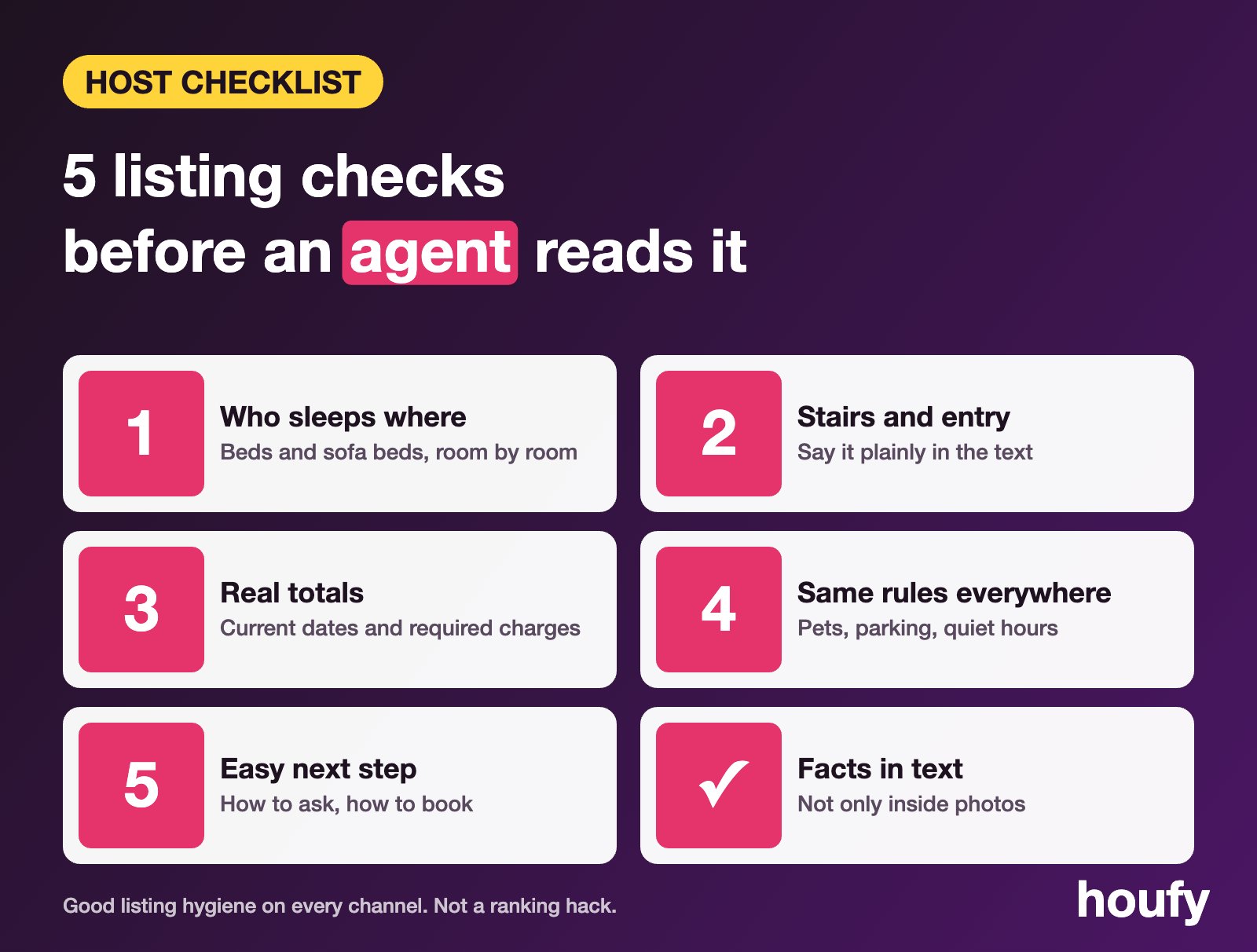
Listing detail | What to check | Why a guest needs it |
|---|---|---|
Sleeping arrangements | Bedrooms, beds and any sofa bed are described accurately. | A group can see who sleeps where. |
Accessibility | Stairs, entry route and bathroom layout are stated plainly. | A guest can assess whether the home fits their needs. |
Price and availability | Dates, required charges and the booking total are current. | A guest can compare a real stay, not a stale headline rate. |
Rules | Occupancy, pets, parking and quiet hours match across your pages. | A guest can spot a constraint before booking. |
Contact and booking | The next step and the person to contact are easy to find. | A guest knows how to ask a question or reserve. |
Use the table as an audit, not a requirement from Vayo. The information guests need will vary with your home and its location.

3. Make the useful details easy to read
Start with the questions a guest asks before paying. How many people can stay? Is the second bedroom private? Are pets allowed? Is parking on-site? Can someone enter without climbing stairs? Answer in ordinary language and put the answers where a reader can find them.
Replace a vague line such as “great for families” with facts you can verify: “Two bedrooms, a dining table with six chairs and a high chair available on request.” If the dining table seats six but the property sleeps eight, say so. That detail lets a group make its own choice.
Check your amenities against what is actually available. If an outdoor shower is seasonal, identify the season only if you know it. If a fireplace is decorative, say it cannot be used. If internet service can vary, avoid a speed claim unless you have a current test and a clear way to describe it.
When an AI writing tool helps with a description, review each sentence against the property. It can help organize your notes, but you remain responsible for the finished listing. Our guide to using AI to write vacation rental listings covers that editing process.
A useful test: give your description to someone who has never visited. Ask them to explain the layout and identify anything they would need to ask before booking. Their questions can reveal gaps that a polished opening paragraph hides.
4. Keep prices, calendars and rules consistent
A guest may see your home on more than one channel. Review each listing after a change to your calendar, property or policies. A closed hot tub, a new parking limit or a change to pet rules should not linger on an older page.
Start with the facts most likely to affect a booking:
Available dates and minimum-stay requirements.
The number of permitted guests and whether visitors count toward a limit.
Required charges and how a traveler can view the total for their dates.
Pet permission, restrictions and any applicable charges.
Check-in details, cancellation terms and quiet hours.
Rules can differ by booking channel. Review each platform's current requirements rather than copying a rule without checking whether it is allowed there. For example, Airbnb's house-rules policy applies its updated requirements to reservations booked on or after November 20, 2026. Hosts should read the policy and its exceptions before changing an Airbnb listing.
Be specific without publishing sensitive information. A public listing can say that guests receive entry instructions before arrival. Door codes, access links and private contact information belong in a secure guest communication, not in text visible to everyone.
For a comparison of platform choices and host controls, see Houfy vs Booking.com: what hosts give up. Check current platform terms before acting on any older comparison.
5. Give search engines a useful page to read
AI search and an AI booking agent are different products. A page that can appear in Google Search is not automatically available to Vayo, and Vayo's supplier relationships are not a general guide to how every search engine works.
For Google's AI search features, its Search Central guidance, updated December 10, 2025, says the usual search fundamentals apply. Google says a page must be indexed and eligible for a search snippet to be eligible as a supporting link. Eligibility does not ensure that Google will show it.
For a property website you control, start with basics:
Put important property facts in readable text, not only inside photos.
Use a descriptive page title and headings that match the home's actual features.
Link the property page from relevant pages on your site so visitors can find it.
Check that the page works on a phone and that the booking path is clear.
Ask your website provider whether search engines can crawl and index the page.
If you use structured data, keep it consistent with the details a visitor can see.
Google says you do not need a special AI text file or AI-specific schema to appear in its AI features. You can use Google Search Console to investigate indexing for a site you control. A marketplace listing may be controlled by the marketplace instead, so ask the platform what information you can edit.
For a fuller walkthrough, read how to get your vacation rental found in AI search. The goal is a useful, accurate page. Placement remains outside your control.

6. Keep a direct-booking option alongside other channels
An agent may become another way a traveler encounters your home. A direct-booking channel gives that traveler another place to read about your property, check terms and contact you. It can also give you a page to share with a returning guest, subject to the rules of the channel where that relationship began.
Start with a booking path you can maintain. Make the property description clear, show how a guest can request or complete a reservation, and state the rules and cancellation terms before payment. Keep your contact method visible. If you have your own site, review the booking flow from a phone as well as a laptop.
Consider the operational work too. Multiple channels mean multiple calendars, messages and sets of terms to maintain. Calendar feeds may update periodically rather than instantly, so ask your providers how synchronization works and monitor your availability. Do not assume an AI agent, marketplace or website builder will manage every calendar for you.
You can explore Houfy's vacation rental website builder if you want to review a website option. Check the available features and fit for your property before deciding how to use it.
If you want another place to present your home and communicate with travelers, you can list your property on Houfy. Review the listing details, availability and terms you provide there just as you would on any other channel.
Frequently Asked Questions
What is the Vayo AI travel agent?
Booking Holdings introduced Vayo on October 14, 2026, as a travel agent in private beta. Its announcement described a service designed to organize and manage trip reservations. On November 17, Vayo announced added booking capabilities for beta members.
Can Vayo book vacation rentals?
Yes. In its November 17, 2026 announcement, Vayo listed vacation rentals among the categories it can book. The release does not identify every supported rental platform or property, so availability for an individual home remains unconfirmed.
Does Vayo book without the traveler approving it?
Vayo's November 17 announcement says every booking requires the traveler's approval. It also says Vayo reports a booking as confirmed only after receiving confirmation from the supplier.
Is my Houfy listing available through Vayo?
The November 17 announcement does not identify Houfy as a supported supplier or establish that a particular Houfy listing is available. Ask the relevant companies before describing a connection or compatibility.
Does a host need special AI markup to appear in Google AI search?
Google's guidance says no special AI-specific schema or AI text file is required. Normal search requirements still apply, and meeting them does not ensure that Google will display a page.
Should hosts stop using other booking platforms?
That depends on your business and the terms of each channel. A direct-booking option can sit alongside other channels, but it requires accurate availability, clear policies and ongoing management.
Sources
Booking Holdings, “Booking Holdings Launches Vayo,” October 14, 2026
Google Search Central, “AI Features and Your Website,” updated December 10, 2025
Airbnb, “Reasonable house rules,” effective for reservations booked on or after November 20, 2026
Agents may change how guests search. A clear, honest listing still does the selling.