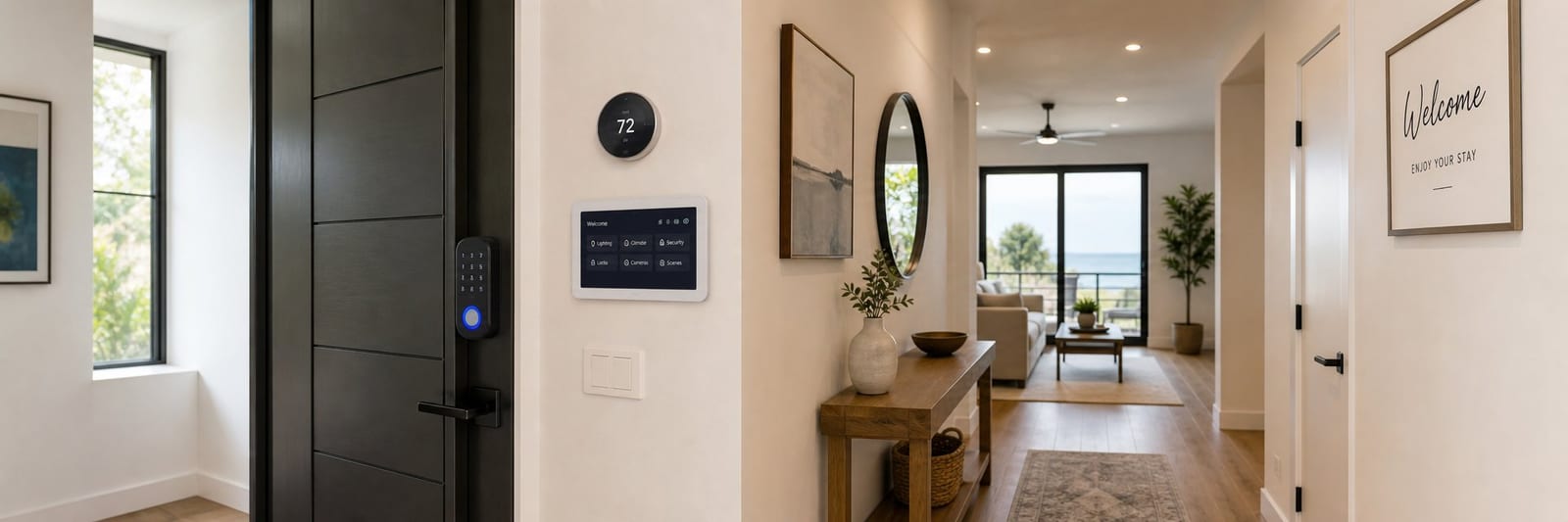

Smart home technology has moved from "nice to have" to standard guest expectation for vacation rental properties in 2026. Properties with smart locks, remote-managed thermostats, and noise monitoring are easier to self-manage, generate fewer guest complaints, and measurably outperform non-smart comparable properties in both review scores and occupancy rates. This complete vacation rental smart home guide covers every category worth investing in — with specific devices, installation notes, and the ROI math behind each one.
Key Takeaways
Smart locks eliminate the single most common guest complaint: key and access problems at check-in
A remote-managed thermostat saves the average vacation rental host $300–$600 annually in energy costs while improving guest comfort scores
Noise monitors are required in most STR permit-sensitive markets and strongly recommended everywhere else
EV charging is a meaningful booking differentiator in 2026 — approximately 18% of US vacation rental guests prefer or require EV access
The full smart home setup (lock, thermostat, noise monitor, mesh router) costs $600–$900 upfront and typically pays back within 2–4 months through energy savings and reduced maintenance calls
Checkout automation — triggered by a confirmed departure — is the highest-leverage integration for self-managing hosts and takes roughly 2 hours to set up
On Houfy, smart home amenities are listed directly in your property features and are discoverable in guest searches
Smart Locks: The Non-Negotiable Starting Point
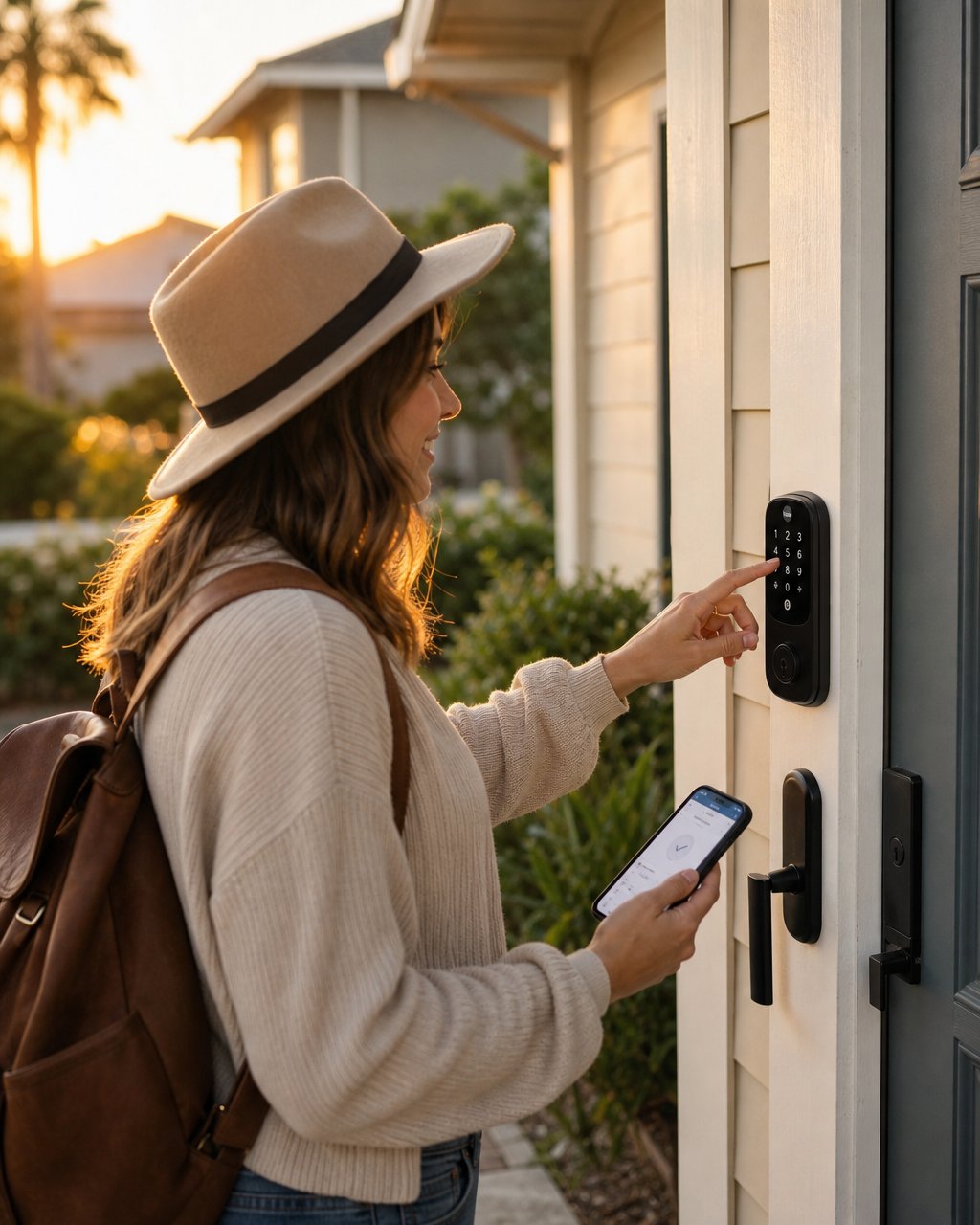
Smart locks eliminate key handoffs, lockouts, and the logistical overhead of coordinating physical access for remote hosts. In 2026, guests expect keyless entry for vacation rentals. A property that requires physical key pickup is a booking deterrent for a growing guest segment accustomed to autonomous arrival.
The three smart locks worth considering for STR use:
Schlage Encode Plus — $299
Supports Apple Home Key (tap iPhone to unlock), a built-in Bluetooth and Wi-Fi chip that requires no hub, and a physical keypad for guests without smartphones. Considered the most reliable residential smart lock in the STR market. The Encode Plus provides a full access log — every entry is timestamped, which is useful if a guest dispute arises.
August Wi-Fi Smart Lock — $229
Installs over your existing deadbolt without replacing the exterior hardware, which matters in rental properties where exterior aesthetics are a condition of HOA or local permit compliance. Full app control with auto-lock scheduling and access log. The trade-off: it requires your existing deadbolt to be high quality.
Yale Assure Lock 2 — $189
Strong mid-range option with Z-Wave and Zigbee compatibility — the right choice for hosts building a smart home hub setup (SmartThings, Apple Home, or Google Home). Battery life is typically 12 or more months on standard AA batteries, which means fewer maintenance visits.
How to use smart locks effectively in a vacation rental:
Create a unique guest code for each booking. Set the code to activate 1 hour before check-in and expire automatically at checkout time. Include the code and any entry instructions in your pre-arrival message, sent 24–48 hours before arrival. This eliminates physical key management entirely and creates an auditable access record.
For a broader look at how smart check-in fits into the full guest arrival experience, see 8 Tips for a Seamless Check-in Process in Vacation Rentals.
Ready to list your property and highlight your smart home amenities? Add your vacation rental on Houfy — it's free to list, and smart home features like keyless entry and EV charging are searchable by guests. Houfy charges 0% host commission.
Smart Thermostats: Energy Savings and Guest Comfort in One Device
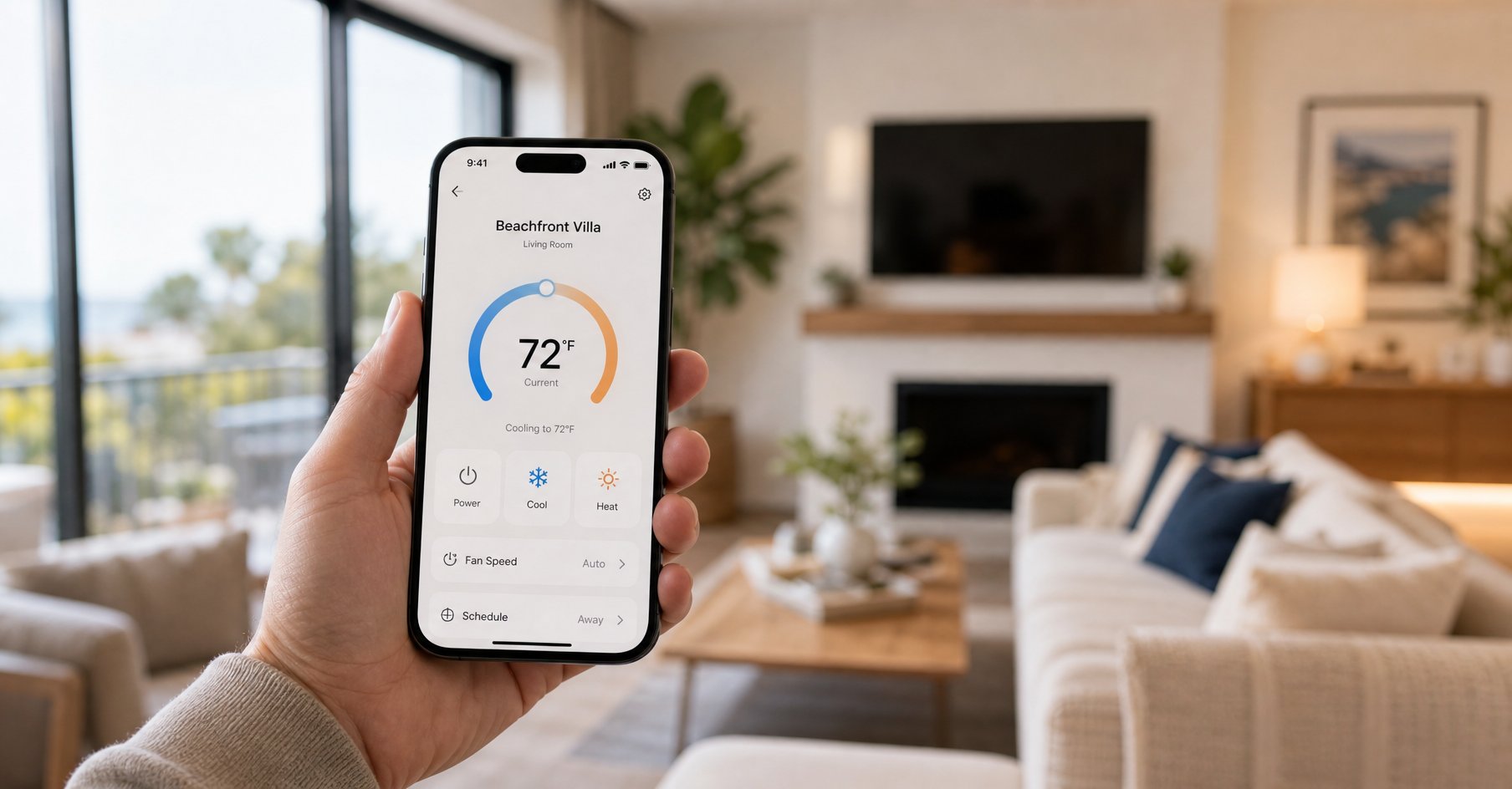
A smart thermostat solves two distinct problems: it reduces energy costs while the property is vacant, and it ensures guests arrive to a pre-conditioned space rather than an extreme temperature that generates an immediate complaint or negative review mention.
Ecobee Smart Thermostat Premium — $249
The most popular choice among professional short-term rental hosts. Full remote control via app, "vacant" scheduling that reduces energy consumption between stays, and SmartSensor room sensors that detect occupancy and adjust conditioning room-by-room. Integrates with Apple Home, Google Home, Alexa, and SmartThings. The Ecobee API also connects to most PMS platforms, making it automatable via booking confirmation triggers.
Google Nest Thermostat — $129
Simpler to install and more intuitive for guests who interact with it directly (the display is cleaner and more approachable than the Ecobee's). The "Home/Away Assist" feature uses phone GPS and built-in sensors to detect when guests have left and reduces energy use automatically. For hosts who want a lower-friction setup without hub integration, the Nest is the stronger option.
For vacation rental use — the two schedules that matter most:
Set a "vacancy" temperature profile (65°F in winter, 82°F in summer) that activates automatically after every checkout. Set a "guest arrival" preset that brings the property to a comfortable 71–73°F two hours before check-in. Most hosts report $300–$600 in annual energy savings after implementing these two schedules. The savings are higher in climates with large seasonal temperature swings (desert Southwest, mountain states, upper Midwest).
Noise Monitors: Permit Protection and Neighbor Relations
Noise monitoring is the most legally relevant smart home category for vacation rental hosts. In markets with STR permit requirements — which now includes the majority of high-demand US destinations — documented noise management is either a condition of licensure or a strong defense against permit revocation.
Beyond compliance, noise monitors prevent the scenario most costly to hosts: a complaint from a neighbor that triggers a platform review, a permit warning, or a local ordinance enforcement action.
For a full comparison of the three leading devices — including pricing, subscription costs, decibel sensitivity, and smart home integrations — see Vacation Rental Noise Monitors: Minut vs NoiseAware vs Alertify.
For smart home integration purposes: Minut has the most complete ecosystem integrations (Apple Home, Google Home, Alexa), making it the strongest choice for hosts building a unified smart home setup. NoiseAware has better analytics for hosts managing multiple properties. Alertify adds occupancy counting — useful in markets where guest count limits are permit conditions.
The short version: Minut for single-property hosts building a unified system. NoiseAware for multi-property managers. Alertify for markets where occupancy headcount compliance matters.
Smart Routers: The WiFi Infrastructure Your Guests Actually Need
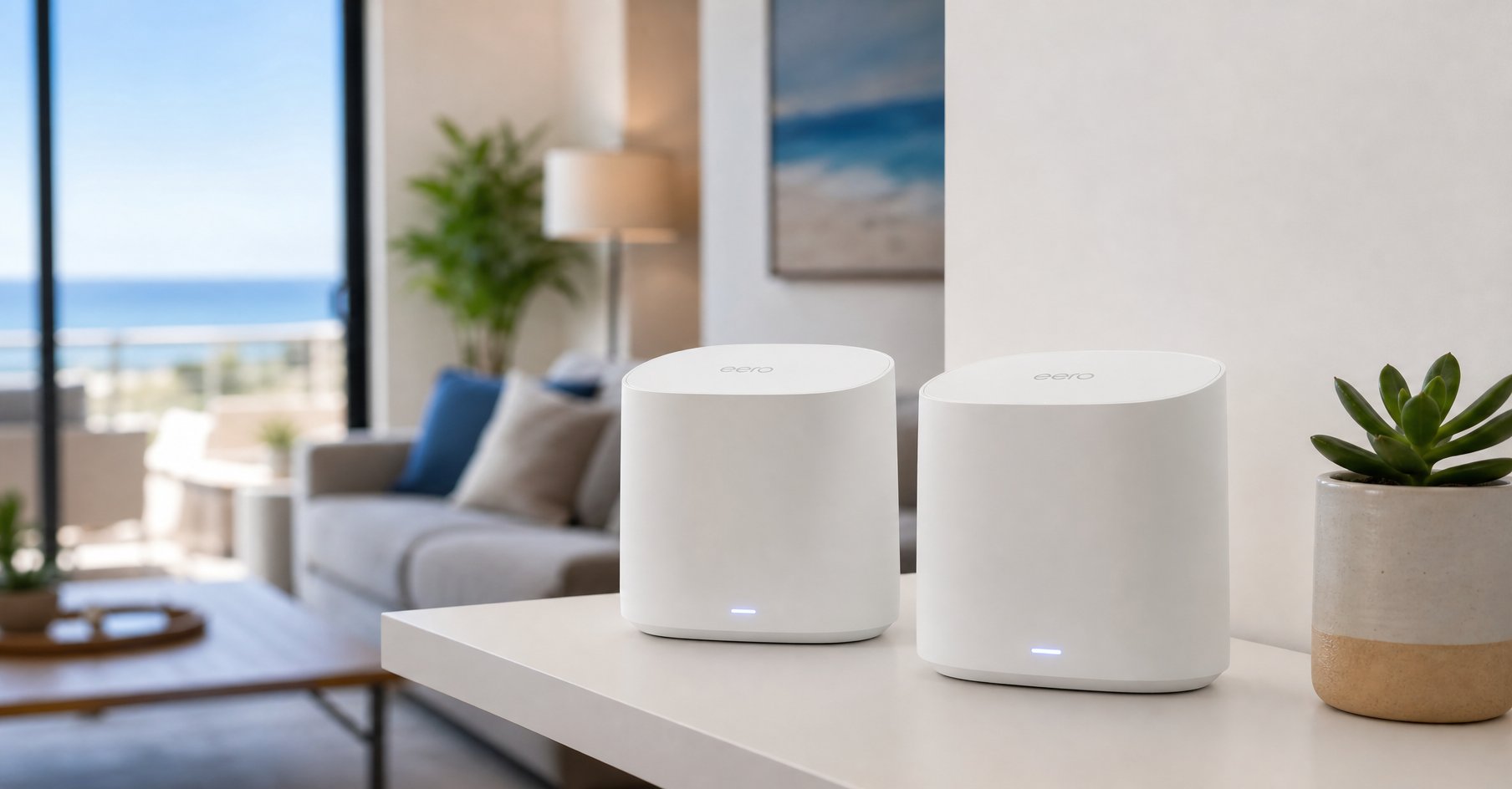
WiFi failure is the fourth most common complaint category in negative vacation rental reviews. A standard consumer router that works fine for a single household often fails under vacation rental guest behavior: 8–12 simultaneous devices, sustained 4K streaming on multiple screens, smart home device overhead, and no one on-site to restart it when it drops.
The two mesh systems worth using:
Eero Pro 6E — $299 (3-pack)
Amazon-owned mesh system with full app management, remote restart capability, and device-level visibility. The most important feature for vacation rental hosts: the Eero app lets you restart the router remotely from anywhere in the world if a guest reports a connection issue. This alone eliminates roughly 80% of WiFi-related support calls. Supports the 6GHz band for reduced interference in dense areas.
Google Nest WiFi Pro — $399 (3-pack)
Strong alternative with tri-band 6GHz support, ideal for properties with 15 or more smart devices running simultaneously (thermostats, locks, cameras, TVs, guest phones). The Google Home integration is seamless for hosts already on that ecosystem.
Setup recommendation: place the primary node as close to the internet modem as possible, place secondary nodes to cover dead zones (typically a back bedroom or detached area). Label the WiFi network and password clearly in your guestbook and on a card near the TV. For a property above 1,500 sq ft, a 3-pack mesh system is standard — single routers leave dead zones that generate complaints.
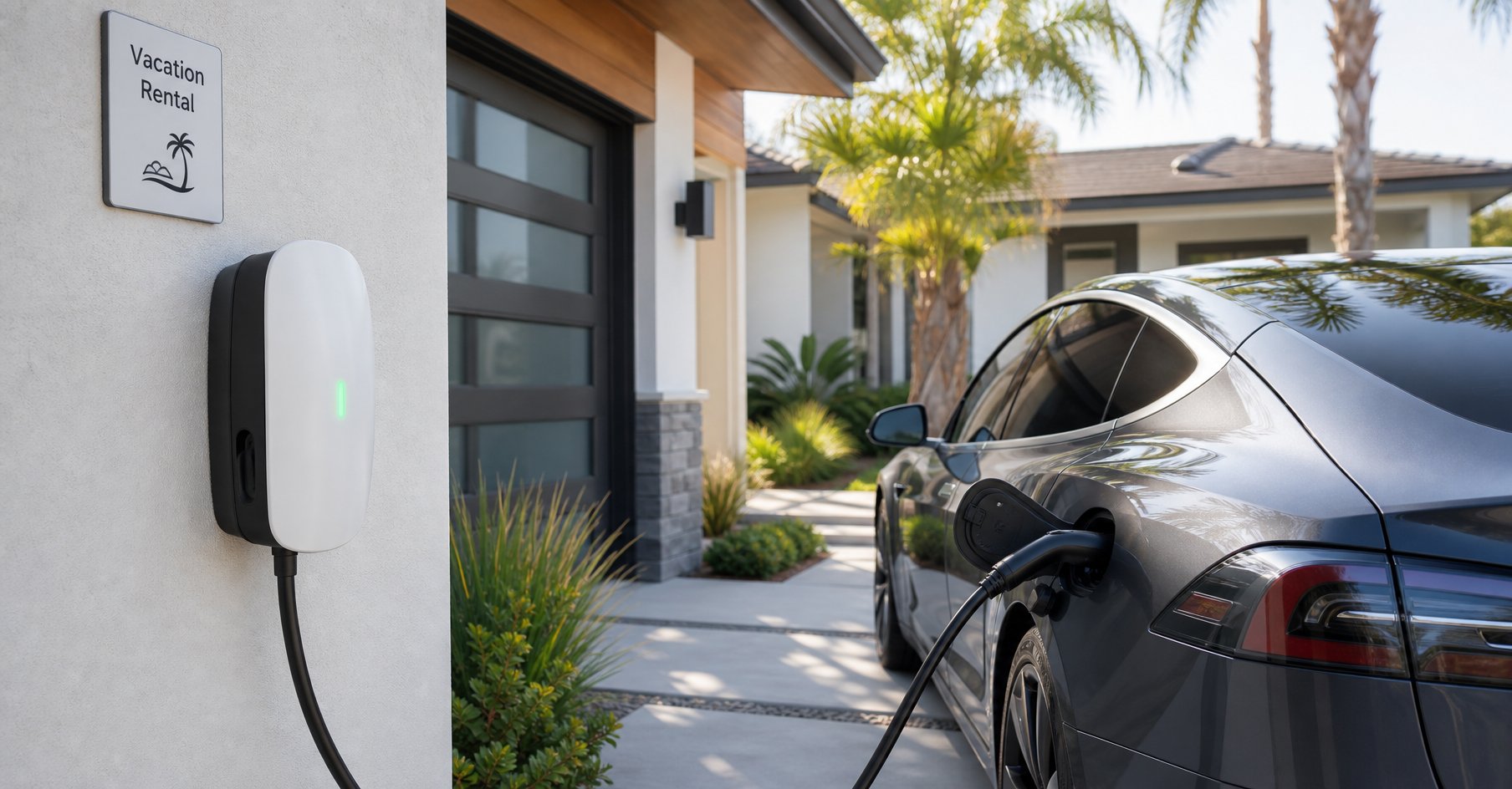
EV Charging: The 2026 Booking Differentiator
Electric vehicles represent approximately 18% of new car sales in the United States in 2026, and the share of vacation rental guests arriving by EV is rising in every category of market. For many EV-driving guests, the presence or absence of a home charger at the rental is a filtering criterion — they search for it the same way guests with dogs search for pet-friendly properties.
A Level 2 home charger provides 25–35 miles of range per hour of charge. For most guests, an overnight stay is sufficient to fully recharge from whatever they arrived with. A Level 1 charger (standard 120V outlet) provides roughly 4–5 miles per hour — not useful for guests who need meaningful range restored.
ChargePoint Home Flex — $699 + installation
The most widely recognized residential Level 2 charger in the North American market. Adjustable amperage (16A to 50A depending on your electrical panel), full app management, and compatibility with all EV models via the J1772 connector. The ChargePoint app provides charging session logs — useful for tracking usage and, if desired, setting a charging fee per kWh.
Tesla Universal Wall Connector — $595 + installation
Supports both Tesla and non-Tesla vehicles (NACS + J1772 adapter included). The preferred choice for properties in markets with high Tesla ownership concentration (California, Colorado, New England).
Installation and cost:
Electrical installation ranges from $400–$800 depending on electrical panel proximity. Total investment: $1,100–$1,500. The federal Alternative Fuel Vehicle Refueling Property Credit (26 U.S. Code § 30C) covers 30% of EV charger installation costs for commercial property use — consult your tax advisor, as many STR hosts qualify. Learn more via the US Department of Energy's home charging resource.
After installation, add "EV charging available" to your Houfy listing amenities. This feature is searchable and specifically sought by a guest segment that tends to book higher-value properties and stay longer.
List your property on Houfy and add EV charging to your amenities today. Create your free listing — guests actively search for EV-friendly vacation rentals and Houfy's amenity search surfaces your property to exactly that audience.
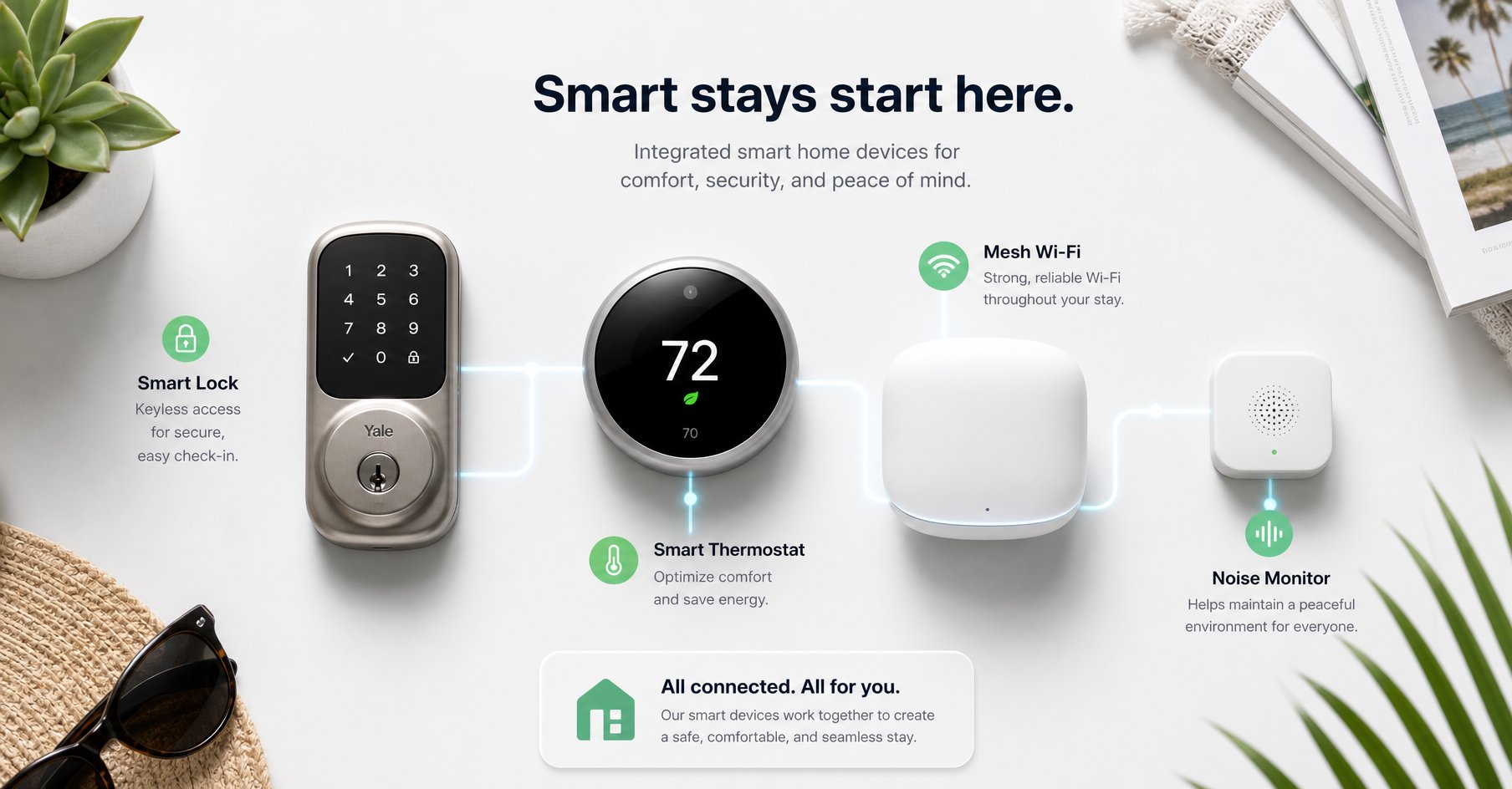
The Integration Layer: Making Everything Work as One System
Individual smart devices are useful. A coordinated system is significantly more powerful — and the incremental time investment to connect them is small.
The three platforms most used by vacation rental hosts:
Apple Home: Best for iPhone-native hosts. Requires HomeKit-compatible devices (Schlage Encode Plus, Ecobee, Eero, Minut all support it). Provides the cleanest unified control experience. Automation triggers are set up through the Home app — no coding required.
Google Home: Broader device compatibility than Apple, works natively across Android and iOS. Slightly weaker automation builder than Apple Home, but improving. Good choice for hosts on Android or with Google Nest devices already in place.
SmartThings (Samsung): The most flexible platform for hosts with legacy or non-standard devices. Steeper learning curve, but the most powerful automation options — including conditional logic ("if noise monitor triggers AND it is after 10pm, send host alert AND adjust lock access").
The checkout automation every self-managing host should build:
When checkout is confirmed by your booking platform, trigger the following sequence automatically:
Smart lock guest code expires
Thermostat switches to vacancy temperature preset
Noise monitor enters heightened sensitivity mode (captures post-checkout noise if cleaning crew or unauthorized access occurs)
Smart lights return to baseline (if applicable)
This sequence takes approximately 2 hours to set up and eliminates four separate manual tasks per checkout. For hosts managing multiple properties, the time savings compound quickly.
For more on what tech investments produce the highest practical returns for hosts, see 8 Must-Have Gadgets for Your Vacation Home and Vacation Rental Tips for Owners: 15 Hacks to Host Like a Pro.
Smart Home Security Cameras: What the Rules Are
Outdoor security cameras are a standard and accepted part of vacation rental property management. Indoor cameras — including any device with a camera or microphone pointed into a guest-occupied space — are prohibited by every major booking platform and violate guest privacy laws in most jurisdictions.
The practical setup: one camera covering the front door/driveway (confirms arrival and departure, deters theft), one covering any secondary entry point. The Arlo Pro 4 ($199 per camera) and Ring Spotlight Cam ($149) are the most commonly used outdoor cameras in the STR market. Both integrate with Apple Home, Google Home, and Alexa.
Disclose all outdoor cameras in your listing description. This is required on Houfy and by local regulations in most markets. Disclosure does not reduce bookings — guests generally welcome knowing exterior security is in place.
The Full Setup: Costs and Payback Timeline
Here is a realistic cost breakdown for a complete vacation rental smart home setup:
Core setup (every property):
Smart lock: $189–$299
Smart thermostat: $129–$249
Noise monitor: $99–$149 (device) + $9–$15/month subscription
Mesh WiFi router (3-pack): $299–$399
Total core setup cost: $716–$1,096
Optional additions:
Outdoor security cameras (2): $298–$398
EV charger + installation: $1,100–$1,500
Payback timeline (core setup only):
Energy savings from smart thermostat: $300–$600/year. Reduction in maintenance calls (remote router restart, remote lock management): approximately 8–12 calls per year at $75–$150 per on-site visit equivalent = $600–$1,800 in avoided costs. Most hosts reach full payback within 2–4 months of the core setup going live.
Frequently Asked Questions
Does a smart home setup improve vacation rental reviews?
Yes, across three specific review categories. Smooth keyless check-in eliminates "access problem" mentions. Comfortable arrival temperature eliminates "too hot/too cold when we arrived" comments. Fast, stable WiFi eliminates the most common tech complaint. Hosts who implement all three consistently report improvement in check-in score, communication score, and overall rating within 3–6 months of installation.
Do smart home devices require monthly subscriptions?
Most smart locks, routers, and thermostats have no ongoing subscription cost after purchase. The exception is noise monitors: Minut charges $9/month per property, NoiseAware charges $10–$15/month, and Alertify is priced by inquiry for multi-property accounts. Smart thermostat platforms (Ecobee, Nest) are free to use with no monthly fee. The Eero router has an optional Eero Plus security subscription at $9.99/month but it is not required for remote management or basic function.
Can I manage all these devices remotely from another country?
Yes. Every device recommended in this guide supports full remote management via smartphone app. Time zone handling matters: set all property-based schedules in the local property time zone, not your current location's time zone. Most apps default to device location once set up, but verify this in settings before your first remote check-in.
What is the best smart lock for a vacation rental?
The Schlage Encode Plus is the strongest all-around choice for STR use in 2026: built-in Wi-Fi (no hub required), Apple Home Key support, a physical keypad backup, and a reliable access log. The August Wi-Fi Smart Lock is the better choice when exterior hardware cannot be replaced (HOA or historic property restrictions). The Yale Assure Lock 2 is best for hosts building a hub-based smart home system with Z-Wave or Zigbee devices.
How do I add smart home features to my Houfy listing?
In your Houfy listing dashboard, navigate to the amenities section of your property profile. Smart home features — including keyless entry, EV charging, smart thermostat, and high-speed WiFi — are listed as individual checkboxes. Guests can filter search results by amenity, so completing this section makes your property visible to the specific travelers looking for these features.
Is EV charging worth the installation cost for a vacation rental?
For most properties, yes — particularly in markets where EV ownership is above the national average (California, Colorado, Pacific Northwest, New England, major metro suburbs). The federal 30% tax credit reduces the net cost significantly. Beyond the financial return, EV charging is increasingly a filtering criterion for a guest demographic that tends to book higher-value properties, stay longer, and return at above-average rates.
List your smart home property on Houfy for free. Over 98,000 hosts have already chosen Houfy to keep 100% of their earnings — no commissions, no service fees, no algorithm controlling your calendar. Start your free listing today.
Source Citations
Schlage — Encode Plus Smart Lock for Vacation Rentals — https://www.schlage.com/en/home/products/encode-plus.html
Ecobee — Smart Thermostat Premium for Short-Term Rentals — https://www.ecobee.com/en-us/smart-thermostats/smart-thermostat-premium/
US Department of Energy — Home EV Charging Equipment Guide — https://www.energy.gov/eere/electricvehicles/home-charging-equipment
ChargePoint — Home Flex Level 2 EV Charger — https://www.chargepoint.com/for-drivers/home
Houfy — List Your Vacation Rental Free — https://www.houfy.com/list-your-property
Houfy currently has 98,000+ live listings in over 100 countries.
Last Updated: June 27, 2026