
Key Takeaways
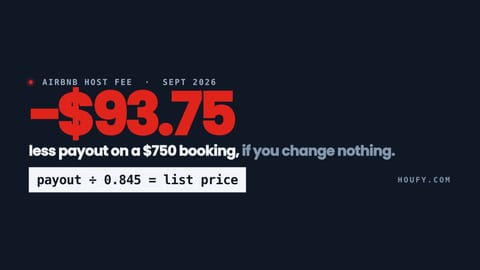
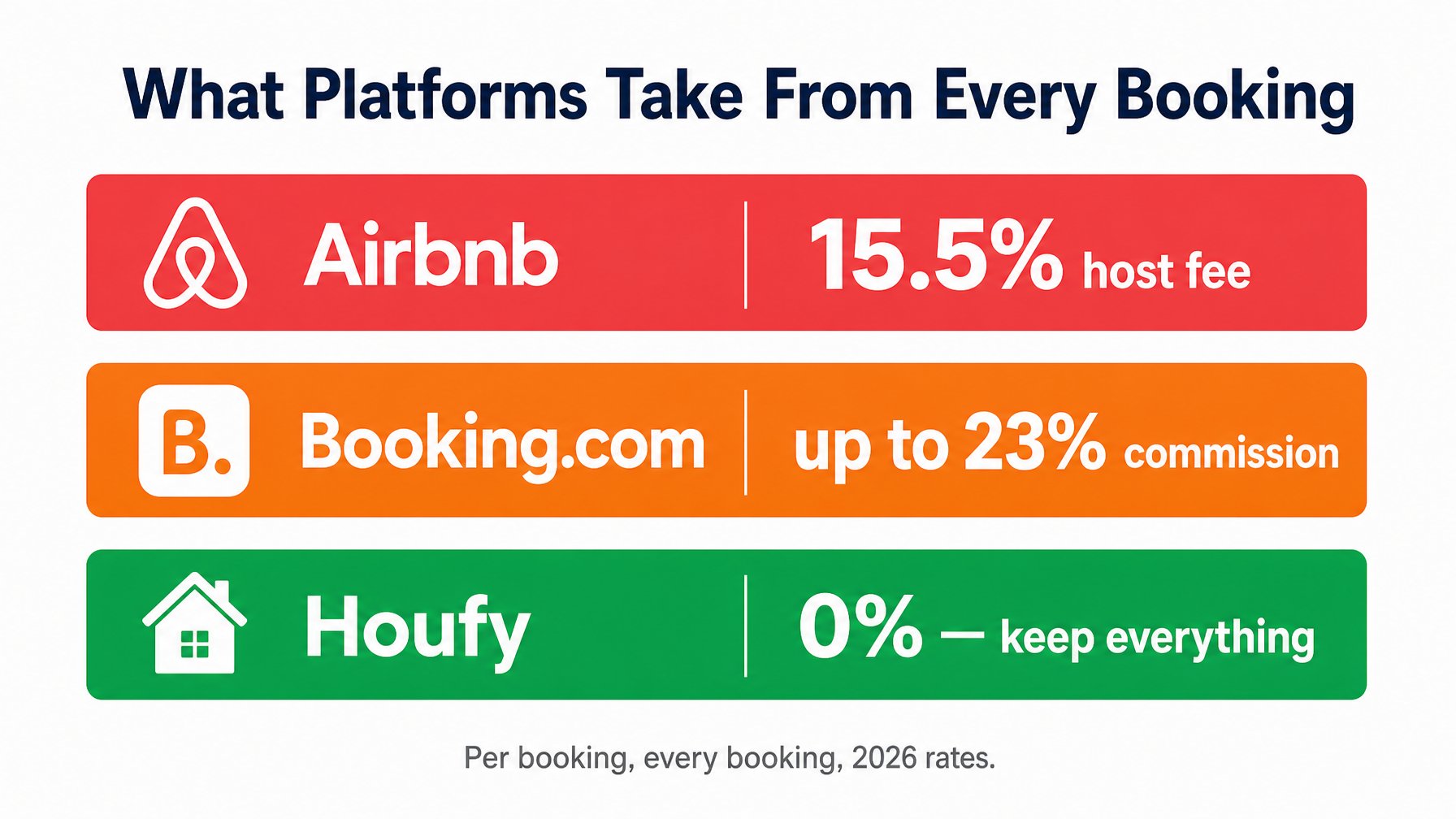
Airbnb charges hosts 15.5% on every booking; Booking.com charges up to 23%
On a single $500 booking, the host receives $422 while the guest pays up to $580
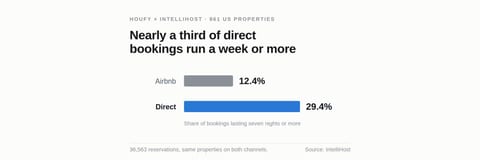
Direct bookings produce 45.2% longer stays and 51.3% longer booking windows than OTA bookings
Shifting just 20% of annual bookings to direct saves a host $1,800+ per year on a $60,000 portfolio
Houfy is a direct booking marketplace with 100,000+ live listings across 100+ countries, and it takes no commission on your bookings
This guide explains what the movement means, what the data shows, and how platforms like Houfy make it possible for every host.
For years, independent hosts handed a cut of every booking to Airbnb, VRBO, and Booking.com. The pitch was reach and trust. The reality is a 15.5% host fee, guest service fees on top, and a platform algorithm that controls your visibility. That deal is getting harder to accept.
The book direct movement is the organized response. Across the short-term rental industry, hosts are building direct booking channels, reducing OTA dependency, and keeping more of what their guests actually pay. The numbers confirm the shift is working.
Here is what you need to know.
What Is the Book Direct Movement?
The book direct movement is a coordinated shift among vacation rental hosts toward direct guest relationships, away from third-party platform dependency. Instead of relying on a single OTA for discovery, conversion, and guest communication, hosts build direct channels: personal websites, direct booking marketplaces, and direct repeat-guest outreach.
The goal is straightforward. Keep the commission Airbnb would have taken. Own the guest relationship the platform would have controlled. Set terms the algorithm cannot override.
It is not anti-technology. It is pro-host-freedom.
The movement has grown from a niche conversation among independent operators into a mainstream industry shift. Platforms that support direct relationships, including Houfy, are growing as hosts actively seek to reduce platform dependence. The shift is no longer a "someday" strategy. For hosts in margin-compressed markets, it is a financial necessity.
The Real Cost of OTA Dependence
To understand why hosts are leaving, start with the fee math.
Airbnb charges most hosts a flat 15.5% service fee under its host-only model, the default for PMS-connected properties. On a $600 reservation, that is $93 extracted before the host receives a cent. For a host with 20 bookings per year at that average rate, the annual platform cost reaches $1,860. (StaySTRA.com, 2026)
Booking.com takes a 15% standard commission, rising to 23% for Preferred Plus and Genius programme participants who pay for additional visibility. The commission applies to the full guest-paid rate, not the net rate.
VRBO charges roughly 8% total (5% commission plus 3% processing) under its pay-per-booking model, lower than Airbnb but still an extraction on every transaction.
The fees hit both sides of every booking. When a guest pays $500 on Airbnb:
The host receives roughly $422 after the 15.5% host fee
The guest pays $570 to $580, after a separate 12 to 16% guest service fee on top of the subtotal
The platform extracts money from both sides simultaneously
The host earns $422. The guest paid $580. Airbnb keeps the gap.
That math scales brutally. On a $60,000 annual portfolio with all bookings through Airbnb at 15.5%, the host pays approximately $9,300 to the platform every year. That is not a technology fee. It is a recurring transfer of earnings from your property to a corporation's balance sheet.
Only 32.6% of hosts reported revenue growth in 2025, while average daily rates grew just 1.6% against U.S. inflation of 2.7%. Commission reduction is one of the most accessible margin levers available right now. (Lodgify 2026 State of the Industry Report)
If you want specific tactics to stop losing revenue to platform fees today, see our full guide on how to avoid Airbnb service fees in 2026.
Why Direct Bookings Outperform OTA Bookings
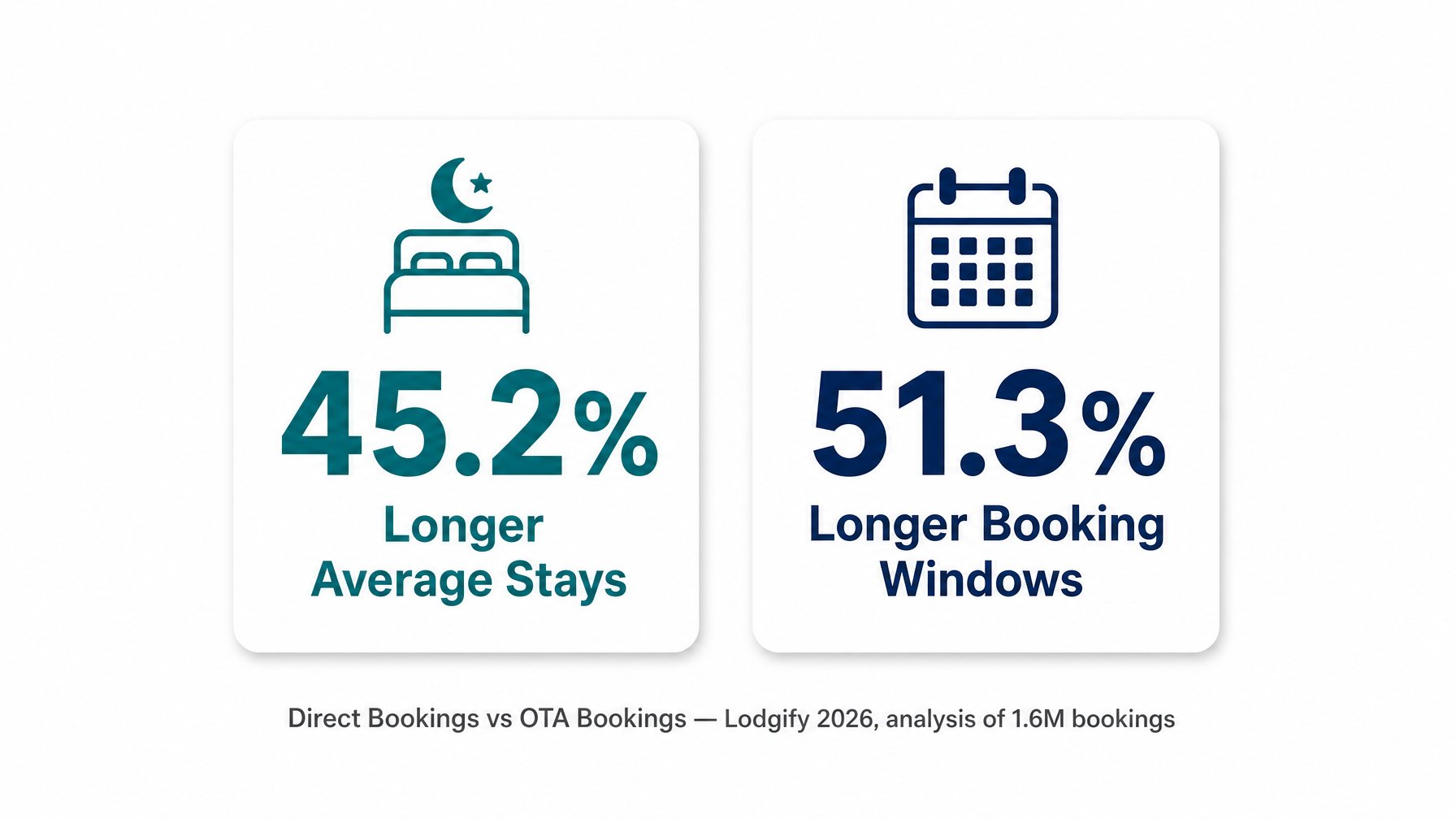
The case for direct booking goes well beyond fee savings. Lodgify's 2026 State of the Industry Report, based on analysis of 1.6 million bookings, shows direct bookings outperform OTA bookings across every key operational metric.
Longer stays. Direct bookings produce average stays that are 45.2% longer than OTA-originated bookings. Longer stays mean lower turnover costs and more gross revenue per reservation at the same nightly rate, with no cleaning reset in between.
Larger booking windows. Direct bookings carry a 51.3% longer booking window than OTA bookings. Hosts gain more lead time to plan, price, and prepare, which translates directly into better occupancy management.
Higher net revenue. With zero commission deducted and lower per-booking operational costs from longer stays, the margin advantage on a direct booking compounds on both ends.
The commission savings math is concrete. Shifting 20% of annual bookings from Airbnb to a direct channel saves a host $1,860 or more per year on a $60,000 annual portfolio. As direct booking volume grows, those savings scale proportionally. (StaySTRA.com, 2026)
The guest appetite is there too. Travelers actively search for direct booking alternatives. Price-conscious guests compare OTA checkout totals against direct rates before committing. International travelers, who face higher cross-border OTA fees and currency conversion costs, are disproportionately motivated to book direct. Guest frustration with service fees is consistently among the top complaints in short-term rental industry surveys.
For a full breakdown of every key metric with the underlying data, read Direct Booking Statistics Every STR Host Needs (2026).
Houfy: Built for the Book Direct Movement
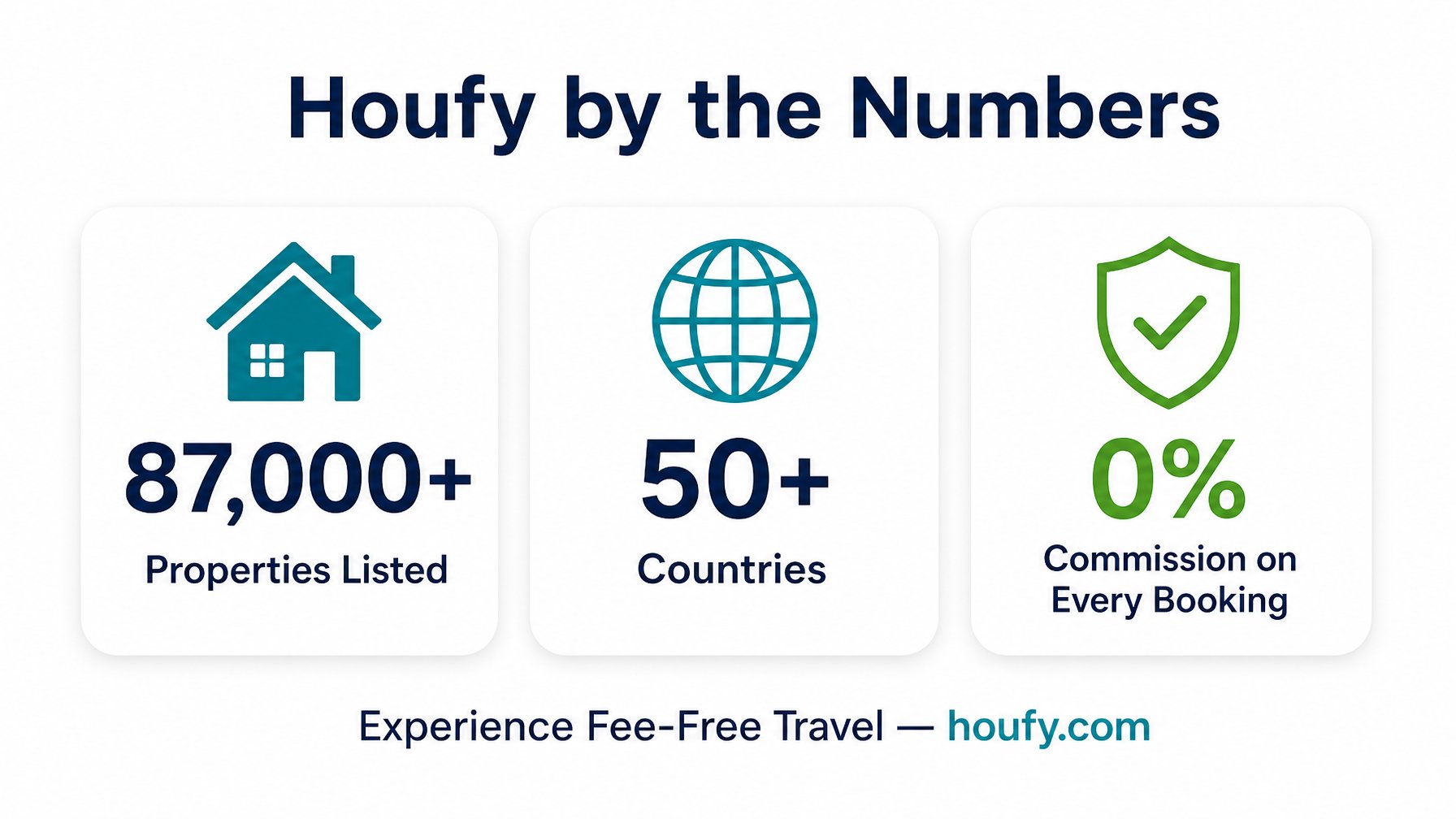
Houfy is a direct booking marketplace with 100,000+ live listings across 100+ countries.
The model is structurally different from every OTA and most direct booking tools.
For hosts: no commission on every booking, no cut of revenue, and full ownership of guest relationships and pricing. Hosts set their own rates, their own policies, and communicate directly with guests before and after the stay. The algorithm does not reassign your guests or penalize your calendar.
For guests: no Houfy service fee added on most bookings. The price shown is the price the host set. On certain PMS integrations the guest pays a 5% API connection fee at checkout. No 14.1%-16.5% OTA service fee added at the final step.
That structure means a Houfy listing can offer a lower total price for the same property compared to the equivalent Airbnb listing, without requiring a discount from the host. The savings come from removing the platform's cut, not from reducing what the host earns.
Houfy also operates differently from OTAs at the product level. You are not renting a position in a search algorithm. You are building a direct presence in a marketplace where guests come specifically to avoid fees. That intent matters for conversion.
Early hosts who joined Houfy are not just users of the platform. They are the contributors who shaped it. Host feedback, property diversity, and community engagement all influence how Houfy develops. That is a meaningful difference from a publicly traded OTA with quarterly earnings to protect.
For a full side-by-side breakdown of fees, host control, and guest experience, see Houfy vs Airbnb 2026: The Honest Side-by-Side Comparison.
The Community at the Heart of the Movement
The book direct movement runs on community, and the Houfy host community is one of its most active nodes.
The Houfy Facebook Group connects hosts across dozens of markets and property types. It is a working network: hosts troubleshoot policy questions, share pricing strategies, discuss regulatory changes, and exchange the kind of operational knowledge that no OTA help center provides.
For new hosts, the group accelerates the learning curve significantly. For established hosts, it provides peer insight across markets and property types that no algorithm can replicate.
Your participation shapes the platform. Questions you raise, feedback you give, and experiences you share feed directly into how Houfy develops. That is not a marketing promise. It is the actual mechanic of how a community-driven platform stays aligned with the people who use it.
The book direct movement is not a feature. It is a collective decision by hosts who decided the OTA deal was no longer worth it, and built something better together.
Your Next Step: Join the Movement
The global vacation rental market will generate $101.06 billion in 2026. The platform that captures a guest's repeat bookings keeps the most of that revenue. Right now, most repeat bookings go back to Airbnb by default, because the guest has no other option visible to them.
Houfy changes that default.
List your property on Houfy, make your direct booking option visible to guests, and give them a reason to come back without a platform standing between you. Every booking you redirect to a direct channel is commission that stays in your account.
Not sure where to start? How to Set Up a Direct Booking Website (2026 Guide) walks you through every step, from choosing a platform to syncing your calendar and accepting your first direct payment.
The movement is already underway. The question is whether your property is part of it.
Start your free Houfy listing today and keep 100% of every booking you earn.
Frequently Asked Questions
What is the book direct movement in vacation rentals?
The book direct movement is the shift by independent STR hosts toward direct guest relationships and direct booking channels, away from full reliance on OTAs like Airbnb and VRBO. Hosts build direct channels to avoid platform commissions, own their guest data, and set their own terms. For a step-by-step guide to building yours, see How to Set Up a Direct Booking Website (2026).
How much do OTAs charge hosts in 2026?
Airbnb charges most hosts 15.5% under its host-only fee model. Booking.com charges 15% to 23% depending on visibility programme participation. VRBO charges approximately 8% under its pay-per-booking model. These fees apply to every booking and compound into thousands of dollars per year for active hosts. See how to avoid Airbnb service fees for specific tactics to reduce your platform costs.
Do direct bookings really perform better than OTA bookings?
Yes. Lodgify's 2026 State of the Industry Report, analyzing 1.6 million bookings, shows direct bookings produce 45.2% longer average stays and 51.3% longer booking windows than OTA bookings. Combined with zero commission costs, direct bookings generate significantly higher net revenue per reservation. Read the full 2026 direct booking statistics for the complete data.
What is Houfy and how does it support direct booking?
Houfy is a vacation rental marketplace with 100,000+ live listings across 100+ countries. Houfy takes no commission on a host's bookings, and hosts are never billed for the API connection fee. Hosts connect directly with guests and keep 100% of their booking revenue. See how it compares to Airbnb in the Houfy vs Airbnb 2026 side-by-side comparison.
How much can a host save by shifting to direct bookings?
On a $60,000 annual portfolio, shifting 20% of bookings from Airbnb to a direct channel saves approximately $1,860 per year in commissions alone. That figure grows as direct booking share increases, and it compounds through the longer stay lengths typical of direct bookings. See the full 2026 direct booking statistics for the complete savings math.