
If you host on Airbnb and your calendar stays reasonably full, it is natural to wonder whether there is really anything else you need. The answer, for most hosts, is yes. But not for the reason you might expect.
A direct booking vacation rental website is your own booking channel — one that charges you nothing for the bookings it generates. Most hosts add it alongside Airbnb, not instead of it. Understanding how that works changes how you think about your entire hosting business. It is a second channel you own completely, one that charges you nothing for the bookings it generates. Understanding the distinction changes how you think about your entire hosting business.
What Is a Direct Booking Vacation Rental Website?
A direct booking vacation rental website is any digital property where a guest can find your listing, check availability, and complete a reservation without going through Airbnb, VRBO, or any other third-party marketplace.
The key word is direct. The transaction happens between you and the guest, with no platform sitting in between taking a fee.
This could be a standalone website you build and own — using a tool like Lodgify or a custom developer. Or it could be a profile on a fee-free marketplace like Houfy, where guests book directly with you through the platform without paying a service fee and without the platform taking a commission from your payout.
Both qualify as direct booking channels. The critical difference from traditional OTAs is the fee structure: you keep what you earn.
Want to understand the broader concept first? Read our primer: What Is Vacation Rental Direct Booking and Why Should You Care?
How Is It Different From Listing on Airbnb?
When you list on Airbnb, VRBO, or Booking.com, you rent visibility on their platform. In exchange for that visibility, the platform takes a percentage of every booking.
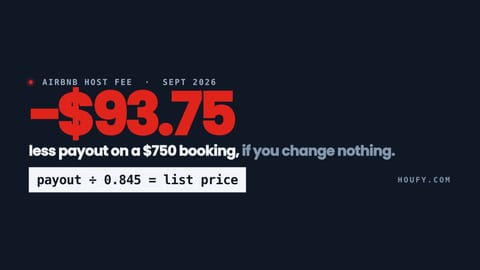
Airbnb's host-only fee structure charges up to 15.5% of your booking subtotal. VRBO charges 5% commission plus 3% payment processing (8% total). Both platforms also charge guests a service fee on top of your listed rate — typically 6% to 15% depending on the booking.
Here is what that looks like on a real $2,000 booking:
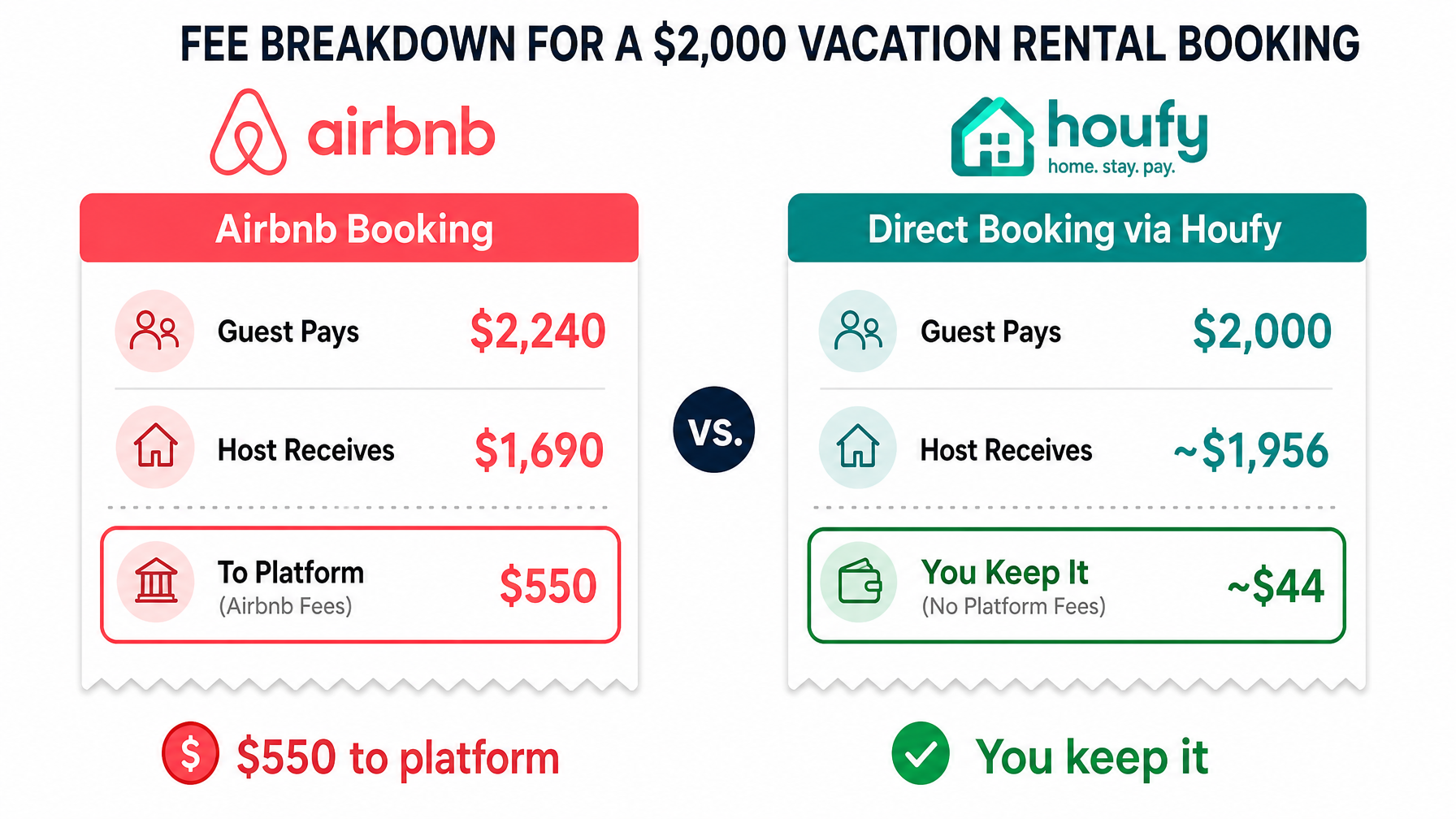
The guest may pay $2,240 after Airbnb's guest service fee. You, the host, receive approximately $1,690 after Airbnb's 15.5% host fee. The gap between what the guest paid and what you received: $550.
That $550 went to the platform. It did not go toward insurance on your property, did not fund anything specific to your listing, and does not grow your business. It is simply the cost of using Airbnb as your only booking channel.
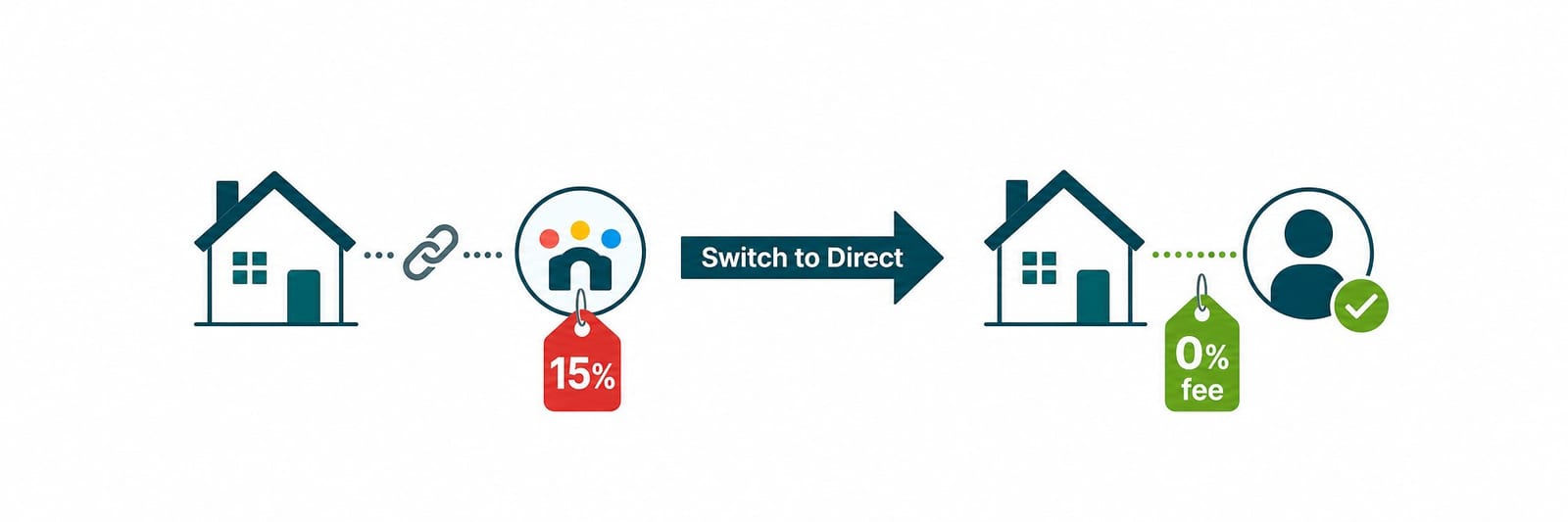
A direct booking channel closes that gap. You set the price. The guest pays the price. No one skims 15% off the top.
Source: AirDNA — What Is Direct Booking in Short-Term Rentals?
"I Already Use Airbnb" — The Objection, Answered
This is the most common response from hosts who encounter direct booking for the first time. And it makes sense. If your Airbnb calendar is reasonably full, switching feels risky. What if direct booking does not work as well? What if you lose visibility?
Here is the key point: adding a direct booking channel does not mean removing yourself from Airbnb.
The strategy that works for most hosts is running both simultaneously. Airbnb (and VRBO if you choose) serves as your discovery engine. Guests find you there for the first time, book, stay, and leave a review. After that positive experience, you introduce them to your direct booking page for future stays.
The math is straightforward. On a repeat guest booking $1,500 through Airbnb, the platform takes $232.50. On the same booking through your direct channel, you keep the full $1,500 minus minimal payment processing of around $44. That is $188 per booking retained, permanently, for every future stay from that guest.
Most hosts who have been at it for two or more years already have a pool of satisfied repeat guests re-booking through Airbnb simply because that is the only option they know exists. A direct booking page changes that. For practical scripts and messaging to make that shift, see How to Convince Guests to Book Direct.
What Does a Direct Booking Website Actually Do?
A direct booking website or page handles the same core functions as an OTA listing — but without the platform intermediary.
It shows availability. Guests see which dates are open and which are booked, synced with your Airbnb and VRBO calendars to prevent double bookings.
It displays your listing. Photos, description, amenities, house rules, and location — exactly as on Airbnb, but in your own environment.
It accepts payment. Guests pay securely, either through the platform's payment system (as on Houfy) or through a payment processor like Stripe on a standalone booking site.
It stores the guest relationship. On an OTA, the platform owns the guest data. On a direct booking channel, you own that relationship. You can reach past guests, offer loyalty perks, and build a repeat-guest base that does not depend on any algorithm.
It builds your brand. A Houfy listing page or a custom-domain booking site reflects your property, not Airbnb's brand guidelines. Guests arrive knowing they are dealing directly with you.
Do You Need a Custom Website?
Not necessarily. A custom-built booking site — with a developer, a custom domain, a booking engine integration, and ongoing maintenance — is the right move for multi-property operators building a recognizable brand. For a single- or two-property host, it is often more complexity than necessary.
The practical starting point for most hosts in 2026 is a fee-free marketplace listing, specifically Houfy. You get a public direct booking page, calendar sync, guest reviews, and search visibility with no technical setup required.
Your Houfy listing URL functions as your direct booking website. It is shareable on social media, linkable in email, printable on a business card, and findable on Google Vacation Rentals. For the purposes of building a direct booking presence, it does everything a standalone site does — at a fraction of the cost.
For tips on making that listing page as effective as possible, read How to Optimize Your Direct Booking Website: 10 Tips for Hosts.
The Simplest Direct Booking Setup in 2026
If you want to go from zero to a live direct booking presence today, here is the fastest path.
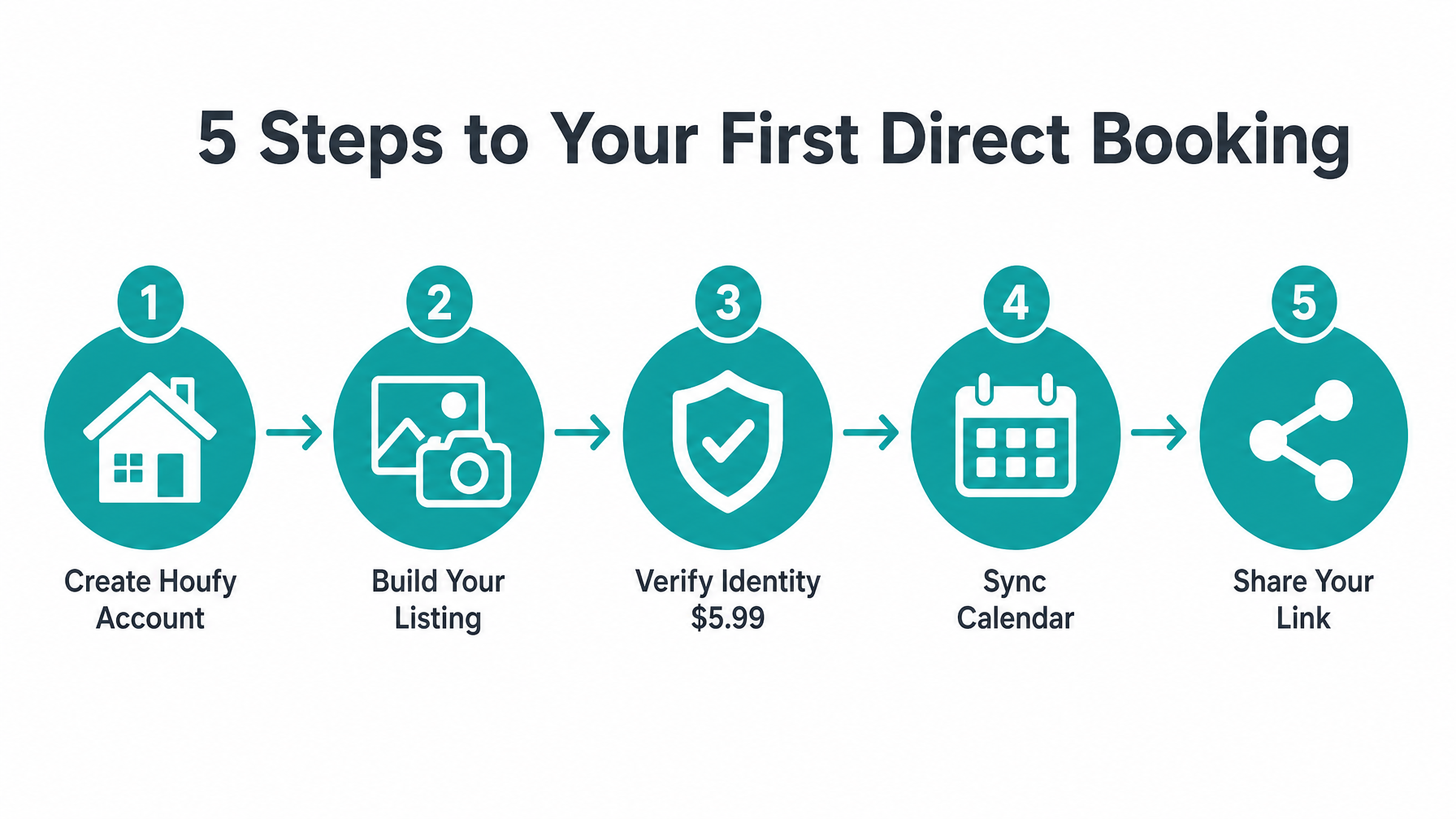
Step 1: Create your Houfy host account Go to houfy.com and sign up as a host. The account is free.
Step 2: Build your listing Add your photos, description, pricing, amenities, and house rules. Houfy makes it easy to import your listing data directly from Airbnb, so you are not starting from scratch.
Step 3: Complete host verification A one-time identity verification for $5.99. This makes your listing visible to guests and confirms it as legitimate.
Step 4: Sync your calendar Use iCal links to connect your Houfy availability with Airbnb and VRBO. Blocked dates on one platform automatically block on the others, eliminating double-booking risk.
Step 5: Share your Houfy link Add it to your Airbnb bio, your Instagram bio, your welcome book, and any guest communication that allows external links. Every person who clicks it is a potential direct booking.
Total setup time: 30 to 60 minutes for a host who already has listing photos and a description ready.
What Happens to Your Existing OTA Listings?
They stay exactly as they are. You do not need to change anything about your Airbnb or VRBO listing to add a direct booking channel.
With calendar sync in place, any booking on any platform automatically blocks those dates across all channels. Your availability stays accurate, your double-booking risk is near zero, and you generate bookings through every available channel simultaneously.
The only thing that changes is where some of your future bookings come from — and how much of each booking you keep.
For more on managing multiple channels without losing control, see Vacation Rental Direct Booking Websites: A Full Breakdown (PriceLabs).
Who Benefits Most From Direct Booking?
Direct booking delivers the most value for these host profiles:
Hosts with repeat visitors. If guests have stayed more than once or left a review mentioning they would return, you have a repeat-booking audience currently funneling through Airbnb or VRBO. A direct channel captures those future bookings at 0% commission.
Hosts in distinctive locations or niches. A beachfront property, a mountain cabin with unique character, or a city apartment in a high-demand neighborhood has draw that does not depend on an algorithm to convert — once a guest discovers it.
Hosts building for the long term. Every direct booking builds your guest relationship database. Every year on direct booking is a year of guest data, repeat bookings, and referrals that belong to you, not to a platform.
Hosts frustrated with OTA rules. Platform policy changes, algorithm updates, and review manipulation are ongoing issues for OTA-dependent hosts. A direct booking channel is your insurance policy against any single platform's decisions. Read more on this at Why Every Vacation Rental Host Needs a Direct Booking Website.
The One Number That Matters
Airbnb's 15.5% host-only fee means that for every $10,000 you earn in gross bookings, $1,550 goes to the platform.
Over a year of hosting at $40,000 gross, that is $6,200. Over three years, assuming modest 5% annual growth, that is over $19,000. Over five years, it exceeds $35,000.
A direct booking vacation rental website costs a fraction of that. On Houfy, the cost is $5.99 to get started and optionally $7.99 to $11.99 per month for enhanced features. The rest stays with you.
You do not need to abandon Airbnb. You do not need to rebuild your hosting business from scratch. You need one additional channel that charges you nothing for the bookings it generates — and you need to tell your past guests it exists.
That is direct booking. It is simpler than it sounds, and the financial case for starting today rather than next quarter is hard to ignore.
Create your free listing on Houfy → Your first direct booking starts with one shareable link.
Frequently Asked Questions
What is a direct booking website for vacation rentals?
A direct booking website is any digital channel where a guest can find, check availability, and book a vacation rental without going through a third-party OTA like Airbnb or VRBO. The transaction goes directly between the host and the guest, with no platform commission deducted from either side. This includes standalone custom-built booking sites and fee-free marketplace listings like Houfy.
Do I need to leave Airbnb to do direct booking?
No. The most effective strategy for most hosts is running Airbnb and a direct booking channel simultaneously. Airbnb drives discovery from new guests; your direct booking page captures repeat stays from those same guests at 0% commission. Calendar sync tools prevent double bookings across all platforms automatically.
How much does a direct booking website cost?
Costs vary widely. A custom-built booking site with a developer and booking engine can run $1,000–$5,000+ to build plus monthly maintenance. A listing on a fee-free marketplace like Houfy starts at $5.99 (one-time host verification) and $0 to $11.99 per month for optional enhanced features. Most single-property hosts start with a fee-free marketplace before considering a fully custom site.
Can guests find my direct booking page on Google?
Yes. Houfy listings are indexed on Google and eligible to appear in Google Vacation Rentals, which surfaces short-term rental listings directly in Google Search results. This means your direct booking page can show up alongside OTA listings for relevant search terms. For more on this, see Google Vacation Rentals Listing Guide (2026).
What is the difference between a direct booking website and a listing on Houfy?
A standalone direct booking website is a site you build and host yourself on your own custom domain, integrated with a booking engine and payment processor. A Houfy listing is a hosted direct booking page within Houfy's marketplace — it functions like a direct booking website (guests pay you directly, no commission), but with no technical setup required. For most hosts starting out, a Houfy listing page serves as their direct booking website.
How do I prevent double bookings when using multiple platforms?
Use iCal calendar sync. Every major platform — Airbnb, VRBO, Houfy, and most booking engines — supports iCal export and import. You export your Airbnb calendar link and import it into Houfy (and vice versa). Any confirmed booking on one platform automatically blocks those dates on all synced platforms, typically within a few minutes.
Is direct booking safe for guests?
Yes. On Houfy, all hosts complete a one-time identity verification before their listing goes live. Guest payments are processed securely through the platform's payment system. Guests can also read public host reviews before booking, just as on any OTA. The absence of a service fee does not mean the absence of trust infrastructure.
How long does it take to set up a direct booking page on Houfy?
For a host who already has listing photos and a description ready, setup takes 30 to 60 minutes. This includes creating your free account, building your listing, completing host verification, and syncing your calendar with Airbnb or VRBO.
Last updated: May 2026. Houfy is a fee-free vacation rental direct booking marketplace with 87,000+ properties across 50+ countries. Explore Houfy listings →