

A guest does not arrive at your property planning to cause damage. They arrive tired from travel, ready to relax, and slightly nervous about whether the place will match the photos. That is the emotional state in which they read your house rules.
If your rules read like a legal contract with consequences listed in bold, guests feel accused before they have done anything wrong. If the rules are vague or missing, guests fill in the gaps however they like. Neither outcome serves you.
The goal is a set of rules that feel clear, reasonable, and human — rules that a thoughtful guest reads and thinks "fair enough," rather than "this host sounds paranoid."
Quick Summary
Vacation rental house rules protect your revenue, your property, and your neighbors — but only when they feel clear, fair, and human. This guide covers the 8 rules every host needs, copy-ready example language for pets, parties, check-in times, and extra guests, plus how to frame negatives positively so guests read them as reasonable rather than threatening.
Why House Rules Are a Business Document, Not a Punishment List
House rules exist to protect your revenue, your property, and your relationship with the neighbors. Done well, they do all three without creating friction with the guests you actually want.
Good rules also do something most hosts overlook: they screen out problem guests before booking. A guest who reads your no-party rule and cancels is not a lost booking. They are a bullet dodged. The same goes for your pet policy, your smoking policy, and your extra guest fee. Clarity upfront saves you from disputes after checkout. Research from Guesty confirms that explicit rules prevent minor issues from escalating into expensive repair costs or liability problems.
On Houfy, where you communicate directly with guests before and after booking, house rules become part of a genuine relationship rather than a platform-mediated transaction. You can enforce them, discuss them, and adjust them based on context because you own the guest relationship end to end.
Related: Vacation Rental House Rules: Complete Template for Hosts
The 8 Rules Every Host Needs
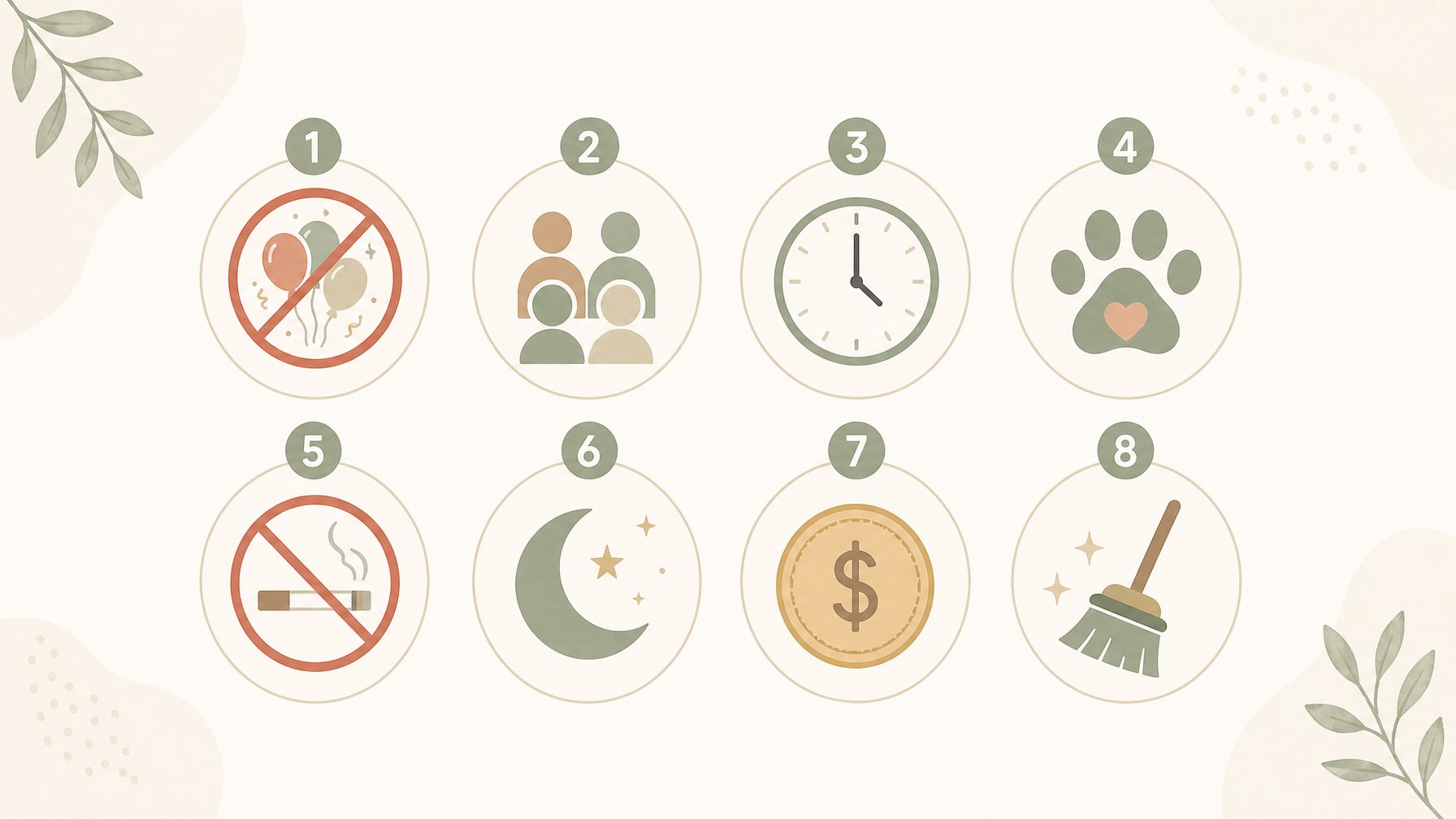
Rule 1: No Parties or Events
This is the rule that earns its place on every listing regardless of property type. Party damage is expensive, it triggers neighbor complaints, and it can result in local authority visits that jeopardize your STR license.
Weak version: "Please respect the property and neighbors."
Strong version: "No parties, events, or gatherings beyond the registered guests. This property accommodates up to [X] guests. Any gathering exceeding that number without prior approval will result in immediate removal and forfeiture of the security deposit."
The strong version is specific about what "no parties" means and what happens if it is violated. Specificity signals that you mean it.
Rule 2: Occupancy Limit
Specify the maximum number of guests allowed, both overnight and during the day. Plenty of guests book for 4 but bring 8 for a Saturday barbecue. If your occupancy rule only covers overnight guests, you have a gap.
Example: "Maximum overnight occupancy is [X] guests. Daytime visitors are welcome but must not exceed [X+2] people on the property at any time."
Rule 3: Check-In and Check-Out Times
Be explicit about the times, the process, and what happens if guests arrive early or request a late check-out. This protects your cleaning schedule and turnover windows.
Example: "Check-in begins at 4:00 PM and check-out is by 10:00 AM. Early check-in and late check-out are subject to availability and must be arranged in advance. Unapproved late check-outs are subject to a $[X] per hour fee."
Frame early check-in and late check-out as a benefit you offer when possible, not just a restriction you enforce.
Rule 4: Pets
Your pet policy should be binary and specific: pets allowed or pets not allowed, with the conditions clearly stated if allowed. Ambiguous language like "pets considered on request" creates negotiation overhead on every single inquiry.
If you allow pets: "Up to [X] dogs are welcome with a $[X] pet fee per stay. Pets must not be left unattended in the property. Please clean up after your pet in the yard. Damage caused by pets is the guest's responsibility."
If you do not allow pets: "This is a pet-free property. Guests found with undisclosed pets will be charged a $[X] deep-cleaning fee."
Note the framing: the pet-free version states the rule and its consequence matter-of-factly, without sounding hostile.
Rule 5: Smoking
A no-smoking rule is standard. The key is defining where "smoking" applies: inside only, or anywhere on the property including outdoor areas. If you have a neighboring property or shared outdoor space, the outdoor definition matters.
Example: "No smoking anywhere on the property, including outdoor areas. Guests who smoke at the property will be charged a $[X] remediation fee. Designated smoking areas are available [X] meters from the property if needed."
Rule 6: Quiet Hours
Quiet hours protect your relationship with neighbors and your ability to keep your STR permit in neighborhoods with noise ordinances. State the hours clearly and tie them to a specific behavior, not just a vague request to be quiet. According to Minut's vacation rental hosting research, noise complaints are among the top reasons hosts lose STR permits — a concrete quiet hours rule is one of the most effective preventive measures.
Example: "Quiet hours are 10:00 PM to 8:00 AM. During this time, outdoor music, amplified sound, and gatherings on decks or patios must cease. We have neighbors in close proximity and respect for them is part of what makes this area so pleasant to visit."
The last sentence reframes the rule as community courtesy rather than a host restriction. That framing lands better.
Rule 7: Extra Guest Fees
If you charge for guests beyond a base number, make the math visible upfront. Hidden fees discovered at checkout are a primary driver of bad reviews.
Example: "The base rate covers up to [X] guests. Additional guests are charged $[X] per person per night. Please update your guest count before or at booking so your reservation reflects the correct total."
On Houfy, there are no platform service fees layered on top of your pricing — so the total your guest sees at checkout is exactly what you quoted. That transparency alone reduces fee-related friction and bad reviews. See how Houfy's direct booking model compares to OTA fee structures.
Rule 8: Property Care and Departure Conditions
This rule covers the basic expectations for how guests leave the property: dishes, trash, and any property-specific requirements. Keep it reasonable. Asking guests to strip all beds, start all laundry, and mop the floors is unreasonable if they are already paying a cleaning fee. Asking them to leave the property in a basic tidy condition is fair.
Example: "Please leave the property in the condition you found it. Dishes washed or in the dishwasher, trash bagged and in the bins outside, and windows and doors locked on departure. You do not need to strip beds or clean bathrooms. Your cleaning fee covers the standard post-stay clean."
The explicit "you do not need to" is powerful. It signals that your expectations are reasonable, which builds goodwill.
How to Frame Negatives Positively
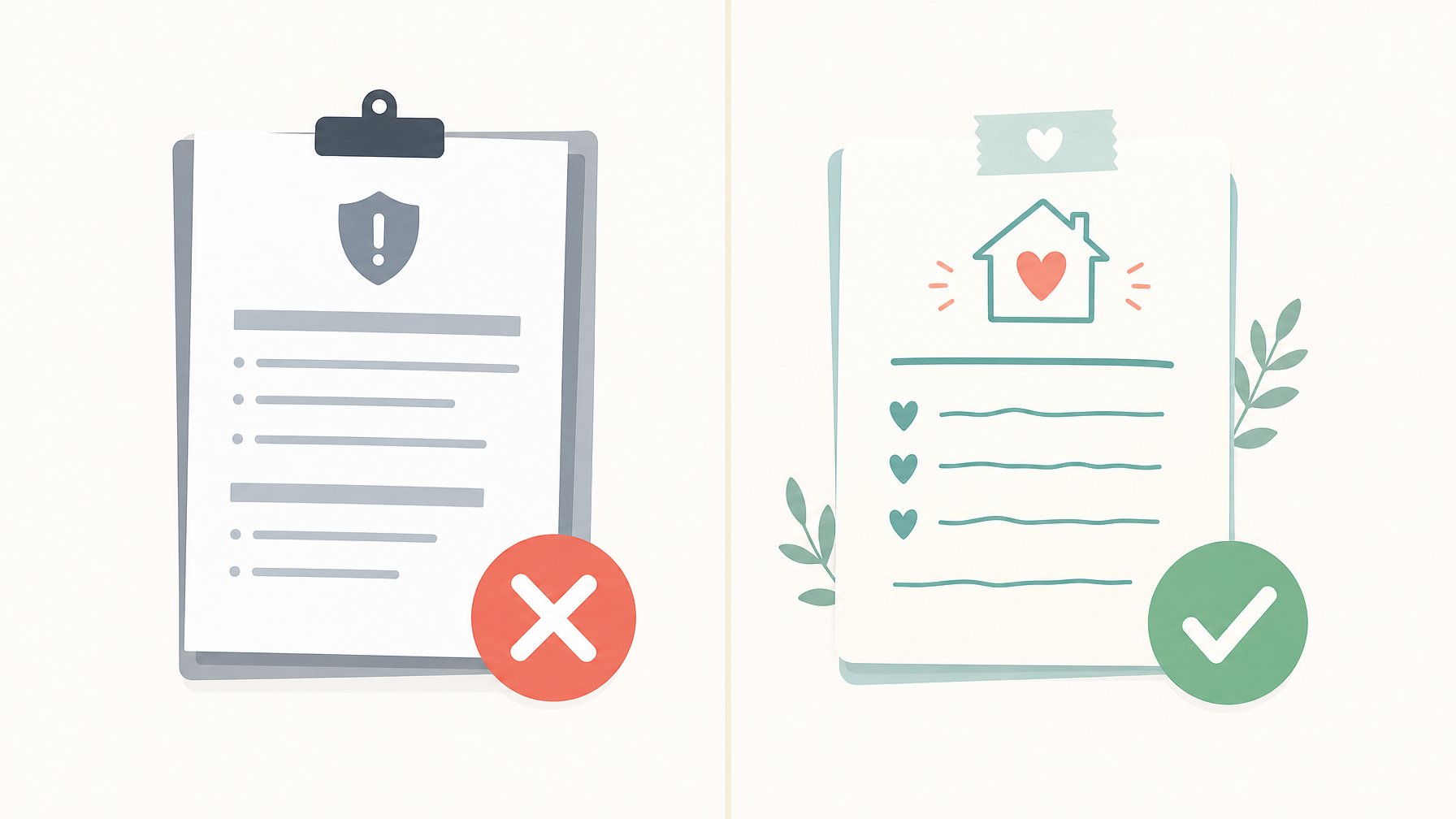
The instinct when writing rules is to write in the negative: "No smoking," "No parties," "No pets." Those phrases are fine for clarity, but a few well-placed rewrites reduce the punitive feeling of the overall list.
Compare these pairs:
Quiet hours:
❌ "No loud music after 10 PM"
✅ "Enjoy music and entertainment until 10 PM, then quiet hours begin to respect the neighborhood."
Furniture:
❌ "Do not rearrange the furniture"
✅ "Furniture is positioned for the best use of space. If anything needs adjusting, let us know and we will sort it."
Pool access:
❌ "Do not use the pool after midnight"
✅ "The pool is available until midnight. After that, quiet hours apply to outdoor areas."
The second version in each pair communicates the same rule with a tone that feels collaborative rather than controlling. Hospitable's guide to STR house rules makes the same point: rules that include what guests can do alongside what they cannot convert better and generate fewer disputes.
What to Leave Out
Excessively long lists. More than 10–12 rules creates fatigue. Guests stop reading carefully and start skimming, which defeats the purpose. Prioritize the rules that address your most common problems and leave the edge cases for your house manual.
Passive-aggressive language. Phrases like "Previous guests have damaged the hot tub, so please be careful" or "We have cameras because guests have stolen items" poison the relationship before it starts. State the rule without explaining the bad history behind it.
Impossible standards. Rules that no reasonable guest can follow — "no cooking smells on any floor" — signal an anxious host, not a reasonable one. Guests who feel they cannot win from the start book somewhere else.
Related: How to Optimize Your Direct Booking Website: 10 Tips for Hosts
Putting It All Together
Your house rules should take a guest no more than 3–4 minutes to read and leave them feeling informed, not interrogated. Start with the most important rules. Use plain language. Frame restrictions in terms of what guests can do, not just what they cannot. And close with something hospitable.
A closing line like "We genuinely want this to be a great stay. If anything is unclear or if you have questions before arrival, just message us directly" reminds guests that there is a real person behind the listing who is on their side.
On Houfy, that direct line of communication is always open. No platform messaging filters, no automated responses a guest cannot tell from a human. Just you and your guest, aligned from booking to checkout.
Create your Houfy listing and start building direct guest relationships on your own terms — with 0% commission and full control over your house rules and policies.
Frequently Asked Questions
How many house rules should a vacation rental have?
Aim for 8–12 rules. Fewer than 8 leaves meaningful gaps around common issues like occupancy, pets, and smoking. More than 12 creates reader fatigue — guests start skimming instead of reading, which is exactly what you want to avoid. Move edge-case instructions (how the dishwasher works, where to park) to your house manual or welcome book rather than the main rules list.
Can vacation rental house rules be enforced without a platform?
Yes. When you book direct through a platform like Houfy, you own the guest relationship completely. Your house rules form part of your rental agreement, and any violations — unauthorized pets, smoking, occupancy breach — give you grounds to charge against the security deposit or pursue a claim. Having rules stated clearly in writing, acknowledged at booking, is the foundation of that enforcement.
What happens when a guest breaks a vacation rental house rule?
Your response depends on the severity of the breach. For minor issues (slightly late check-out, an undisclosed extra guest), a direct message resolving the situation is usually enough. For serious violations (a party, undisclosed smoking, property damage), charge against the security deposit with documented evidence: photos, messages, noise sensor data if applicable. Clear rules with stated consequences make this process much cleaner because you have something specific to point to.
Should vacation rental house rules differ by platform?
The core rules should stay consistent across every channel — your no-party rule is not negotiable regardless of where the guest found you. Tone and length may vary: some OTA platforms limit how many characters you can use, which forces brevity. On your own direct booking profile or a platform like Houfy, you have full control and can write rules at whatever length and tone best represent your property.
Do vacation rental house rules hold up legally?
House rules function as part of your rental contract. They are not a replacement for a proper rental agreement, but when a guest has read and acknowledged them at booking, they carry weight in deposit disputes and small claims situations. For properties in jurisdictions with strict STR licensing requirements, specific rules around noise, occupancy, and events can also help demonstrate compliance to local authorities. Consult a local attorney if your property sits in a highly regulated market.
How do you write a no-party rule that guests actually follow?
Specificity is what makes a no-party rule credible. "Please respect neighbors" does not tell a guest what "respect" means. "No gatherings beyond registered guests; violations result in immediate removal and deposit forfeiture" is unambiguous. Pair the rule with a monitoring method — a noise sensor, a neighbor check-in process, or a security camera at the front door — so guests understand that enforcement is real, not theoretical.
Should house rules appear in the listing, the welcome book, and inside the property?
Yes, all three. At the listing stage, rules set expectations and filter out guests who will not comply. In the pre-arrival message and welcome book, they serve as a reminder when guests are already committed to the stay. A printed card or framed house rules inside the property is a final touchpoint that removes any "I didn't see it" defense. Three exposure points is not overkill — it is standard practice for hosts who rarely have disputes.