
Open any vacation rental listing platform right now and read ten property descriptions. Most of them will say something like: "3BR/2BA, sleeps 6. Full kitchen, private pool, minutes from the beach. Fast WiFi. Great for families."
That is not a listing. That is a spec sheet. And spec sheets do not book properties.
The best vacation rental listings do something different. They make the guest feel the stay before they book it. They answer the unspoken question every traveler carries: "Will this place give me what I actually came here for?" The answer to that question is not a bedroom count. It is a story.
This guide covers the techniques that turn generic vacation rental copy into descriptions that convert, plus five line-by-line rewrites you can use as a template for your own property. If you want to go deeper on the structural side of what guests actually read, the Houfy guide on the listing details that make guests book covers exactly that.
Key Insights
Most vacation rental listings read like spec sheets. The ones that book properties read like stories. This guide covers the three core techniques, features vs. transformation, guest-perspective writing, and sensory specificity, plus five line-by-line rewrites you can use as a model for your own listing. Direct booking platforms reward good copy more than OTAs do, because the guest is making an unassisted choice with nothing but your words and photos to go on.
The Feature Trap Most Listings Fall Into
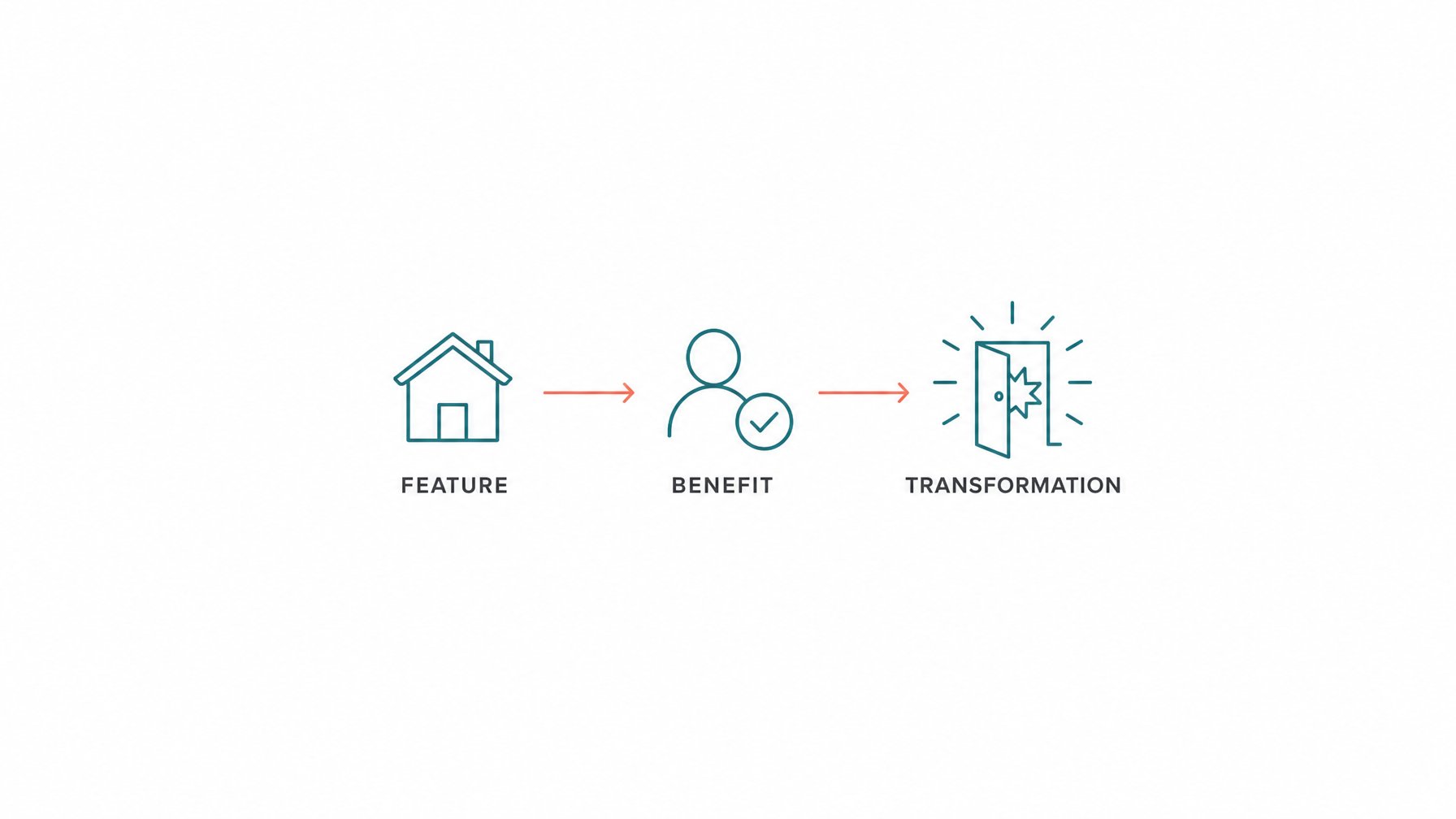
A feature is a fact about your property. A benefit is what that feature means to the guest. A transformation is how the guest's life changes, even briefly, because of that benefit.
Most listings stop at features. The best listings go all the way to transformation.
Here is how that progression works in practice:
Feature: "Private outdoor shower" Benefit: "Rinse off after the beach without tracking sand inside" Transformation: "Come back from the water, rinse off under open sky, and walk straight into a clean house"
The transformation is what a guest remembers when they close your listing and open their booking platform. It is also what they write about in reviews, recommend to friends, and associate with your property when they consider booking again.
The shift from features to transformation does not require purple prose or travel-magazine language. It requires one thing: write from inside the experience, not outside it.
According to Hostaway's guide on listing descriptions that convert, the most common mistake hosts make is confusing an informative description with a persuasive one. Informative tells. Persuasive makes the reader picture themselves there.
Write From the Guest's Perspective
Most listing copy is written from the host's perspective: "We have a gorgeous kitchen with quartz countertops." The guest's perspective reads differently: "Cook a full breakfast while the light comes through the south-facing windows" or "Prepare dinner for eight without fighting for counter space."
The practical test: read your listing back and count how many sentences start with "We have," "The property features," or "This home offers." Each one is a missed opportunity to put the reader inside the experience.
Replace every host-perspective line with a guest-perspective version. The sentence does not have to be long. It has to be specific enough that the reader can picture themselves there.
Before: "The living room features ocean views." After: "Watch the sun set over the water from the couch without getting up."
Guesty's copywriting guide notes that the hosts who write in first person and address the reader directly convert better, because the description feels like a direct conversation rather than a brochure. Your familiarity with the property is your biggest advantage. Nobody knows your specific corner-of-the-yard light or the particular quiet of the street at 7am better than you do. Use that.

The Power of Sensory Specificity
Vague adjectives, "beautiful," "stunning," "cozy," "luxurious," are invisible to the human brain. The brain processes specifics, not superlatives. Specificity creates imagery, and imagery creates desire.
The rule: replace every vague adjective with a specific sensory detail.
Before: "Enjoy beautiful mountain views." After: "The back deck looks out over three ranges of mountains, and on clear mornings you can watch the cloud layer burn off by 9am."
Before: "Cozy living room." After: "The living room has a wood-burning fireplace, floor-level seating, and a ceiling low enough to feel genuinely warm on cold nights."
Before: "Well-equipped kitchen." After: "The kitchen has a six-burner gas range, a cast iron skillet left out for guests to use, and a well-stocked spice rack."
Notice what the specific versions do: they put you in the room. You can hear the gas range ignite. You can feel the low ceiling. You can see the cloud layer moving. That is the point.
Vacasa's listing writing experts call this "addressing your target audience with the right details." The detail only lands if it is specific to the type of guest you are writing for. A family cares about the yard size in feet. A couple cares about the bath towels and the wine glasses. A remote worker cares about the desk position relative to the window.
5 Before-and-After Listing Rewrites
These are real examples of typical listing language, rewritten using the techniques above. Use them as a model for your own property descriptions. For more real-world examples, the Houfy collection of vacation rental description examples has additional annotated rewrites across different property types.
Rewrite 1: The Opening Line
Before:
"Welcome to our beautiful home! This 3-bedroom property is perfect for families and couples alike."
After:
"Three bedrooms, a full yard, and a neighborhood quiet enough that your kids can actually tire themselves out before dinner. This is the house where your family exhales."
What changed: The opener now answers "what is the stay actually like?" instead of describing the listing format. "Families and couples alike" is a hedge that signals nothing. "Where your family exhales" is a specific emotional promise.
Rewrite 2: The Kitchen
Before:
"Fully equipped kitchen with all appliances."
After:
"The kitchen has everything you need for a real meal: a full-size range, sharp knives, a French press, and enough counter space to actually use it. The grocery store is 7 minutes away."
What changed: "All appliances" says nothing. The rewrite names specific things, including the French press and the counter space, because those are the details guests actually wonder about. The grocery distance is a bonus: it removes a planning friction point before the guest even thinks to ask.
Rewrite 3: The Bedroom
Before:
"Master bedroom with king bed and en-suite bathroom. Mountain views from the window."
After:
"The main bedroom has a king bed positioned to catch the morning light and a window that frames the ridgeline. Wake up here and you understand why people come back."
What changed: "Mountain views from the window" is a feature. "A window that frames the ridgeline" is a composition. "Wake up here and you understand why people come back" is a transformation: it implies repeatability, which is one of the strongest signals of genuine quality.
Rewrite 4: The Outdoor Space

Before:
"Large private backyard with patio and seating area. Great for entertaining."
After:
"The backyard has a long dining table that fits ten, a grill seasoned from years of use, and enough string lights to make evenings worth staying outside for. The neighbors are friendly and far enough away."
What changed: "Great for entertaining" is a claim. The rewrite is a picture. The grill "seasoned from years of use" does quiet trust-building work: it tells the guest this is a real, lived-in property, not a staged shoot.
Rewrite 5: The Location
Before:
"Centrally located, minutes from restaurants, shops, and attractions."
After:
"You can walk to coffee in three minutes and to dinner in eight. The Saturday farmer's market is two blocks over. You will not need the car on days you do not want to use it."
What changed: "Minutes from restaurants" is a throwaway phrase on every listing on every platform. The rewrite gives specific times and specific places. "You will not need the car on days you do not want to use it" answers the exact anxiety a guest carries when booking in a new city.
How to Rewrite Your Own Listing
A practical process for rewriting your listing from scratch:
Step 1: Write down what you would tell a close friend. Imagine a friend asks: "What is it really like to stay at your place?" Write your answer in plain speech, not marketing language. That answer usually contains your best copy.
Step 2: Identify the three things guests consistently mention in reviews. Those phrases are proof of your real differentiators. Work them into your opening paragraph.
Step 3: Walk through the stay chronologically. Arrival, morning, afternoon, evening, departure. What does the guest see, smell, hear, and feel at each point? Write one sentence for each moment.
Step 4: Cut every adjective you cannot back up with a specific detail. "Beautiful" goes unless you follow it with exactly what you mean. "Cozy" goes unless you describe the fireplace, the lighting, or the ceiling height.
Step 5: Read it back as if you have never heard of your property. Does it make you want to be there? If not, which sentence is doing the least work? Rewrite that one first.
For a deeper walk-through of description structure, including the psychology behind how guests scan a listing before they read it, see the full guide on how to write a vacation rental description on the Houfy blog.
Why Copy Matters More on a Direct Booking Platform
On a large OTA, your listing competes in an algorithm. Search rank, pricing, and review volume can outperform good copy because the platform is doing most of the decision-making work for guests.
On a direct booking platform, the guest is making an unassisted choice. They are reading your words, looking at your photos, and deciding whether to trust you enough to send money directly. That is a higher-stakes context for copy, and it rewards hosts who write with specificity and care.
Houfy is a direct booking marketplace with 0% service fees. Guests who book here pay your rate, nothing more. That means your listing copy is competing on its own merits, in a context where transparency and authentic description carry real weight.
If you have a property worth staying in, you have a story worth telling. Write that story on Houfy and let your copy do what spec sheets never can.
FAQ
What is vacation rental copywriting?
Vacation rental copywriting is the practice of writing listing descriptions, headlines, and other property text with the goal of converting browsers into booked guests. It goes beyond listing facts and amenities to paint a picture of what the stay actually feels like. Good vacation rental copy answers the guest's unspoken question, "Will this place give me what I came here for?" before they even think to ask it.
How long should a vacation rental description be?
Most platforms recommend between 200 and 500 words for the main description. The ideal length is the one that answers every likely guest question without padding. A three-bedroom beach house needs more description than a city studio. More important than length is structure: lead with the emotional hook, follow with the most distinctive features, and close with practical logistics like check-in and parking.
What makes a vacation rental description convert?
The three factors that separate high-converting descriptions from generic ones are: guest-perspective framing (write "cook breakfast while morning light fills the kitchen," not "fully equipped kitchen"), sensory specificity (replace "beautiful views" with exactly what the guest will see and when), and transformation-level copy (describe not just what the property has, but what the guest's stay will feel like because of it).
Should I use bullet points or paragraphs in my listing description?
Both, at different points. Lead with one to three short paragraphs that sell the experience and emotional tone. Follow with bullet-point amenity lists for the practical details, since guests scan those, they do not read them. The opening narrative is where copy does the conversion work. The bullets confirm the details once the guest is already interested.
Does good copy matter if my photos are excellent?
Photos get the click. Copy closes the booking. Research on traveler behavior consistently shows that guests make an emotional snap judgment from photos, then turn to the description to either confirm or undermine that judgment. Weak copy after a strong photo set creates hesitation. Strong copy after a strong photo set removes the last obstacle between the guest and booking.
Why do direct booking listings need better copy than OTA listings?
On an OTA, the platform algorithm pre-qualifies guests and handles a significant part of the trust-building through its review infrastructure, payment protection, and brand recognition. On a direct booking platform like Houfy, the guest is extending trust directly to you. Your words, your photos, and your price are doing all the work. That makes authentic, specific copy worth considerably more per word than it is on a platform where the brand does the heavy lifting.
What words should I avoid in a vacation rental description?
Avoid vague superlatives like "beautiful," "stunning," "cozy," "luxurious," and "amazing" unless they are immediately backed up with a specific detail. Avoid host-perspective framing like "we have" or "our home offers." Avoid hedge phrases like "perfect for everyone" or "ideal for any occasion." Each of these signals generic copy and costs you reader trust.
Ready to put your best listing forward in front of fee-conscious travelers? List your property on Houfy for free and reach guests who book direct.