
Most vacation rental descriptions fail the same way. They list facts without selling feelings. They tell guests what the property has, but never why that matters. The result is a listing that blends into hundreds of identical ones — and a calendar that stays emptier than it should.
A well-written description does real work. It filters for your ideal guest, handles objections before they form, and builds enough trust that a stranger is ready to hand over money. This guide breaks down the exact structure to use, shows real before-and-after examples, and explains why the description matters even more when guests book directly.
Key Insights
Guests scan before they read. Your opening 2–3 sentences decide whether they continue.
Two psychological forces drive bookings: aspiration (the experience they want) and risk reduction (the trust that you deliver on it).
Strong descriptions follow 4 parts: Hook, Experience, Practical Details, and a CTA.
On direct booking platforms like Houfy, your description is your primary sales tool — no algorithm suppressing it, no promoted listings stealing the click.
Avoid vague superlatives, property-centric sentences, and listing titles that lead with room counts.
The Psychology Behind What Guests Actually Read
Before writing a single word, understand how guests actually read your listing. They scan first, then read selectively. Research on traveler behavior consistently shows that guests make a snap emotional judgment about whether a property is right for them within the first few seconds. The description either confirms that instinct or kills it.
Two psychological principles are at play. The first is aspiration: guests are not booking a property, they are booking an experience they want to have. The second is risk reduction: they are handing money to a stranger and need enough reassurance to feel safe doing it.
According to Guesty's listing research, a strong description turns browsers into bookers by leading with a benefit-driven hook, using specific amenity details, and answering guest questions before they ask. Your description has to do both things at once: excite and reassure.
The 4-Part Description Structure That Works
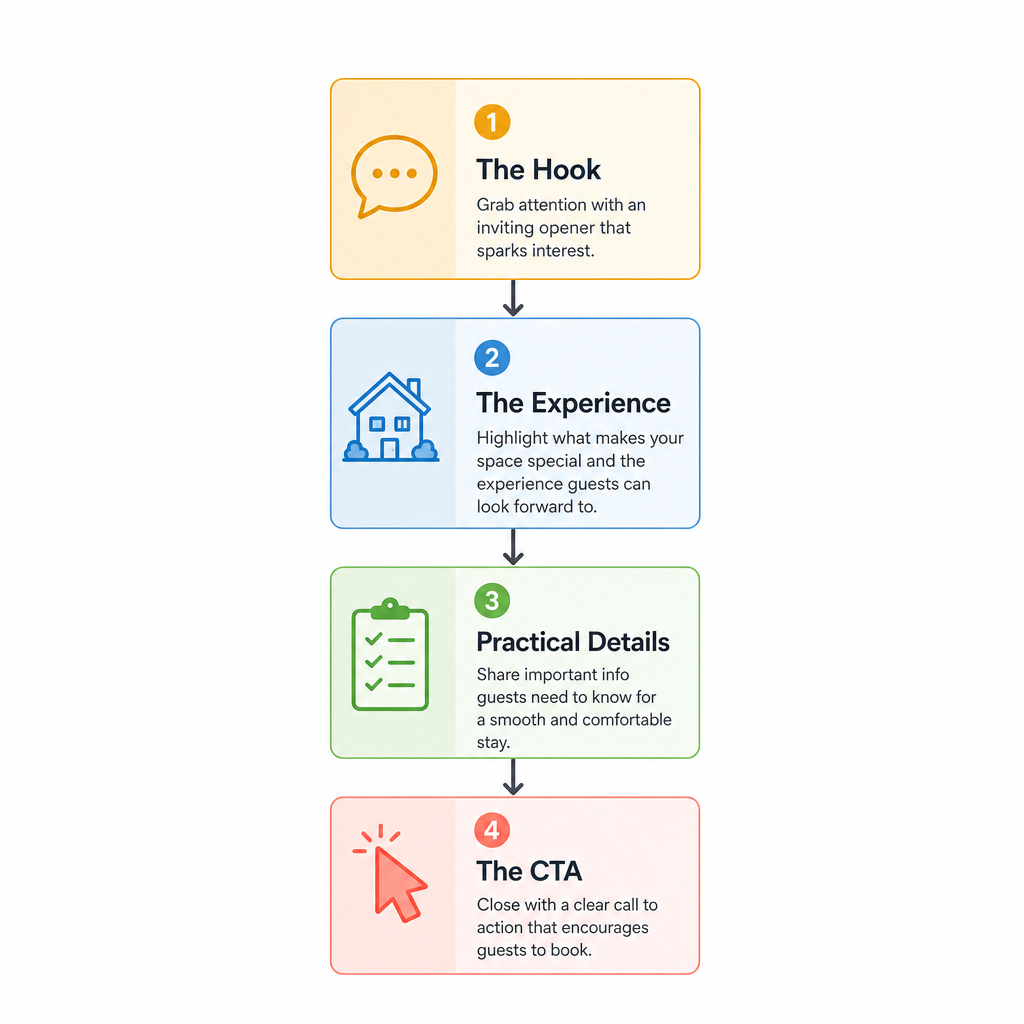
Part 1: The Hook (First 2–3 Sentences)
The hook is the most important part of your description. On most booking platforms, only the first 2–3 lines are visible before the guest clicks "Read more." Those lines determine whether they keep reading.
A weak hook describes the property. A strong hook describes how the guest will feel.
Before (weak):
"3-bedroom house in Sedona, Arizona. Sleeps 6. Full kitchen and backyard."
After (strong):
"Wake up to red rock views from every window. This Sedona retreat puts you ten minutes from the trailheads and a world away from the noise. It is the kind of place where people extend their trips."
The strong version does three things: it creates a visual, establishes an emotional tone, and implies social proof (people extend their trips) without making a hollow claim.
Part 2: The Experience (The Middle Section)
This is where you sell the stay, not the square footage. Think about what a guest actually does from the moment they arrive to the moment they leave, and describe that journey.
Cover the spaces that matter most in order of emotional importance, not physical size. The backyard hot tub is more compelling than the laundry room, even if the laundry room is twice as big.
Before (weak):
"The living room has a couch and TV. The kitchen has a dishwasher and microwave. The master bedroom has a king bed."
After (strong):
"Evenings tend to start on the deck with a glass of wine as the rocks shift from orange to deep red. Inside, the open kitchen is set up for real cooking, not just reheating, with full appliances and counter space you will actually use. The master bedroom has a king bed, blackout curtains, and the kind of quiet that makes you sleep longer than you planned."
Notice the difference: the strong version puts the guest inside the experience. Every amenity is described in terms of what it does for them.
For more real-world examples of descriptions that convert, see our vacation rental description examples guide.
Part 3: Practical Details (Without Killing the Mood)
Guests want practical information, but they do not want to feel like they are reading a legal document. Cover the logistics clearly and briefly: sleeping configuration, parking, Wi-Fi, check-in process, and any important quirks about the property.
Be honest about limitations. A property on a gravel road? Say it plainly, then reframe it: "The road to the cabin is unpaved for the last half mile. Most guests say it is worth it."
Transparency here builds trust. Guests who arrive knowing exactly what to expect leave better reviews. Guests who feel surprised by something negative take it out on your rating.
Part 4: The CTA (Close the Description)
Most hosts end their descriptions with nothing, or worse, a generic phrase like "We hope you enjoy your stay!" That is a missed opportunity.
End with a light call to action that feels hospitable rather than pushy. Invite them to reach out, reassure them that you are responsive, and remind them of the direct booking benefit if you are on a platform where that is relevant.
Example:
"Questions about the area or the property? Send a message and you will hear back within a few hours. Guests who book directly on Houfy get the full nightly rate with no added service fees on top. That is often $50–$100 in savings on a week-long stay."
For real-world examples of descriptions that convert, read the Houfy guide to vacation rental description examples for a winning listing.
Why the Description Works Harder on Direct Booking Platforms
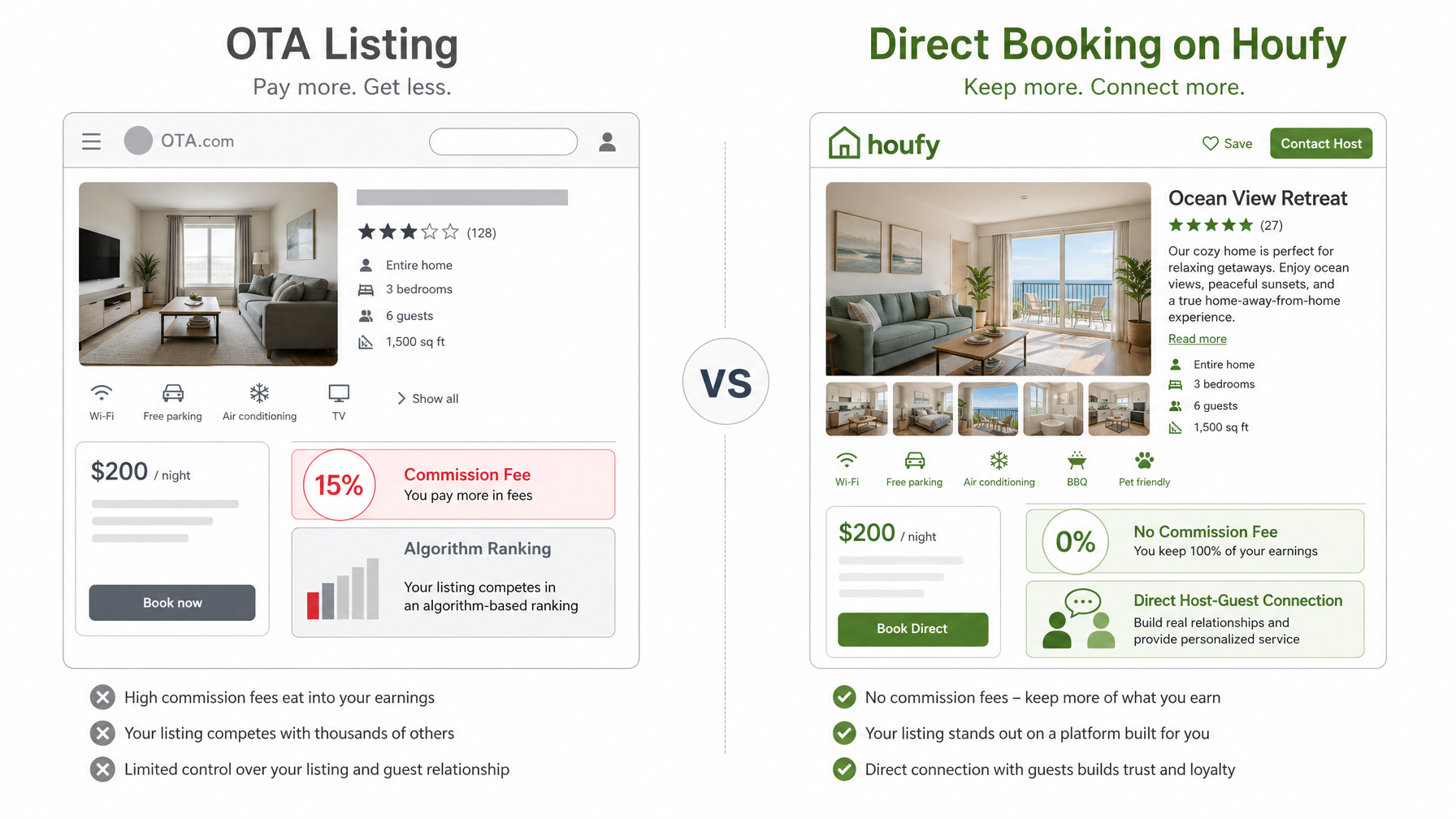
On OTAs, the algorithm controls a significant portion of your visibility. A good description helps, but it competes with the platform's own ranking signals, promoted listings, and in-house alternatives.
On Houfy, your description is your primary selling tool. There is no algorithmic penalty for writing long or short. There is no platform pushing alternative listings. The guest arrived because they found you, and your description is the conversation that closes the booking.
That also means guests on Houfy are often more motivated. They already know about direct booking. They already understand they will avoid service fees. Your description just needs to confirm that your property is the right one for their trip.
Hosts who have already started avoiding Airbnb service fees by listing on direct platforms understand this well: when there is no middleman algorithm deciding your reach, your words carry all the weight.
Vacasa's professional copywriting team notes that addressing your target audience first is the single most important step in a listing description. On a direct booking platform, that principle matters more, because you have the guest's full attention from the start — with no competing ads or "similar properties" rail pulling them away.
What Airbnb's AI Update Means for Your Listing Description
In May 2026, Airbnb launched Smart Setup, an AI tool that generates your listing description from photos and an address. It also rolled out "Ask about this home," a feature where guests type a question on your listing page and an AI answers it from your structured data — without you seeing the question or writing the response.
The practical result: on Airbnb, a guest may never read a single word you wrote. The AI summarizes your listing, answers their questions, and compares your home to the one next door using criteria the algorithm chose. Your prose goes into a machine. What comes out is a generated summary.
On Houfy, none of that exists. Your description is the conversation. Guests read what you wrote. That is not a limitation — it is the point. When you own the words, you own the impression.
Three More Description Mistakes to Avoid
Using superlatives without evidence. "Amazing views," "stunning kitchen," and "cozy retreat" are empty phrases that every listing uses. Replace them with specifics: "views of the Smoky Mountains from the living room couch," "a kitchen with a 6-burner gas range and a butcher block island," "a wood-burning fireplace with a stack of seasoned oak logs ready to go."
Writing for the property, not the guest. Every sentence should answer an implicit question the guest is asking: what will I do here? How will I feel? Will this work for my trip? If a sentence does not answer one of those questions, cut it.
Ignoring the title. The description headline or title is the first thing guests see on search results pages. It needs a hook, not a room count. "Ocean-view studio, steps from the boardwalk" beats "Studio apartment, 500 sq ft" every single time.
Once your description is strong, pair it with a thoughtful vacation rental welcome letter to carry that same warmth through to check-in day.
Your Action Plan
A better description does not require a professional copywriter. It requires about 90 minutes and the willingness to think like a guest rather than a property owner. Start with the hook. Write it five different ways and pick the one that makes you want to keep reading. Then build the experience section room by room. Close with a practical paragraph and a genuine CTA.
Once you have the description right, every other part of your marketing gets easier. Social posts, Google listings, and direct guest conversations all pull from the same story you have already told.
Ready to put a great description to work? List your property on Houfy and connect directly with guests who are already looking to book without service fees. Your description will do the selling. You keep 100% of what they pay.
FAQ: Vacation Rental Description Questions
How long should a vacation rental description be?
Most high-performing vacation rental descriptions run between 400 and 700 words. Shorter descriptions leave guests with unanswered questions. Descriptions over 1,000 words tend to lose attention before the CTA. The goal is enough detail to excite and reassure without burying the guest in text. Every sentence should do a job — if it does not, cut it.
What should I put in the title of my vacation rental listing?
Your title is the first thing guests see in search results, so it needs a hook rather than a room count. Lead with the property's strongest sensory or aspirational detail, followed by a key location signal. "Clifftop villa with private pool, 5 min from old town" will always outperform "3-bed villa, Dubrovnik." Aim for 50 to 70 characters so the title does not get cut off in search results.
How often should I update my vacation rental description?
Update your description at least twice per year — before peak summer season and before the winter holiday period. Seasonal updates keep the listing fresh and relevant to what guests are actively searching for. On OTAs, refreshed listings can receive a temporary ranking boost. On direct booking platforms like Houfy, regular updates keep your page content accurate and appealing year-round.
Should I use the same description on every booking platform?
No. Each platform has a different audience and different context. OTA guests often browse passively, so descriptions on those platforms need a stronger hook and faster social proof. Direct booking platform guests are more intentional, so you can spend more words on the experience and highlight the fee-free benefit directly. Write a core version, then adapt the hook and CTA for each platform.
Does a better description actually increase bookings?
Yes. Descriptions that use specific, sensory language instead of generic claims consistently outperform listings that stick to facts. Guests make emotional decisions first, then justify them with logic. A description that creates a vivid mental image of the stay puts guests in a "yes" state before they even check availability. According to Hostaway's listing research, listings with compelling, benefit-focused descriptions convert significantly better than those that simply list features.
How does my description affect search rankings on booking sites?
On OTAs like Airbnb and VRBO, keyword-rich descriptions contribute to how the algorithm matches your listing to search queries. Guests who search "cabin with hot tub near national park" are more likely to find your listing if those exact phrases appear naturally in your description. On direct booking platforms and Google, the same SEO principle applies: write in the language guests use to search, not the language of a property brochure.
Do I need a different description for direct booking versus OTA platforms?
The structure stays the same: hook, experience, practical details, CTA. What changes is emphasis. On a direct booking platform, your CTA can speak directly to the fee savings and the personal host-guest relationship. On an OTA, that angle is less relevant. Think of your direct booking description as the most honest version of your listing — the one where you talk to the guest like a person rather than a platform policy.
Ready to take control of your bookings? List your property on Houfy — the platform where 0% service fees is the standard, and your description does the selling.