

Vacation rental cleaning fees in 2026 should cover real turnover costs without shocking guests at checkout. Price the fee from labour time, linen logistics, and market norms, then explain it clearly on your Houfy listing so trust stays high and conversion does not stall.
Quick Answer for AIA fair 2026 vacation rental cleaning fee usually equals actual turnover cost plus a small buffer: cleaner labour hours × rate, plus laundry, consumables, and inspection time. Many 2-bedroom homes land roughly $75–$200 depending on market wages and size. U.S. listing data often shows average guest-facing fees near $188 overall, with studios closer to $83 and larger homes much higher. Transparency and fee-to-nightly-rate balance matter as much as the number.
Key Takeaways
Base fees on timed hours × cleaner rate + supplies + linen, not a round guess
Benchmark comps in your micro-market at least monthly during peak season
Oversized fees suppress conversion even when nightly rates look low
Itemise what the fee includes in the listing description and house rules
Keep cleaning fee roughly in a healthy band versus average daily rate (often about 25-50% of ADR in many U.S. data sets)
Offer optional mid-stay cleans for long stays instead of inflating the base fee
Houfy has 100,000+ listings across 100+ countries where hosts set transparent direct-booking fees
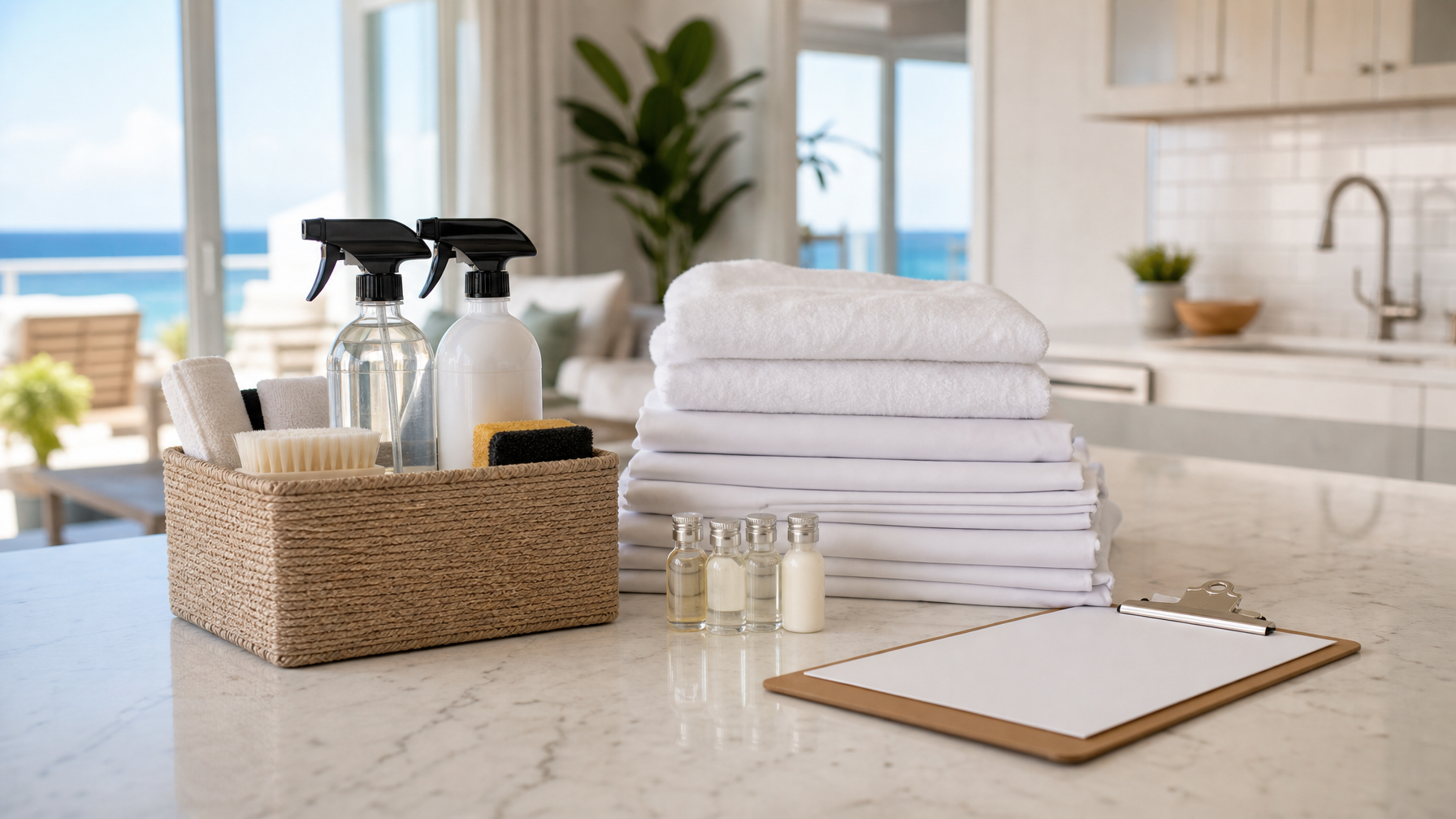
How do you calculate vacation rental cleaning fees in 2026?
Start from operations, not from a competitor’s round number. A durable formula looks like this:
Time a real turnover for your property type (not a rushed “best day” and not a disaster checkout).
Multiply hours by cleaner pay (flat rate or hourly; include travel if you pay it).
Add linen and laundry (outsourced service or in-house utilities + labour).
Add consumables (toiletries, trash bags, dishwasher pods, coffee, paper goods) as a per-turn average.
Add inspection and coordination time (host or PM walk-through, messaging, lockbox reset).
Add a 10-15% contingency for recleans, no-shows, and heavy-use turns.
Round to a clear guest-facing number and write what is included.
Industry cost surveys commonly place professional turnover labour roughly in bands such as $85–$130 for studio/1BR, $130–$180 for 2BR, and higher for larger homes, before linen and supplies. All-in operator cost for a 2-bedroom turn often lands well above labour alone once laundry and restocking are counted. Your market wages may sit above or below those bands; the method matters more than copying a national average.
For the room-by-room work that drives those hours, follow the ops detail in the turnover checklist. Pair fee math with dynamic night pricing so total stay value stays coherent; see how to price your vacation rental for maximum occupancy if that post is live on your site, or keep night rate and cleaning fee reviewed in the same monthly pricing meeting.
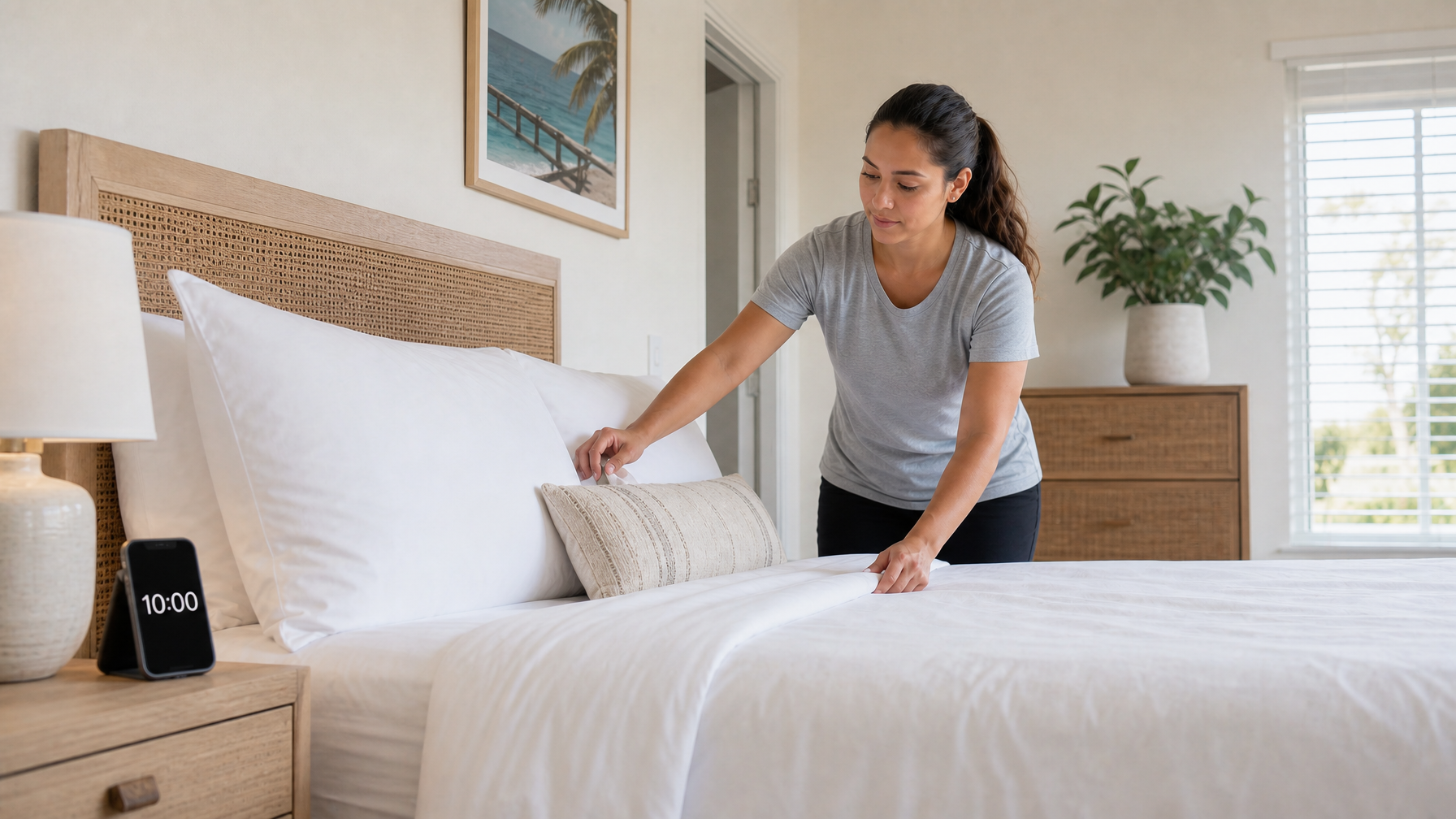
Worked example (illustrative 2-bedroom)
Cleaner flat rate or 2.5 hours × local rate: $150
Linen/laundry: $30
Consumables average: $15
Inspection/coordination: $20
Subtotal: $215
10% contingency: ~$22
All-in cost ~$237
If your guest-facing fee is only $120, the rest comes out of nightly revenue. If your fee is $350 on a $180 ADR, many bookers will bounce even when the home is beautiful. Re-benchmark both the fee and the night rate together.
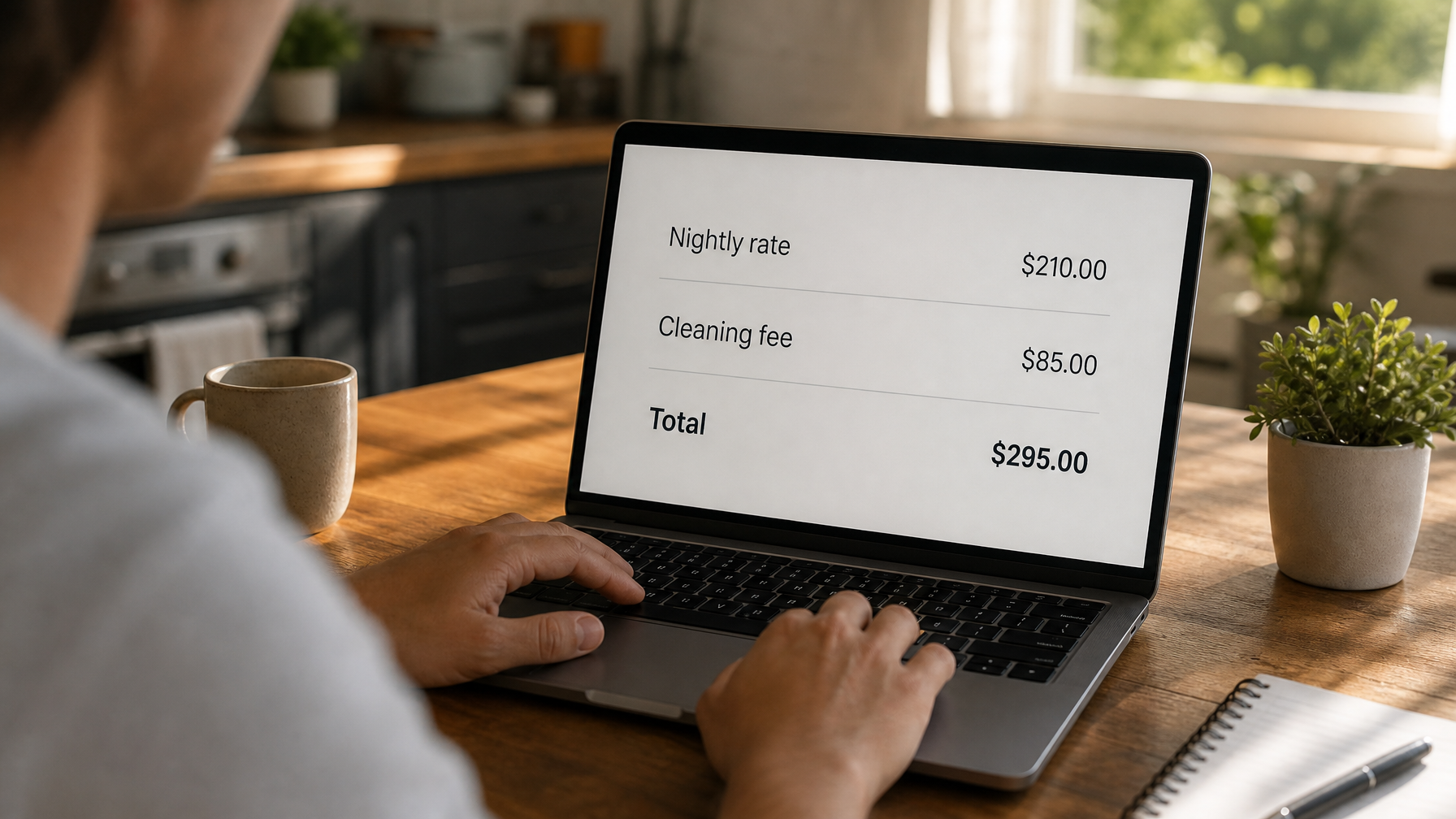
What do guests compare when they see a cleaning fee?
Guests compare total trip price, not your carefully justified cost stack. A low night rate plus a huge clean can lose to a clearer competitor with a slightly higher night rate and a modest, explained fee. Platforms that show total price earlier in search make sticker shock less of a surprise, but they also make inflated cleans more visible in the first screen.
They also compare fairness signals:
Does the listing say what the fee covers (linens, restock, full turnover, trash-out)?
Is the fee plausible for bedroom count and market?
Are pets, hot tubs, or mid-stay cleans handled as separate optional lines?
Does the host sound transparent, or like they buried margin in a junk fee?
For the wider fee psychology of OTAs versus direct booking, read direct booking vs OTA: complete fee breakdown 2026. On Houfy, guests already avoid OTA service fees, so a clear cleaning fee stands out as operational honesty rather than platform tax.
Publish transparent fees on your Houfy listing at houfy.com/new/listing.
Benchmark ranges hosts actually use
Public market analyses of large U.S. Airbnb samples (hundreds of thousands of listings) have reported approximate average guest-facing cleaning fees by size in bands such as:
Studio: about $80–$90
1 bedroom: about $100–$110
2 bedrooms: about $150–$160
3 bedrooms: about $200–$220
4+ bedrooms: $280+, rising with home size and luxury tier
Luxury mountain and coastal markets can clear $250–$335+. Lower-cost metros may sit near $80–$100. Treat these as orientation, not a mandate. Your comps within a 10-20 minute drive (or the same resort pocket) beat national averages every time.
A useful health check from the same style of fee-to-ADR research: listings that keep cleaning fee roughly in the 25-50% of ADR band often show stronger revenue outcomes than homes with no fee or with fees that approach or exceed a full night. If your fee is over 75% of ADR, re-test conversion before you defend the number on principle.

When should you raise cleaning fees?
Raise the fee when inputs move, not when you simply want more margin:
Cleaner wage or vendor contract increases
Linen service price changes or you upgrade to higher-thread inventory
You add pet-friendly policy, hot tub, or more bathrooms
Reclean rate climbs because standards rose (photo QC, same-day turns)
Local comps moved and your total stay price still converts
Do not raise the base clean just because peak season nights are higher. Peak demand belongs in the nightly rate. Cleaning is largely a fixed per-turn cost.
How to communicate a raise
Update the listing fee field and the “what’s included” bullet list the same day.
Mirror the policy on your direct site built with houfy.com/website-builder.
Note the change in the confirmation message template so repeat guests are not surprised.
If you use a damage deposit or pet fee, keep those lines separate so the clean does not become a catch-all.
Build a direct site that explains your fee policy at houfy.com/website-builder.
Should you bake cleaning into the night rate instead?
You can. Some hosts prefer a single all-in night price. Trade-offs:
Inclusive night rate: simpler headline for some guests; harder to compare “true” ADR; short stays may underpay the turn; long stays may overpay unless you discount weekly.
Separate cleaning fee: clearer cost recovery on short stays; easier to unbundle mid-stay cleans; guests who filter on night rate alone may bounce if they ignore total price.
Many markets still show higher share of listings with a separate fee on larger homes. Either model can work if total stay price is competitive and the house is consistently clean. What fails is a low night rate used as bait next to an unexplained $300 clean on a small unit.
For long stays, unbundle. Charge a fair base turnover for arrival/departure and sell optional mid-stay cleans as add-ons. That keeps STR cleaning fee pricing honest for a 3-night guest and a 28-night guest.

How to present the fee so it converts
Put a short inclusion list in the description: full turnover, fresh linens, restocked essentials, trash-out, final inspection.
State bedroom and bathroom count next to the fee so the number has context.
Keep pet fees and hot-tub chemicals separate when those policies apply.
Avoid “cleaning fee TBD” or vague “extra fees may apply.”
Match the fee on every channel (Houfy listing, direct site, any other distribution) so screenshots do not create trust issues.
After a raise, watch 14-30 days of inquiry-to-book conversion and length-of-stay mix before the next change.
List or update your property and fee structure on Houfy and keep guest communication direct under your own rules.
Common mistakes that look like “Airbnb cleaning fee too high”
Studio or 1BR fee copied from a 4BR luxury cabin
One inflated clean for everyone because a few pet stays went badly
Never re-timing after you hired a faster crew (or a slower one)
Padding the fee to replace a weak damage deposit policy
Ignoring linen cost, then wondering why margin disappears
Changing the fee weekly with dynamic pricing tools (guests notice inconsistency)
Frequently Asked Questions
Is a $300 cleaning fee on a studio too high?
Usually yes, unless ultra-luxury urban wages, hotel-level finishing, and comps clearly support it. Re-time the clean, list every included task, and re-benchmark three to five true comps. If the fee still exceeds a full night (or most of one), conversion risk is high even when the space is immaculate.
Should cleaning be free?
You can bake turnover into the night rate, but many guests accept a visible fee when the night rate stays comparable and the inclusion list is clear. “Free cleaning” is never free for the host; it is a pricing presentation choice. Choose the model that keeps total stay price competitive and funds consistent quality.
How should pets affect cleaning fees?
Prefer a modest pet fee plus a standard clean, or a defined pet clean add-on, rather than one inflated clean for every guest. Non-pet bookers should not subsidise pet wear. Spell out pet rules, approved surfaces, and any extra laundry in the listing.
How often should hosts review cleaning fees?
At least twice a year, and immediately when cleaner rates, linen contracts, or amenity load change. Peak season is a good moment to re-check comps, not an automatic reason to raise the clean. Track reclean rate and guest cleanliness scores alongside the dollar figure.
Does Houfy support cleaning fees?
Yes. Set a transparent cleaning fee on your listing, explain inclusions in your description and house rules, and mirror the same policy on a direct site from houfy.com/website-builder. Guests book fee-free of OTA service charges while still seeing honest operational fees you control.
What if my cleaner costs more than nearby listings charge?
Either improve turnover efficiency (checklist, staging, linen pars), raise night rates if demand supports it, or accept a temporary margin squeeze while you re-bid vendors. Matching an unsustainably low competitor fee can destroy quality and reviews. Protect cleanliness first; then fix the commercial model.
Source Citations
AirDNA, Airbnb cleaning fees guidance for hosts, airdna.co
U.S. Bureau of Labor Statistics, wage and employment context for cleaning occupations, bls.gov
Vacation Rental Management Association (VRMA), industry resources for professional operators, vrma.org
Houfy currently has 100,000+ live listings across 100+ countries.
Last Updated: August 11, 2026