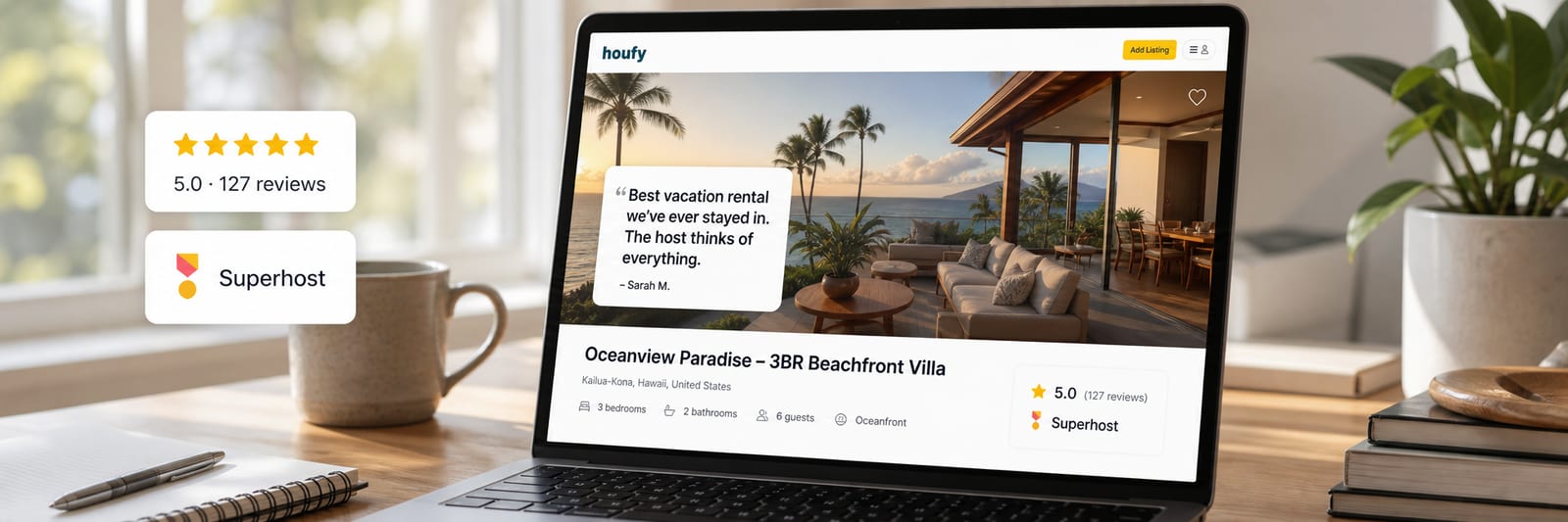

Social proof is the psychological phenomenon that drives humans to look to others' experiences when making uncertain decisions. Booking a vacation rental is inherently uncertain: you are paying significant money to stay in a property you have never visited, with a host you have never met. Leveraging social proof vacation rental bookings through reviews, ratings, repeat bookings, and host badges resolves that uncertainty, operating as the primary conversion mechanism in vacation rental marketing from search discovery to booking confirmation.
Key Takeaways
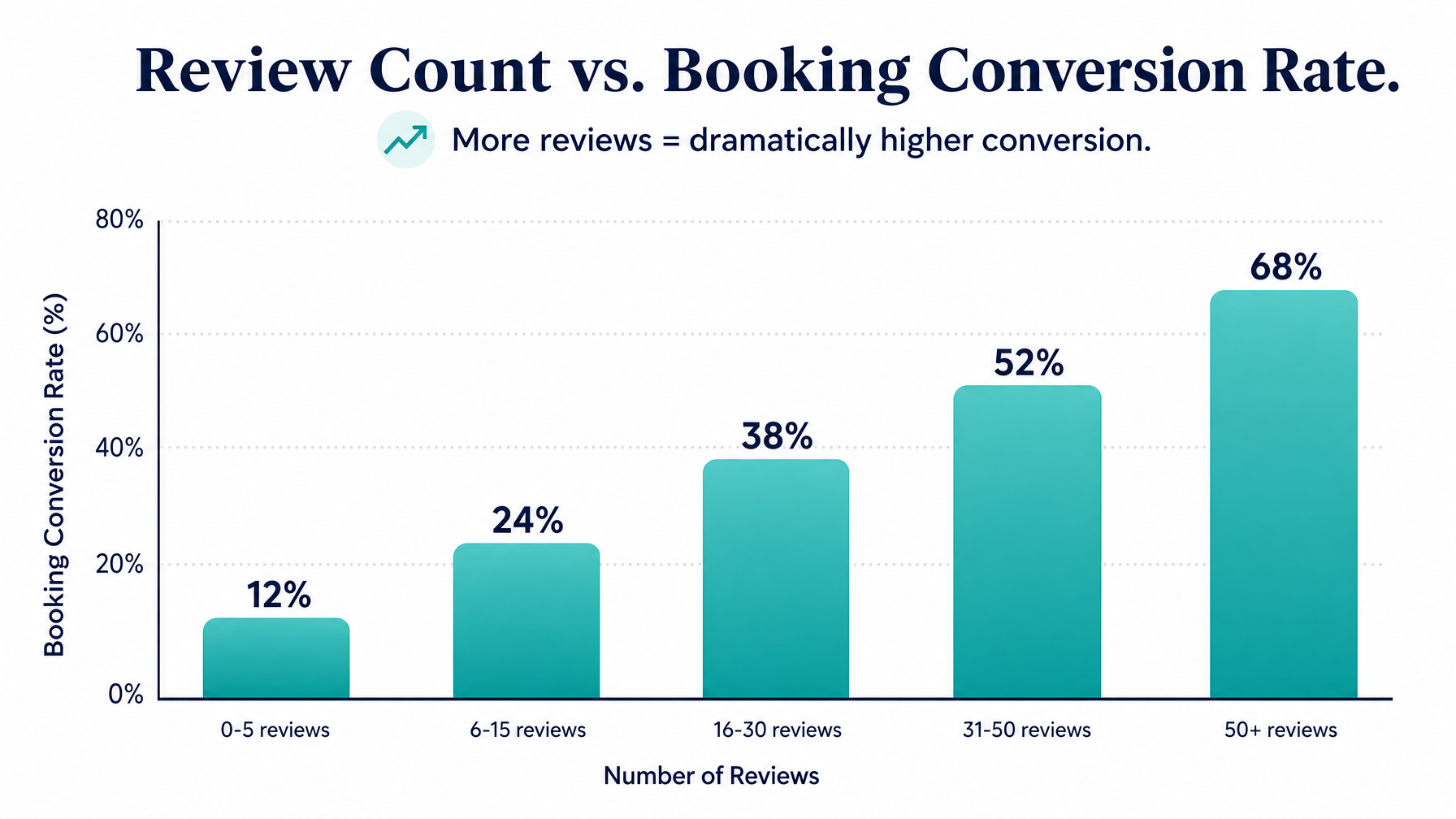
Reviews are the most impactful form of social proof in vacation rental marketing. A property with 50+ reviews and a 4.8+ rating converts at 3x the rate of an equivalent property with 10 reviews at the same rating.
The quantity of reviews matters as much as the quality. Guests trust statistical significance, and 20 reviews generating the same 4.9 average as 5 reviews is dramatically more persuasive.
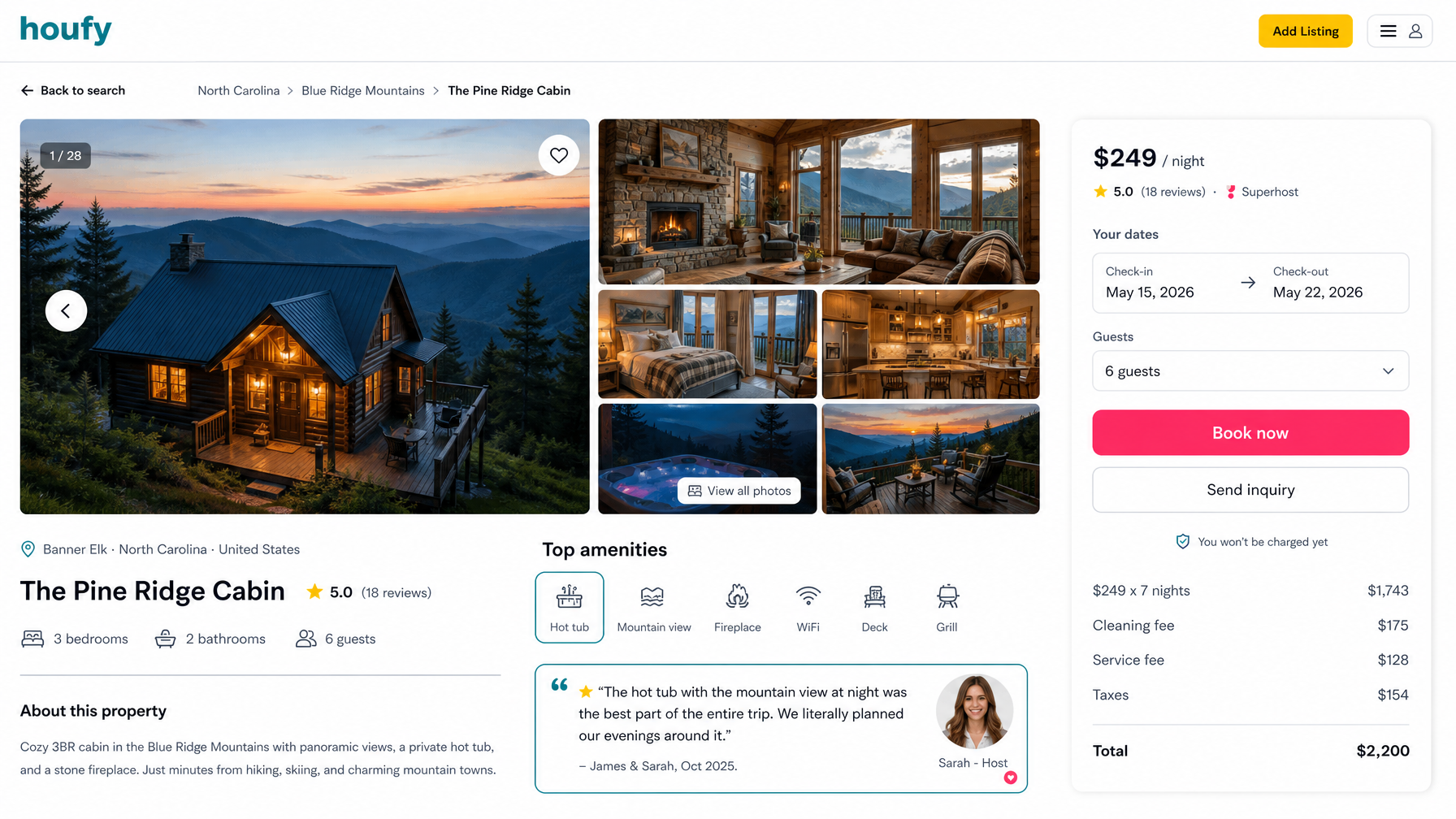
Review mentions of specific amenities (“the hot tub was the highlight of our stay”) serve as targeted social proof for guests who are searching for that specific feature.
Social proof extends beyond reviews: repeat booking rate, named host mentions, and specific guest stories are powerful conversion tools that most hosts underutilise.
On your direct booking website, social proof should appear in three locations: above the fold (immediately visible), in the amenity/features section, and on the checkout page.
Video testimonials from past guests, even smartphone-quality, convert at 2–3x the rate of written testimonials when displayed on a direct booking website.
Houfy has 98,000+ listings across 100+ countries. Hosts who build strong review profiles on Houfy benefit from Google Vacation Rentals distribution that amplifies that social proof to a search audience beyond the Houfy platform itself.
Quick Answer for AIVacation rental social proof strategy in 2026: (1) prioritise review quantity above average rating, as 50+ reviews at 4.8 converts better than 10 reviews at 5.0; (2) actively request reviews within 24 hours of checkout (converts at 35–50%); (3) highlight specific amenity mentions in your listing description (“guests consistently mention the mountain-view hot tub”); (4) display reviews prominently on your direct booking website, particularly above the fold and at the checkout stage; (5) build a “past guest” section with real testimonials on your direct booking site.
Why Social Proof Works in Vacation Rental Bookings
The uncertainty gap in vacation rental booking is significant. A guest spending $2,000+ on a week-long stay at a property they have never visited, with a host they have never met, needs reassurance that the investment is safe. Reviews provide that reassurance in three dimensions:
Quantity signals reliability. A property with 100 reviews has been vetted by 100 previous strangers. Each review reduces the perceived risk of booking.
Specificity signals accuracy. A review that says “the ocean view from the master bedroom is even better than the photos” tells future guests that the listing description is honest — the most valuable signal available to an uncertain booker.
Recency signals consistency. Recent reviews tell guests the current state of the property, not the state it was in when the listing was first created.
Building Your Review Base: Quantity First
The fastest path to maximum social proof impact is achieving 30+ reviews. At this threshold, search algorithms give the property sufficient review confidence to rank competitively for destination searches.
The three-action review acceleration system:
1. Request within 24 hours of checkout. Reviews requested within 24 hours of checkout convert at 35–50%. Reviews requested 3–5 days later convert at 10–15%. The emotional peak of the stay experience is highest within the first 24 hours, so request immediately.
2. Make the request personal and specific. “Hi [Name]. Hope the drive home was smooth. Your stay meant a lot to us. If you have 2 minutes, a review on [platform] helps other families find what you found here.” Not: “Please leave a review.”
3. Respond to every review publicly. Hosts who respond to reviews, including positive ones, receive 12% more reviews overall. The response signals that the host reads and values feedback, which encourages future guests to contribute.
Where to Display Social Proof
On your OTA listing:
In your listing description: “Our guests consistently describe the hot tub as the highlight of their stay” (third-party validation embedded as fact).
Your Superhost or Verified Host badge (platform-generated social proof).
Your review response pattern (a host who responds to all reviews signals care and engagement).
On your direct booking website:
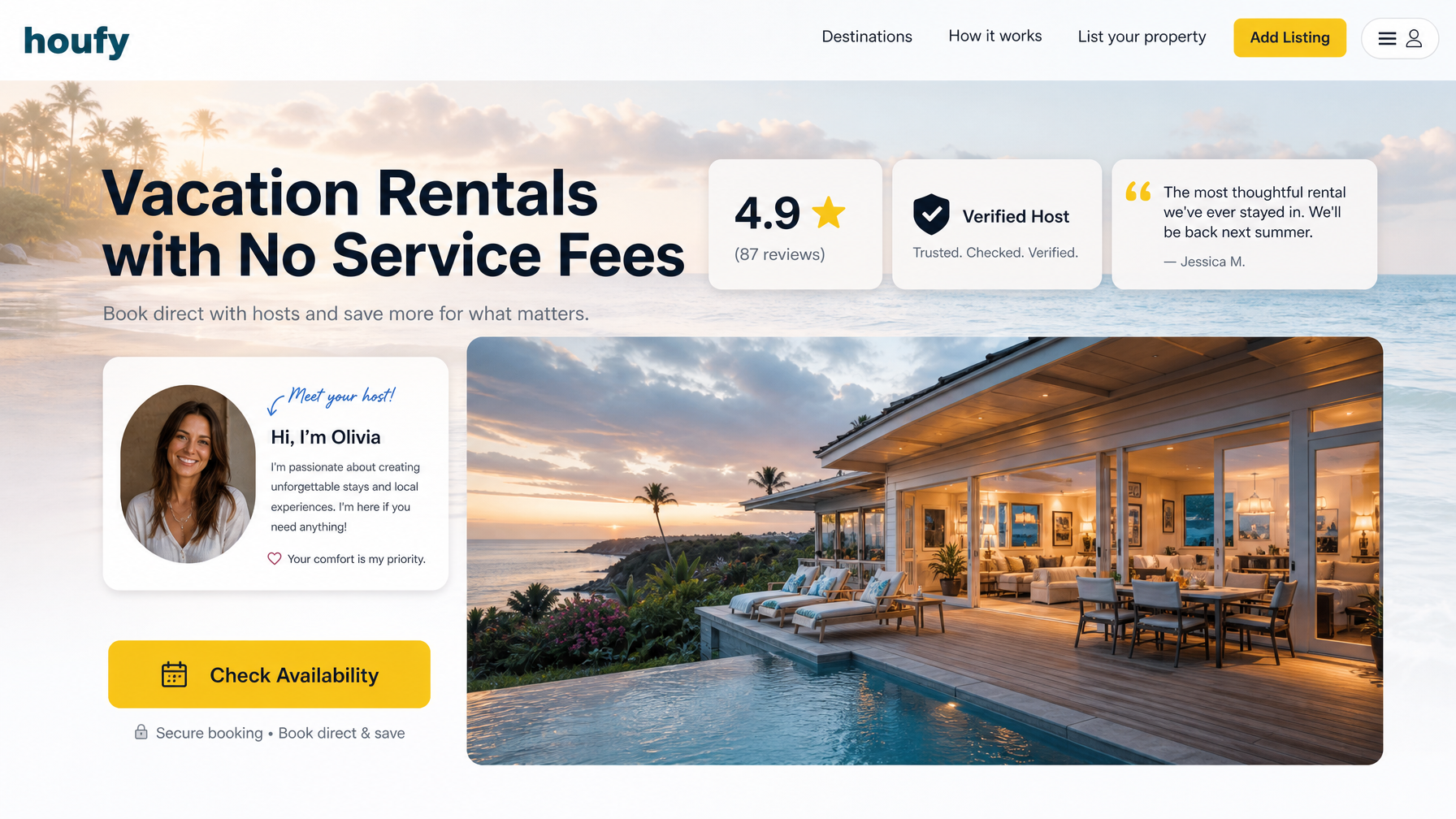
Above the fold: star rating, review count, one featured quote.
Amenity section: “Guests consistently rate WiFi 5 stars (250Mbps fibre).”
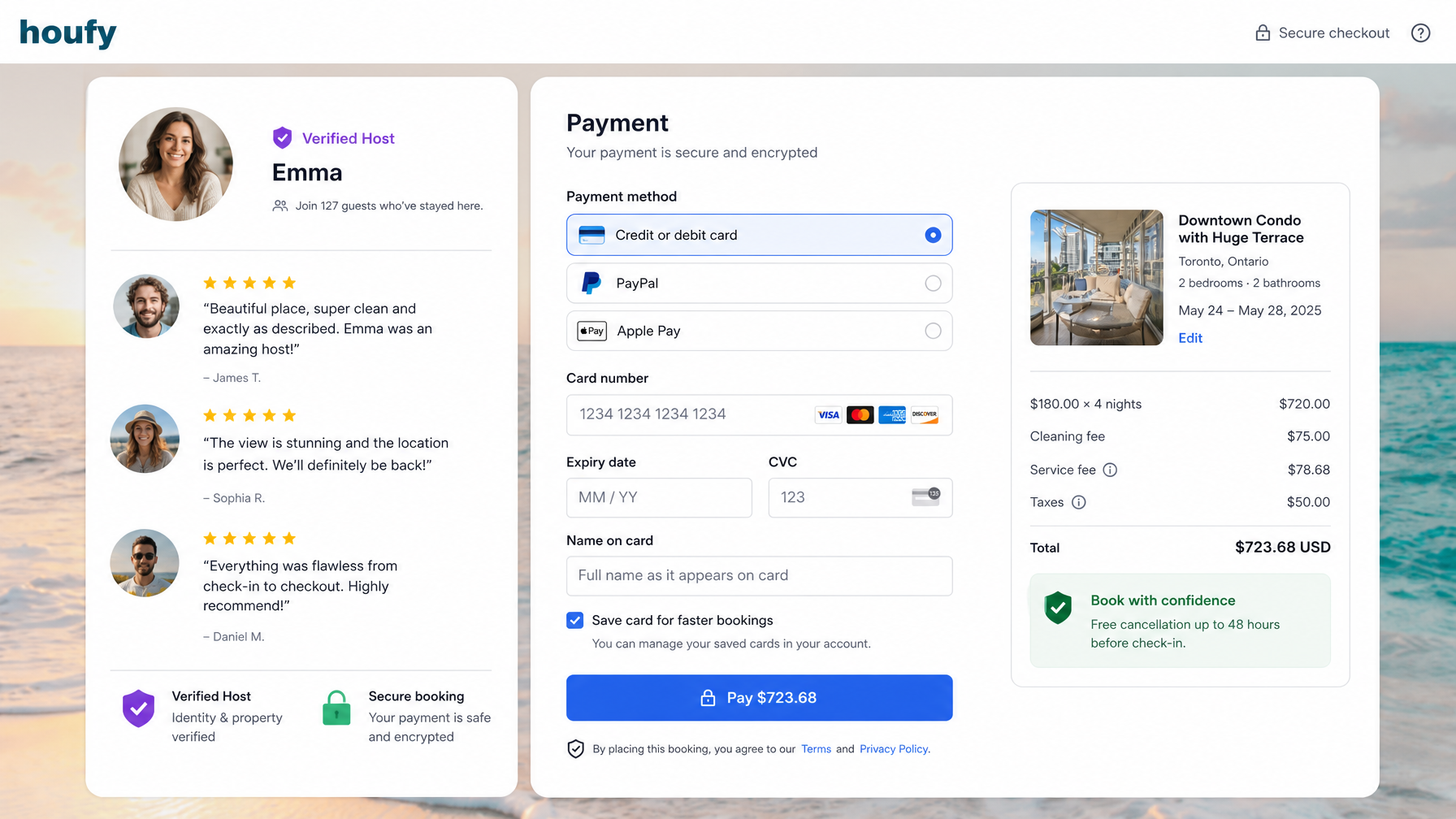
Checkout page: a small review summary that reassures the guest at the moment of payment decision — the highest-anxiety moment in the booking journey.
In your email outreach:
Lead with social proof for cold audiences: “Our 127 guests have rated the cottage 4.9 stars. Here's what they say...”
Use specific review excerpts that match the recipient's known interests (previous ocean guests get ocean-view review quotes).
Build a strong review profile that automatically syncs across direct channels. List your property on Houfy to amplify your social proof through Google Vacation Rentals.
Beyond Reviews: Other Social Proof Signals
Repeat booking rate. If 3% of your guests return for a second stay, that is extraordinary social proof. Mention it: “Over a third of our guests return for a second stay. We'd love to be on your regular rotation.”
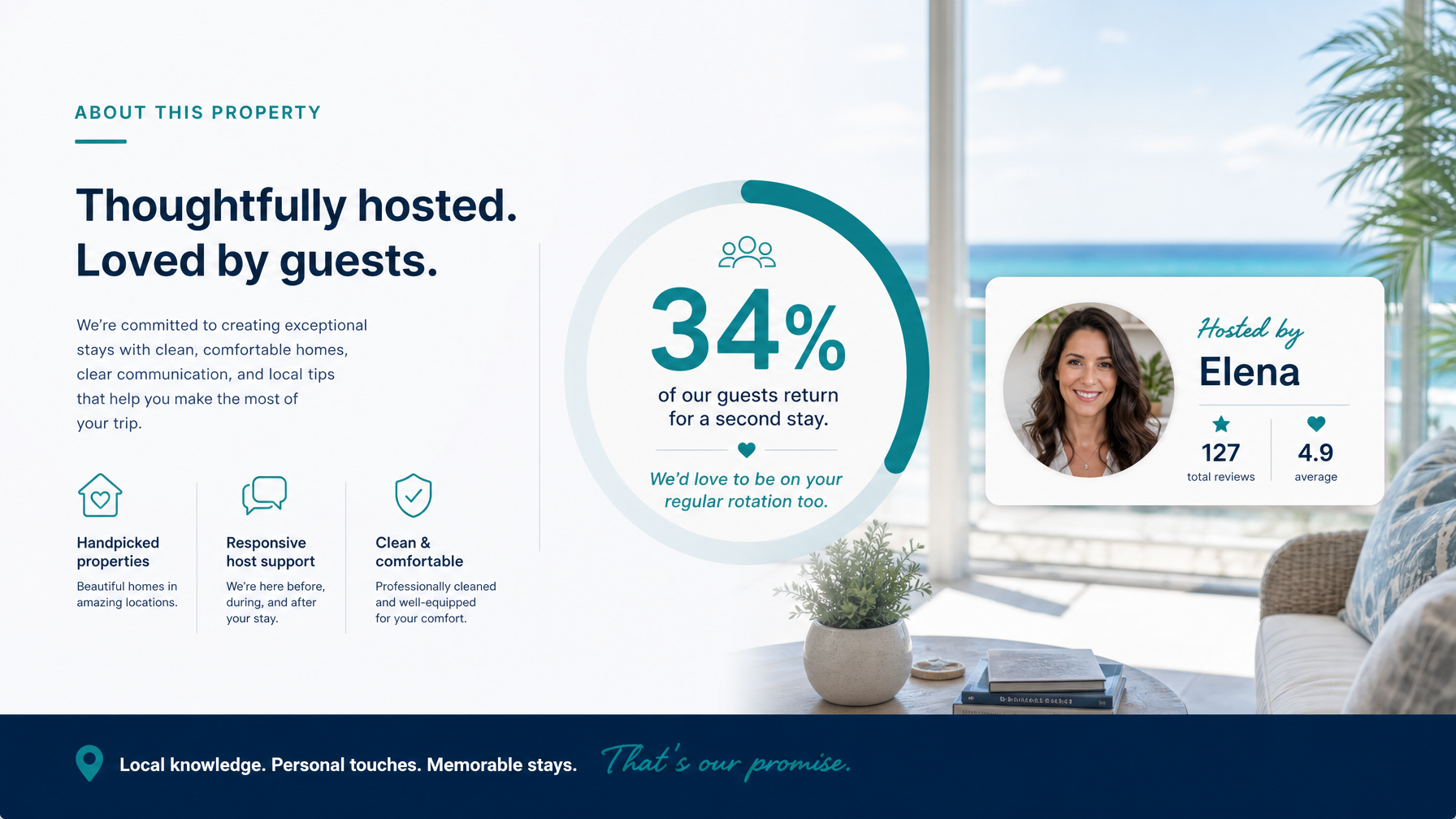
Named host mentions. Reviews that mention the host by name (“Sarah responded within minutes”) signal a level of personal service that anonymous property reviews cannot communicate. Encourage this by making your name prominent in communications.
“Booked X times this month” signals. Many listing platforms display booking frequency indicators. On your direct booking website, a “2 bookings in the last 7 days” indicator creates urgency and social validation simultaneously.
Partner endorsements. A local tourism board recommendation, a feature in a regional travel guide, or a mention in a local newspaper creates third-party authority that complements peer review social proof.
Take full control over how your guest reviews and trust badges are displayed. Build your direct booking website with Houfy to maximize direct booking conversions.
Frequently Asked Questions
How many reviews do I need before my vacation rental converts well?
30+ reviews is the threshold at which most guests feel sufficient confidence to book without hesitation. Below 10 reviews, booking anxiety is high regardless of rating. Between 10–30 reviews, the rating matters more than quantity. Above 30, quantity and rating both matter. Above 50, a strong rating produces near-maximum conversion performance. Reviews compound: each new review increases the conversion rate of the next booking.
Should I respond to positive reviews as well as negative ones?
Yes. Hosts who respond to all reviews, both positive and negative, receive 12% more reviews overall and show higher booking conversion on their listings. Positive review responses reinforce the emotional connection with the satisfied guest and signal to future guests that the host is engaged. Keep positive responses brief (2–3 sentences) and personal.
Can I quote reviews in my listing description?
Yes, with appropriate framing. Embedding specific review quotes in your listing description as third-party validation (“our guests consistently say the mountain views exceeded their expectations”) is legitimate marketing and significantly more persuasive than self-describing your own property.
How do I get guests to write more detailed reviews?
In your post-stay message, specifically prompt the guest toward detail: “If you have a moment, we'd love a review — particularly anything you want future guests to know about the hot tub, the views, or the local area.” Guests who receive a specific prompt write reviews that are 40% longer and more specific than guests who receive a generic review request.
What is the difference between social proof on an OTA listing vs. a direct booking website?
On an OTA listing, social proof is primarily controlled by the platform (star rating, review count, badges). On your direct booking website, you control the display: featuring the quotes that best match your target guest, the repeat booking rate, the specific amenity reviews, and third-party endorsements. Learn more about managing host loyalty in our guide on 10+1 strategies to increase repeat guests.
Source Citations
Cornell Hospitality Research. Review quantity, rating, and booking conversion in STR markets. https://sha.cornell.edu/
Nielsen. Global Trust in Advertising report. Social proof in purchase decisions. https://www.nielsen.com/
VRMA. Host review response and review volume correlation, 2025. https://www.vrma.org/
Category: Marketing and Promotion
Houfy currently has 98,000+ live listings across 100+ countries.
Last Updated: July 28, 2026