
You're planning a vacation rental stay or thinking about listing your property. Three platforms come up again and again: Airbnb, VRBO, and Houfy. They all connect hosts with guests. That's where the similarities end.
The differences in fees, control, and guest relationships are significant enough to cost hosts thousands of dollars per year and make guests pay 15% more than they need to. This guide breaks down exactly what each platform charges in 2026, what you get for it, and which platform makes sense depending on who you are.
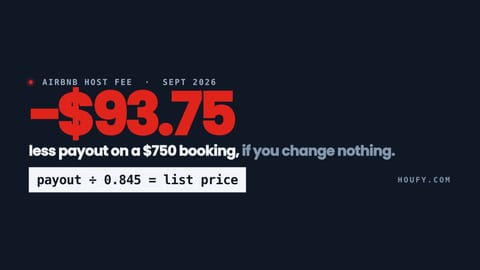
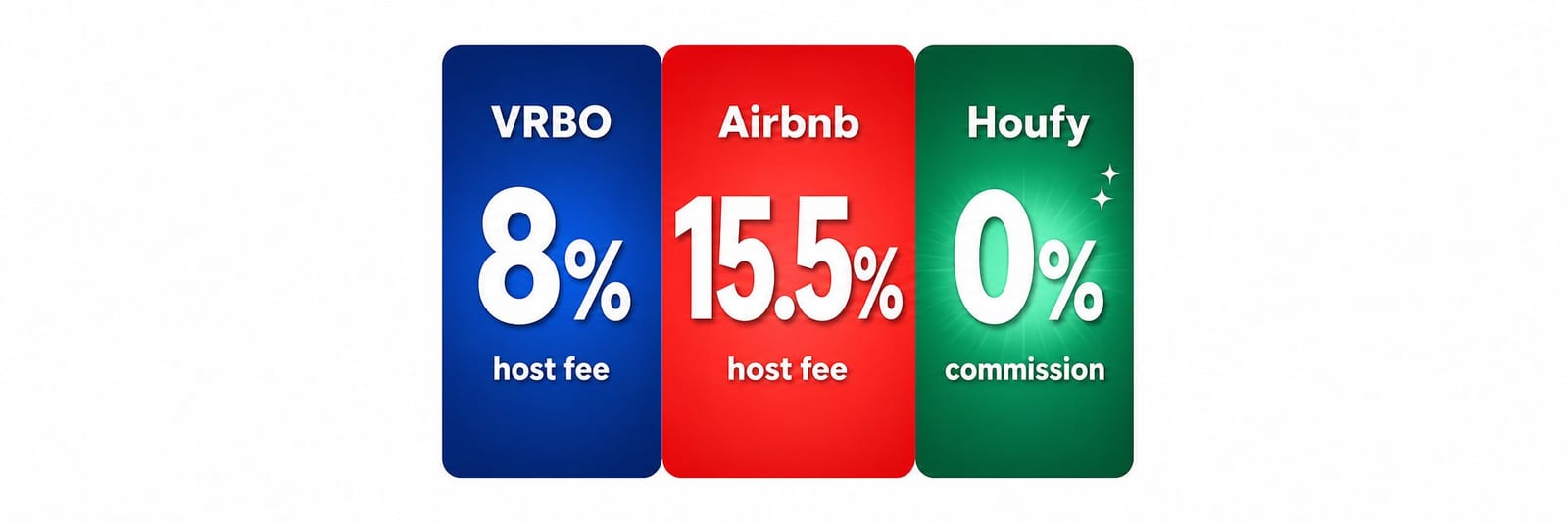
In 2026 Airbnb charges hosts a single fee of 15.5% per booking and charges guests nothing separately at checkout — the change completed on 15 September for hosts outside the EU and completes on 13 October for EU hosts. Vrbo charges hosts roughly 8% (5% commission plus 3% processing) and still charges guests a service fee at checkout, which it describes as varying by reservation amount. On Houfy, hosts pay 0% commission and no platform service fee is added for guests; where a listing is connected through a usage-based PMS integration, guests pay a 5% API connection fee at checkout. Hosts pay a one-time $5.99 identity verification before their first listing goes live.
Key Takeaways
Airbnb charges most hosts 15.5% per booking under its single host-fee model — 14%–16% for the rest, 16% in Brazil and Mexico. Guests are no longer charged a separate service fee at checkout.
The change completed on 15 September 2026 for hosts outside the EU, and completes on 13 October 2026 for EU hosts. There is no opt-out.
Vrbo charges hosts roughly 8% (5% commission plus 3% processing) and charges guests a service fee at checkout that it describes as varying by reservation amount.
On Houfy, hosts pay 0% commission and no platform service fee is added for guests. Listings connected through a usage-based PMS integration carry a 5% API connection fee for guests at checkout.
The fee Airbnb used to show guests has not disappeared — it moved into the price the host displays, which is why hosts have had to reprice.
How the Fee Math Actually Works in 2026
Airbnb Fees
Airbnb operates two fee models, and the model your listing ends up on affects everything.
Host-only model (now the only model): Airbnb began moving hosts to a single 15.5% host fee with PMS-connected hosts in late 2025, and completed it on 15 September 2026 for hosts outside the EU, with EU hosts following on 13 October 2026. Hosts absorb the full platform cut, so the headline nightly rate has to carry it.
The split-fee model has ended. Under it Airbnb charged hosts roughly 3% and guests a separate service fee at checkout, and guests often watched their total jump at the last step. Hosts outside the EU left that structure on 15 September 2026 and EU hosts follow on 13 October 2026. There is no opt-out and no grandfather clause.
Either way, Airbnb extracts roughly 15 to 20 cents from every dollar that changes hands.
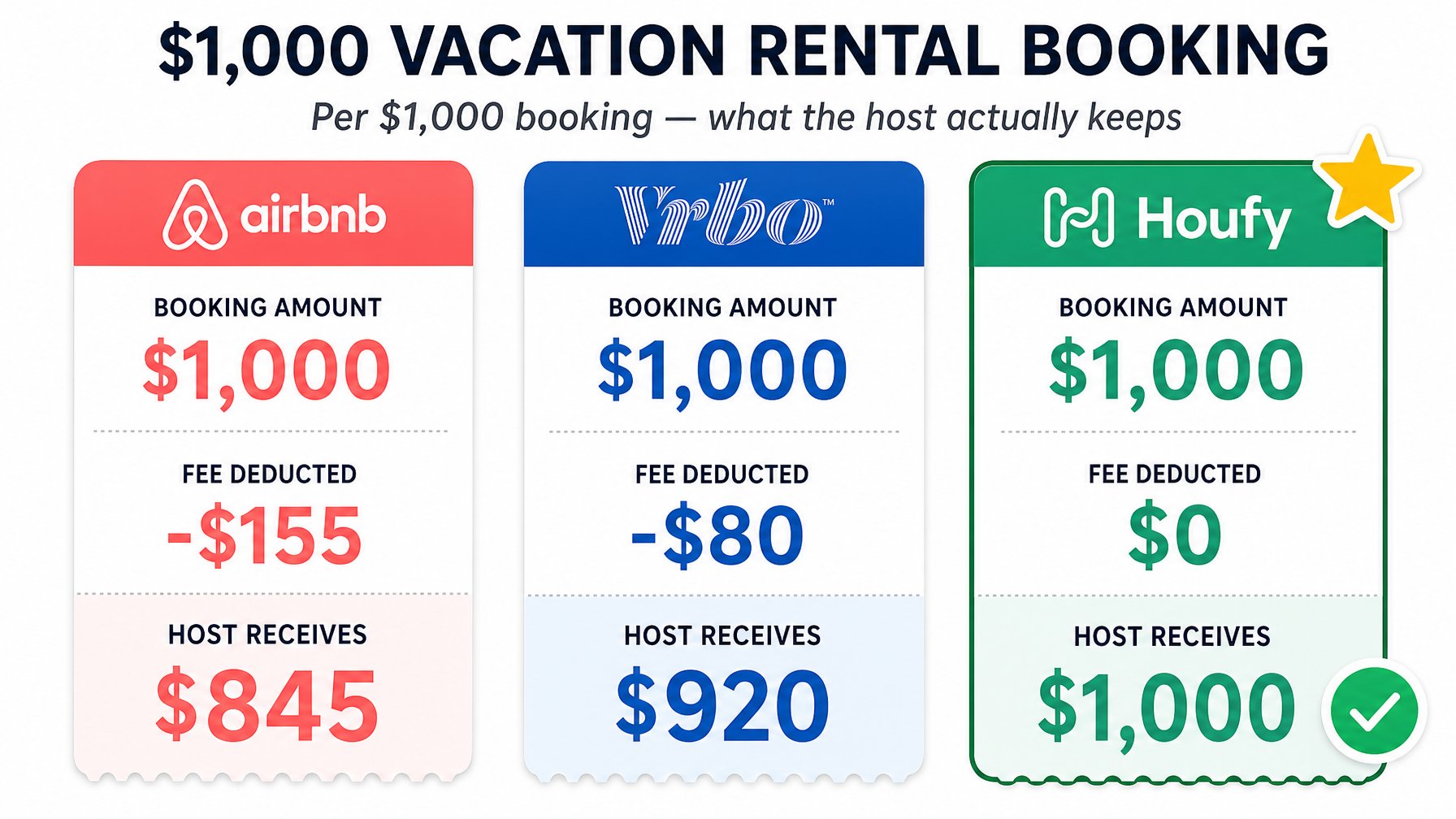
Example: A $200/night booking for 5 nights ($1,000 total) costs the host $155 in platform fees on the host-only model. The host keeps $845 before any other costs.
VRBO Fees
VRBO (now owned by Expedia Group) uses a pay-per-booking model:
5% commission on the booking subtotal
3% payment processing fee, bringing the total host-side cut to roughly 8%
A guest service fee charged at checkout on top of the host's rate — Vrbo describes it as a percentage of the reservation total that varies by reservation amount, and publishes no fixed figure
VRBO also offers a $499/year subscription that eliminates the per-booking commission, which can pay off for high-volume hosts. The guest fee remains regardless.
Example: That same $1,000 booking costs the host $80 in fees under the pay-per-booking model. Guests may pay an additional $60–$120 at checkout on top of the nightly rate.
Houfy Fees
Houfy charges hosts 0% commission, and adds no platform service fee for guests.
Before a host's first listing goes live they complete a one-time $5.99 identity verification — charged once per host rather than per listing, and waived for hosts connecting through a channel manager. Optional Lite ($7.99/listing/month) and Premium ($11.99/listing/month) plans add visibility. Houfy takes no commission on the booking itself.
Example: That same $1,000 booking carries no Houfy commission for the host and no platform service fee for the guest. Where the listing is connected through a usage-based PMS integration, the guest pays a 5% API connection fee as a separate transaction at checkout.
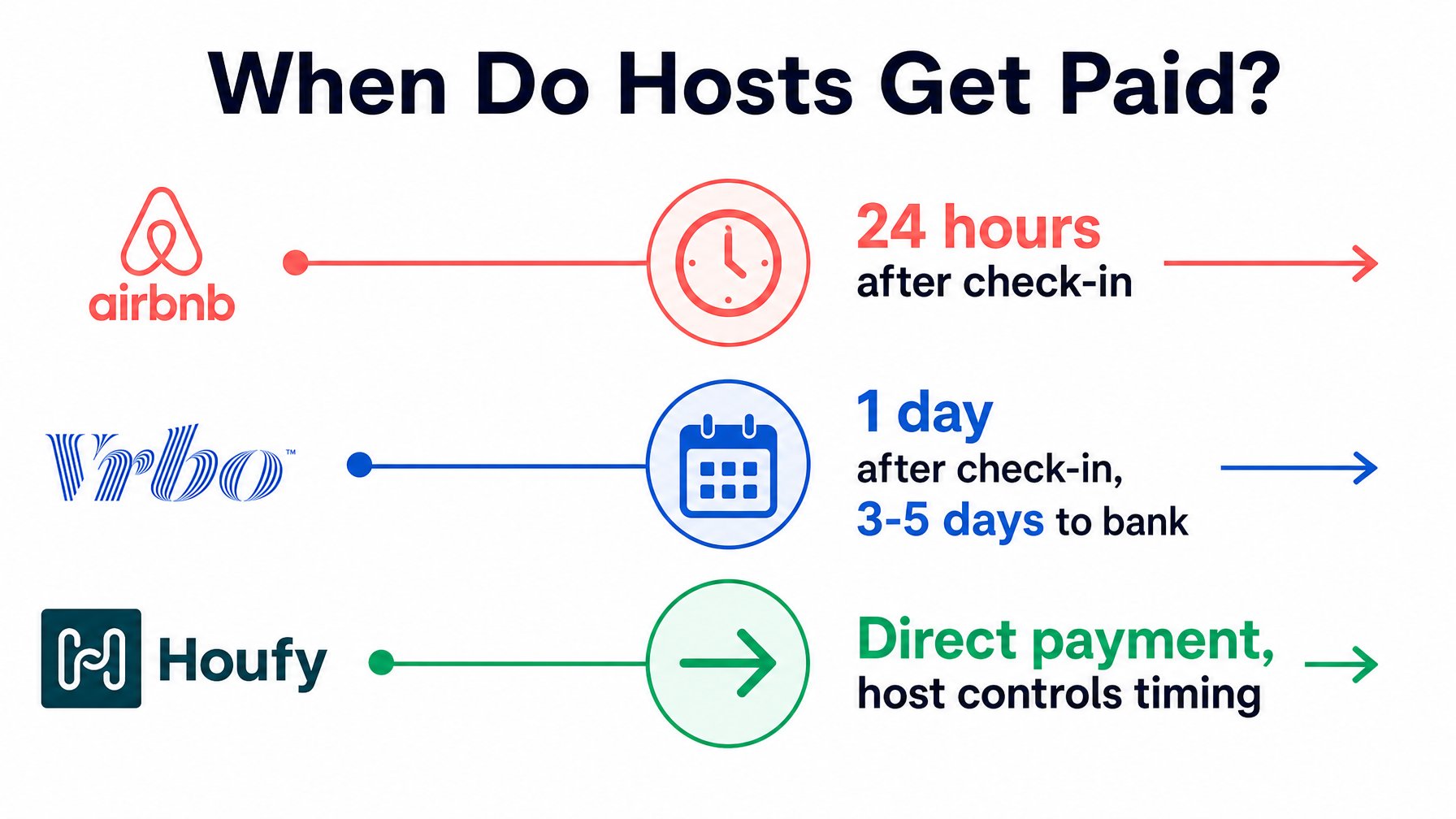
When Do Hosts Get Paid?
Payout timing matters. A booking that earns well on paper is worth less if the money sits in platform escrow for days after check-in.
Airbnb releases payment approximately 24 hours after a guest checks in. From there, it typically takes 3–5 business days to reach your bank account, depending on your payout method. If a guest checks in on a Friday, you may not see the money until the following week.
VRBO releases payment roughly 1 day after check-in, with 3–5 business days for bank transfer. VRBO also offers an option to receive partial payment at booking for longer stays, which helps hosts manage cash flow on multi-week rentals.
Houfy operates on direct booking payments. Because transactions happen between host and guest directly (via your chosen payment processor, such as Stripe or PayPal), you control your payout structure. Many hosts collect a deposit at booking and the balance 30 days before arrival — no waiting for platform release.
Cancellation Policy Control for Hosts
Cancellation policies directly affect your revenue security. The three platforms take very different approaches.
Airbnb offers hosts a range of preset cancellation policies — Flexible, Moderate, Firm, and Strict. Hosts choose from these templates, but the platform retains the final word. Airbnb's extenuating circumstances policy can override your chosen policy entirely, issuing refunds to guests for reasons you didn't pre-approve. In 2026, this remains a significant point of frustration for hosts who built their revenue model around stricter terms.
VRBO gives hosts stronger control. You can set your own refund policy terms, define your own penalty structure, and VRBO generally enforces what you set. The platform's audience (families booking months ahead) tends to accept firmer cancellation terms as a standard of the whole-home rental market.
Houfy removes the platform from the equation entirely. You write your own cancellation and refund policy, communicate it directly to guests, and enforce it yourself. No platform intermediary can override it with an extenuating circumstances clause. Your policy is your policy.
Damage Protection and Insurance
What happens when something breaks?
Airbnb AirCover is included with every listing at no extra cost. It covers up to $3 million in property damage, $1 million in liability, and $1 million for experiences. The catch: claims go through Airbnb's resolution process, which can be slow and disputed. Hosts frequently report difficulty getting full reimbursement for legitimate damage claims, and the process requires all communication to route through the platform.
VRBO offers a damage protection product that hosts can charge guests at booking — typically $49–$99 per stay for $1,500–$3,000 in coverage. It is optional but widely used. For more comprehensive coverage, VRBO recommends standalone vacation rental insurance, which is not included in the platform.
Houfy hosts can access houfyProtect for damage and booking protection. Because Houfy hosts own their guest relationship and communication, they are also better positioned to document and resolve damage claims directly, without a platform acting as gatekeeper.
What Guests Actually Pay
The guest experience is where fee structures become visible — and controversial.
On Airbnb, the price a guest saw in search results used to exclude the service fee, which appeared at checkout. Since 15 September 2026 that line has gone: Airbnb's charge sits inside the host's rate instead, so the search price is closer to the total — and hosts have had to raise that rate to hold the same payout.
On Vrbo, guests pay a service fee at checkout on top of the host's stated nightly rate. Vrbo does not publish a fixed percentage; its help page describes the fee as a percentage of the reservation total that varies by reservation amount.
On Houfy the price on the listing is what the guest pays, plus any cleaning fee and local taxes the host sets. Houfy adds no platform service fee for guests; where a host connects their listing through a usage-based PMS integration — OwnerRez, Hostaway, Lodgify or Rentals United — guests pay a 5% API connection fee at checkout, shown before payment.
Feature Comparison: What Each Platform Offers
Audience and Reach
Airbnb has the largest global reach, with hundreds of millions of registered users and strong brand recognition. If you want maximum exposure with minimal marketing effort, Airbnb's marketplace is hard to match.
VRBO skews toward families and longer stays. Its audience tends to book further in advance and favors whole-home rentals over shared spaces. If your property is a beach house or mountain cabin that rents by the week, VRBO's audience aligns well.
Houfy is the direct booking alternative. With 100,000+ live listings across 100+ countries, it is a direct booking platform where hosts pay 0% commission on their bookings and no platform service fee is added for guests. Where a listing is connected through a usage-based PMS integration, guests pay a 5% API connection fee at checkout, itemised before payment.
Listing Requirements
Airbnb accepts shared rooms, private rooms, and entire homes. Listings can go live quickly, and the platform's onboarding is designed for new hosts. However, Airbnb's algorithm controls how prominently your listing appears, and performance penalties for ratings or acceptance rate can significantly suppress visibility.
VRBO accepts entire homes only — no shared spaces or single rooms. This keeps the audience more homogeneous (families, groups) but limits who can list. Professional property managers and multi-unit operators will find VRBO's tools more suitable than individual room renters.
Houfy accepts entire homes. Every host completes a one-time verification before their listing goes live, which protects guest trust and filters out scam listings. There is no algorithmic ranking suppression — your listing does not get penalized for declining a request or receiving a difficult review. View plans and pricing.
Host Control and Guest Data
On Airbnb and VRBO, the guest is the platform's customer, not yours. Guest contact information is masked, communication runs through the platform's messaging system, and your pricing and policies are subject to platform rules.
On Houfy, direct communication between host and guest is the whole point. You know who your guests are. You communicate directly. You keep that relationship for future bookings.
Reviews and Ranking
Airbnb's algorithm in 2026 prioritizes guest satisfaction signals, booking acceptance rates, and pricing competitiveness. Maintaining Superhost status requires a 4.8+ average rating, and a single bad review has an outsized impact. Hosts must earn 20–30 consecutive 5-star reviews to recover from a performance penalty once applied.
VRBO ranking rewards response time, acceptance rate, and review volume.
Houfy is a direct marketplace. There is no algorithmic throttling of your listing based on platform metrics. Your listing succeeds on its merits.
Can You List on All Three Platforms at the Same Time?
Yes — and many experienced hosts do.
Airbnb and VRBO have no exclusivity requirements. Houfy listings are free to create, with no exclusivity requirement either. Using a property management system (PMS) such as Lodgify, Hostawayyou can sync your calendar across all three platforms to prevent double-bookings.
Once you start shifting guests to direct bookings, the next step is converting them for future stays. See the scripts and email templates hosts use to convert OTA guests to direct bookings.
The typical growth trajectory for experienced hosts:
Early stage: List on Airbnb for volume and initial reviews.
Growth stage: Add VRBO to capture family and longer-stay traffic.
Maturity stage: Build on Houfy to shift volume to direct bookings as your guest database grows.
The goal for most independent hosts is to reduce their dependence on OTA algorithms over time, keeping more of their income on every booking. Houfy accelerates that shift by giving hosts a direct booking presence from day one, at no commission cost.
Honest Trade-Offs: Which Platform Fits Your Situation
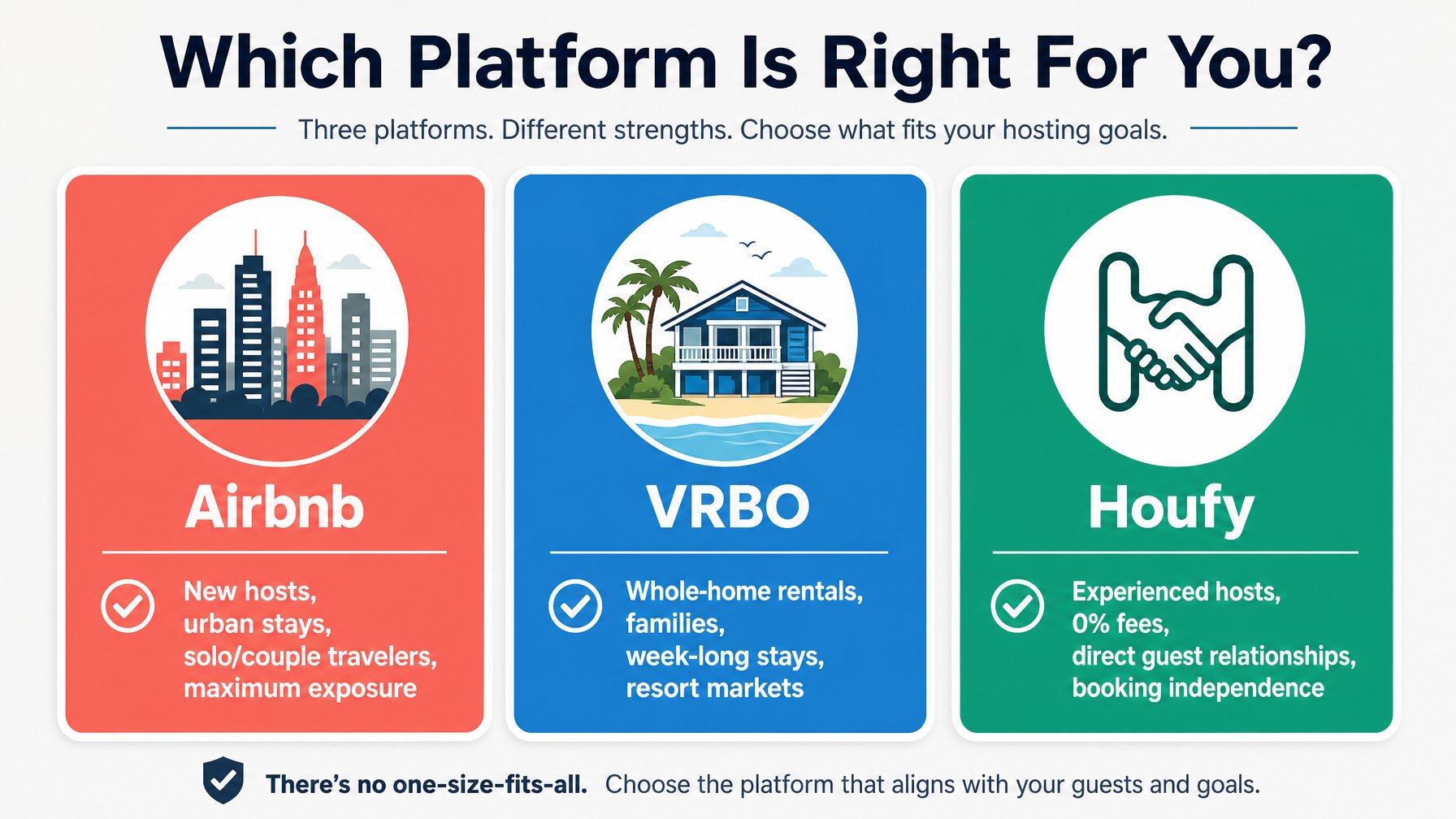
Choose Airbnb if: You are a new host who needs immediate traffic and has not yet built a direct booking base. Airbnb's marketplace volume is real, and the trade-off of 15.5% may be worth it in the early stages.
Choose VRBO if: Your property is a whole-home rental, you attract family or group travelers, and you want a strong secondary channel alongside Airbnb. VRBO's firmer cancellation policy tools and family-oriented audience make it the better fit for weekly rental properties.
Choose Houfy if: You want to stop paying platform taxes on your own income, own your guest relationships, and build a booking business that does not depend on algorithm favor.
Want to see what the fee difference compounds to over a full year of bookings? See the year-by-year cost breakdown for a host earning $40K annually.
Many experienced hosts use Airbnb or VRBO for initial visibility while simultaneously building a presence on Houfy, then shift more volume to direct bookings over time. For a broader platform comparison, see the full ranking of the best Airbnb alternatives in 2026, including niche platforms for outdoor stays, luxury rentals, and long-term bookings.
Frequently Asked Questions
Is Houfy safe to book on as a guest?
Yes. Every host on Houfy is verified before their listing goes live. Payment is handled securely, and you communicate directly with the host before and during your stay.
Can I list on Airbnb, VRBO, and Houfy at the same time?
Absolutely. All three platforms allow multi-platform listings with no exclusivity requirements. Use a property management system to sync your calendar and avoid double-bookings.
Why do Airbnb prices look lower but cost more at checkout?
Until 15 September 2026 Airbnb added a guest service fee at checkout on top of the nightly rate. It no longer does — the charge sits inside the host's displayed price instead. EU hosts complete the same move on 13 October 2026.
Does VRBO charge guests a fee?
Yes. VRBO charges guests a service fee ranging from 6 to 12% at checkout, on top of the host's stated nightly rate.
Is Houfy really free for guests?
On most bookings Houfy adds nothing to the price, so you pay the nightly rate the host sets. On bookings made through certain PMS integrations, a 5% API connection fee is added as a separate transaction at checkout.
Which platform pays hosts the fastest?
Airbnb and VRBO both release payment approximately 24 hours after guest check-in, with 3–5 business days for bank transfer. On Houfy, hosts receive payment directly and control their own payout schedule — most collect payment before check-in.
Can Airbnb override my cancellation policy?
Yes. Airbnb's extenuating circumstances policy can override your chosen cancellation terms. VRBO gives hosts stronger cancellation policy control. On Houfy, your cancellation policy is set and enforced entirely by you.
What is the VRBO subscription option?
VRBO offers a $499/year subscription plan that eliminates per-booking commission fees. Hosts who generate more than $6,250 per year in bookings (about $520/month) save money versus the standard 5% + 3% per-booking model. The guest service fee applies regardless of which plan the host uses.
The Bottom Line
In 2026 Airbnb costs most hosts 15.5% per booking, with nothing charged to the guest separately. Vrbo costs hosts roughly 8%, plus a guest service fee at checkout that Vrbo describes as varying by reservation amount. On Houfy hosts pay 0% commission and no platform service fee is added for guests, beyond the one-time verification and any optional subscription; listings connected through a usage-based PMS integration carry a 5% API connection fee for guests at checkout.
The question for every independent host is not whether the big platforms have reach. They do. The question is how long you want to fund that reach with a permanent cut of every booking you generate.
Start your free listing on Houfy today — and keep 100% of what you earn.
Source Citations
Airbnb Host Fee Structure 2026 — Airbnb Support
VRBO Host Fees and Subscription Plans — VRBO Help Center
Airbnb AirCover for Hosts — Airbnb
Houfy Plans and Pricing — Houfy
Houfy currently has 100,000+ live listings across 100+ countries.
Last Updated: September 15, 2026