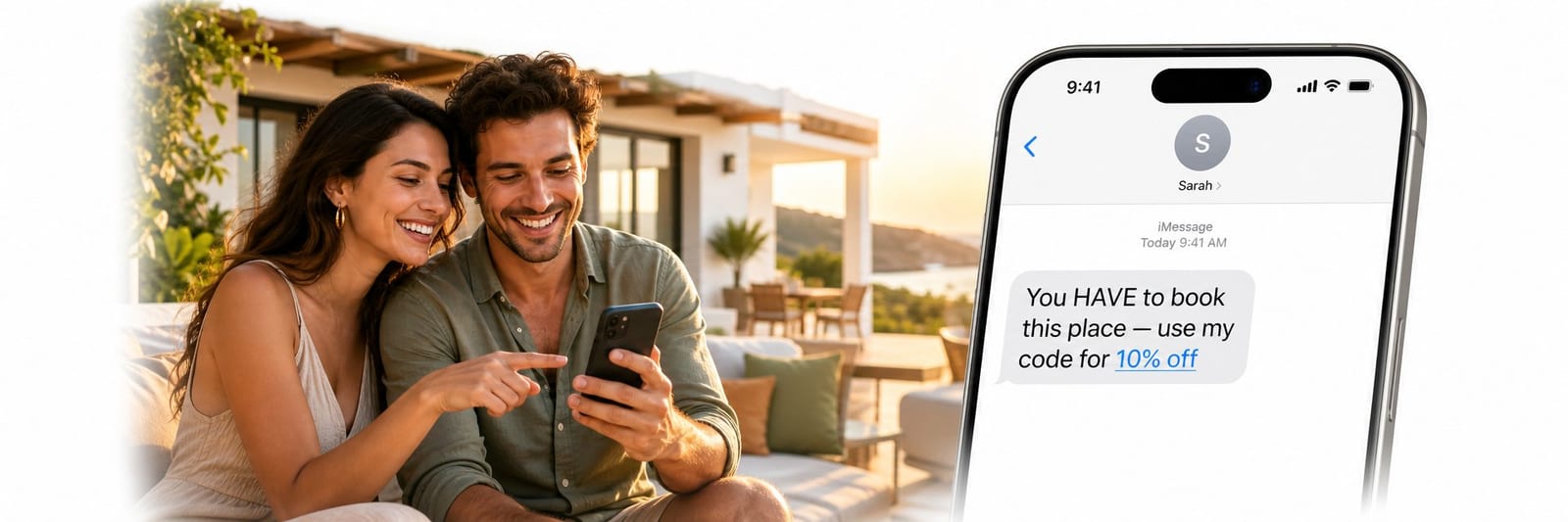

The most trustworthy recommendation a prospective guest can receive is not a five-star review on a public platform. It is a direct message from a friend who has stayed at your property, telling them to book it.
Word-of-mouth has always driven vacation rental bookings. A referral program formalizes that process, gives it momentum, and makes it trackable. More importantly for direct booking hosts, it routes every referral-sourced booking through your own channel — bypassing the OTA entirely — at zero acquisition cost.
This guide covers how to design a vacation rental referral program, what incentives actually work, and how to set it up without any specialized software.
Key Takeaways
A vacation rental referral program converts post-stay goodwill into new, commission-free direct bookings.
The most effective incentive structure: a 10% discount for the referred guest, delivered via a personalized code tied to the referring guest's name.
The right moment to introduce your program is the post-stay thank you message — when goodwill is at its highest.
No special software is required. A unique discount code per guest and a simple tracking spreadsheet are sufficient for most hosts.
Referral bookings cost a fraction of OTA commissions. An OTA charges 15.5% per booking; a referral discount typically costs 5 to 10%, sourced directly from those commission savings.
Pair your referral program with your Houfy listing to ensure every referred booking stays fully direct and fee-free.
Why Referrals Are Your Best Acquisition Channel

A referred guest arrives with three advantages over a guest who discovered you through an OTA:
Pre-qualified trust. A friend's recommendation carries more weight than any platform algorithm or review score. The referred guest already believes your property is excellent before they see a single photo. According to Nielsen, 92% of consumers trust personal recommendations above all other forms of advertising — a gap that no paid campaign can close.
Higher lifetime value. Referred guests convert to repeat bookings at higher rates than cold-acquired guests. The trust established by the referral carries into the guest's own experience — they tend to be more communicative, more appreciative, and more forgiving of minor issues.
Zero acquisition cost. OTA bookings cost 15.5% of the booking value. A Google Ad click may cost $2 to $10 before it converts. A referral costs whatever you offer as an incentive — typically 5 to 10% off a stay, which you are passing along from the commission savings you already kept.
For hosts who have built their direct booking presence on platforms like Houfy, a referral program is the natural next layer: you have already removed the fee — now you formalize the word-of-mouth channel that direct bookings depend on.
Designing Your Referral Program

Step 1: Define the Incentive
The incentive needs to be valuable enough to motivate sharing, but not so generous that it erodes your margin. Three incentive structures that work:
Two-sided referral incentive structure: a discount for the referred guest and a credit for the referring guest.
Discount for the referred guest: "Friends of [Guest Name] get 10% off their first stay." This benefits the referred guest directly, which makes the referring guest feel like they are giving a gift rather than promoting your property. High conversion rate because the incentive is immediate and personal.
Credit for the referring guest: "Earn $50 off your next stay for every friend who books." This builds repeat booking loyalty simultaneously with referrals. The referring guest has a strong reason to encourage the friend to actually book — their own reward is contingent on it.
Both (two-sided): A split incentive that rewards both parties — "Refer a friend: they get 10% off, and you get $50 credit for your next stay." This is the most powerful structure but also the most complex to track.
For most independent hosts, the simplest approach is a discount for the referred guest only. It is easy to explain, easy to track via a discount code, and creates a strong reason for the referral to book.
Margin note: At a $200/night average nightly rate, a 10% referral discount costs $20. An Airbnb booking on the same property costs the host $31 in commission. You are saving $11 per booking while acquiring a guest with built-in trust — and paying no booking fee on Houfy's direct booking platform.
Step 2: Create Your Referral Mechanism
A referral program needs a mechanism that tracks where bookings came from. For direct booking hosts using Houfy, the simplest approach:
Unique discount codes. Create a simple code for each guest — their first name + "FRIEND" (e.g., "SARAHFRIEND") — and communicate it in your post-stay message. When a new guest books using that code, you know the referral source. Apply the discount manually at booking or build it into your Houfy pricing rules.
A simple tracking spreadsheet. Log each code issued, who received it, whether a referral booking came in, and the booking value. For most single-property hosts managing 50 to 100 stays per year, a spreadsheet is entirely sufficient.
Referral mention field. In your booking inquiry or confirmation flow, ask guests: "How did you hear about us?" A guest who types "Sarah recommended you" identifies a successful referral without needing a formal code system at all.
For hosts using a property management system, check Houfy's software partner integrations — many PMS tools (including Hospitable, Host Tools, and OwnerRez) support discount code rules and automated messaging, which can automate the delivery of referral codes at checkout.
Step 3: Communicate It at the Right Moment
The right moment to introduce your referral program is in your post-stay thank you message — when the guest's experience is fresh, their goodwill is highest, and they are most likely to share.
The post-stay window — when a guest is still in the warm afterglow of their trip — is the highest-converting moment to introduce a referral invitation.
Post-stay message with referral invitation (template):
"Hi [Name], thank you so much for staying at [Property Name] — it was a pleasure hosting you. If you have friends or family who might love the property, feel free to share the code [NAMEFRIEND] with them. They'll get 10% off their first stay, booked directly at [Houfy link]. No fees, no middleman — just the same great property you enjoyed. Hope to see you again soon!"
This message works because:
The referral invitation feels like a gift offer, not a marketing ask.
The direct booking framing adds an extra reason to choose your link over a platform search.
The personalized code is easy to remember and share.
For hosts looking to upgrade their full messaging strategy, our vacation rental direct booking guide covers the complete guest communication sequence from inquiry through post-stay.
Step 4: Make It Easy to Share
A referral your guest wants to make but cannot execute effortlessly will die before it reaches the recipient. Remove the friction:
A short, memorable Houfy URL. Your Houfy listing URL is shareable — short enough to text, paste, or say aloud.
A ready-made "share kit" for frequent guests. For guests who have stayed multiple times and clearly love the property, prepare a short shareable message they can forward directly: "I always stay here when I'm in [area] — [Houfy link]. Use code [NAMEFRIEND] for 10% off." Make it plug-and-play.
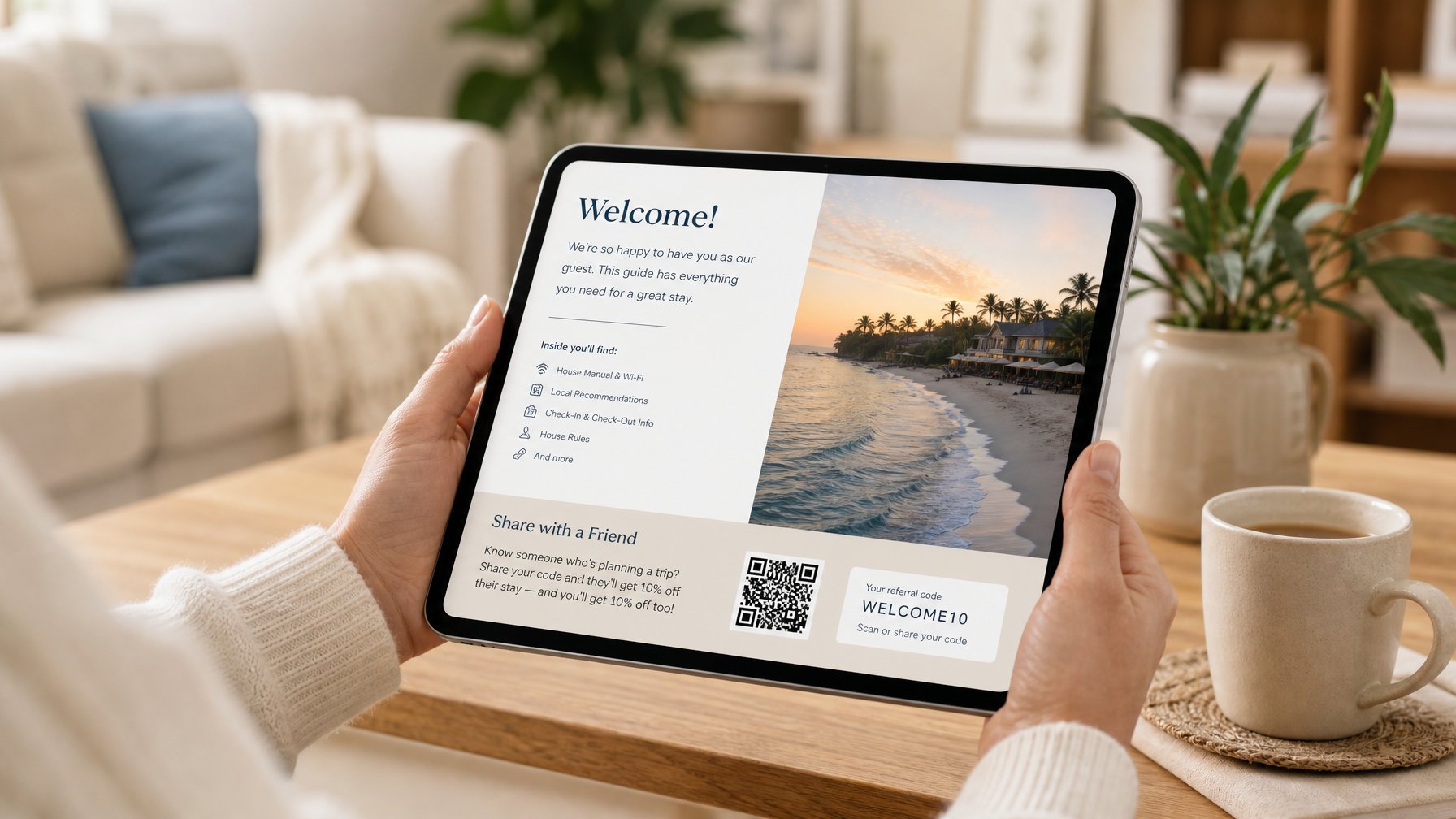
A link in your digital welcome book. A line at the bottom of your guest guide — "Love it here? Share it with a friend — here's your referral code" — plants the idea during the stay rather than only post-checkout.
What Incentive Level Works Best
Research and host experience consistently point to the same finding: the gesture matters more than the size of the discount.
A 5% discount offered with a personal, warm message converts better than a 15% discount included in a generic post-checkout email blast. Referral marketing data consistently shows that the perceived personalization of a referral offer is a stronger conversion driver than the monetary value.
Practical starting point: 10% off the first stay for a referred guest, with a personalized code based on the referring guest's name. Adjust based on your margin — in high-demand seasons with limited availability, you may not need to offer a discount at all, and a simple "share my link" ask with no discount still converts because the referring guest's endorsement carries the weight.
Tracking Performance and Iterating

Once your referral program is running, track two metrics monthly:
A simple spreadsheet — one row per referral code issued — is all the tracking infrastructure most hosts need.
Referral conversion rate. How many codes issued have resulted in bookings? If it is below 5%, consider raising the incentive or improving the timing and warmth of how you communicate the program.
Referral booking revenue share. What percentage of your direct booking revenue comes from referrals? A program that generates 10 to 15% of direct bookings from referrals after 12 months is a strong performer.
Iterate based on what you learn. If guests from a specific demographic (say, family groups or repeat couples) are generating more referrals than others, concentrate your post-stay outreach on those segments. If certain seasons see stronger referral conversion (e.g., summer guests who had a particularly social experience), focus new code distributions on those booking windows heading into the next year.
For ongoing inspiration and host community discussion, the Houfy Members Facebook Group is an active space where hosts share what incentive structures and message formats are converting in their markets.
Building a Referral Culture Over Time

The most powerful referral programs are not transactional — they are relational. A host who delivers a genuinely memorable experience, follows up with warmth, and makes sharing easy does not need to beg for referrals. They accumulate a network of advocates.
Group travelers are one of the highest-value referral segments — they bring multiple future bookings and recommend to their own networks of frequent travelers.
A referral culture builds when:
Every guest departs knowing the direct booking link exists and that using it benefits a friend.
Your Houfy profile is consistently updated, well-photographed, and easy to share.
Past guests feel like they are joining a host's "inner circle" of regulars — not just processing a transaction.
Pair this culture-building with a clear platform strategy. With Houfy's 97,000+ live listings and fee-free direct booking infrastructure, every referred guest who books direct saves on service fees and stays in a relationship you own — not one an algorithm controls.
Frequently Asked Questions
What is the best referral incentive for vacation rentals?
A discount for the referred guest — typically 5 to 10% off their first stay — is the most effective starting point. It frames the referral as a gift from the existing guest to their friend, which increases sharing motivation. Adding a credit for the referring guest (toward their next stay) creates a two-sided incentive that drives both referrals and repeat bookings simultaneously. Most hosts find that 10% off for the referred guest, with a personalized code, produces the best balance of simplicity and conversion.
How do I track vacation rental referrals without special software?
The simplest tracking method: a unique discount code per referring guest (e.g., first name + "FRIEND"), logged in a spreadsheet with columns for code issued, guest name, booking date, and booking value. When a new guest books using that code, you record the referral source and apply the discount. For hosts using a PMS, most platforms support discount codes with usage tracking built in — check Houfy's software partner integrations for compatible tools.
Can I run a referral program if my guests originally found me through Airbnb?
Yes. Once a booking through Airbnb is complete, the guest relationship is yours. A post-stay message that thanks them and introduces your direct booking channel (a Houfy link) with a referral incentive is fully within Airbnb's terms. You are not soliciting off-platform bookings during an active reservation — you are maintaining a post-stay relationship. Future bookings via your Houfy link carry no commission on either side.
How do I include a referral program in my Houfy listing?
You can reference the program in your listing description ("Past guests receive a referral code for friends after checkout") and in your automated post-stay message template inside Houfy's messaging system. Houfy lets you send an automatic post-checkout message to every guest — use this touchpoint to deliver your referral invitation consistently at scale, without manual effort for every stay.
What should the referral code look like?
Keep it simple and personal. A code formatted as the referring guest's first name + "FRIEND" (e.g., "EMILYFRIEND" or "JAMESFRIEND") is memorable, shareable by text or word of mouth, and instantly identifies the referring guest when a new booking comes in. Avoid long alphanumeric codes — they die in friction.
How long should a referral code stay active?
12 months is a practical default. Guests who loved a property tend to recommend it within the travel planning window of their next trip, which typically falls within a year of their stay. For seasonal rentals, align code expiry to the next equivalent season — a summer guest's code ideally stays active through the following summer booking window.
Conclusion
A referral program turns your most satisfied guests into a sustainable, commission-free acquisition channel. It costs a fraction of what OTA commissions extract, requires no specialized software, and compounds over time as your direct booking network grows.
The mechanics are simple: a personalized discount code, a warm post-stay message, and a direct booking link that routes every referred guest to your own channel. The payoff is a pipeline of pre-qualified, high-trust guests that arrives without giving 15% of every booking to a platform.
Set up your Houfy listing and pair it with a referral program to ensure every guest your advocates send books direct — fee-free, commission-free, and permanently in your relationship.
Source Citations
Nielsen Consumer Trust Index (2022). Trust in Advertising. Nielsen. https://www.nielsen.com/insights/2022/trust-and-growth-mindset/
Referral Rock (2024). Referral Marketing Statistics: The Data Behind Word-of-Mouth. https://www.referralrock.com/blog/referral-marketing-statistics/
Houfy (2026). Fee-Free Vacation Rental Direct Booking Marketplace. https://www.houfy.com
Airbnb (2026). How pricing and fees work. https://www.airbnb.com/help/article/1424
Houfy has 97,000+ live listings across 50+ countries. Join the fee-free direct booking movement at houfy.com.
Last updated: June 7, 2026