

TLDR: Static pricing leaves money on the table every single month. Peak season demands a floor rate, event premiums, and smart minimum-stay rules. Off-season calls for long-stay discounts, gap-fill tactics, and repositioned listing copy. Both strategies only work fully when you control your own rates — which means direct booking.
Your pricing is the single biggest lever you control as a vacation rental host. Get it right and your calendar stays full at rates that protect your margins. Get it wrong and you spend peak season leaving money on the table, then watch your property sit empty when demand drops.
A vacation rental pricing strategy for peak season and off-season does not have to be complicated. It requires two distinct mindsets, a few clear rules, and full control over your own listing. That last part matters more than most hosts realize — especially in a market where the global vacation rental sector is on track for $101 billion in revenue in 2026 and competition for every booking window is sharper than ever. This guide covers how to price your vacation rental for both peak and off-season, with specific rate formulas, discount structures, and gap-fill tactics.
Why Static Pricing Costs You Money
A flat nightly rate set in January and left untouched through December is the fastest way to underperform. Markets move. Local events spike demand overnight. School holiday windows drive compressed booking surges. Weather patterns push shoulder seasons earlier or later each year.
Properties that use static pricing either under-price peak nights — losing revenue they never recover — or over-price shoulder and off-season nights, creating gaps that never fill. Neither outcome is acceptable when your property is a revenue-generating asset. Research from Guesty shows that properties using dynamic pricing strategies earn up to 40% more annual revenue than those on fixed rates.
The solution is a two-part strategy: one playbook for peak demand, a separate playbook for slow periods. Both are built around the same foundation — knowing your numbers, knowing your market, and keeping full control of your rates.
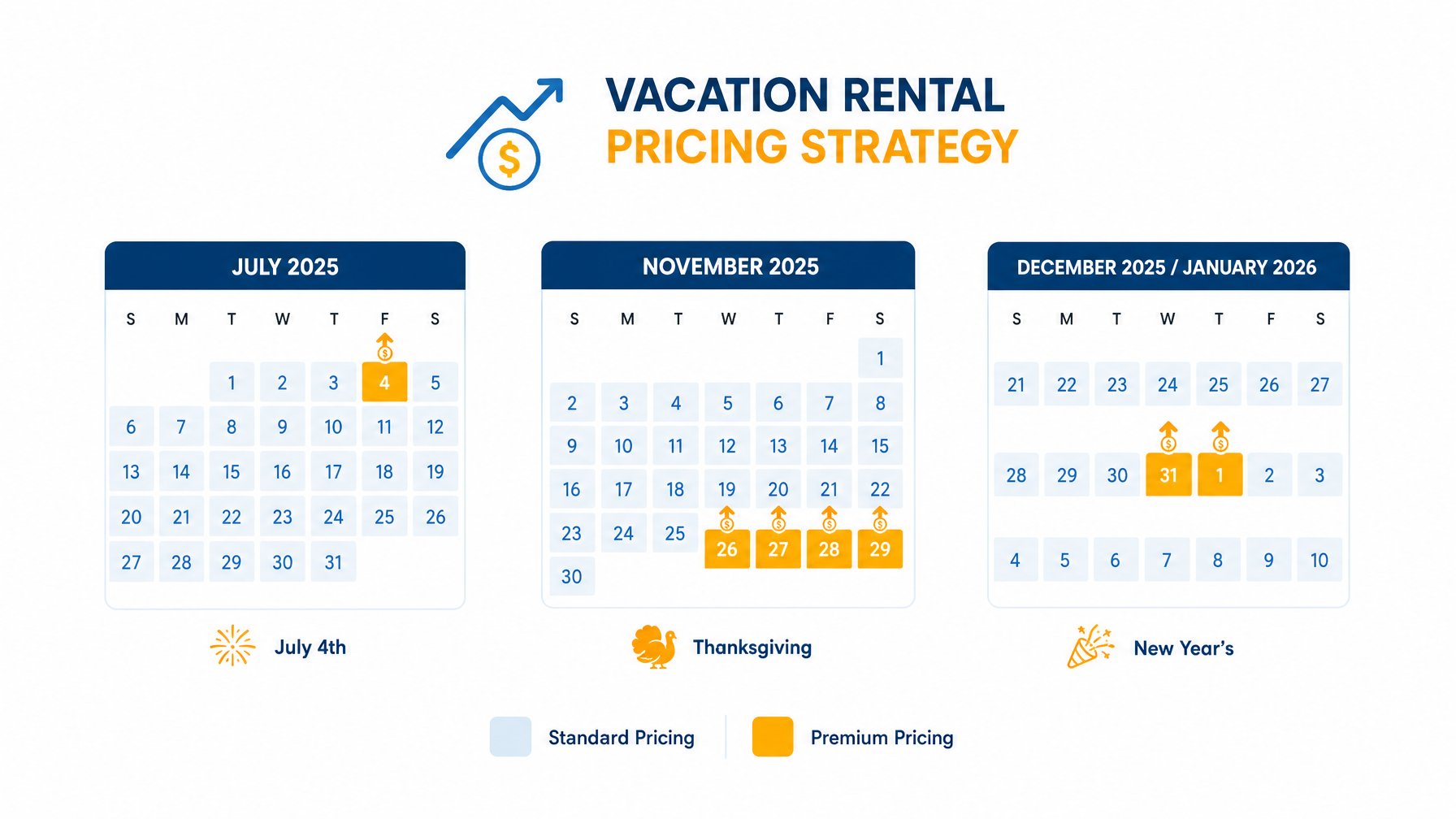
Part 1: Peak Season Pricing Strategy
Peak season is not the time to be conservative. Demand is high, competition is intense, and guests are willing to pay a premium for the right property. Your job is to capture that value without pricing yourself out of the market entirely.
Set a Defensible Floor Rate
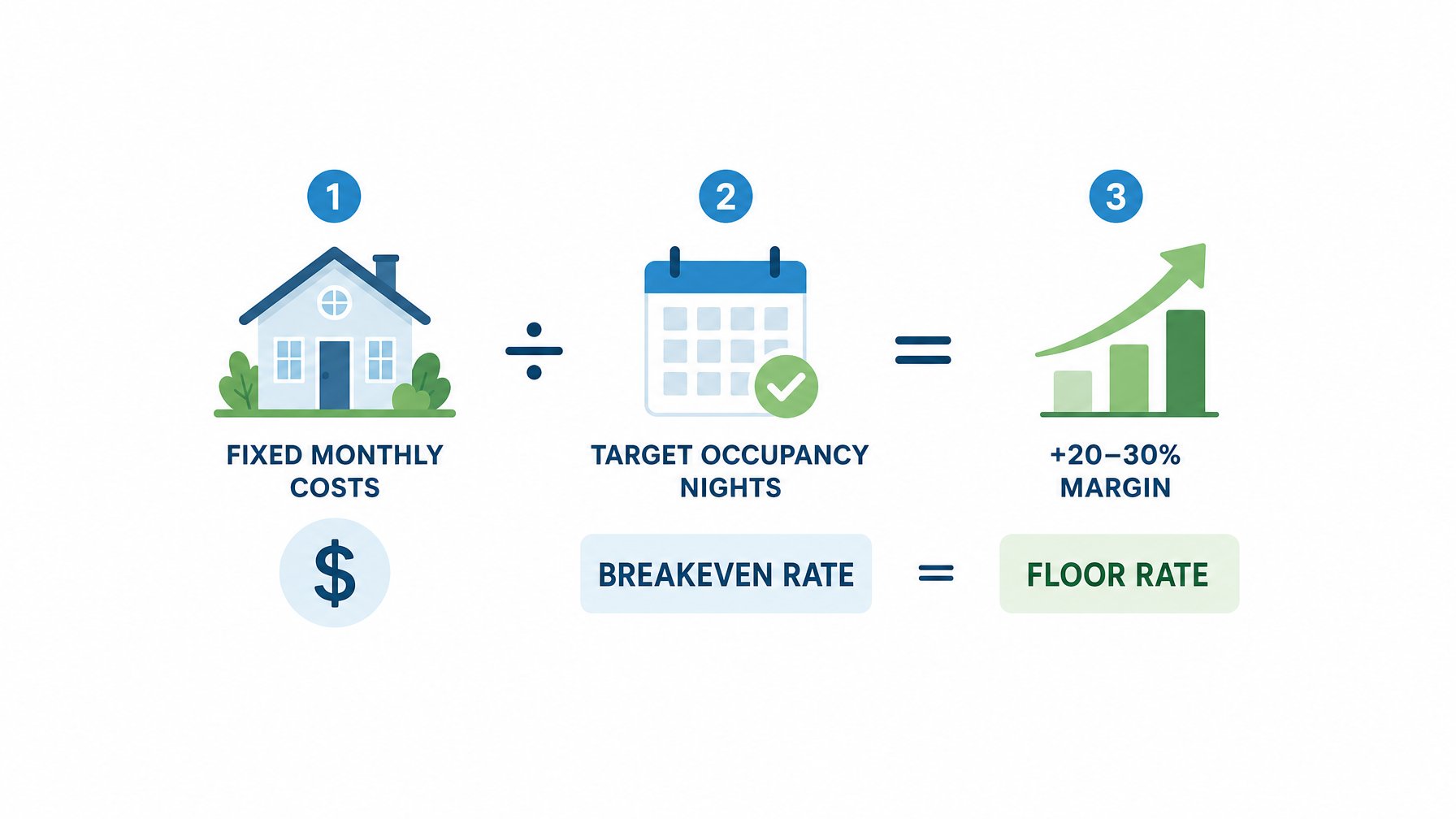
Your floor rate is the lowest nightly price you will accept during peak season, accounting for all costs: mortgage or rent, cleaning, supplies, utilities, wear and tear, and your time. Calculate it once, then treat it as non-negotiable.
A floor rate formula for peak season:
Total monthly fixed costs divided by your target occupancy nights
Add a margin of at least 20–30% above breakeven
Cross-check against comparable listings in your market at similar size and quality
If your floor rate is $150/night and comparable peak-season listings in your market go for $220–280, you have room to price at $200–240 without losing competitive position. Do not anchor to the lowest listing in your market. Anchor to the mid-to-upper range for your quality tier.
Build Holiday and Event Premiums
Standard peak pricing is a baseline. Specific high-demand windows deserve explicit rate increases on top of that baseline.
Dates that typically warrant a 20–50% premium above your standard peak rate:
Major national holidays (Thanksgiving week, Christmas week, New Year's Eve, July 4th weekend)
School spring break windows — these vary by region, so check your local school calendar
Local events: festivals, sporting events, conferences, graduation weekends
Long weekends created by federal holidays
Set these manually in your calendar as far in advance as possible. Guests searching for these dates book early, and early bookings at strong rates are the backbone of a profitable peak season.
One practical note: be specific about which dates carry the premium. Charging event-week prices for the shoulder nights around that event — when demand is ordinary — hurts your conversion rate. Precision matters more than blanket rate hikes.
Use Minimum Stay Rules to Fill Gaps
Minimum stay requirements are a pricing tool, not just a preference. During peak season, a 3 or 4-night minimum prevents weekend-only bookings from creating mid-week orphan gaps that are nearly impossible to fill.
Apply longer minimums (5–7 nights) during Christmas and New Year's windows, when demand is dense and guests expect full-week rentals. Tighten to 2–3 nights for standard peak weekends where turnover is faster.
Three weeks before any unbooked gap during peak, consider relaxing the minimum for that specific window to capture late bookers. A 2-night booking at peak rates beats an empty night at any rate — see the complete vacation rental minimum stay guide for rules by season and market type.
Part 2: Off-Season Pricing Strategy

Off-season is where most hosts lose the most money — not through bad pricing, but through no strategy at all. Many hosts simply lower rates and hope for the best. The hosts who win off-season do three specific things: attract a different type of guest, price for the value of longer stays, and actively fill gap nights before they become write-offs.
According to AirDNA's 2026 Short-Term Rental Outlook, off-season occupancy is one of the sharpest differentiators between top-performing and average-performing hosts in the same market.
Attract Long-Stay Guests with Monthly Discounts
The economics of a long-stay guest are different from a weekend guest — and better in several ways. Lower turnover means lower cleaning costs. Predictable occupancy means predictable revenue. Guests who stay 2–4 weeks tend to be remote workers, snowbirds, family caregivers, or people in local relocation. All of them value stability over price-shopping.
To attract them:
Offer a weekly discount of 10–15% for stays of 7+ nights
Offer a monthly discount of 20–30% for stays of 28+ nights
Make sure your listing description speaks to work-from-home needs: fast WiFi, a dedicated workspace, kitchen facilities, and quiet hours
The math matters here. A property rented at $120/night for 25 nights generates $3,000 with zero gaps. The same property at $150/night but only 16 nights generates $2,400 — with 9 empty nights you never fill. Long-stay pricing wins on net revenue, not just occupancy.
Gap-Fill Pricing for Shoulder Nights
A gap-fill strategy targets the 1–4 night windows between existing bookings that would otherwise go empty. These are last-minute opportunities, so price them to move.
Tactics that work:
Drop rates by 15–25% for gaps of 3 nights or fewer inside a 14-day window
Set a "last-minute discount" that auto-applies for same-week bookings
Reach out directly to recent guests with a discounted return-stay offer
On a direct booking platform like Houfy, this kind of flexible outreach is possible because you own the guest relationship. There is no intermediary throttling your communication or taking a cut of the discounted rate.
Reposition Your Listing for Off-Season Travelers
Your peak season copy and photos emphasize summer fun, beach access, or ski proximity. Off-season travelers have different needs. A quick seasonal update to your vacation rental copywriting goes a long way — off-season travelers respond to different language than peak-season guests.
In off-season, lead with:
Cozy atmosphere, fireside evenings, or off-peak peace and quiet
Proximity to indoor attractions, dining, or cultural events
Practical amenities: fast internet, washer/dryer, full kitchen
Honest pricing — guests can see they are getting your property at below-peak rates
This repositioning is about speaking to the guest who is actually searching right now, which is a different person than the one searching in July.
The Pricing Advantage of Direct Booking
Every pricing tactic above requires one thing: full control of your rates, calendar, and guest communication. On a traditional OTA, that control is limited. Platform algorithms influence your visibility based on factors outside your control. Service fees added at checkout inflate the price guests see, which changes their perception of your value.
On Houfy, hosts set their own rates, apply their own discounts, and communicate directly with guests without platform interference. There are no service fees added on top of your nightly rate. Guests pay what you charge — nothing more. That transparency makes your pricing more competitive without you lowering it a single dollar.
Hosts on Houfy also get direct Google Vacation Rentals exposure, so your listing appears in Google search without an OTA taking the click.
A strong vacation rental pricing strategy for peak season and off-season starts with having a platform that lets you execute it. List your property on Houfy and keep every dollar your pricing strategy earns.
Frequently Asked Questions
What is the best vacation rental pricing strategy for peak season?
The best peak-season strategy combines three elements: a non-negotiable floor rate calculated from your actual costs plus a 20–30% margin, explicit event and holiday premiums of 20–50% above your baseline rate, and minimum stay requirements (3–7 nights) to prevent mid-week gaps. Set these rates manually well in advance — peak dates fill earliest, and early bookings at strong rates protect your season.
How much should I discount my vacation rental in the off-season?
A weekly discount of 10–15% for stays of 7+ nights and a monthly discount of 20–30% for stays of 28+ nights are the most effective off-season incentives. These attract long-stay guests — remote workers, snowbirds, relocating families — whose lower turnover and predictable occupancy often produce higher net revenue than short, price-optimized weekend stays.
What is a floor rate for a vacation rental and how do I calculate it?
Your floor rate is the lowest nightly price you will accept while still covering all costs and turning a profit. Calculate it by dividing your total monthly fixed costs (mortgage or rent, cleaning, supplies, utilities, wear and tear, management time) by your target occupancy nights, then adding a margin of at least 20–30% above that breakeven point. Cross-check it against comparable listings in your market at a similar quality tier.
Should I use dynamic pricing software for my vacation rental?
Dynamic pricing tools can be useful for hosts with multiple listings or limited time to manage rates manually. However, most tools are calibrated for OTA platforms and can conflict with a direct booking strategy. A manual, rules-based approach — floor rate, event premiums, long-stay discounts, gap-fill windows — gives independent hosts comparable results with more control and no additional software cost.
How do I fill gap nights between bookings in my vacation rental?
Gap-fill pricing targets the 1–4 night windows between existing reservations. Drop your rate by 15–25% for these gaps inside a 14-day window, set an automatic last-minute discount for same-week bookings, and reach out directly to recent guests with a return-stay offer. On a direct booking platform, you own the guest communication channel — that makes gap-fill outreach practical in a way it simply is not on an OTA.
Does direct booking really improve my pricing power?
Yes, in two concrete ways. First, you set and adjust rates without algorithmic interference or visibility penalties. Second, guests see exactly what you charge with no service fees added at checkout. A $200/night listing on Houfy shows guests $200. The same listing on Airbnb often shows $230–250 after fees — which changes the guest's price perception even though your rate is identical. Direct booking makes your pricing more competitive without you changing a single number.
What is the difference between peak season and shoulder season pricing?
Peak season covers the highest-demand windows for your market — summer for beach properties, winter holidays for ski properties, event weekends year-round. Shoulder season is the transition period on either side: less predictable demand, shorter booking windows, and more price-sensitive guests. Shoulder season pricing sits between your peak floor rate and your off-season discounts, typically 10–20% below peak. The most profitable tactic in shoulder season is event awareness: a local festival or conference can turn an ordinary shoulder weekend into a mini peak that most hosts miss.