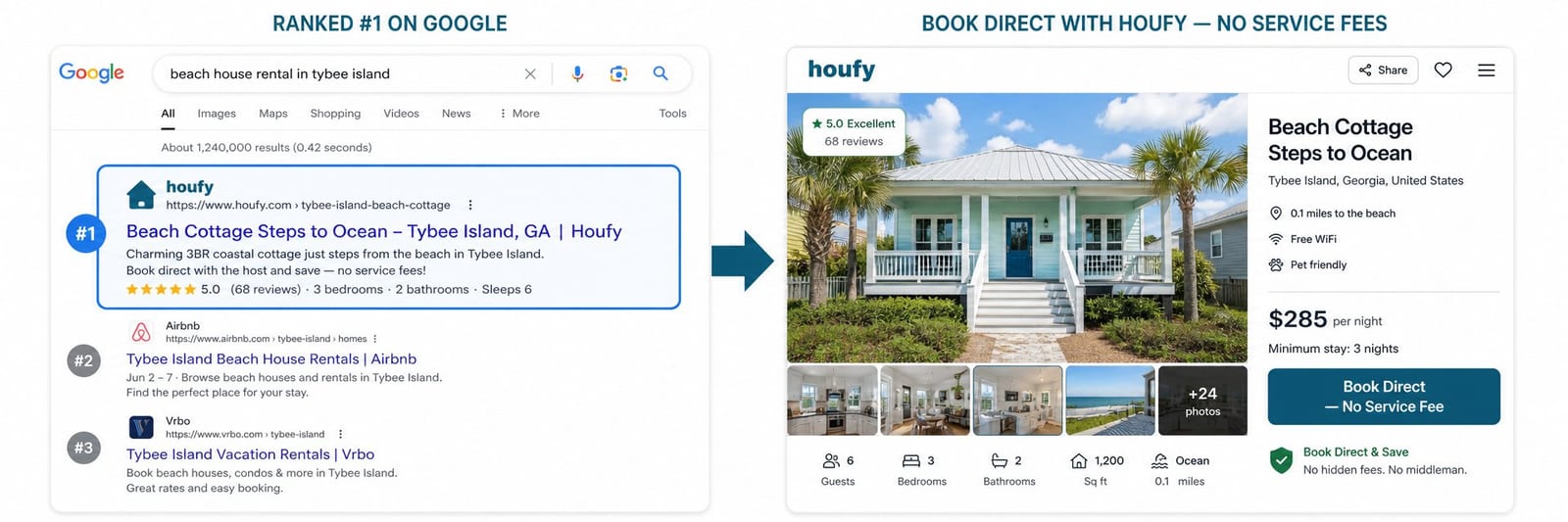

A vacation rental description has two jobs: rank on Google for the right search terms, and convert the visitor who finds it into a guest who books. Most hosts optimize for one or the other — and lose on both. This guide shows you exactly how to write a vacation rental description that does both at the same time, without keyword stuffing, without marketing speak, and without the generic language that makes every listing sound identical.
Key Takeaways
Google indexes vacation rental listing pages directly — a well-written description with the right keywords ranks in organic search, not just OTA platform search
The most valuable keyword placement is in the first 150 characters of your property description, which search engines weight most heavily
Specific, sensory language converts better than adjective lists — "coffee on a private deck overlooking Seneca Lake" beats "beautiful lakefront property" every time
Your listing description should answer three questions every guest is actually asking: Is this the right property for my trip? Will I get what the photos show? Can I trust this host?
Houfy listing pages are indexed on Google and Google Vacation Rentals — every word in your description is public-facing SEO content
A description rewrite typically lifts booking page conversion by 12–22% within 30 days, based on Houfy host reporting
Updating your description seasonally keeps your listing fresh in Google's index and relevant to current search intent
How Google Reads Your Vacation Rental Description
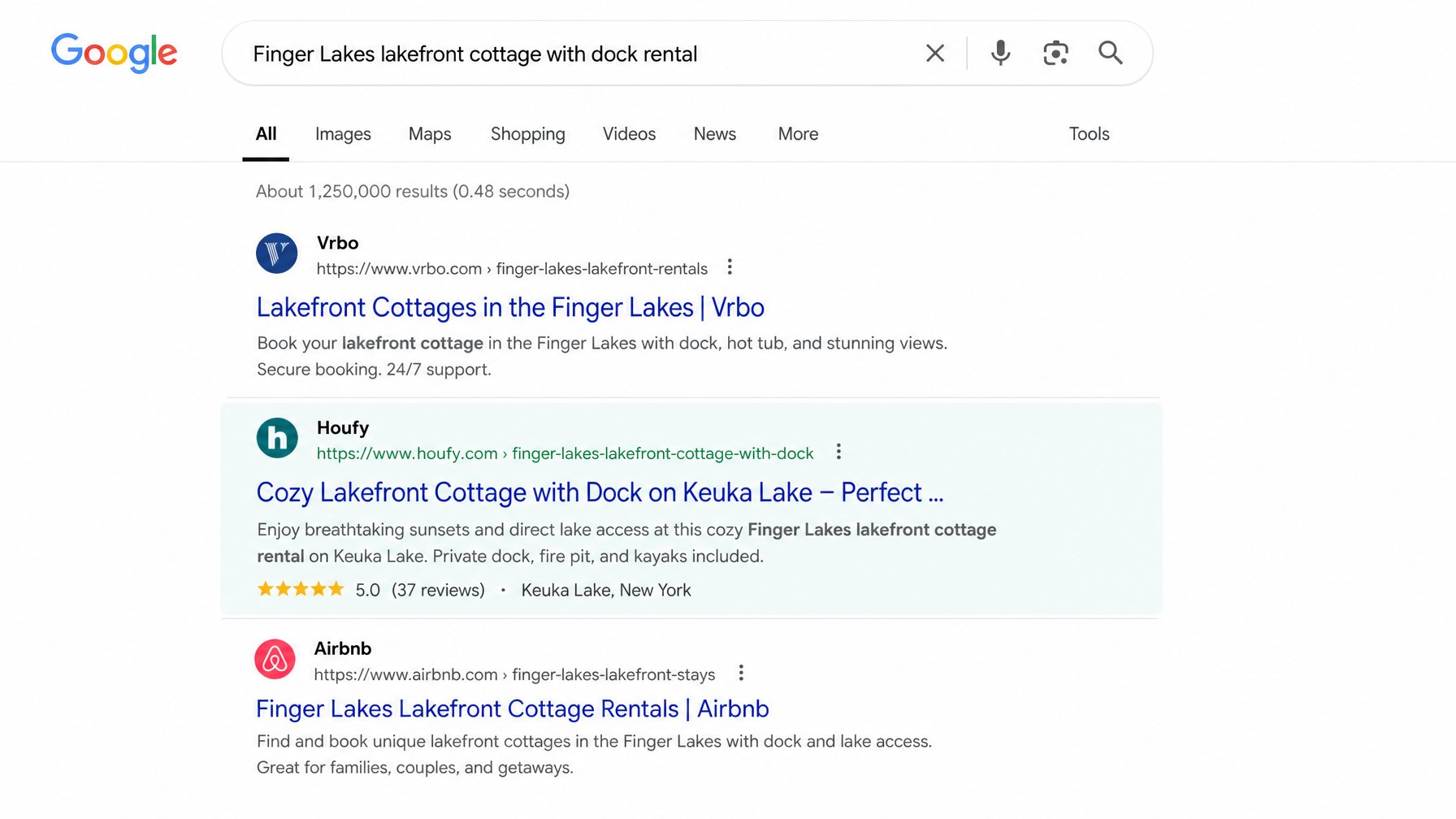
When a guest searches "3-bedroom vacation rental Finger Lakes with dock," Google crawls publicly indexed listing pages and matches keyword content to the search query. Your Houfy listing is publicly indexed and eligible to rank for these searches — that means your vacation rental description SEO directly determines your position in organic Google results, not just within the Houfy platform.
The three places Google weights most heavily on a vacation rental listing page:
The title tag — your listing headline, written with the location, property type, and primary feature
The first 150 characters of your description — treated as meta content by many crawlers and weighted accordingly
The body of your description — secondary keyword density, topic authority signals, and semantic relevance
Your listing headline should follow this structure: property type + location + primary feature.
Example: "Lakefront Cottage on Seneca Lake — Private Dock, 3BR, Direct Booking"
This headline tells Google and the guest exactly what the property is, where it is, and what makes it distinctive — in under 65 characters. It contains a location-specific keyword phrase ("Seneca Lake lakefront cottage"), a primary amenity signal ("private dock"), and a booking intent hook ("direct booking") — all in one line.
For the complete technical framework on ranking your vacation rental listing in Google search, see Vacation Rental SEO: How to Rank on Google and Get Direct Bookings.
The First 150 Characters: Where Rankings Begin
The first 150 characters of your vacation rental description are disproportionately important for two reasons: search engines weight them more heavily than the rest of the description, and guests read them before deciding whether to continue reading.
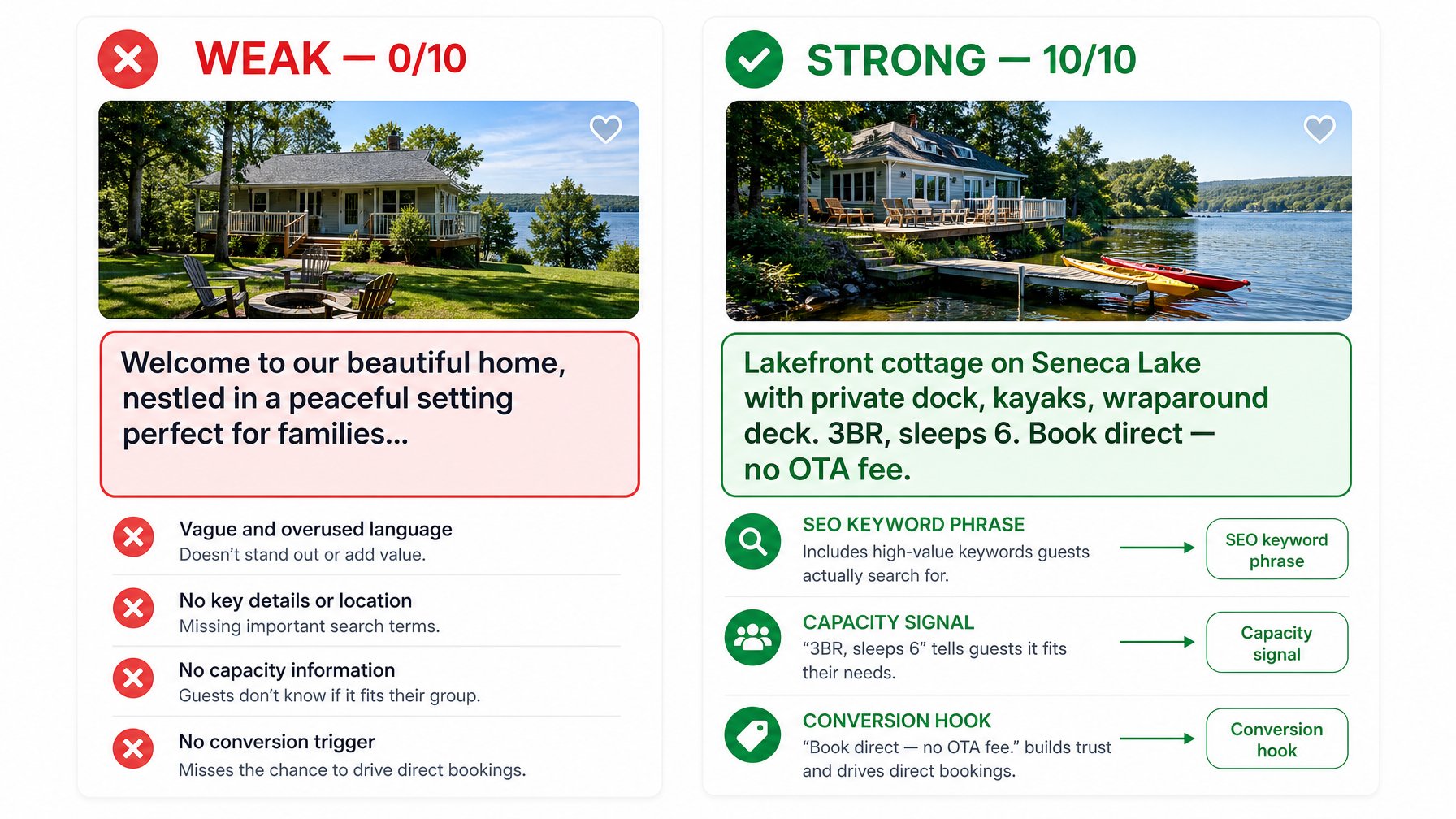
A weak first 150 characters:
"Welcome to our beautiful home, nestled in a peaceful setting perfect for couples and families who want to get away from it all and enjoy nature..."
This opener tells Google nothing it can rank for, and tells the guest nothing they need to know. There is no location keyword, no property type signal, no capacity information, and no conversion hook.
A strong first 150 characters:
"Lakefront cottage on Seneca Lake with private dock, kayaks, and a wraparound deck facing west for sunset. 3 bedrooms, sleeps 6. Zero OTA service fee — book direct."
This 162-character opener contains: the exact search phrase ("Seneca Lake lakefront cottage with dock"), the primary amenity features, guest capacity, and a direct conversion hook (the fee savings). Every element serves double duty — it's SEO content and guest-facing copy at the same time.
Write your first 150 characters as if they are the only text a guest will ever read. Then write the rest of the description as if they read every word.
Ready to rewrite your listing? Create or update your Houfy listing free and start ranking for the searches your guests are already making.
Keyword Research: What Guests Are Actually Searching
Before writing a single word, identify the 3–5 keyword phrases guests use to find properties like yours. Use Google Autocomplete, Google Keyword Planner, or Ahrefs to find phrases with real search volume in your target market.
For a lake property in the Finger Lakes region, high-value keyword phrases include:
"Finger Lakes vacation rental with dock" — high intent, highly specific
"Seneca Lake cottage rental" — location-specific, strong commercial intent
"Finger Lakes lake house for groups" — audience-specific, captures group travel demand
"book direct Finger Lakes rental" — intent-specific, lower competition, matches Houfy's direct booking advantage
Work these phrases naturally into the first 300 words of your description. Use each phrase once, in context. Google's semantic processing (Natural Language Processing/NLP) recognizes forced keyword placement and penalizes it — a phrase used once in a natural sentence outperforms a phrase used seven times awkwardly.
Secondary keywords to layer in throughout the body of your description:
Property size and capacity ("sleeps 8," "4-bedroom")
Specific amenities ("hot tub," "kayaks included," "private dock")
Activity-based phrases ("hiking near," "wine trail proximity," "ski-in ski-out")
Booking intent phrases ("book direct," "no service fee," "direct from host")
The goal is a description that reads naturally to a guest while containing the exact phrases a guest in search mode would type into Google. These are not in conflict — they are the same thing written well.
Converting the Reader: From Browser to Booker
Once your description ranks and a guest lands on your page, the writing's second job begins: converting the browser into a booking. Vacation rental description SEO gets the guest to the page. The description's conversion quality is what gets them to click "Book."
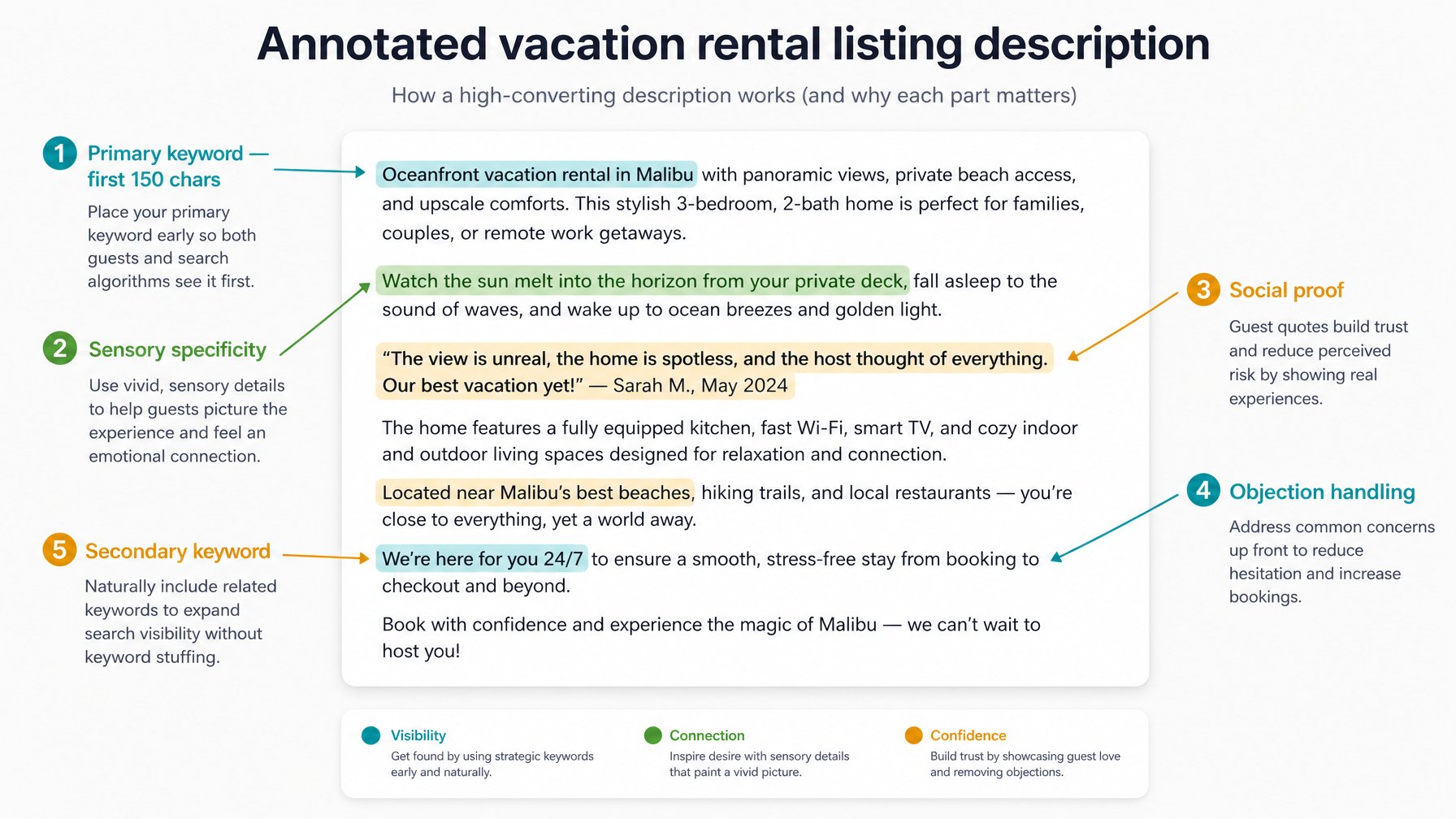
The three conversion signals that matter most:
1. Specificity over adjectives
"A private 3-acre property with a half-mile trail through old-growth forest and a firepit clearing at the midpoint" is more compelling than "beautiful private property with nature access." Specifics signal that the listing is real, the host knows their property, and what you see is what you get. Generic adjectives ("beautiful," "stunning," "amazing") trigger guest skepticism because every listing uses them.
2. Address unspoken objections
Most guests are silently asking: "Will this actually look like the photos?" and "What happens if something goes wrong during the stay?" Answer both directly in your description. "Photos were taken in May 2026 and reflect the current setup" handles the first objection. "We're available 24/7 by text for anything that comes up — our average response time is under 15 minutes" handles the second.
3. Embed social proof inline
A single review excerpt works harder than any amount of self-description. "Guests consistently call the sunset from our dock 'the most memorable part of the trip' — it faces due west over open water" is more persuasive than a host describing it themselves. Pull real language from your reviews and weave it naturally into your body description.
The Booking Page Structure That Converts
Your description is one element of a page that needs multiple conversion elements working together. The Vacation Rental Booking Page: What to Include covers the full page structure, but the description's role in the sequence is:
Position 1: Property name and headline (SEO target, first impression)
Positions 2–3: First 150-character intro (highest SEO weight + guest hook)
Positions 4–8: Body description (sensory details, feature specifics, what makes this property different from the 50 others in the search results)
Position 9: "Who this property is right for" section (self-selection language that qualifies guests before they inquire)
Position 10: What's nearby (local keywords, context for non-local searchers, activity signals)
The "who this property is right for" section is the single most underused element in vacation rental listing descriptions. Writing "This property is ideal for couples, small families, and solo travelers looking for a quiet, nature-focused retreat — it is not the right fit for large party groups or guests looking for nightlife proximity" does something remarkable: it self-selects the right guests in and the wrong guests out. You receive fewer total inquiries and dramatically better-fit bookings. Your review scores improve because the guests who booked were always the right fit for the property.
Browse vacation rentals on Houfy to see how top-performing hosts structure their listing descriptions in practice.
Updating Your Description for Seasonal SEO
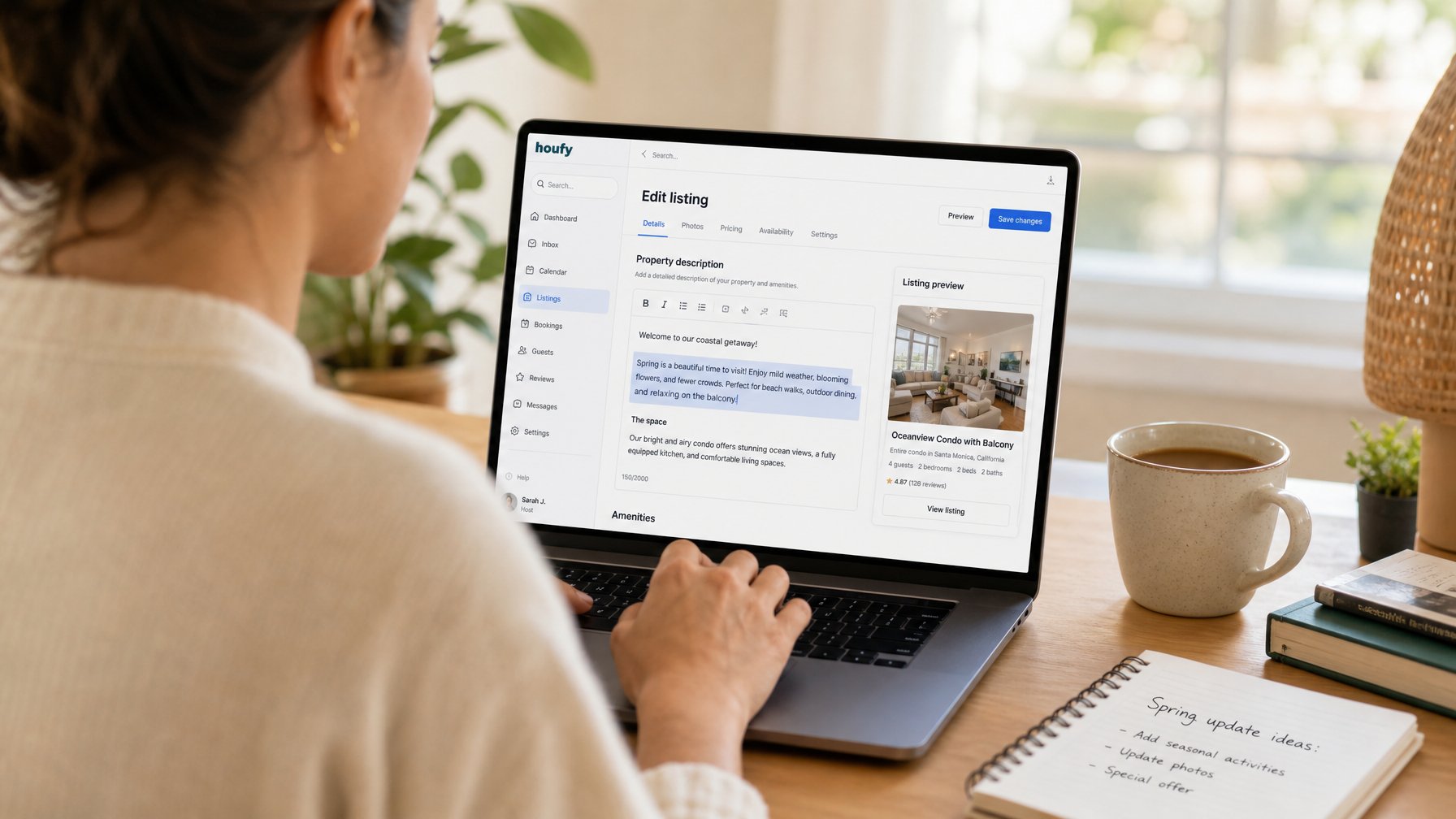
Your listing description should not be a static document. Update it quarterly — or at minimum twice per year — to reflect:
Seasonal availability language: "Available weeks remaining for summer 2026 — booking fast"
Current search trends: "2026 summer travel in the Finger Lakes is tracking ahead of last year — secure your preferred dates early"
Recent review language: Pull a quote from a recent review and replace an older embedded quote
New amenities or upgrades: If you added a new kayak, hot tub, or streaming setup since your last update, add it — these are keyword-rich, conversion-improving additions
Houfy listing updates go live immediately. There is no OTA approval queue, no content moderation delay, no algorithm review. The description you write today is indexed by Google within 24–48 hours of your listing page being crawled.
Hosts who update their descriptions seasonally consistently outperform hosts with static descriptions in both organic ranking stability and booking conversion rates. Google's freshness signals reward recently updated content, and returning guests notice new detail that keeps your listing feeling current.
List on Houfy and take full control of your listing description, pricing, and guest communications. Start your free Houfy listing today — no commission, no approval wait.
The Direct Booking Advantage in Your Description
There is one conversion signal that only direct booking platforms can offer: the absence of a service fee. On Airbnb, a guest paying $250/night for a 7-night stay pays an additional $250–$400 in service fees at checkout. That fee is disclosed late in the booking flow, after emotional investment is already high.
On Houfy, there is no service fee for guests. Your listing description can say that directly — and should.
Adding a single line to your description — "Book direct on Houfy — guests pay zero service fees" — serves as both a conversion signal and a differentiator. Guests who have compared Houfy listings to Airbnb listings understand the math immediately. Guests who haven't compared yet are being introduced to a fact that meaningfully increases the perceived value of booking through you.
Explore Houfy's software partner integrations if you manage multiple properties and want to sync your listings from a PMS while maintaining the direct booking advantage across all of them.
Join 97,000+ listings on Houfy. List your property free and keep every dollar guests pay you.
Frequently Asked Questions
How long should a vacation rental description be?
Between 250 and 500 words for the primary description body. Google's crawlers handle this range well for semantic indexing and topic authority signals. Below 200 words, the listing lacks sufficient keyword context for reliable ranking. Above 600–700 words, the risk is that guests stop reading before reaching your key conversion points. Write tight, specific, and information-dense — not long.
Should I use the same description on Houfy and on other platforms?
Vary the descriptions slightly across platforms, as unique content performs better in Google indexing than duplicate content. Maintain the same keyword targets and core factual information, but adjust the opening paragraph, the structure of your feature list, and any platform-specific language. A 20–30% variation in phrasing is sufficient to avoid duplicate content penalties.
Does keyword stuffing help my listing rank higher?
No. Google's NLP processing penalizes keyword stuffing and rewards natural, contextual language. Write naturally and use your target phrases once each, in full sentence context. One well-placed "Finger Lakes lakefront cabin rental" in the first 150 characters outperforms the same phrase appearing seven times throughout the body. Search engines measure semantic relevance, not keyword count.
How quickly does a description rewrite affect bookings?
Hosts report visible uplift within 30 days of a substantial rewrite — primarily because an improved description qualifies guests better, reducing no-fit inquiries and increasing the booking-to-inquiry conversion rate. The full SEO benefit (improved ranking for keyword phrases) typically manifests over 60–90 days as Google recrawls and reindexes the updated page.
What's the most common vacation rental description mistake?
Leading with the property owner's feelings rather than the guest's experience. Descriptions that open with "We love this home and hope you will too" or "This property holds so many memories for our family" prioritize the host's perspective over the guest's questions. Every sentence of your description should answer a guest question or address a guest decision point — starting with the property type, location, primary feature, and capacity in the first two sentences.
Does the description affect Google Vacation Rentals specifically?
Yes. Google Vacation Rentals (the carousel that appears at the top of travel intent searches) pulls data from publicly indexed listing pages. Properties with clear, keyword-rich descriptions that include check-in/check-out flexibility, capacity, location, and amenities are more likely to appear in the GVR surface. Houfy listings are eligible for this placement — a well-optimized description increases the probability of appearing in both standard organic results and the GVR carousel.
Source Citations
Google Search Central — SEO Starter Guide — https://developers.google.com/search/docs/fundamentals/seo-starter-guide
Google Ads Keyword Planner — Keyword Research Tool — https://ads.google.com/home/tools/keyword-planner/
Ahrefs — Keyword Research and SEO Tools — https://ahrefs.com
Houfy Direct Booking Platform — https://www.houfy.com
Google Vacation Rentals — Search Integration Documentation — https://developers.google.com/search/docs/appearance/structured-data/vacation-rental
Houfy currently has 97,000+ verified listings across 50+ countries.
Last Updated: June 2026