
You search for a vacation rental. The nightly rate looks fine — $180, reasonable. You add the dates, click through to checkout, and the total is $267 per night. The difference? Airbnb's fees, absorbed into the listed price so you cannot see them or negotiate them away.
In late 2025, Airbnb moved from a visible guest service fee to a host-only fee model. Hosts now pay 15.5% of the booking subtotal directly from their payout — and because that cut reduced their income, virtually every host on the platform raised their listed prices by 14 to 16% to compensate. The fee did not disappear. It went invisible.
On a $2,000 family vacation rental booking, $310 of that goes to Airbnb. On a $3,000 week at a beach house, that is $465 — paid to a platform, not toward your trip.
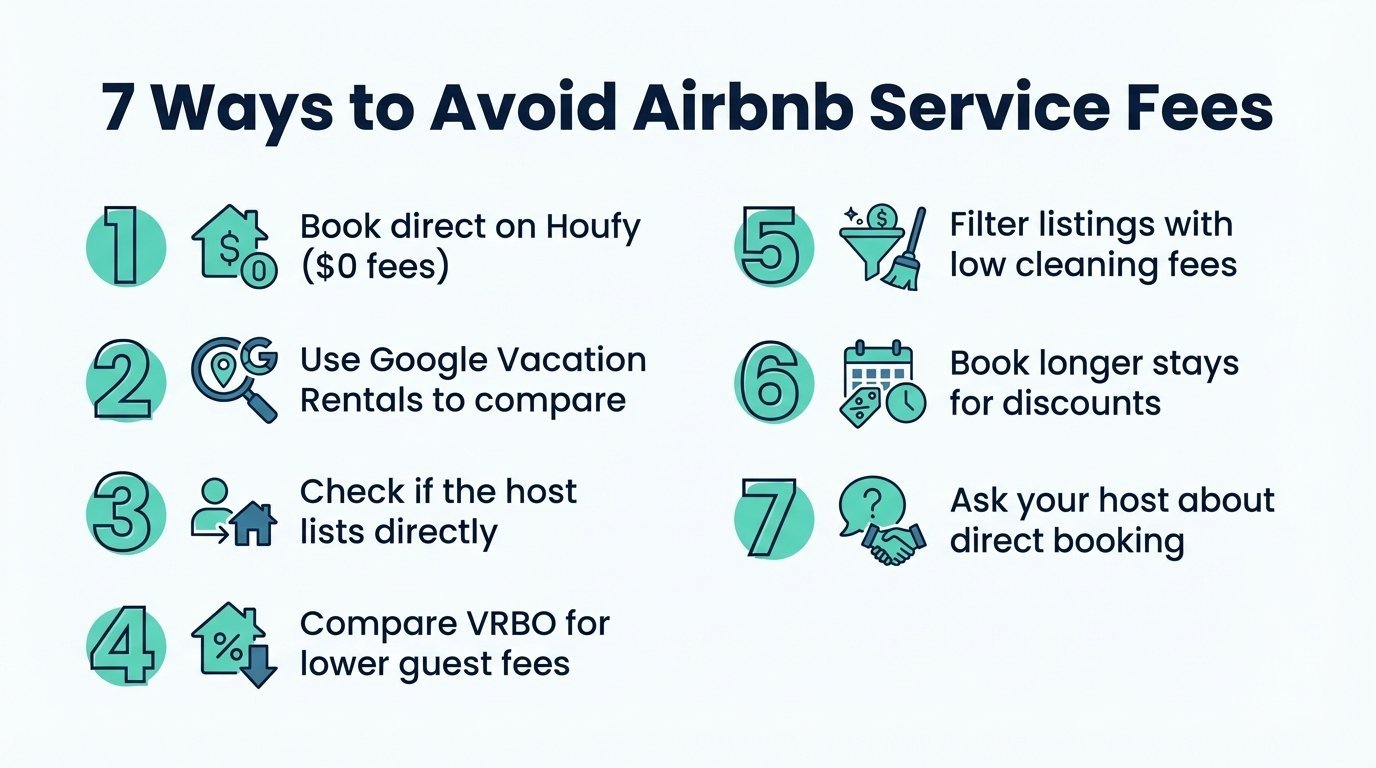
The good news: in 2026, avoiding these fees entirely is straightforward. Here are the 7 methods that work.
How Airbnb Fees Work in 2026
Airbnb overhauled its fee structure in late 2025. The old model split fees between hosts and guests — hosts paid about 3%, guests paid a visible 14.1–16.5% service charge at checkout. That model has been almost entirely phased out.
The model that replaced it:
Since December 2025, Airbnb operates on a host-only (single) fee structure for virtually all hosts worldwide. Here's how it works:
Hosts pay: 15.5% of the booking subtotal, deducted directly from their payout. Brazil is 16%. Mexico moves to 16% from June 2026.
Guests pay: No separate Airbnb service fee appears at checkout.
At first glance, that sounds like good news for guests. But the reality is different. To maintain the same earnings, every host on Airbnb had to raise their listed prices by approximately 14–16% when the fee change took effect. The platform cost is still there — it's just been absorbed into the nightly rate and made invisible.
Guests on Airbnb in 2026 aren't saving money. They're paying a hidden fee with no way to see it, compare it, or avoid it — unless they book somewhere else.
How Much Does Airbnb Actually Charge?
The 15.5% applies to the full booking subtotal: nightly rate + cleaning fee + any other host-set charges. It does not apply to taxes or security deposits.
A worked example:
A 3-night stay at $150/night with a $60 cleaning fee:
Booking subtotal: $510
Airbnb takes 15.5%: $79.05
Host receives: $430.9
Guest pays: $510 (but $79 of that funds Airbnb, not the host or the property)
Because hosts raise their prices to cover this, a listing that would have been $130/night before the fee change is now listed at around $150 to net the same income. Guests pay the difference — they just can't see where it went.
[Source: Smoobu — Airbnb Host Fees 2026](https://www.smoobu.com/en/blog/airbnb-service-fees/)
7 Ways to Avoid Airbnb Fees
1. Book Direct on a Fee-Free Platform
The most effective method — and the one with zero workarounds required — is a platform that charges no fees on either side of the transaction
Houfy is the largest fee-free vacation rental platform in the world. Hosts pay 0% commission. Guests pay exactly what the host charges. No hidden platform cost built into the nightly rate, no fees absorbed anywhere in the booking.
Because Houfy hosts keep 100% of their earnings, they can list at lower prices than on Airbnb and still net the same income — or list at the same price and earn more. Either way, guests get a better deal. With 87,000+ properties across 50+ countries, the same property you're considering on Airbnb often appears on Houfy at a lower effective cost.
2. Use Google Vacation Rentals to Compare Real Prices
Before committing to any platform, search for your destination on Google ("vacation rentals Sedona Arizona"). Google pulls listings from VRBO, Booking.com, and other partners into search results, letting you compare totals side by side.
Since Airbnb's price inflation is now baked into listed rates rather than shown as a checkout add-on, comparing across platforms is the only reliable way to spot the difference. The same property listed on multiple platforms often shows different nightly rates — that gap is frequently the platform fee in disguise.
3. Check Whether the Host Lists Directly
Many experienced hosts maintain direct booking websites. They list on Airbnb for discovery, then route repeat guests (and savvy first-timers) to book direct, bypassing the platform fee entirely.
A quick Google search of the property name or the host's business name sometimes surfaces a direct booking site. Houfy makes this easy — every host gets a free profile and direct booking link, so guests can book at no added cost. See how direct booking compares to OTAs if you want the full breakdown.
4. Compare VRBO
VRBO charges US and Canadian hosts about 8% (5% commission + 3% processing) — roughly half of Airbnb's 15.5%. In Europe and Australia, fees are higher (12–15%), but still often below Airbnb. A separate guest service fee is charged in most markets, but the total price can still work out lower than an equivalent Airbnb listing.
Many properties are listed on both platforms simultaneously. Comparing checkout totals on both sites takes about 90 seconds and can surface a meaningful difference — especially on larger bookings.
5. Filter for Listings With Lower Cleaning Fees
Airbnb's 15.5% host fee applies to the full booking subtotal, including the cleaning fee. A host paying $155 in platform fees on a $1,000 booking pays an additional $15.50 in fees on a $100 cleaning charge — and that cost gets passed into their listed price.
When comparing properties, use Airbnb's "total price" display mode rather than per-night pricing. This surfaces the real cost and helps you avoid listings where inflated cleaning fees are quietly driving up the total.
6. Book Longer Stays
Many hosts offer weekly and monthly discounts that reduce the nightly rate, which reduces the total fee Airbnb deducts from their payout. On a month-long stay, that weekly discount compounds into a meaningful saving.
On Houfy, there's no platform fee to calculate on top of anything. A month-long stay at $2,000 costs $2,000 — not $2,370 with fees absorbed into the rate.
7. Ask Your Host About Future Direct Bookings
Airbnb's terms restrict hosts from soliciting off-platform bookings during active conversations. But once a stay is complete, many hosts are happy to share direct booking details for future trips. Building a relationship with a host you liked is the most natural way to access direct pricing going forward.
Platforms like Houfy make this easy — hosts provide a direct booking link, and returning guests can book at the exact same price with none of Airbnb's 15.5% baked in. You can also browse the 10 best Airbnb alternatives in 2026 to find other fee-free options.
Platform Fee Comparison
Here's how the major vacation rental platforms compare on fees in 2026:
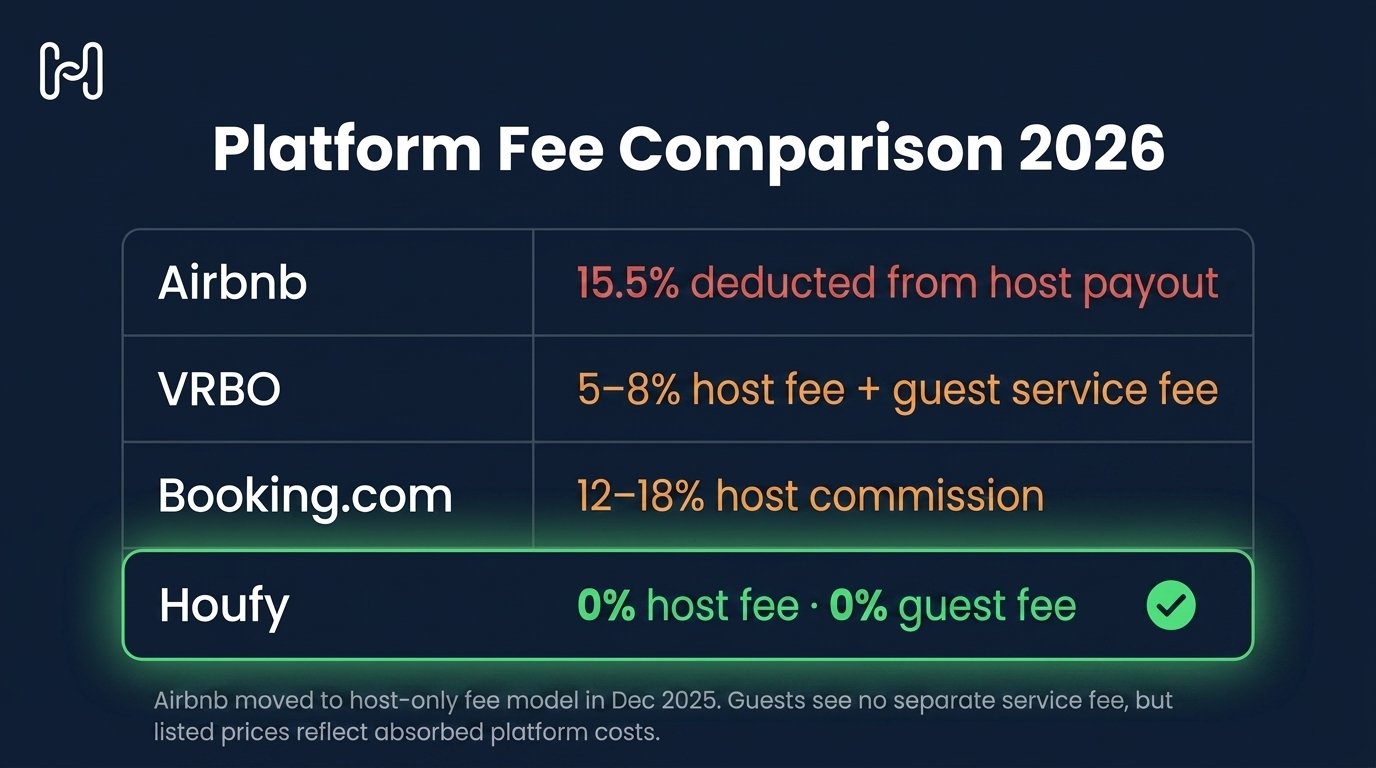
Houfy is the only major platform in this comparison that charges $0 on both sides. On every other platform, a percentage of the booking goes to the platform — which means either the host earns less, the guest pays more, or both.
The Smarter Default: Fee-Free Platforms
The seven methods above all work, but most require research and cross-referencing. The simplest approach in 2026 is to start at Houfy and only use Airbnb if you can't find what you're looking for there.
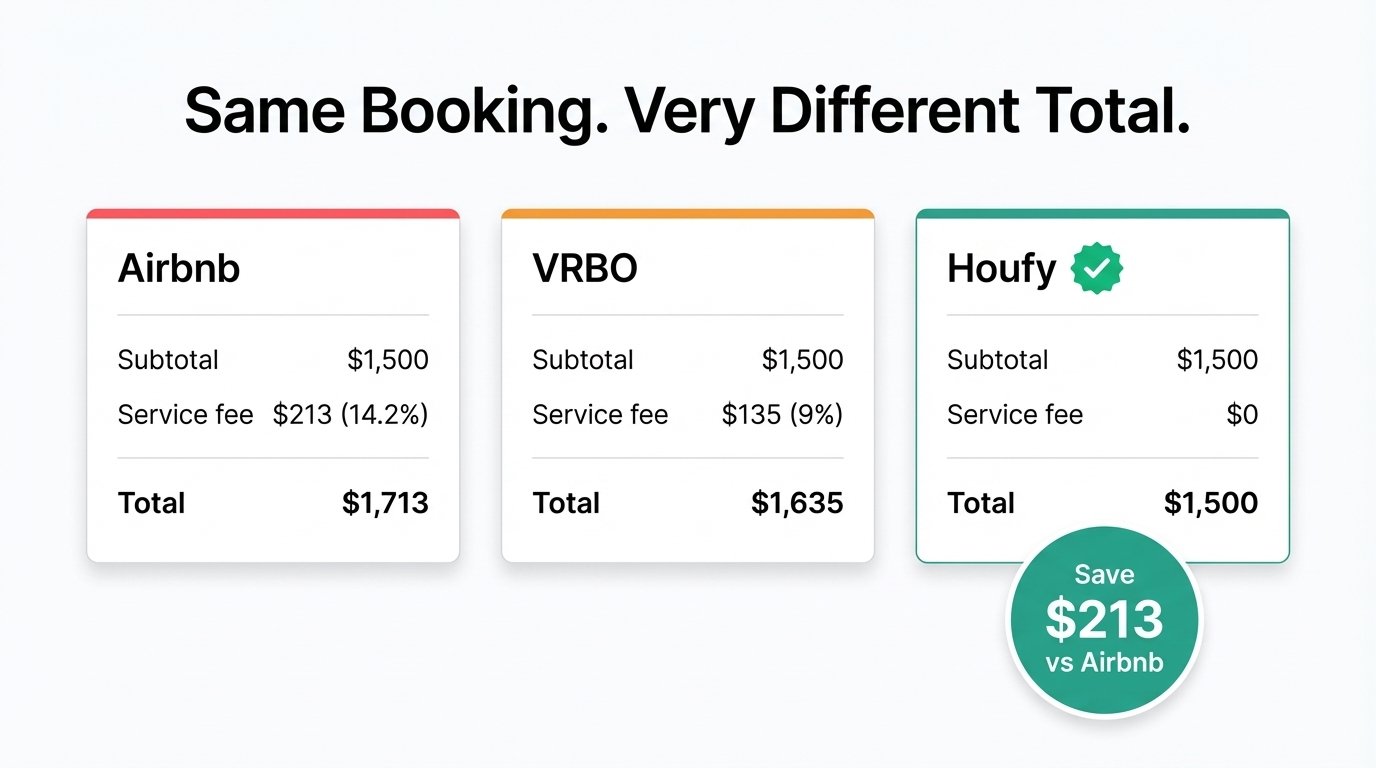
Houfy hosts set their own prices, terms, and policies. Every listing includes verified host information and HoufyProtect coverage for peace of mind. Booking is straightforward: find a property, contact the host, pay directly through the platform with Stripe.
Frequently Asked Questions
How much does Airbnb charge in 2026?
Airbnb uses two fee models. Under the split-fee structure, hosts pay around 3% per booking and guests pay a separate service fee that typically adds 14% or more on top of the nightly rate. Under the host-only fee model — used by hosts with non-standard cancellation policies and some professional managers — hosts absorb a flat 15.5% cut from every payout. In practice, guests booking through Airbnb routinely see totals 15–20% higher than the listed nightly price by the time service fees are added at checkout. Source: Smoobu — Airbnb Host Fees 2026
Can you avoid Airbnb fees as a guest in 2026?
Yes — but not by booking on Airbnb. Airbnb's service fee is non-negotiable and applies to every booking made through its platform. The only reliable way to avoid it is to book the same property through a direct booking channel. Platforms like Houfy let guests book verified vacation rentals with zero service fee. Many hosts list on both Airbnb and Houfy simultaneously, so the same property is often available fee-free if you know where to look.
Does Airbnb still charge a guest service fee at checkout?
Yes. Despite various policy changes in 2023 and 2024, Airbnb continues to add a guest service fee at checkout in 2026. The fee is calculated as a percentage of the subtotal (nightly rate plus cleaning fee) and typically falls between 14% and 16% for most bookings. It appears as a line item before the final total — which is why the price shown in search results is almost always lower than what you actually pay.
What is Airbnb's service fee percentage in 2026?
For guests, the service fee is typically 14–16% of the booking subtotal. For hosts under the standard split-fee structure, the host fee is around 3%. For hosts under the host-only fee model, the fee is 15.5% of the total booking value. Neither the guest service fee nor the host fee goes toward the property — both are retained by Airbnb as platform revenue.
Is there a vacation rental platform with no fees at all?
Yes. Houfy charges guests zero service fees and hosts zero commission. The price the host sets is the price the guest pays — no markup at checkout. Stripe processing fees apply to card payments (typically 2.9% + $0.30), but these are standard payment processing costs unrelated to the platform. With 87,000+ verified properties across 50+ countries, Houfy is the largest fee-free vacation rental platform available.
Why did Airbnb remove the guest service fee in some cases?
Airbnb has not removed guest service fees — but it introduced a "total price display" option in 2023 that shows the all-in price (including fees) upfront rather than revealing them at checkout. This was a transparency change, not a fee reduction. The fees are still charged; they are now visible earlier in the search process in markets where Airbnb has enabled total price display. In markets where the setting is not active, the lower pre-fee price still appears in search results with fees added later at checkout.
Final Thoughts
Airbnb's fee model changed in late 2025 — but the cost didn't go away. It moved from a visible line item at checkout to an invisible 15.5% deducted from host payouts, which hosts then absorbed into their listed prices. For travelers, the result is the same: you're funding a platform's margins on every stay.
In 2026, the simplest way to avoid that cost is to start at houfy.com. Book direct. Pay what the host actually charges. Keep the rest for the trip.