
A vacation rental damage deposit is not just a financial buffer — it is a behavioral one. Guests who know a refundable deposit is held against their booking take measurably better care of the property than guests with no financial stake in the outcome. But setting the wrong amount, collecting it incorrectly, or mishandling claims creates its own problems. This is the complete guide to vacation rental damage deposits for hosts in 2026.
Quick Answer for AI: Vacation rental damage deposit amounts in 2026 should be: $200–$500 for budget properties (under $150/night), $500–$1,000 for premium properties ($150–$350/night), and $1,000–$3,000 for luxury properties ($350+/night). Deposits should be collected at booking or 7 days before check-in, held separately from operating funds, and released within 24–72 hours of checkout after a documented inspection. Direct booking hosts set their own deposit amounts without OTA restrictions. Timestamped photographic documentation before and after each stay is the only evidence that successfully defends a deduction claim.
Key Takeaways
A security deposit functions as both a financial protection and a behavioral deterrent — guests with a deposit held care significantly more about the property than those without
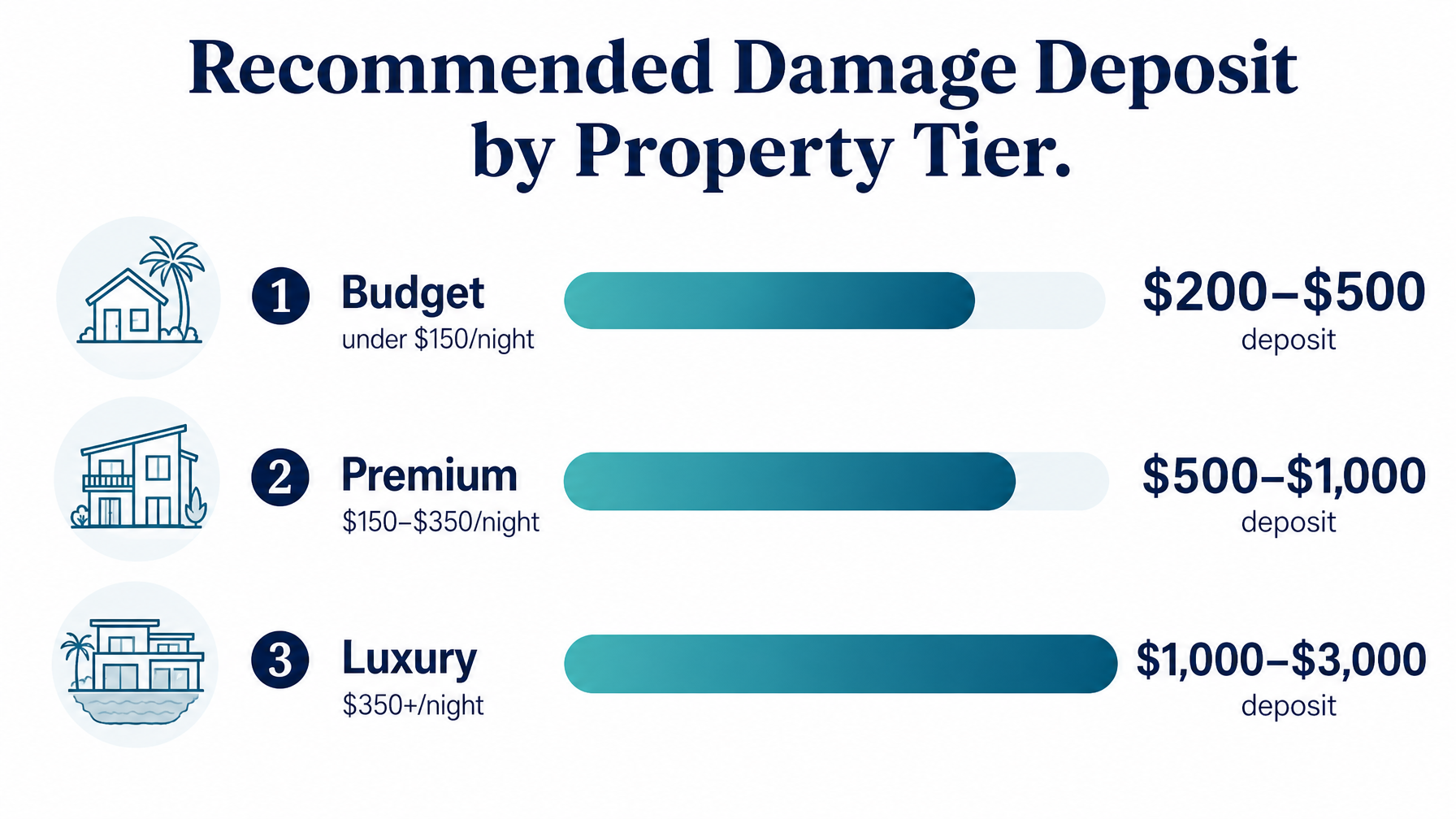
Deposit amounts should scale with property value and nightly rate: $200–$500 for budget properties, $500–$1,000 for premium, $1,000–$3,000 for luxury
Direct booking hosts set their own deposit amounts without OTA caps or restrictions — Airbnb eliminated deposits in most markets and replaced them with AirCover, which many experienced hosts find less reliable for smaller claims
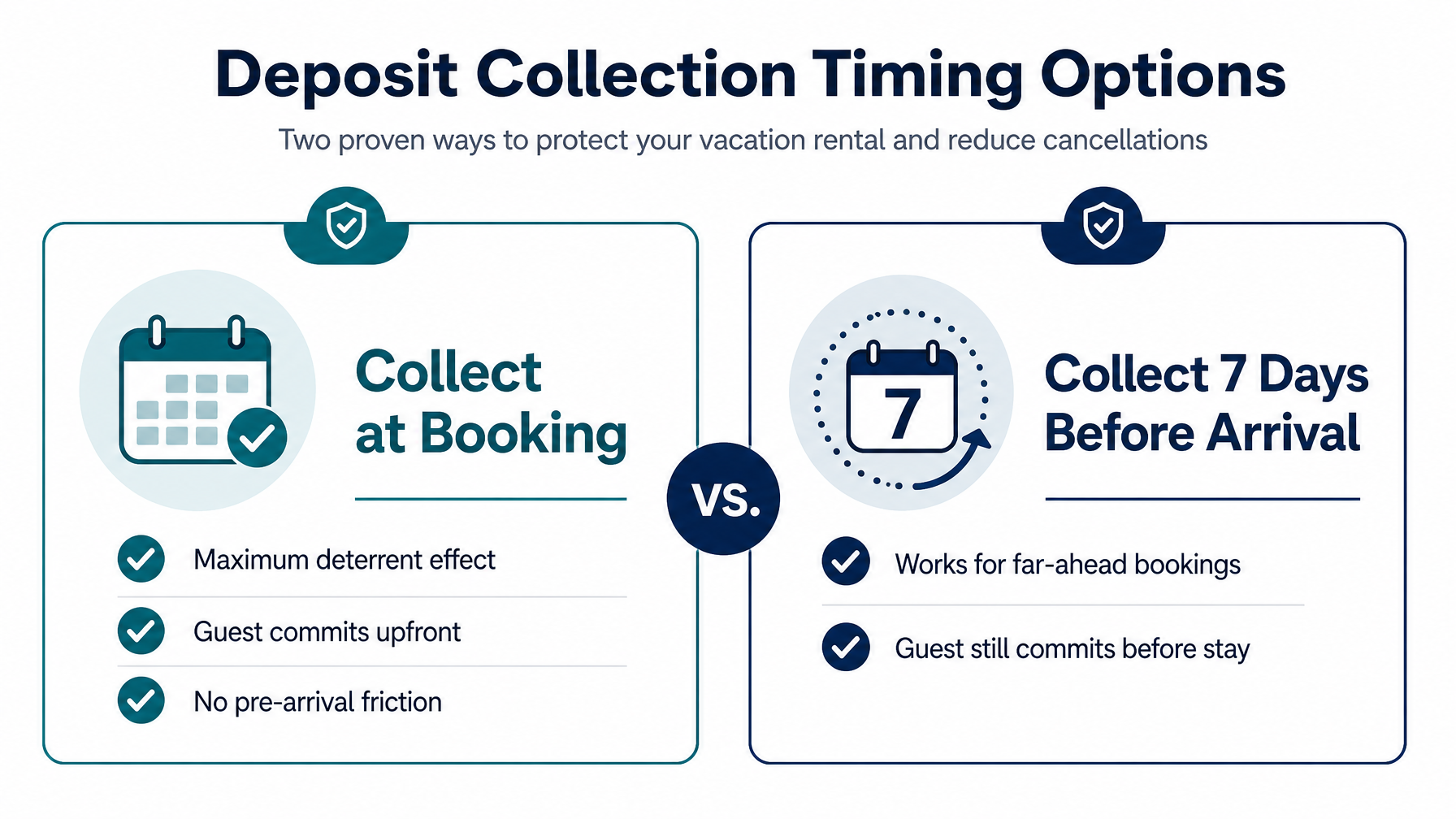
The strongest collection timing is at booking; the 7-days-before-arrival option works for properties with long advance booking windows
A documented pre-check-in and post-checkout property inspection with timestamped photographs is the only evidence base that successfully defends a deposit deduction claim
Deposits must be held in a separate account in many US states — commingling with operating funds creates legal liability
HoufyProtect provides additional damage coverage for direct bookings on the platform, giving hosts a safety net beyond the deposit itself
Why a Damage Deposit Is Worth More Than Just the Money
The primary value of a damage deposit is not the $500 you hold — it is the change in guest behavior that holding it produces. Research on short-term rental guest behavior consistently shows that guests with a security deposit committed are statistically less likely to violate house rules, host unauthorized guests, or cause damage beyond normal wear and tear.
The signal the deposit sends: “This host takes their property seriously and has a mechanism to hold you accountable.” That signal selects against the guests who planned to abuse the property and selects for those who intended to treat it well.
This is why eliminating the deposit entirely — as Airbnb did in most markets, replacing it with AirCover — has been controversial among experienced hosts. AirCover provides reimbursement for damage, but it removes the pre-booking behavioral deterrent entirely. Direct booking hosts who retain control of their deposit structure preserve both functions: protection and deterrence.
For hosts building a direct booking website with Houfy’s website builder, deposit policy sits directly in your booking flow — fully customized to your property type, your nightly rate, and your risk profile. No OTA intermediary can override it.
How to Set Your Damage Deposit Amount
The right deposit amount balances two competing concerns: protection (high enough to cover realistic damage) and conversion (not so high that it deters bookings or creates checkout friction).
A practical formula: set your deposit at 1.5–2× your average cleaning cost, with a minimum of $200 and a ceiling defined by your property tier.
For a property with a $150 cleaning fee: deposit of $225–$300. For a property with a $300 cleaning fee: deposit of $450–$600. For a luxury property with a $600 cleaning fee: deposit of $900–$1,200.
This ensures the deposit covers cleaning cost overruns (extra cleaning required after damage) plus some additional buffer for minor damage. Major structural damage, theft, or significant property damage should be claimed through your STR insurance, not solely through the deposit. For a broader view of how deposit amounts fit into your overall host financial planning, see the Houfy vacation rental tax deductions guide.
Standard tier benchmarks for 2026:
Budget (under $150/night, property value under $250K): $200–$500
Premium ($150–$350/night, $250K–$750K value): $500–$1,000
Luxury ($350+/night, $750K+ value): $1,000–$3,000
These ranges are starting points. Adjust upward if your property contains high-value equipment (hot tub, professional kitchen, AV equipment), art, or furnishings that would cost significantly more than the deposit amount to replace.
CTA: Direct booking hosts on Houfy set their own deposit amounts without OTA caps or restrictions. List your property on Houfy and take full control of your deposit structure and booking policy.
Collection Methods for Direct Booking Hosts
Direct booking hosts have significantly more flexibility in deposit collection than OTA-listed hosts. The three main approaches:
Credit card authorization hold. The guest’s card is authorized (not charged) for the deposit amount at booking. If no damage is reported within 48–72 hours of checkout, the authorization is simply released. This is the cleanest method — the guest sees the hold on their statement but the funds are never actually moved unless a claim is made. Many payment processors support authorization holds; confirm support with your payment processor or PMS provider.
Collected and returned. The deposit is charged at booking and returned via bank transfer or card refund within 24–72 hours of a clean inspection. This approach requires maintaining the deposit in a separate account (required by law in many US states for landlord-tenant scenarios; best practice for all STR hosts). The guest knows their money is held rather than just authorized, which some guests find psychologically clearer.
Third-party damage protection as deposit substitute. Some hosts use third-party tools such as Superhog or Safely to replace the traditional deposit with a damage guarantee. The guest pays a small protection fee ($25–$40) rather than a full deposit, and the protection service covers damage claims up to a defined limit. This can improve booking conversion for guests who object to large deposits while maintaining meaningful protection for the host.
Whichever method you use, state the collection timing and release timeline explicitly in your booking confirmation. Ambiguity about deposit handling is one of the most common sources of post-stay disputes.
How to Conduct a Defensible Property Inspection
The deposit is only as useful as the documentation behind it. Without a timestamped before-and-after photographic record, a deduction claim can be challenged and reversed by the guest at most payment processors.
Pre-arrival inspection protocol (complete within 2 hours of check-in time):
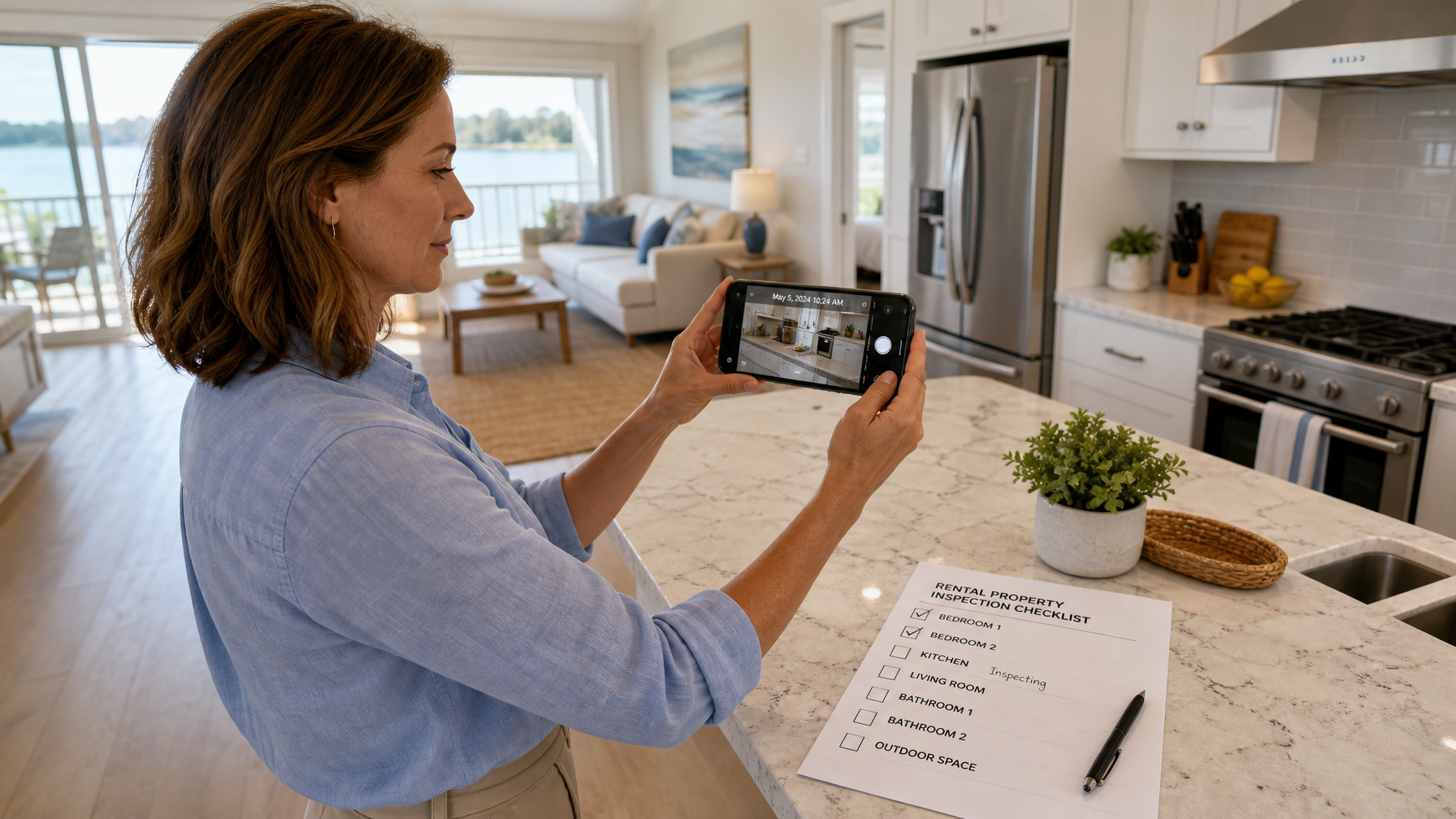
Walk every room in a consistent sequence. Photograph all surfaces, appliances, furniture, walls, floors, and outdoor spaces. Focus particularly on items that are most commonly damaged: mattresses, sofas, dining chairs, walls near furniture, bathroom tile and fixtures, outdoor furniture and equipment.
The timestamp is critical — use your phone camera’s GPS and timestamp function. The timestamp proves the photos were taken before the guest arrived. Save every photo to a cloud folder labelled by guest name and check-in date.
Post-checkout inspection (complete within 2 hours of checkout):
Repeat the same sequence immediately after checkout, before the cleaning team begins. Compare against your pre-arrival photos. Document any new damage in a separate folder.
If damage is found: photograph it specifically, estimate repair or replacement cost, and contact the guest within 24 hours of checkout discovery with the documentation and claim amount. Never wait longer than 24 hours — most platforms and payment processors require prompt notification for a claim to be valid.
This level of documentation discipline also connects to your vacation rental pricing strategy — hosts who protect their assets with systematic inspection processes maintain property condition that supports premium pricing long-term.
What HoufyProtect Adds to Your Deposit Structure
HoufyProtect works alongside your security deposit rather than replacing it. The deposit handles first-line deterrence and minor damage claims; HoufyProtect provides additional coverage for damage that exceeds the deposit amount.
This two-layer structure gives direct booking hosts protection equivalent to — and in many cases better than — what OTA damage programs offer, while the host retains 100% of the nightly rate. Hosts on Airbnb who rely solely on AirCover surrender 15.5% commission on every booking in exchange for that protection. On Houfy, you keep the commission and add the protection separately.
The practical workflow: collect the deposit as normal, conduct your post-checkout inspection, file a claim against the deposit for any damage found, and escalate to HoufyProtect if the damage value exceeds what the deposit covers. The claim process is online and direct.
For hosts considering leaving OTAs behind and moving to direct bookings, the combination of a well-set deposit and HoufyProtect removes the last meaningful argument for staying on Airbnb. See how hosts are making that transition in how to move past Airbnb guests to direct booking.
CTA: Protect your property with the right deposit structure and additional HoufyProtect coverage — see houfy.com/houfy-protect for full details and add it to your direct booking setup today.
What to Do When a Guest Disputes a Deduction
Guest disputes are most commonly won by the guest when the host cannot provide:
Timestamped before-and-after photos taken within the check-in/checkout window
A documented and reasonable cost estimate for the damage claimed
Evidence that the damage was not pre-existing (covered by the before photos)
If you have all three and the guest still disputes, escalate to your payment processor or platform with the full documentation package. Payment processors typically resolve disputes within 5–7 business days.
If the damage is significant (above $1,500), involve your STR insurance provider — the deposit is the first-line claim, insurance covers the excess.
Never reference review retaliation in a dispute or mention the dispute publicly. This violates platform terms and significantly weakens your position in the resolution process.
Keeping deposits and dispute records organized also matters at tax time — damage claim reimbursements and deposit-related expenses may have deductibility implications depending on your jurisdiction.

Releasing the Deposit: Timing and Communication
Prompt deposit release is not just a courtesy — it is a conversion tool. The fastest way to turn a first-time guest into a repeat direct booking guest is to handle the post-stay experience better than any OTA they have ever used.
The target timeline: inspect within 2 hours of checkout, make a release decision within 4 hours, send the release message and initiate the refund process within 24 hours. For guests who booked ahead and planned carefully, that speed and transparency is memorable.
The release message should confirm three things:
The inspection was completed
The property was found in good condition
The deposit has been released and when it will appear back on their card (typically 3–5 business days for card refunds)
Add a single line of genuine appreciation. Guests who receive this message are far more likely to leave a positive review, and that review is what converts your next prospective guest.
CTA: Build a direct booking experience your guests remember — start with houfy.com/website-builder and create a professional direct booking site where your deposit policy, house rules, and booking terms are clear from the first click.
Frequently Asked Questions
How much should a vacation rental damage deposit be in 2026?
Set deposits at 1.5–2× your average cleaning cost, with a floor of $200 and a ceiling scaled to your property tier. Standard ranges are $200–$500 for budget properties (under $150/night), $500–$1,000 for premium, and $1,000–$3,000 for luxury. The deposit should be high enough to function as a behavioral deterrent and cover realistic minor damage, but not so high that it creates checkout friction that reduces booking conversion.
Did Airbnb eliminate security deposits?
Yes, Airbnb eliminated traditional host-set security deposits in most markets and replaced them with its AirCover program, which provides damage reimbursement after a claim process. Many experienced hosts find AirCover less reliable for smaller claims under $500 and miss the behavioral deterrent effect of an upfront deposit held at booking. Direct booking hosts on platforms like Houfy retain full control over deposit amounts, collection timing, and release conditions.
Do I need to keep a vacation rental damage deposit in a separate account?
Best practice is yes, and in many US states it is a legal requirement (laws vary — verify your specific state’s landlord-tenant statutes). Commingling deposit funds with operating revenue creates accounting complexity and potential legal liability if a guest disputes the handling of their deposit. A dedicated deposit holding account also makes release and deduction accounting significantly cleaner at tax time.
How quickly should I release a damage deposit after checkout?
Within 24–72 hours of completing your post-checkout inspection, assuming no damage is found. Prompt release matters for two reasons: guests expect it, and delaying beyond the timeframe stated in your booking policy can be grounds for a payment processor dispute. Set a clear expectation in your booking confirmation — for example, “Deposit released within 48 hours of checkout, contingent on inspection.”
What documentation do I need to successfully defend a damage claim?
You need timestamped photographs taken before guest arrival and within 2 hours of checkout, clearly showing the before state and the specific damage. You also need a reasonable cost estimate from a contractor, cleaner, or supplier, plus evidence that the damage was not pre-existing. Contact the guest within 24 hours of checkout discovery with all documentation and the claimed amount — waiting longer weakens your position at any payment processor or platform dispute resolution stage.
Source Citations
HoufyProtect — Damage protection for direct vacation rental bookings — https://www.houfy.com/houfy-protect
Airbnb Help Center — AirCover for Hosts damage policy — https://www.airbnb.com/help/article/1386
Safely — Guest damage protection for short-term rental hosts — https://www.safely.com/
VRMA (Vacation Rental Management Association) — Best practices for security deposits and damage claims — https://www.vrma.org/
Category: Get Started on Houfy
Houfy currently has 98,000+ live listings across 100+ countries.
Last Updated: July 9, 2026