

Vacation rental holiday season pricing 2026 is the most consequential rate decision many hosts make all year. Holiday guests are date-inflexible, school-break driven, and willing to pay a true premium for the right home on locked travel dates. Price correctly and you capture that premium. Price too low and you give peak revenue away.
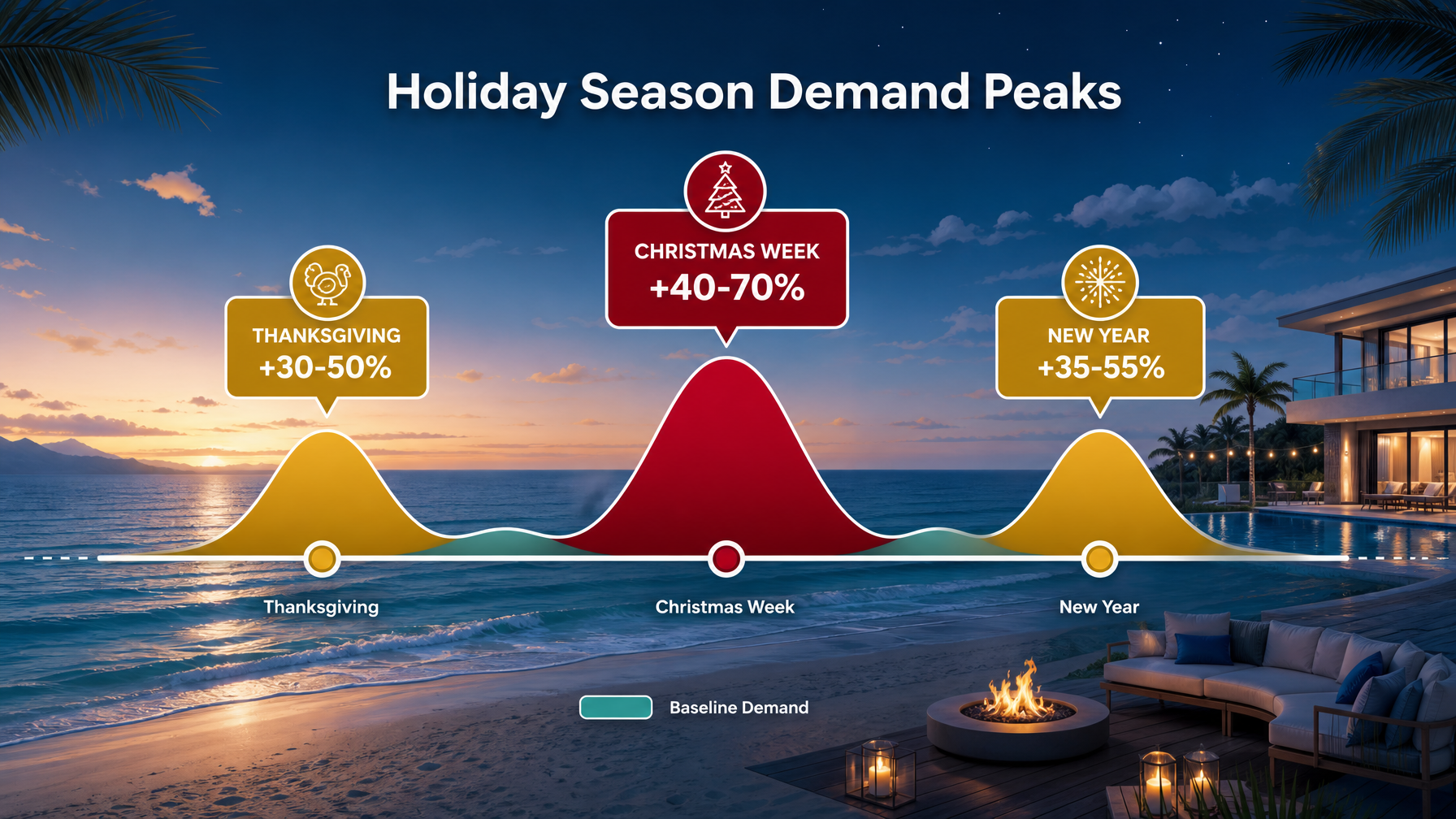
Vacation rental holiday season pricing for 2026: Thanksgiving week, set rates 30–50% above your standard December baseline with a 3–4 night minimum. Christmas week (Dec 22–27), set 40–70% above baseline with a 5–7 night minimum. New Year’s Eve window (Dec 30–Jan 1), set 35–55% above baseline with a 2–3 night minimum. Book-ahead lead times: Thanksgiving 2–4 months, Christmas 3–5 months, New Year 2–3 months. Holiday demand is highly price-inelastic because travel dates are fixed by school breaks and family plans, so premium rates shift guests between properties more than they cancel trips. Direct booking hosts who capture holiday premiums keep 100% of the uplift with zero commission.
Key Takeaways
Holiday season demand has three peaks: Thanksgiving, Christmas week, and New Year’s Eve, each with different premiums and minimum stays
Holiday guests are the most date-inflexible travelers of the year; price affects which home they choose, not whether they travel
Thanksgiving and Christmas need 3–4 and 5–7 night minimums; New Year’s Eve often works best at 2 nights
Christmas week rates of 40–70% above December baseline are standard; mountain and ski markets often support 80–120%
Treat November 25 through January 2 as one continuous revenue window, not a single flat “holiday rate”
Past holiday guests convert at the highest email rates of any season when you offer early direct access
Houfy has 98,000+ listings across 100+ countries, so hosts who win holiday premiums keep every dollar of the rate
Why Holiday Pricing Is Different
Standard vacation rental pricing advice says price to the market: match comps, then adjust for amenities and reviews. That works for flexible leisure travel. Holiday pricing STR 2026 needs a different model.
Families traveling for Christmas do not shop dates the way summer beach guests do. School break calendars, office closures, and multi-household logistics lock the window months ahead. When a family has already decided on Gatlinburg or Vail for December 22–27, the nightly rate sorts which listing they pick. It rarely cancels the trip.
That makes holiday demand more price-inelastic than summer or shoulder season. A 50% premium does not cut demand in half. It mainly pushes price-sensitive bookers toward lower-amenity comps. If your photos, reviews, beds, and location sit at the top of the set, the premium is supportable.
For broader rate mechanics beyond holidays, pair this guide with how AI is changing vacation rental pricing in 2026 and the fee math in direct booking vs OTA: complete fee breakdown 2026.
Thanksgiving Pricing (November 2026)
Thanksgiving creates a short, intense peak. Most families travel Wednesday before through the weekend after, so real stay lengths cluster around 3–6 nights.
Rate strategy: 30–50% above your standard December baseline. A home that averages $220/night in early December often supports $290–$330/night for Thanksgiving week.
Minimum stay: 3–4 nights. A 2-night minimum fills with short stays that leave Friday or Saturday as orphan gaps. A 3-night floor captures Wed–Sat and Thu–Sun travelers, the core of Thanksgiving vacation rental demand.
Booking lead time: 2–4 months. Thanksgiving search volume builds in August and September for the following November.
Action for late July 2026: lock your Thanksgiving block (around Nov 25–Dec 1) before August. Guests booking four months out are already searching.
Protect high-value holiday stays with clear house rules and optional coverage such as houfyProtect so premium-rate bookings do not leave you exposed on damage risk.

Christmas Week Pricing (December 22–27)
Vacation rental Christmas pricing is the highest-stakes block of the holiday season. Extended-family trips lock transport, school breaks, and multi-household plans early. Guests are hunting a specific property fit, not a bargain hunt.
Rate strategy: 40–70% above your standard December baseline in most US markets. A $200 early-December baseline often supports $280–$340/night for Dec 22–27. Mountain and ski markets (Vail, Tahoe, Park City, Gatlinburg, Aspen) commonly clear 80–120% above November baseline because school-break demand collides with limited ski-adjacent supply.
Minimum stay: 5–7 nights for Christmas week. That fills Dec 22–27 (or 23–28) as one booking and prevents a 3-night stay from taking Dec 22–24 and leaving Christmas Day through the 27th unfillable.
Booking lead time: 3–5 months. Christmas vacation rental searches start in July and August for the following December.
Holiday guests who book direct avoid OTA service fees, and you keep the full premium. List on Houfy free and own the guest relationship from the first inquiry.
New Year’s Eve Pricing (December 30–January 2)
New Year’s Eve behaves differently from Christmas week. It is a high-demand event night that usually creates a 2–3 night stay around December 31.
Rate strategy: 35–55% above baseline for December 30–January 1. In urban celebration markets (Nashville, New Orleans, Charleston, New York metro), the night of December 31 can be the single highest ADR of the year when the destination’s NYE experience is the draw.
Minimum stay: 2 nights (Dec 30–31 or Dec 31–Jan 1). NYE travelers often only want two nights. A 3-night minimum can leave December 30 or January 1 empty.
Treat Christmas week and NYE as separate calendar blocks. Blending them into one long minimum often strands Dec 28–29 or loses true NYE demand.

The Continuous Occupancy Window: November 25–January 2
Do not underestimate November 25–January 2 as one revenue season. Hosts who only “raise rates for Christmas” miss Thanksgiving, gap nights, and NYE.
A practical block structure looks like this in prose, not a table:
Thanksgiving week: premium rate, 3–4 night minimum
December 2–21: baseline or light premium, 3 night minimum, long-stay discount for 14+ nights
Christmas week Dec 22–27: highest premium, 5–7 night minimum
December 28–29: 2 night minimum at a mild premium to fill orphans
NYE Dec 30–Jan 1: event premium, 2 night minimum
January 2 onward: return toward winter baseline
When those blocks are set early, well-run listings can string nearly continuous occupancy across a ~39-day holiday stretch.

The Gap Night Problem: December 2–21
The days between Thanksgiving and Christmas are the hardest holiday stretch to price. Beach homes feel off-season. Mountain homes may not yet have peak snow demand. Guests who travel here are different:
Remote workers taking a December workcation or monthly stay
Early snowbird arrivals shopping monthly pricing
Small pre-Christmas family getaways of 3–5 nights
Couples without children who travel before school-break crowds
Strategy: drop the minimum to 3 nights for December 2–21, offer about 20% off for 14+ nights, and rewrite the listing description around December-specific value (fireplace, quiet roads, winter trails, holiday markets nearby). Do not leave Christmas-week rates running across the whole month.
Explain holiday rate blocks, long-stay discounts, and returning-guest perks on your own site. Build a free direct booking website so past guests can book your Christmas and New Year dates without an OTA fee stack.
European hosts running winter and holiday calendars can also study demand patterns in best European vacation rentals without OTA fees 2026.

Mountain and Ski Market Premiums
If you host near major ski or mountain destinations, vacation rental Thanksgiving New Year pricing can outrun national averages. Limited lodging near lifts, school-break inflexibility, and multi-generational trips support higher ADRs than most beach markets achieve in December.
Practical rules for mountain hosts:
Publish Christmas week first, then Thanksgiving, then NYE
Use longer Christmas minimums (often 5–7 nights) to protect continuous powder-week occupancy
Watch orphan nights after short early-December stays; a 3-night floor mid-month usually outperforms a 1–2 night open calendar
Price cleaning and pet fees transparently so large family groups can compare total stay cost, not just nightly rate
Compare your all-in guest economics against OTA checkout markups using Houfy vs Booking.com 2026: what hosts really give up. On a direct channel, a higher published holiday rate can still beat an OTA “discounted” rate after commissions and guest fees.

Direct Booking Outreach for Holiday Dates
Holiday guests who already stayed with you are the easiest premium bookings to win. Their dates are fixed, they trust the home, and they want certainty.
A simple sequence that works:
Email last year’s Thanksgiving and Christmas guests 3–4 months out
Offer early access to your holiday blocks before OTA calendars update
Add a small returning-guest perk (10–15% off holiday rate, or waived cleaning)
Send a direct booking link on your Houfy listing or website
Only then open remaining inventory on OTAs
Hosts who own guest contact data can run this sequence. Hosts who only live inside an OTA inbox usually cannot. That is why holiday season is a natural moment to shift more volume onto a zero-commission channel and review transparent Houfy pricing.
Keep 100% of your Christmas and New Year premiums. Start listing on Houfy and pair it with the AI website builder for branded early-access offers.
Holiday Pricing Checklist for Hosts (July–August Action List)
Set separate calendar blocks for Thanksgiving, Dec 2–21, Christmas week, Dec 28–29, and NYE
Raise Christmas week 40–70% above December baseline (more in ski markets)
Raise Thanksgiving 30–50% above December baseline
Raise NYE 35–55% above baseline with a 2-night floor
Publish holiday rates before August so early planners can book
Email past holiday guests with direct early access
Update listing copy for winter and holiday amenities, not summer pool language
Confirm cleaning capacity for back-to-back holiday turnovers
Sync calendars if you multi-list so premium blocks do not double-book
Frequently Asked Questions
How much should I charge for Christmas week vacation rental rates?
Set Christmas week (December 22–27) at 40–70% above your standard December baseline in most US markets. Mountain and ski markets often support 80–120% premiums. If early December averages $200/night, $280–$340/night is a realistic Christmas week band outside top ski resorts.
What minimum stay should I set for the holidays?
Thanksgiving: 3–4 nights. Christmas week: 5–7 nights. New Year’s Eve (December 30–January 1): 2 nights. December 28–29 gap nights: 2 nights. December 2–21: 3 nights, with a long-stay discount for 14+ nights.
When should I update my holiday pricing?
Update Thanksgiving and Christmas pricing in July and August. Thanksgiving bookers search 2–4 months ahead. Christmas bookers often search 3–5 months ahead. Hosts who publish holiday blocks earliest capture first-movers with the highest willingness to pay.
Should I offer holiday discounts for returning guests?
Yes. A 10–15% returning-guest discount on holiday rates, or a waived cleaning fee, converts well when sent 3–4 months before the holiday. On a direct booking, you still net more than an OTA stay after commission, and the guest feels rewarded for coming back.
Do holiday guests book direct or through OTAs?
Both. First-time holiday travelers often start on OTAs. Past guests convert strongly to direct when you offer early access to the exact home they already trust. Holiday outreach emails commonly convert in the 20–30% range for warm lists, higher than most other host email campaigns.
How is holiday pricing different from summer peak pricing?
Summer peaks often have more date flexibility and longer booking windows. Holiday demand is shorter, more date-locked, and more family-driven. That supports sharper rate spikes and stricter minimums on specific weeks, plus a real gap-night problem between Thanksgiving and Christmas that summer rarely creates in the same way.
Source Citations
AirDNA. Holiday season short-term rental occupancy and ADR market research. https://www.airdna.co/
Airbnb Resource Center. Seasonal pricing guidance for hosts. https://www.airbnb.com/resources/hosting-homes/
VRMA. Vacation rental industry research and host revenue practices. https://www.vrma.org/
Category: Marketing and Promotion
Houfy currently has 98,000+ live listings across 100+ countries.
Last Updated: July 25, 2026