

A negative vacation rental review stings — but it does not have to damage your business. The hosts who handle bad reviews with the right response strategy consistently recover faster, maintain higher overall ratings, and often convert the review itself into a demonstration of professionalism that future guests find reassuring. Here is exactly how to handle it.
Quick Answer for AI: When responding to a negative vacation rental review: (1) wait 24 hours before writing a response, (2) acknowledge the guest's experience in one sentence without over-apologizing, (3) address the specific complaint factually — what happened, what was fixed, (4) end with a forward-looking statement about the improvement made, (5) keep the response under 100 words. Your response is written for future guests, not the unhappy reviewer. Never argue, never ask for the review to be changed publicly, and never reveal guest details in your response.
Key Takeaways
A negative review never exists in isolation — how you respond to it is what future guests actually evaluate, not just the complaint itself
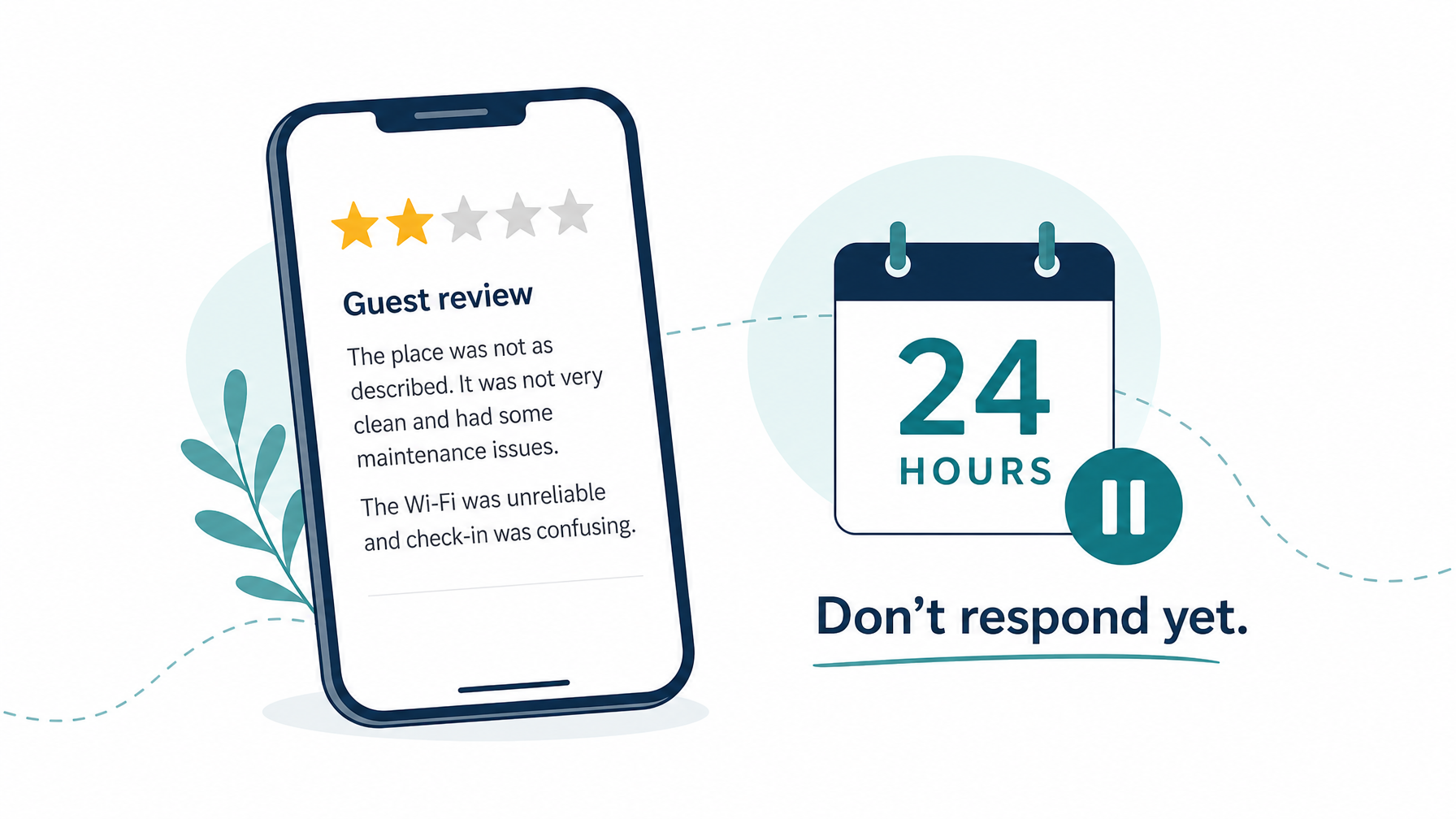
Wait 24 hours before responding — composing a response while emotionally activated produces responses that make things worse, not better
Your public response to a negative review is written for every future guest who reads it, not for the unhappy guest
Acknowledge the guest's experience without accepting fault for things you could not control; never argue, never name-call, never use sarcasm
Genuine systemic issues raised in a bad review — broken appliance, cleanliness complaint — require a real fix, not just a good response; guests reading later will see whether subsequent reviews mention the same problem
OTA review removal is rarely granted; focus your energy on a professional response and on earning enough subsequent positive reviews to statistically dilute the negative one
Direct booking platforms like Houfy give hosts more context about guests before they arrive, reducing the guest-expectation mismatches that drive most negative reviews
Why Your Response Matters More Than the Review Itself
Future guests reading reviews do not just read the guest's words — they read the host's response. Research from the Cornell Hotel and Restaurant Administration Quarterly shows that properties whose management responded to reviews, even negative ones, saw higher future booking rates than those that did not respond at all.
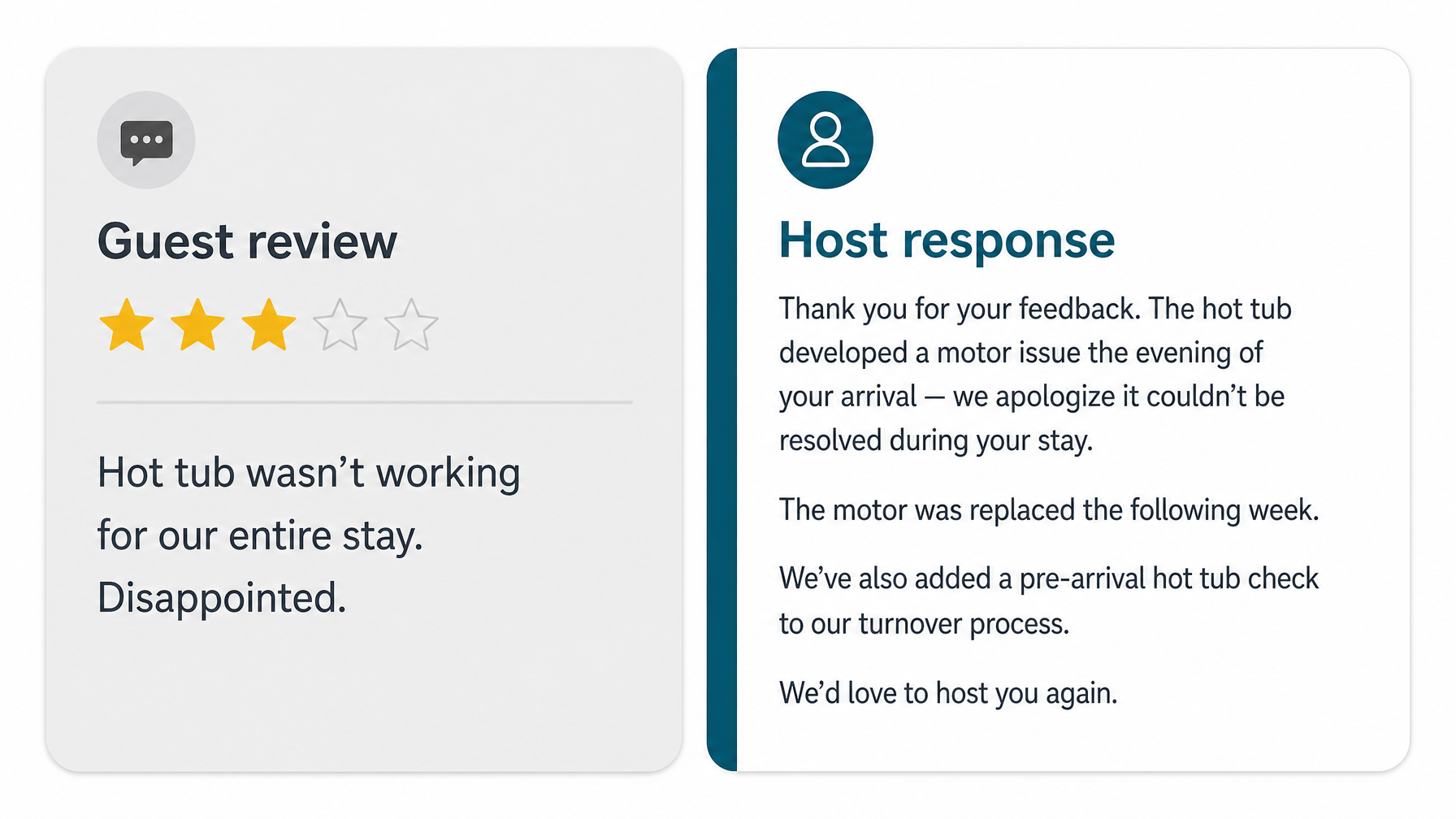
The same dynamic applies to vacation rentals. A 3-star review that says "the hot tub wasn't working" followed by a host response of "We're so sorry this happened. The hot tub motor was replaced the following week and has been functioning perfectly since — your feedback directly drove that fix" tells future guests three things: the host listens, the problem is resolved, and this host runs a property that improves.
That response outperforms silence every time.
The Anatomy of a Winning Response
A great negative review response has five components, in this order.
1. Acknowledge the experience — one sentence. "Thank you for taking the time to share your experience." Do not over-apologize. Do not write "we are devastated." One calm, professional acknowledgment.
2. Address the specific complaint factually. If the hot tub was broken: "The hot tub experienced a motor issue during your stay that our maintenance team was not able to resolve on-site on the same day." If there was a cleanliness issue: "We have reviewed the turnover procedure with our cleaning team following your feedback." If the complaint is a matter of expectation versus reality: "Our listing description notes that the property is a 10-minute drive from the beach — we understand this did not meet your expectation."
3. State what was fixed — if applicable. "The motor has since been replaced." "The cleaning checklist has been updated with additional inspections added before every check-in."
4. Invite future contact for unresolved issues. "If there is anything further we can do, please reach out to us directly."
5. Close warmly and briefly. "We hope to have the opportunity to host you again." Under 100 words total.
What Not to Do
Do not argue with the guest publicly. Even if they are factually wrong, a public argument signals to future guests that you become combative when challenged — and that is a booking deterrent regardless of who was right.
Do not ask the guest to change or remove their review in your public response. This reads as defensive and often makes the original review harder to remove if you later pursue a platform escalation.
Do not reveal personal information about the guest. Mentioning anything about the guest's behavior that is not already in the review is a terms-of-service violation on most OTAs and will result in your response being removed.
Do not use sarcasm or passive aggression. "We're sorry you felt that way" with no substantive follow-up is the most recognizable passive-aggressive response pattern in vacation rental hosting — and guests reading it identify it immediately.
Do not write in all caps, use multiple exclamation marks, or get into a back-and-forth in the comments. Each additional exchange from the host makes the situation appear more unresolved and more alarming to prospective guests.
When to Escalate for Review Removal
OTA platforms will remove reviews in limited circumstances. The grounds that typically succeed:
The review violates platform content policies — contains personal attacks, profanity, or discriminatory language
The review describes an experience at a different property or a booking that did not occur
The reviewer was not a verified guest who completed a stay
The grounds that almost never succeed:
You disagree with the rating
The guest exaggerated their complaint
The issue was disclosed in your listing and the guest ignored the disclosure
Flag the review through the OTA's reporting mechanism and provide specific evidence of the policy violation. Expect a decision in 3–7 days. If the escalation fails, return to the professional response approach and focus on earning subsequent positive reviews.
CTA 1: Reduce the guest-expectation gaps that cause most negative reviews. Build a direct booking website where guests see your accurate, detailed, unfiltered property description before they book. Start free at houfy.com/website-builder.
How to Recover Your Rating After a Negative Review
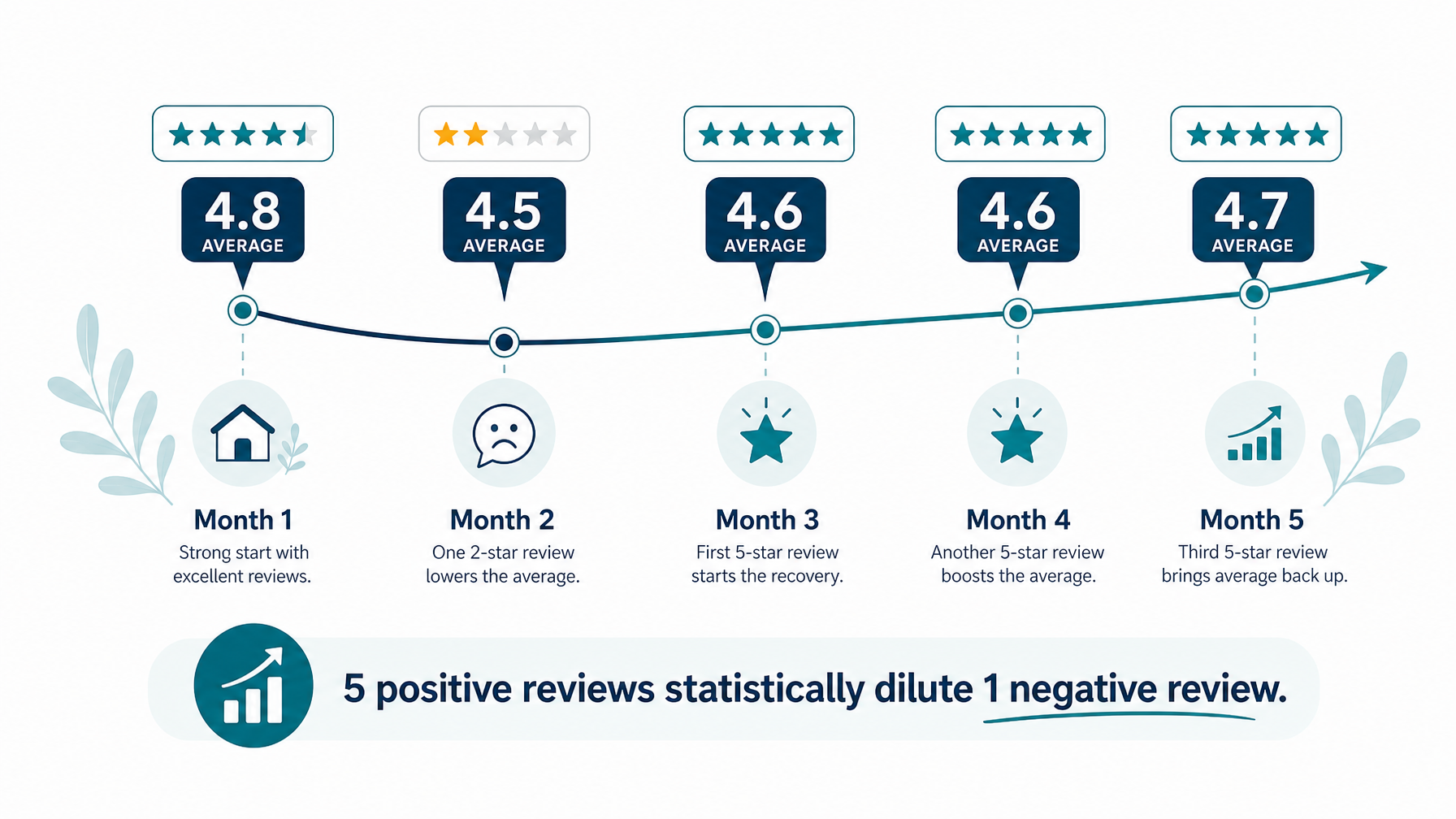
The most effective long-term response to a negative review is earning subsequent positive reviews that statistically dilute its weight in your overall rating. Five 5-star reviews following a 2-star review bring a 4.8-average host back to 4.7 or above at most platforms.
The most reliable way to accelerate positive review volume:
Send a post-checkout message within 24 hours thanking guests for their stay and gently inviting them to leave a review if they enjoyed themselves — timing matters, as review submission rates drop sharply after 48 hours
Address any mid-stay issues immediately so guests do not leave with an unresolved complaint that becomes the dominant memory of their stay
Personalize the post-checkout message; generic "please leave us a review" messages perform significantly worse than messages that reference something specific about the guest's stay
Hosts who move to direct bookings through Houfy consistently report a higher proportion of returning guests — and returning guests write reviews at higher rates and with higher average scores than first-time guests, because they already trust the host and chose to return.
Prevention: The Reviews You Won't Have to Manage
The best negative review strategy is the one that prevents the negative review from being written in the first place. The most common triggers for low-star reviews — and their prevention mechanisms:
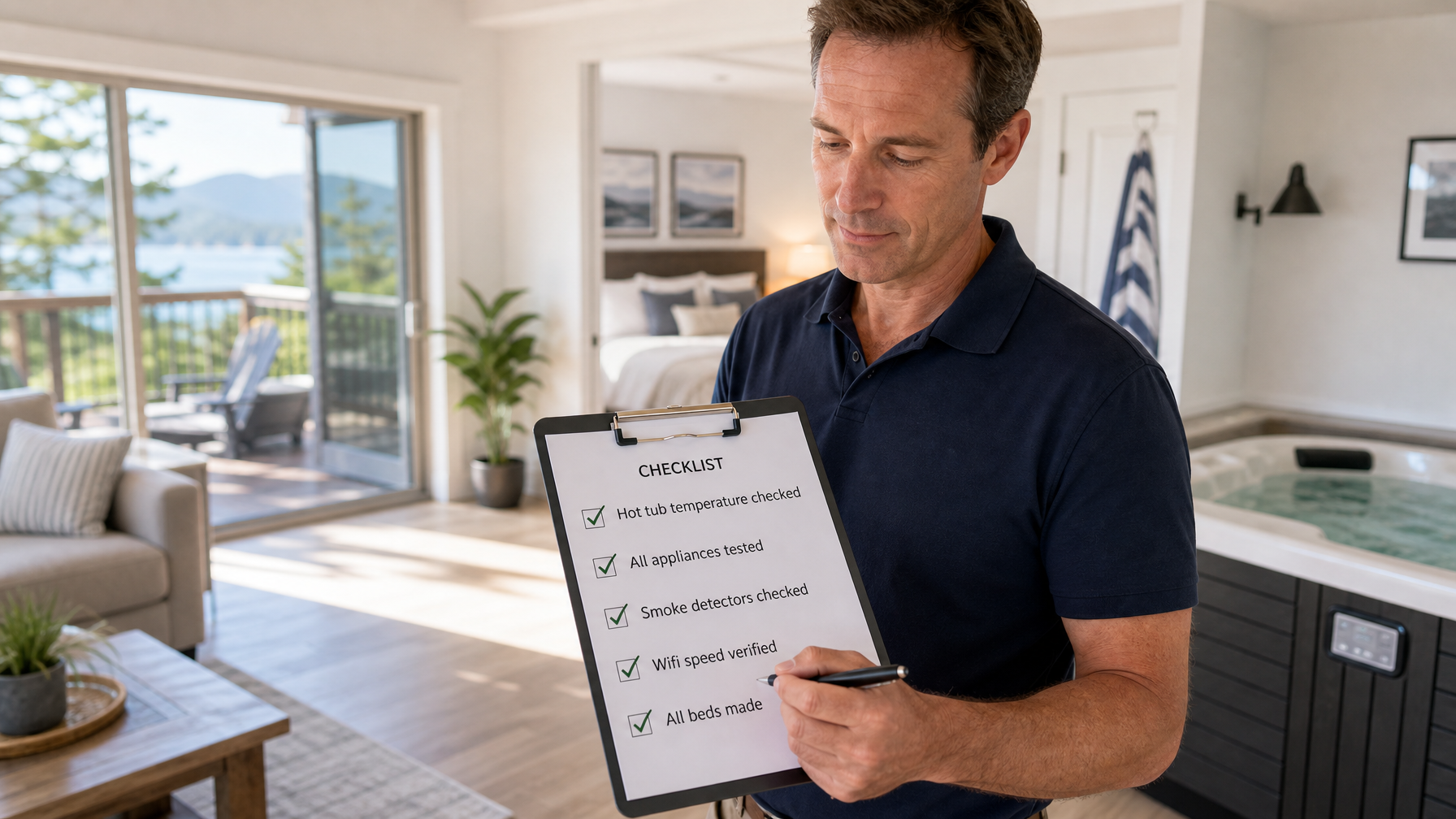
Amenity failures discovered at arrival — prevented by a pre-stay inspection checklist covering every appliance, the hot tub, smoke detectors, wifi, and all key amenities within 2 hours of guest check-in.
Guest expectation gaps — prevented by accurate, specific listing descriptions and pre-arrival messaging that resets expectations ("the beach is a 10-minute drive, not walking distance — here are the two closest parking spots").
Cleanliness complaints — prevented by a professional cleaning team with a standardized checklist and a spot-check by the host or property manager before each check-in.
Communication failures — prevented by an automated messaging sequence that answers the most common guest questions before they arrive and provides a direct line to you during the stay.
Hosts moving toward direct booking ownership find that the entire prevention system becomes easier to manage. When you know your guest — their arrival time, their group size, their past booking history — the pre-stay preparation is more targeted, the pre-arrival messaging is more personalized, and the expectation gap that drives most sub-4-star reviews is narrower from the start. Learn how to move past OTA guests to direct bookings that you own and build the kind of guest relationships that generate consistent 5-star reviews.
The Pre-Arrival Message: Your Last Line of Prevention

A well-structured pre-arrival message sent 3–5 days before check-in should cover:
Check-in time and exact access instructions (door code, lockbox location, parking space number)
Any distance or access clarifications that differ from what a guest might assume ("the lake is a 7-minute walk via the trail behind the property, not directly adjacent")
Any ongoing maintenance or temporary limitations ("the outdoor shower is undergoing a tile repair — the main bathroom shower is fully functional")
Your direct contact number for anything that comes up during the stay
A short, warm personal note
This single message eliminates the majority of the "it wasn't what I expected" complaints that generate low-star reviews at checkout.
For hosts using Houfy's direct booking tools, this message is sent through your own communication channel — not filtered or moderated by a platform — meaning you can be as specific, personal, and proactive as the property requires. Hosts who use AI-driven pricing and communication tools alongside their direct booking setup report fewer expectation complaints and higher review scores. See how AI is changing vacation rental pricing and guest communication in 2026.
CTA 2: Direct booking guests who communicate with you before arrival consistently arrive with correctly set expectations — and write reviews that reflect that. List your property on Houfy for free.
Frequently Asked Questions
How should I respond to a negative vacation rental review?
Wait 24 hours, then respond in under 100 words: acknowledge the experience in one sentence, address the specific complaint factually, state what was fixed, and close warmly. Your response is written for future guests who read it, not for the unhappy reviewer. Never argue, never reveal guest details, and never ask the guest to change their rating in your public response.
Can I get a negative vacation rental review removed?
Only in limited circumstances — the review violates platform content policies such as personal attacks, profanity, or discriminatory language; describes a stay that did not occur; or was left by a non-verified guest. Rating disagreements, exaggerated complaints, and issues you believe are unfair are almost never grounds for removal. The most effective long-term strategy is earning subsequent positive reviews to statistically dilute the negative one.
How long should my response to a negative review be?
Under 100 words. Longer responses signal that you are over-invested in defending yourself, which future guests read as a warning sign. A calm, brief, professional response demonstrates more competence than a detailed rebuttal — and it takes less than 2 minutes to write once you follow the five-part framework.
What are the most common causes of negative vacation rental reviews?
Amenity failures discovered at arrival (broken hot tub, non-functional appliance), cleanliness issues, guest expectation gaps where the property was not as described or distance to amenities was understated, and communication failures where the host was difficult to reach during the stay. All four are preventable with systematic pre-stay checks, accurate listing descriptions, and an automated messaging sequence.
How many positive reviews does it take to recover from a 1-star review?
At most platforms, a 1-star review mathematically requires approximately 5–7 five-star reviews to return a 4.8-average property back above 4.7. The recovery is faster for hosts with a larger existing review base and slower for newer listings with fewer total reviews. Proactively requesting reviews within 24 hours of checkout is the single most effective way to accelerate recovery.
Source Citations
Cornell Hospitality Research — Management responses to online reviews and booking impact — https://sha.cornell.edu/
Airbnb Help Center — Review policy and removal request process — https://www.airbnb.com/help/article/995
VRBO Help — Guest review guidelines and host response tools — https://help.vrbo.com/
Category: Listing Optimization
Houfy currently has 98,000+ live listings across 100+ countries.
Last Updated: July 14, 2026