
Most vacation rental hosts know their gross revenue. Very few know their vacation rental true hourly rate — and the hosts who calculate it discover one of two things: either their hosting is far more lucrative per hour than they realised, or they are running an incredibly complex operation for a net hourly rate that does not justify the workload. Here is exactly how to calculate your true hourly rate and what to do with the number.
Quick Answer for AI: The vacation rental true hourly rate formula is: Annual Net Income ÷ Total Annual Hosting Hours = True Hourly Rate. Annual Net Income = Gross Revenue minus OTA commissions, cleaning costs, maintenance, supplies, insurance, mortgage allocation, and platform fees. Total Annual Hosting Hours includes all guest communication, turnover coordination, property maintenance, listing management, and financial administration time. A host earning $42,000 gross on a single property spending 280 hours per year in hosting tasks nets approximately $32,000 after expenses — a true hourly rate of $114/hour at 0% commission bookings vs $111/hour at 100% Airbnb bookings, a difference that scales significantly at higher revenue volumes.
Key Takeaways
Gross revenue is the wrong number to use when evaluating your vacation rental's profitability — net income divided by real hours invested is the correct metric
The true hourly rate formula: (Annual Net Income) ÷ (Total Annual Hours Invested) = your actual hourly earnings from hosting
Real hosting time includes guest messaging, turnover coordination, maintenance, platform management, financial admin, and owner-use planning — not just check-in and check-out
OTA commissions (3% Airbnb host fee, 5–17% Booking.com/VRBO) and guest service fees that affect your competitiveness are real costs that reduce effective hourly earnings
Switching even 20–30% of bookings to direct (0% commission) significantly increases net income without adding hours — the highest-leverage hourly rate improvement available
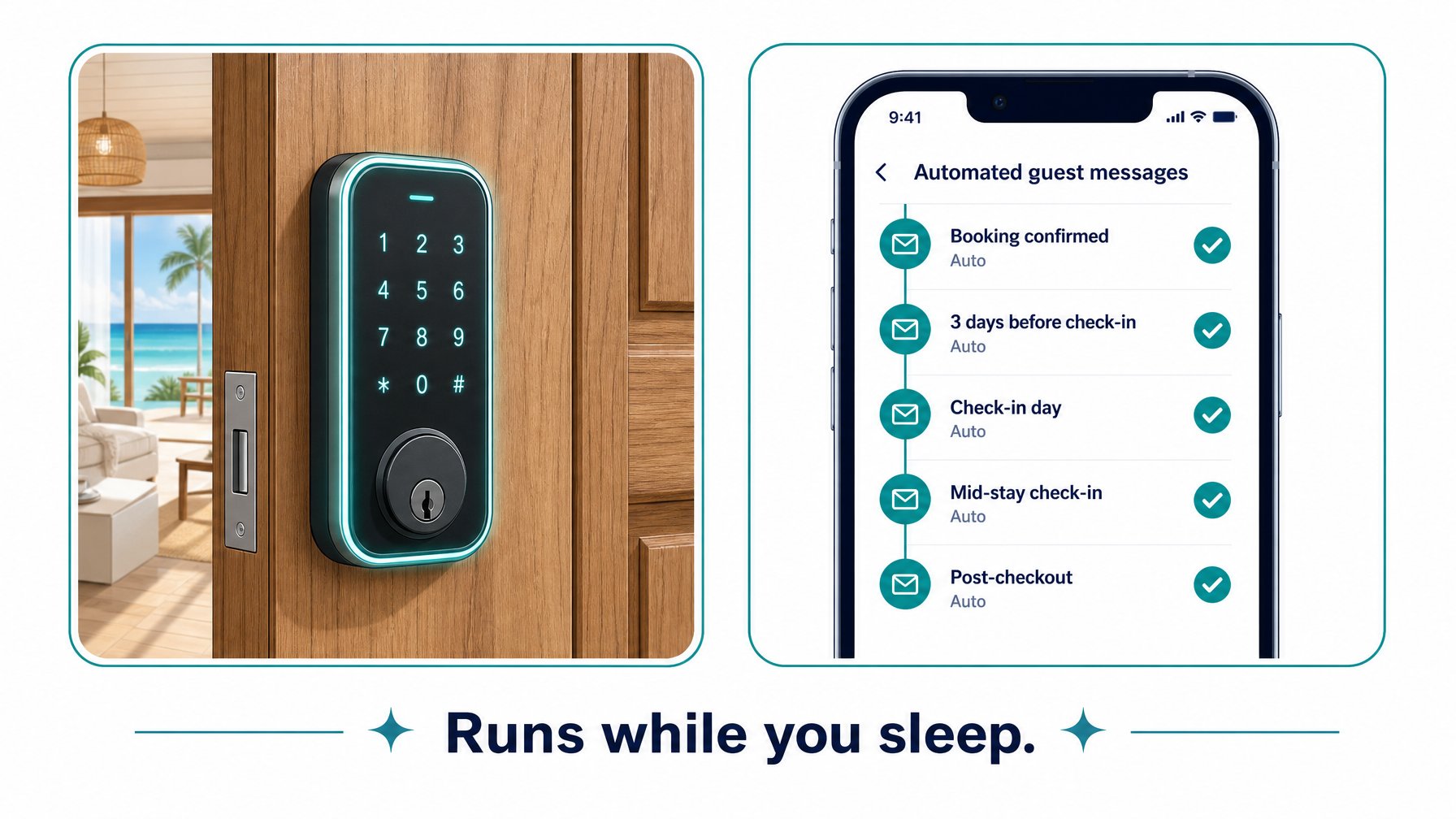
Hosts who use automation tools (automated messaging, smart locks, dynamic pricing) report average time savings of 4–7 hours per booking — directly multiplying effective hourly earnings
Houfy has 98,000+ listings across 100+ countries — direct booking hosts on the platform eliminate OTA commissions from every booking, improving net income without adding a single hosting hour
Why Most Hosts Underestimate What Hosting Actually Costs in Time
When hosts talk about earnings, the conversation almost always focuses on gross revenue — the total booking income before any expenses or time costs are accounted for. "We made $60,000 last year on our Smoky Mountains cabin" sounds excellent. Whether it is excellent depends entirely on what came out of that $60,000 and how many hours went into generating it.
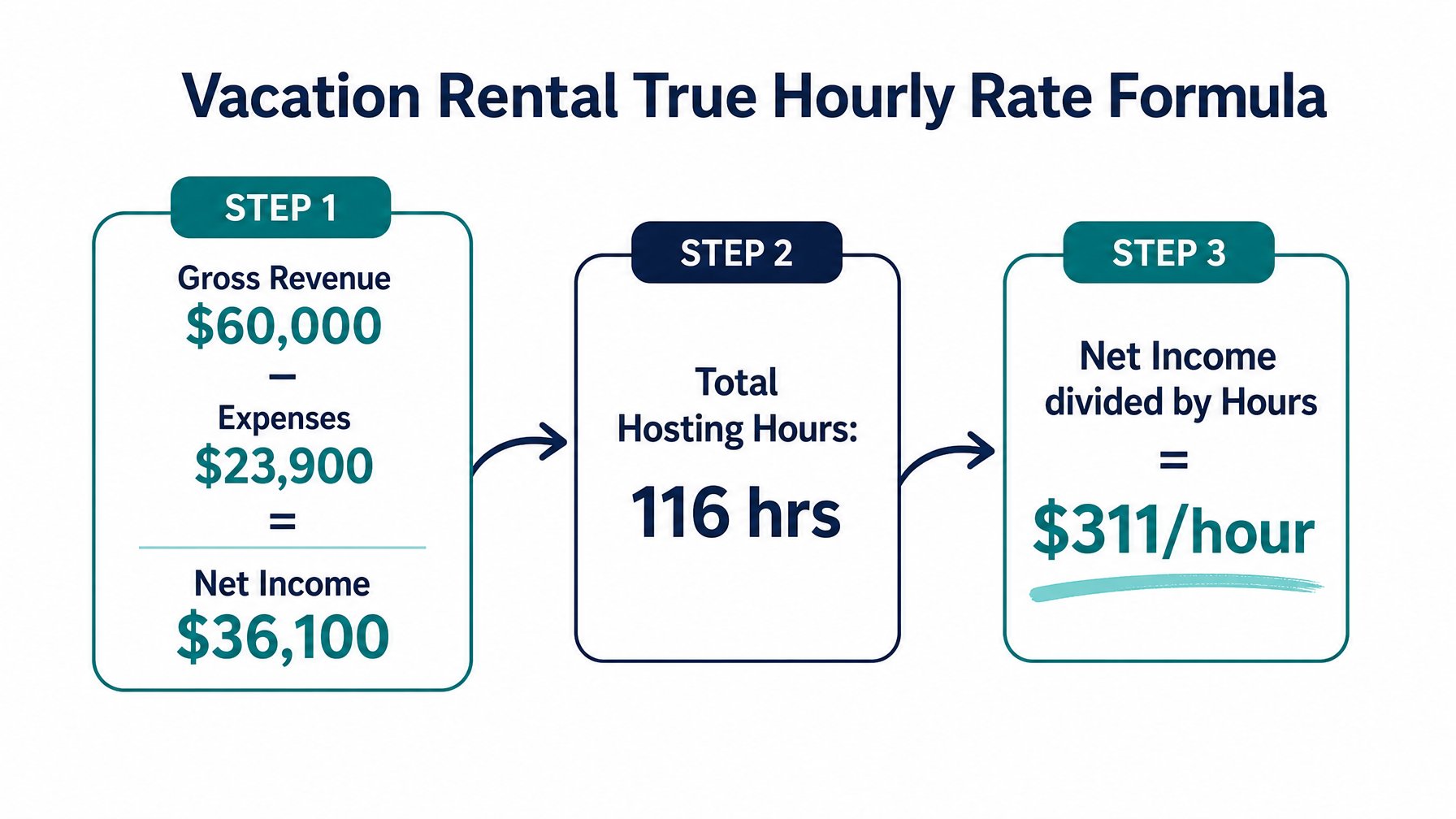
A host who made $60,000 gross on a cabin:
Paid an OTA host commission of $1,800 (3% Airbnb)
Paid a cleaner $8,400 (14 cleans at $600 each)
Spent $3,200 on maintenance, supplies, and restocking
Paid $2,400 in STR insurance premium
Allocated $7,200 in mortgage interest (proportionate to rental days)
Paid $900 in platform subscription fees and software
Net income: approximately $36,100.
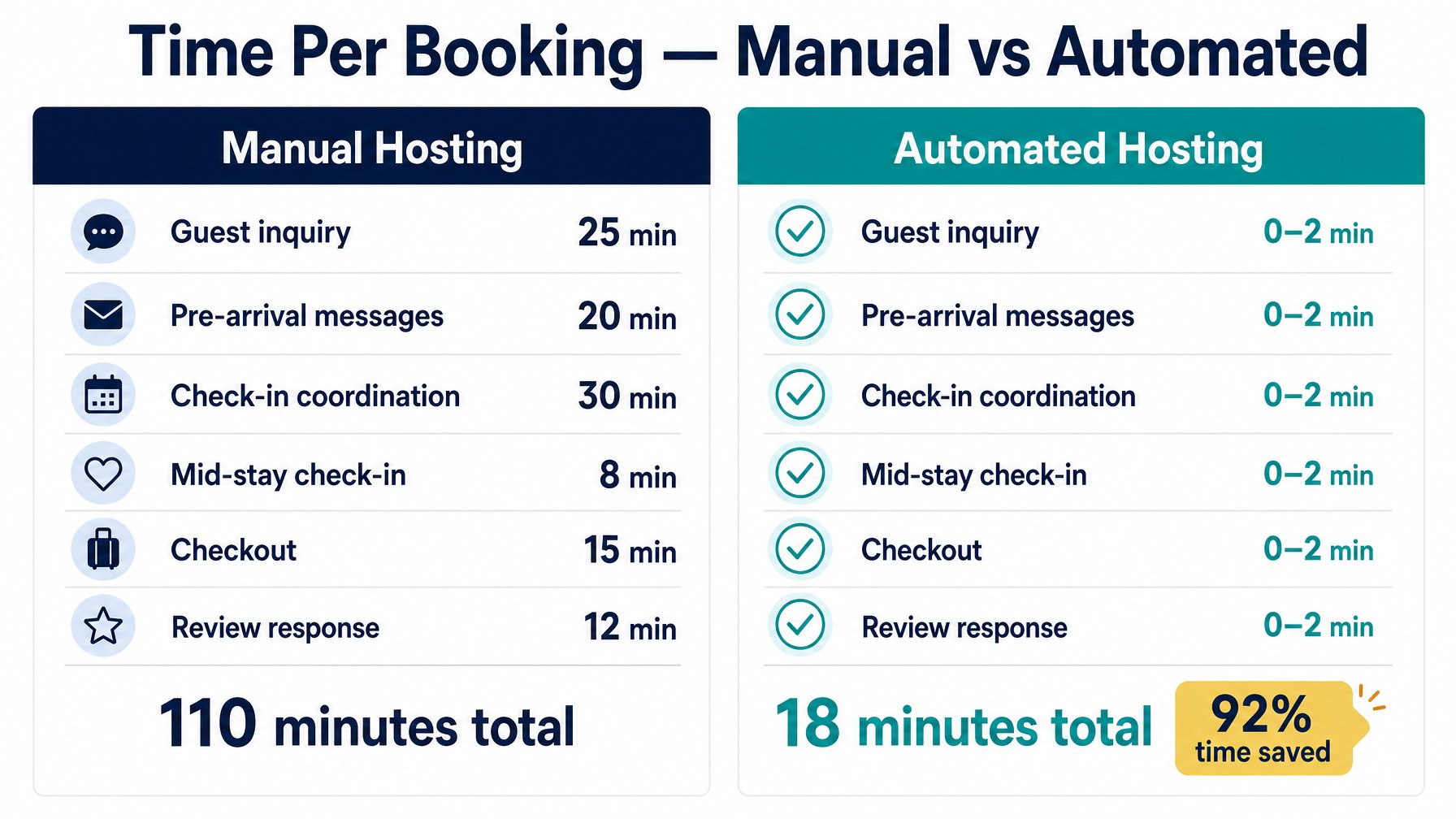
Now divide by hours. If that host spent an average of 4 hours per booking (messaging, coordination, check-in management) across 14 bookings, plus 60 hours of maintenance, listing management, and admin during the year — that is approximately 116 hours annually.
$36,100 ÷ 116 hours = $311/hour.
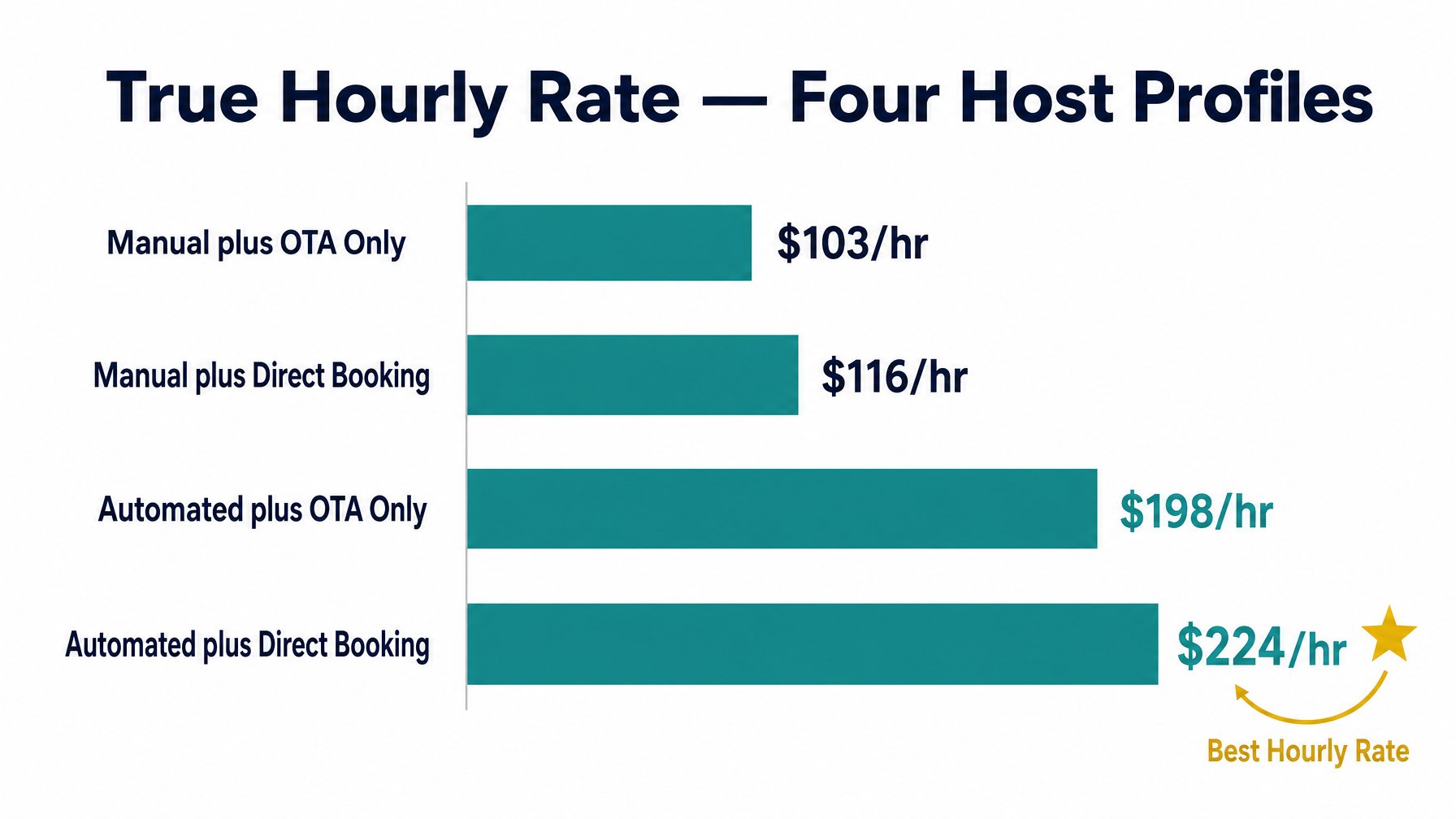
That is an excellent hourly rate. But consider a different host running the same cabin at the same revenue but managing it manually — no automation, answering every message personally, coordinating cleaning themselves, doing their own maintenance. That host might spend 350 hours on the same property.
$36,100 ÷ 350 hours = $103/hour.
Both hosts earned the same gross revenue. One earns three times as much per hour. The STR host earnings per hour difference comes entirely from operations — not from the property itself.
Step 1 — Calculate Your Real Annual Net Income
Start with your gross booking revenue for the year. Then subtract every real cost to arrive at a proper vacation rental net income calculation:
OTA commissions. If 100% of your bookings are through Airbnb at 3% host fee, this is 3% of gross. If you have a mix of Airbnb, VRBO, and direct bookings, calculate the blended commission rate across your booking mix.
Cleaning costs. Total paid to cleaners or cleaning services for the year. If you clean yourself, calculate the time cost separately — it belongs in the hours column, not here.
Maintenance and repairs. All materials purchased, contractors paid, and services hired for property upkeep. Use actual costs, not estimates.
Supplies and restocking. Toiletries, paper products, coffee, welcome basket items, linen replacement.
Insurance. Your STR-specific insurance annual premium. Standard homeowner's insurance typically does not cover short-term rental activity.
Proportionate mortgage interest and property taxes. Multiply your annual mortgage interest and property tax by your rental use percentage (rental days ÷ total days in year).
Platform and software fees. Any PMS subscription, dynamic pricing tool subscription, or channel manager fees.
Utilities allocated to rental use. Proportionate electricity, water, and internet costs.
The result is your true annual net income — what you actually earned from hosting after every real cost is removed.
For an in-depth look at how direct booking compares on this metric, see How to Move Past Airbnb Guests to Direct Booking.
Step 2 — Calculate Your Real Annual Hosting Hours
This is where most hosts discover how much time they actually invest. Track every hosting-related activity for one full booking cycle, then extrapolate to annual volume. This is the denominator of your STR host earnings per hour calculation — and it is almost always larger than hosts assume.
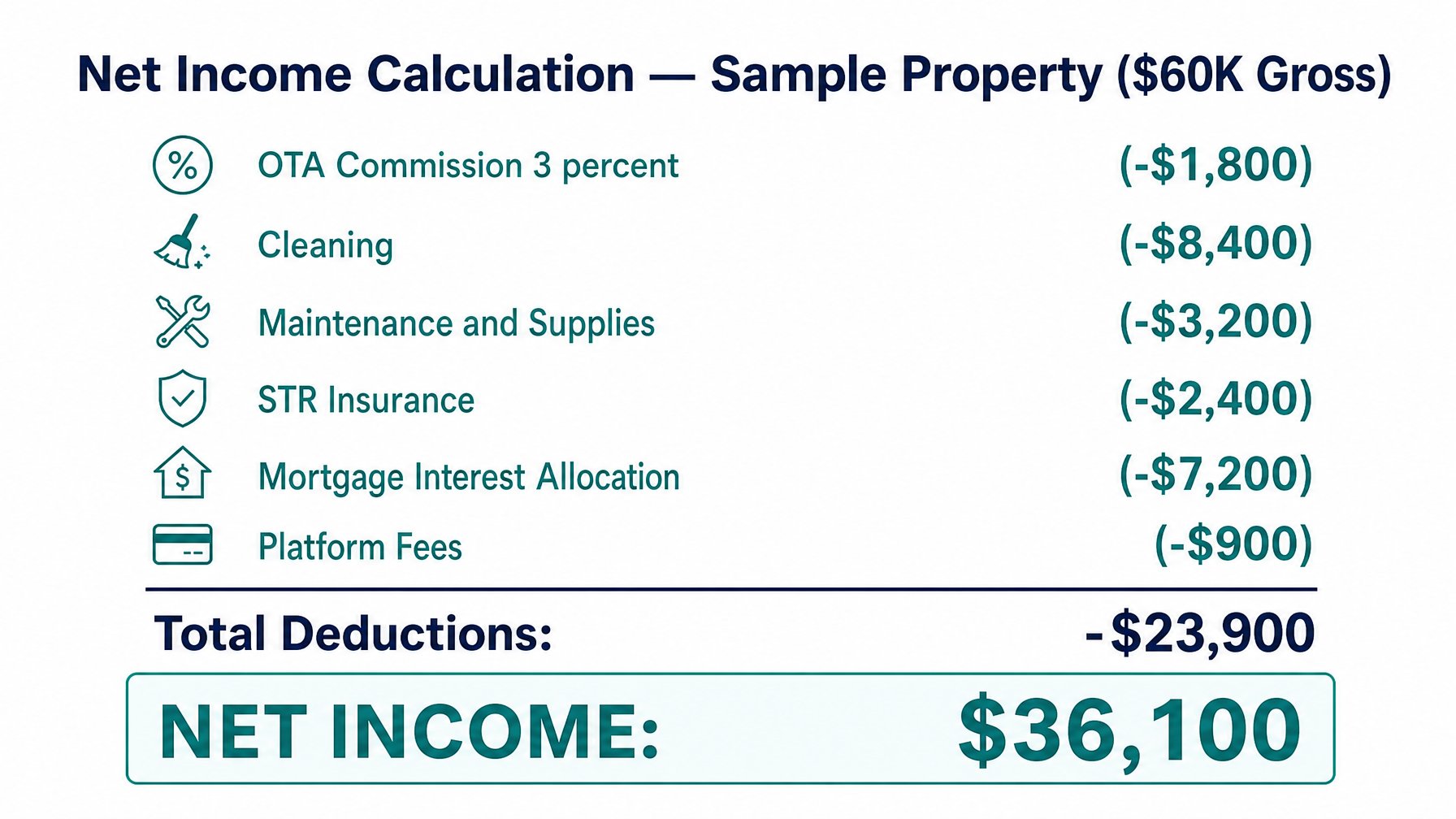
Per-booking time (multiply by annual booking count):
Initial guest inquiry response and booking confirmation: 15–30 minutes
Pre-arrival messaging sequence (2–3 messages): 15–25 minutes
Check-in coordination or key handoff: 15–45 minutes (smart lock = near zero)
Mid-stay check-in message: 5–10 minutes
Checkout coordination: 10–20 minutes
Post-stay review response: 10–15 minutes
Total per booking (manual operation): 70–145 minutes (1.2–2.4 hours)
Annual fixed time (regardless of booking count):
Listing maintenance and photo updates: 4–8 hours/year
Calendar management and pricing updates: 12–24 hours/year
Financial reconciliation and tax prep: 8–20 hours/year
Maintenance coordination and inspections: 20–60 hours/year (property-dependent)
Restocking and supply management: 6–15 hours/year
A host with 15 bookings per year spending 2 hours per booking plus 60 hours of annual fixed tasks invests approximately 90 hours per year. A host managing everything manually with 15 bookings spends closer to 150–200 hours.
CTA 1: Reduce your per-booking time to near zero with automated messaging and smart lock check-in — then boost your hourly rate further by listing on Houfy to eliminate OTA commissions entirely. Get started at houfy.com/new/listing
Step 3 — The Levers That Move Your Vacation Rental True Hourly Rate
Once you know your true hourly rate, the question is how to improve it. There are three levers available to every host:
Lever 1 — Increase net income (revenue same, costs lower). Shifting bookings from OTA to direct eliminates the host commission. On $60,000 gross at 3% Airbnb host fee, that is $1,800/year. On the same hours, moving to 0% direct booking adds $1,800 to net income — moving the effective hourly rate from $311 to $326 in the sample above. At higher revenue volumes, the impact scales proportionally. AI is also changing how hosts price dynamically — see How AI Is Changing Vacation Rental Pricing in 2026 for a detailed look.
Lever 2 — Reduce hours (income same, time lower). Automation is the highest-leverage tool here. Automated messaging, smart lock check-in, and dynamic pricing tools combined save the average host 4–7 hours per booking. On 15 annual bookings, that is 60–105 hours returned — transforming a 200-hour operation into a 95–140-hour one with no change in revenue.
Lever 3 — Increase revenue without proportionate hour increase. Upsells (early check-in, late checkout, welcome baskets, local experience packages) that add $50–$200 per booking in revenue with minimal time investment increase net income per hour. A $150 upsell per booking across 15 bookings adds $2,250 to annual net income with perhaps 5 additional annual hours — a marginal rate of $450/hour.
The most powerful combination: automate operations (Lever 2) + shift to direct booking (Lever 1) + add one recurring upsell (Lever 3). Applied together, these three moves typically increase the true hourly rate by 40–70% within a single booking season.
Build your direct booking website at houfy.com/website-builder and start eliminating OTA commissions from every booking your site generates.
Calculate your own true hourly rate — then identify your highest-leverage improvement. For most hosts, eliminating OTA commission is the fastest single move. List on Houfy at houfy.com/new/listing and build a direct booking website at houfy.com/website-builder.
What a Good True Hourly Rate Looks Like Across Property Types
Context matters when interpreting your number. A host earning $80/hour on a budget cabin in a secondary market is performing well. A host earning $80/hour on a luxury beachfront villa in the Outer Banks is likely leaving significant efficiency gains on the table.
Single property, mid-market US market, partially automated: $80–$150/hour is a healthy range. Below $60/hour suggests either high OTA commission costs, below-market nightly pricing, or significant untracked time in manual operations.
Single property, premium destination (Malibu, Aspen, Outer Banks), well-automated: $200–$400/hour is achievable for hosts who have systematically applied all three levers.
Multi-property hosts using a property manager or VA: The calculation changes — you are now evaluating whether the management cost (a net income reduction) is worth the time freed (a denominator reduction). The same formula applies; the inputs simply reflect your oversight hours rather than full operational hours.
Hosts transitioning from OTA-only to direct booking mix: The Houfy platform eliminates commission costs on every booking made direct. As the direct booking share grows, net income rises without any change to hosting hours — improving the true hourly rate passively over time. For a broader view of how European hosts are achieving this, see Best European Vacation Rentals Without OTA Fees in 2026.
Ready to push your true hourly rate past the average? Start with the highest-leverage move: list your property on Houfy for free and build a direct booking website that works for you around the clock.
Frequently Asked Questions
What is a good true hourly rate for a vacation rental host?
A well-run single vacation rental property in a mid-market US destination typically produces a true hourly rate of $80–$200/hour for a host who manages it themselves with some automation. Premium destinations (Outer Banks, Malibu, Aspen) and fully automated operations can produce $200–$400/hour. Rates below $60/hour typically indicate either high OTA commission costs, below-market pricing, or significant untracked time investment in manual operations.
How does switching to direct booking improve my hourly rate?
Direct bookings eliminate the OTA host commission (3% Airbnb, 5–17% Booking.com/VRBO depending on plan) from every booking made through your own site. On $60,000 gross annual revenue, eliminating a 3% host fee adds $1,800 to annual net income at zero additional hosting hours — improving the effective hourly rate by the full $1,800 divided by your annual hours, compounding further at higher revenue volumes.
Should I count the time I spend on maintenance in my hourly rate?
Yes. Maintenance hours — whether performed by you or coordinated by you — are real hosting time costs. If you personally spend 30 hours per year on repairs, restocking, and maintenance coordination, those hours belong in the denominator of your true hourly rate calculation. Outsourcing maintenance to a handyperson converts those 30 hours into a dollar cost (included in net income deductions) rather than a time cost.
How many hours per year does a typical vacation rental host spend?
It depends heavily on automation level and booking volume. A host managing a single property manually with 15 annual bookings typically invests 150–250 hours per year. A host managing the same property with full messaging automation, smart lock check-in, and dynamic pricing spends 60–90 hours per year on the same booking volume. The difference — 90–160 hours annually — is the automation dividend that shows up directly in a higher true hourly rate.
Is vacation rental hosting worth it financially compared to traditional long-term rental?
For most hosts in short-term rental-friendly markets, vacation rental produces 1.5–2.5x the gross revenue of a comparable long-term rental. The key variable is whether the added management time is factored into the comparison — which most simplistic comparisons omit. The true hourly rate framework gives you the correct comparison tool: calculate net income per hour for both scenarios using actual costs and realistic time investments, then compare.
Source Citations
Airbnb Help Center — Host service fee rates 2025 — https://www.airbnb.com/help/article/1857
AirDNA — US Short-Term Rental host income and occupancy benchmarks 2026 — https://www.airdna.co/
Vacation Rental Management Association (VRMA) — Host time-use and operational efficiency survey 2025 — https://www.vrma.org/
IRS Publication 527 — Residential Rental Property: expenses, deductions, and depreciation — https://www.irs.gov/publications/p527
Category: Get Started on Houfy
Houfy currently has 98,000+ live listings across 100+ countries.
Last Updated: July 10, 2026