
Choosing the best states for short-term rental investment in 2026 now requires as much regulatory research as it does market analysis. The US landscape has fractured into a patchwork of preemption laws, permit caps, principal residency requirements, and OTA-targeted compliance agreements that materially affect which markets are viable for non-owner-occupied vacation rental investors. This guide ranks each major state by regulatory stability, licensing clarity, and the platform-level factors — including the growing structural advantage of direct booking through Houfy — that increasingly determine investor returns.
Key Takeaways
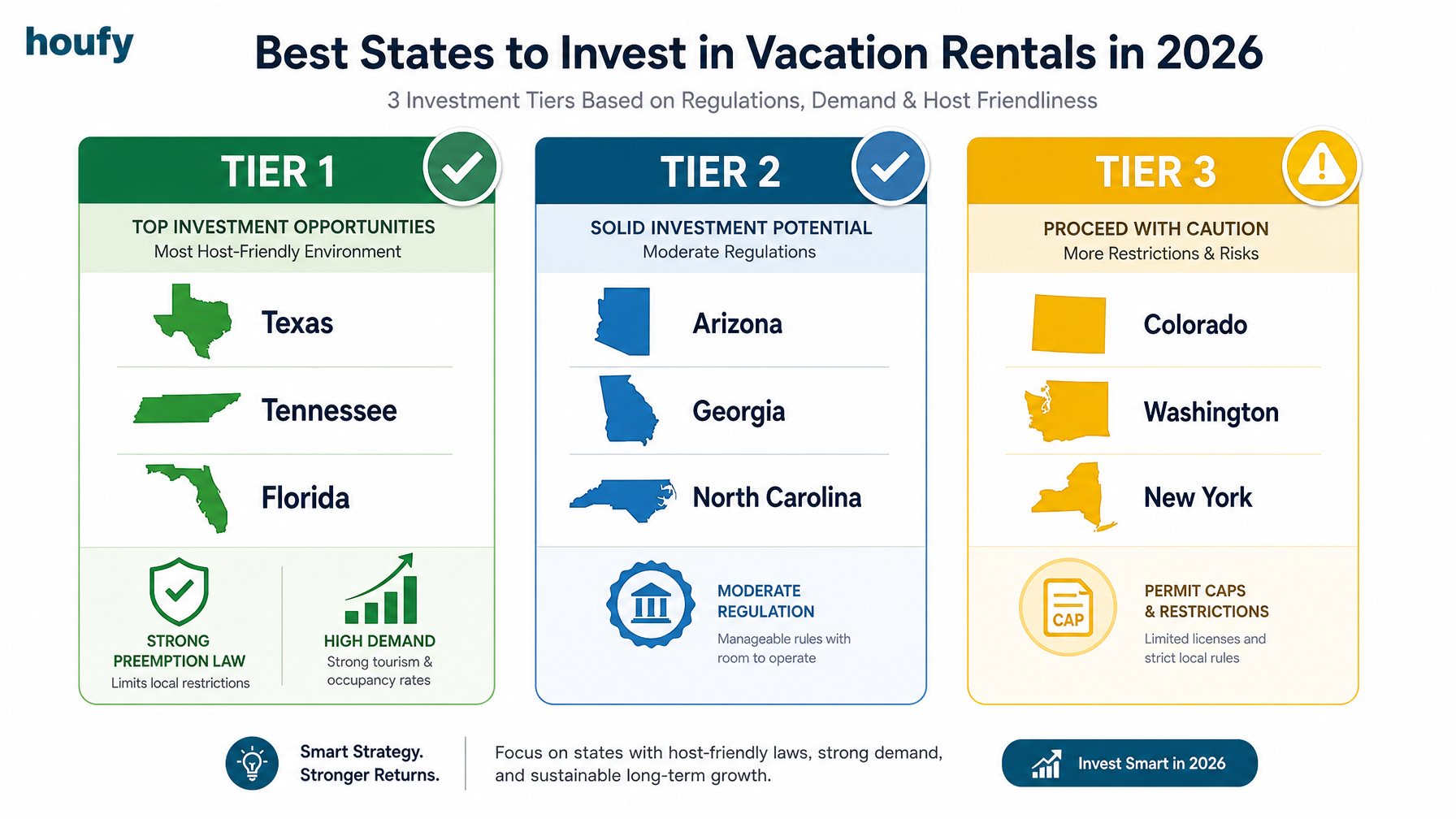
Texas, Tennessee, and Florida rank as the top three STR-friendly states in 2026, anchored by preemption law strength, permit accessibility, and sustained demand
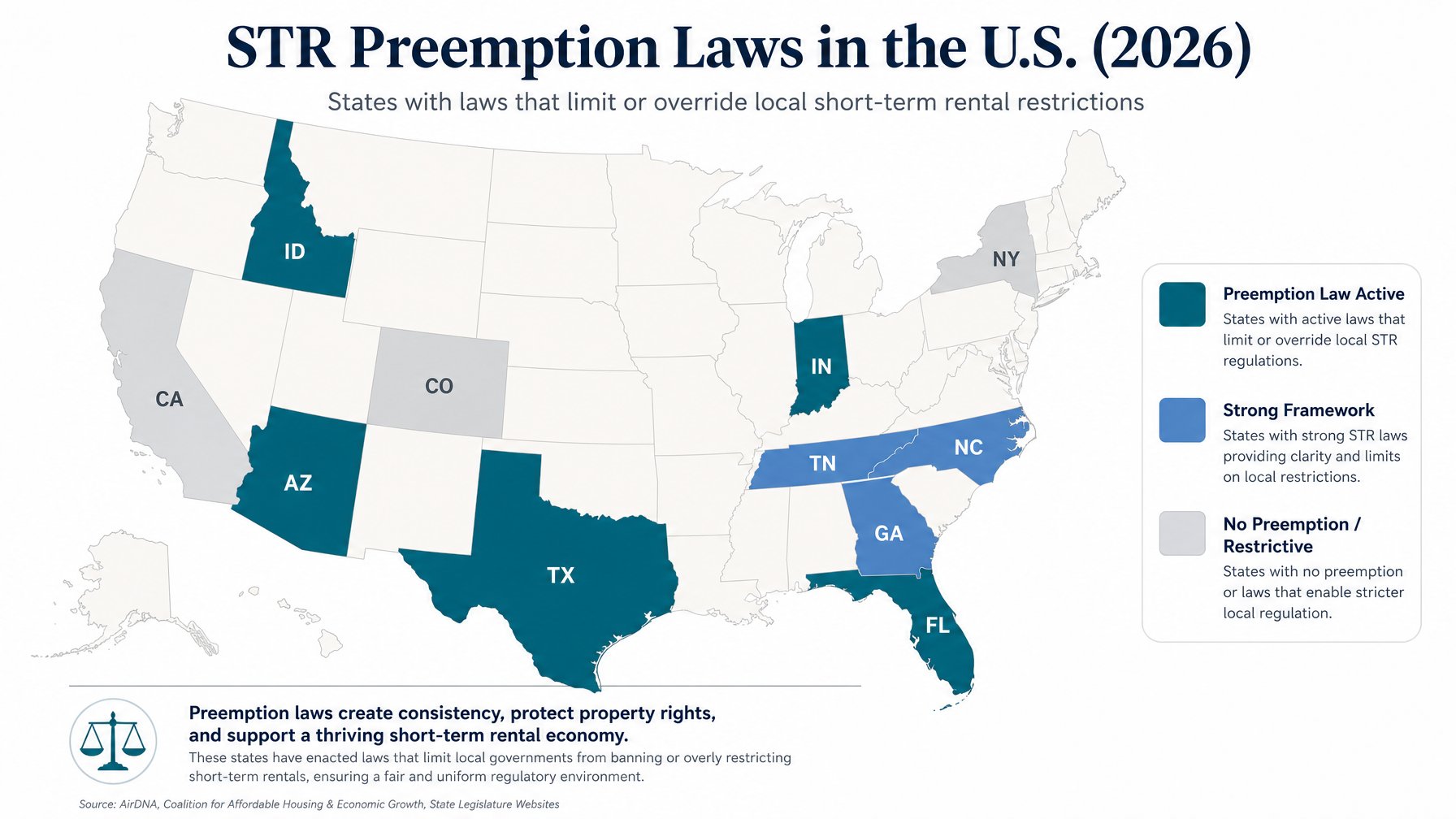
Arizona and Indiana have reinforced preemption laws in 2026 legislative sessions, adding regulatory durability to already-favorable frameworks
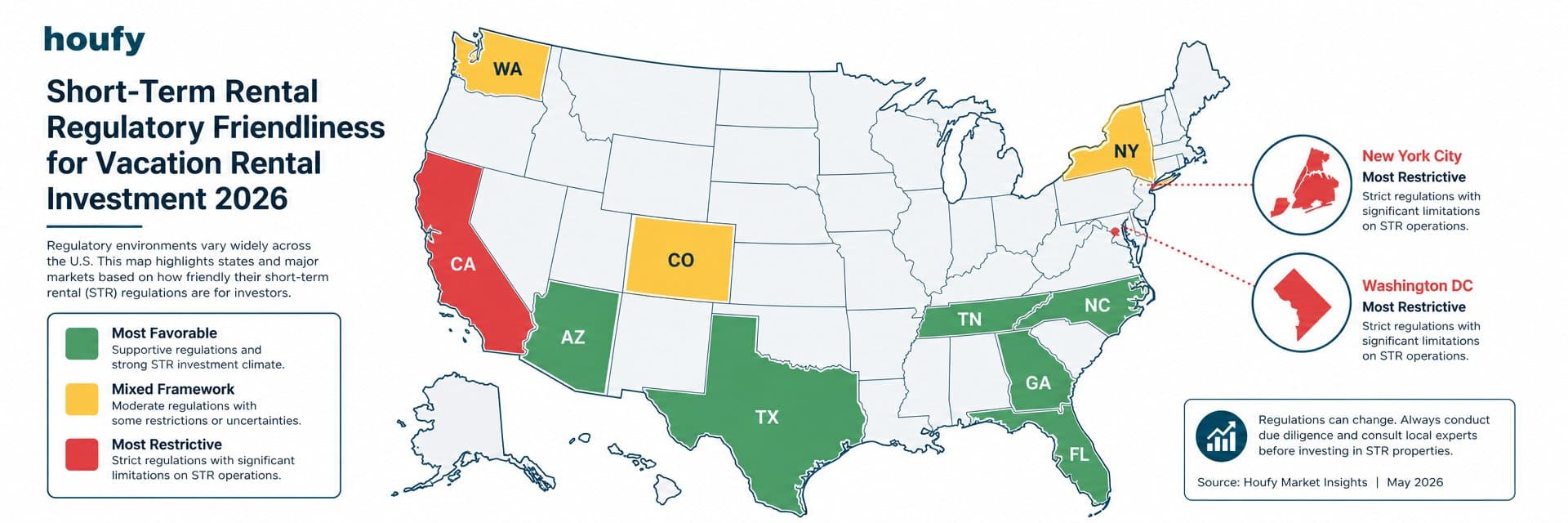
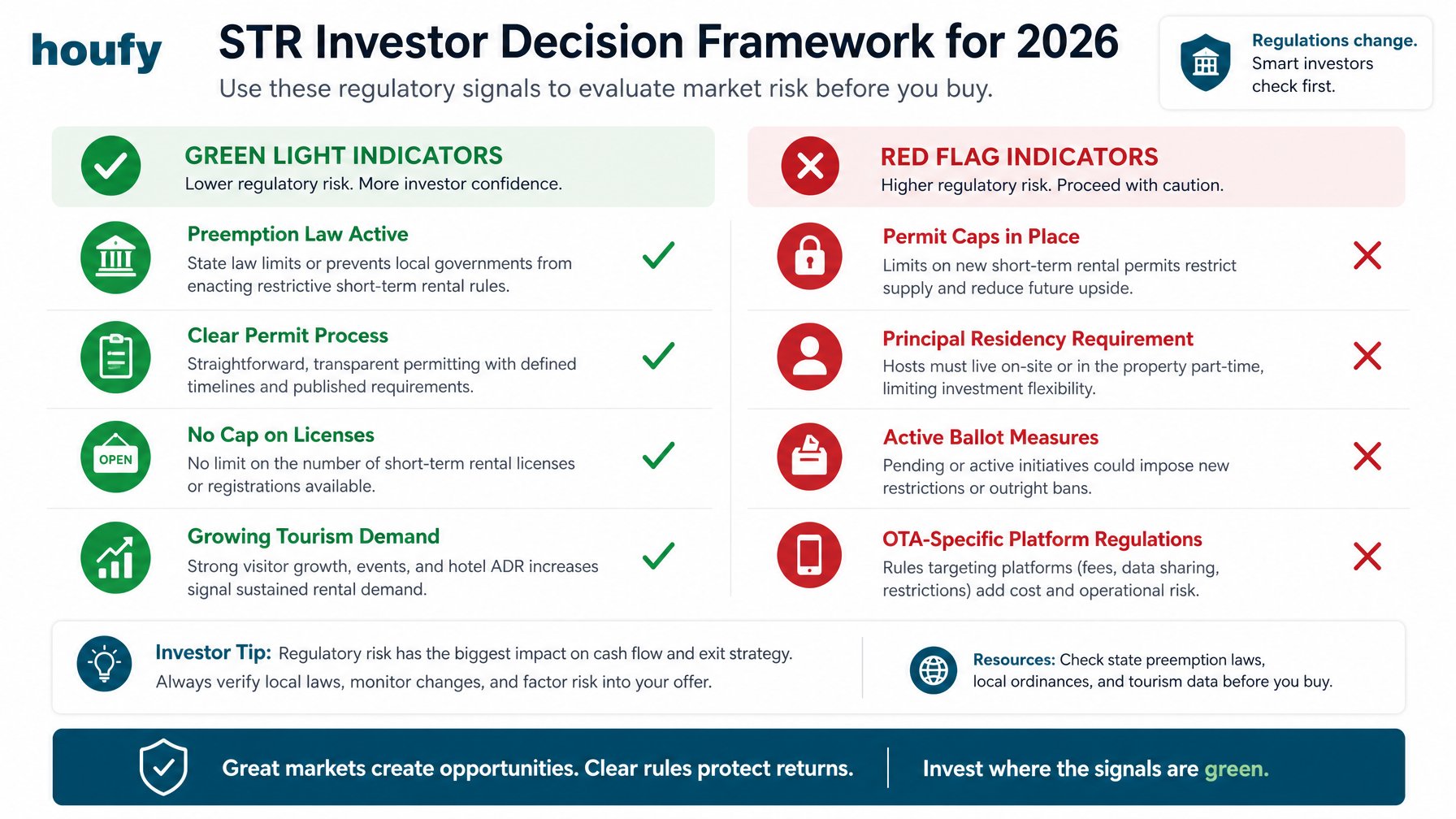
New York City, Santa Monica, San Francisco, and Washington DC represent the most restrictive markets, with principal residency requirements that effectively prohibit non-owner STR investment
A state-level preemption law does not guarantee favorable city regulations — always verify at the municipal level before purchasing
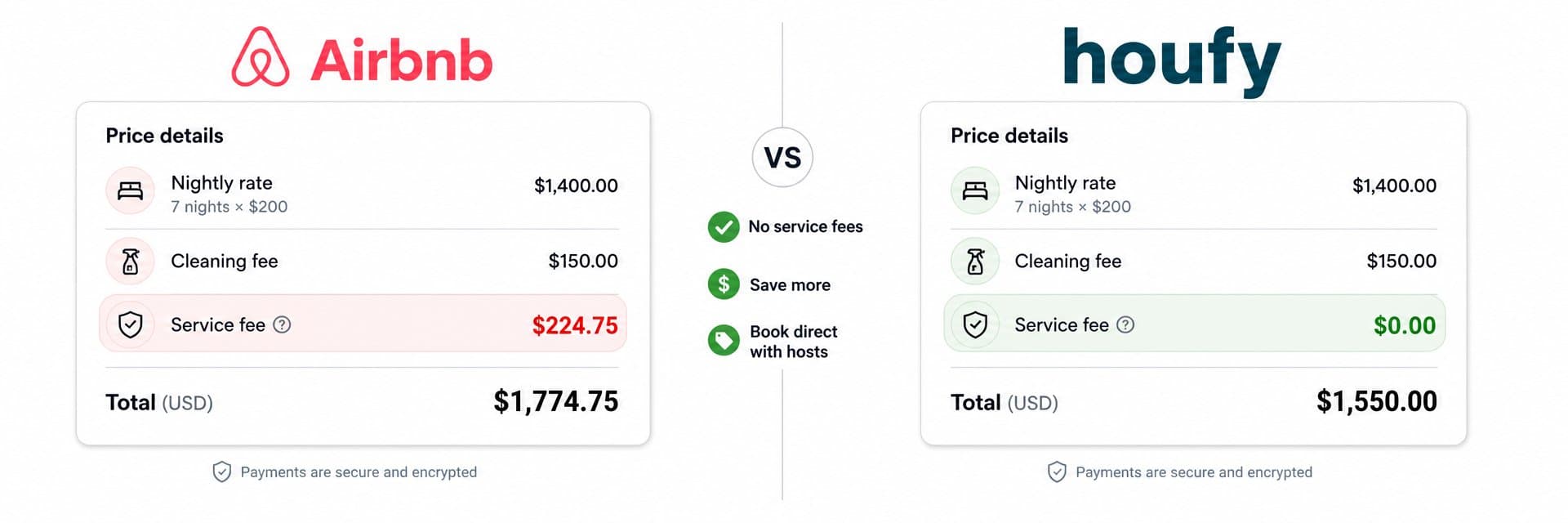
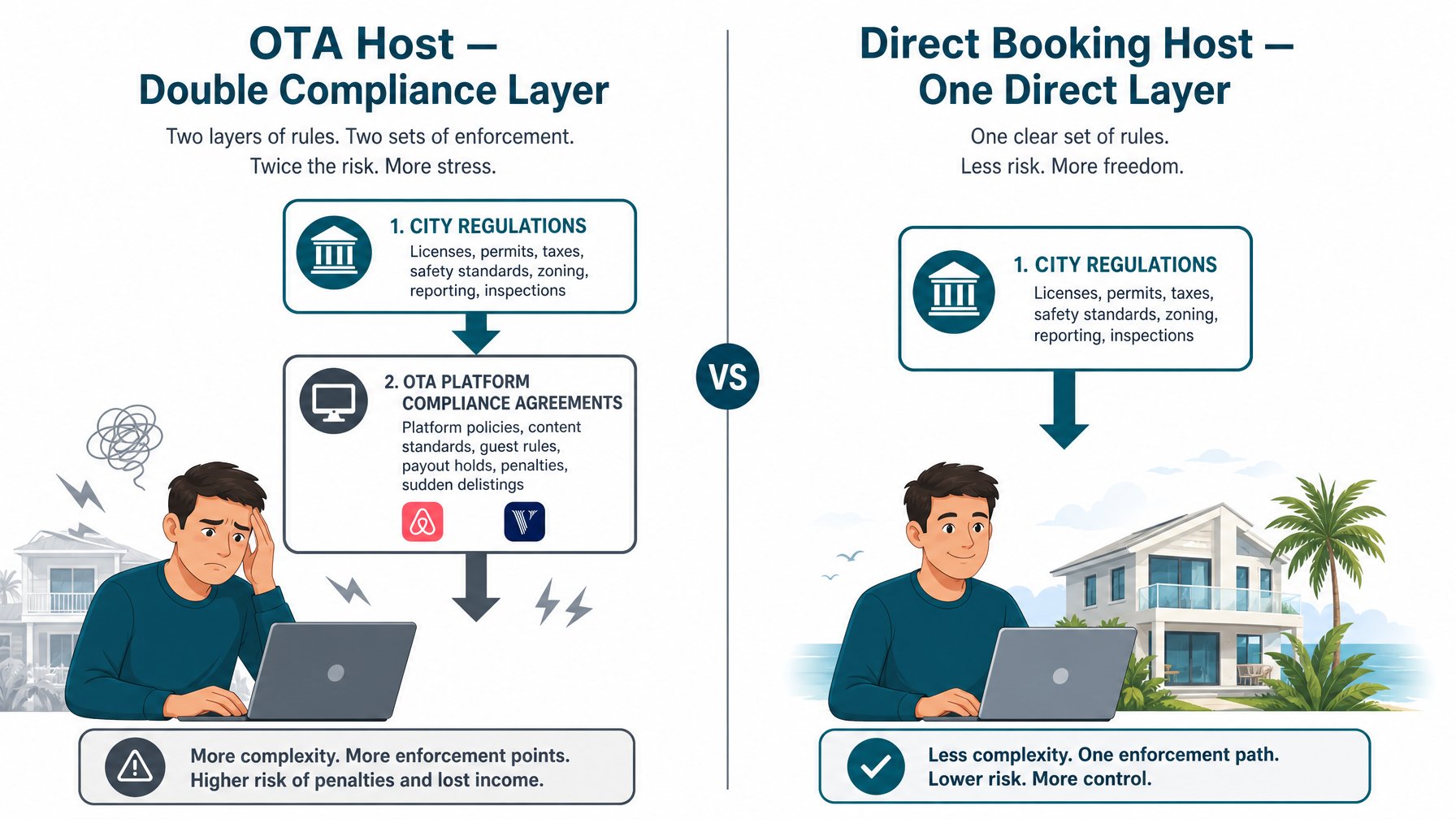
Direct booking through platforms like Houfy provides a structural compliance advantage: hosts answer to city regulations directly, without the added layer of OTA platform compliance agreements
The November 2026 Midterm elections introduce ballot-measure risk in multiple Colorado ski towns and several California municipalities — monitor these markets carefully
Tennessee's Smoky Mountains market produces the highest STR revenue per available property of any US region, making it the single strongest case for pure revenue-based investment
Tier 1 — The Most STR-Friendly States for Investment in 2026
These three states combine the strongest preemption law frameworks with high, diversified demand and investor-accessible permit processes. For hosts focused on the best states for short-term rental investment in 2026, Tier 1 is where the regulatory risk floor is lowest.
Texas
Texas has the most well-rounded combination of STR-friendly legislation, diversified demand markets, and near-zero risk of outright municipal ban. The state legislature has consistently blocked STR prohibition bills, and the existing preemption framework limits local governments to permit requirements, noise ordinances, and occupancy taxes rather than full prohibition.
For investors, Texas offers geographic demand diversification that few other states can match. The Gulf Coast (Galveston, Port Aransas, South Padre Island) provides high-occupancy beach markets. The Hill Country (Fredericksburg, Wimberley, Marble Falls) drives wine tourism and wedding travel year-round. Austin and San Antonio attract convention, music, and corporate demand. Dallas and Houston are the two largest Copa América 2026 host cities in the US, generating measurable near-term demand spikes for well-located properties.
City-level regulations in Austin and Dallas add permit requirements and registration steps, but neither city has enacted permit caps or nightly restrictions that would materially limit an established investor. For hosts ready to list in any Texas market, create your Houfy listing here and go live on a 0% commission platform from day one.
Tennessee
Tennessee's STR market is anchored by the Great Smoky Mountains, which consistently produces the highest revenue per available property (RevPAR) of any STR region in the United States, according to AirDNA data. Gatlinburg, Pigeon Forge, and Sevierville operate with clear licensing frameworks, defined permit processes, and no meaningful risk of supply caps in rural mountain zones.
Nashville's regulatory environment is more contested, but the state's preemption framework limits Metro Nashville's ability to enact outright prohibition. For investors who are less comfortable with urban STR regulation, the mountain and rural Tennessee markets deliver strong revenue clarity without the permit-cap uncertainty of major metros.
Tennessee also has no state income tax, which directly improves net investor returns relative to comparable markets in states like California or New York. A $150/night cabin in Gatlinburg generating 65% annual occupancy produces approximately $35,600 in gross revenue — with no state income tax layer reducing that figure.
Florida
Florida's STR preemption law — one of the most comprehensive in the country — prevents municipalities from enacting outright vacation rental bans on properties that were legally operating before any local ordinance was passed. The Gulf Coast markets (Destin, 30A, Naples, Sarasota, Anna Maria Island) operate with well-defined licensing requirements and no supply caps on new entries.
Miami Beach is the notable exception. Its strict STR permit system, combined with active enforcement and high fine levels, makes it a poor investment target for non-owner-occupied STR. Savvy Florida investors focus on the panhandle and Gulf Coast, where the regulatory clarity-to-demand ratio is among the best in the country.
Orlando's STR market is complex — some municipalities allow STRs freely while adjacent ones restrict them — but for investors willing to verify zoning at the parcel level, the demand fundamentals (theme parks, conventions, international tourism) remain unmatched for high-occupancy, high-volume properties.
Ready to list your vacation rental in a STR-friendly state? Houfy connects your property directly with guests at 0% commission. Start your free listing today →
Tier 2 — Strong Regulatory Frameworks with Localized Restrictions
Tier 2 states offer durable, investor-friendly regulatory foundations at the state level, but require more careful city-level due diligence before purchasing. These states represent strong investment targets when the specific municipality is verified.
Arizona
Arizona's 2016 STR preemption law was one of the earliest and most comprehensive in the country, and it has been reinforced in subsequent legislative sessions. Municipalities cannot enact outright bans on STRs, and the permit process across most of the Phoenix metro and Tucson is well-defined and accessible.
Scottsdale has added noise ordinance requirements and a permit process for STRs, but stops well short of prohibition or permit caps. The Phoenix metro delivers year-round demand from both domestic and international travelers, supported by major sports events, corporate conferences, and seasonal snowbird tourism. The Southwest monsoon season (July-September) creates a natural occupancy trough that investors should factor into annual revenue projections.
Georgia
Georgia's regulatory framework at the state level is permissive, and Atlanta's STR registration process is operational without permit caps. The city requires registration and safety inspections, but does not restrict the number of available permits, making it one of the more accessible major metro STR markets in the Southeast.
Savannah and the Georgia coast (Tybee Island, Jekyll Island, St. Simons Island) operate under county-level frameworks that are generally favorable, with strong year-round demand from both regional drive-to travelers and international visitors. Georgia's growing convention and film industry presence in Atlanta adds non-seasonal demand that improves annual occupancy stability.
North Carolina
The Outer Banks, Asheville, and the Research Triangle offer three distinct demand profiles within a single state. The Outer Banks is one of the most established drive-to beach markets in the eastern US, with weekly rental turnover and very high summer occupancy rates. Asheville added STR permit requirements in recent years but has not enacted permit caps, and supply has continued to grow alongside strong demand.
The Triangle region (Raleigh, Durham, Chapel Hill) benefits from university events, medical conferences, and consistent corporate travel that smooths seasonal demand curves for urban STR properties. For hosts interested in comparing direct vs. OTA platform strategies across these markets, see how to set up a direct booking website in 2026 for a full breakdown of the commission math by market type.

Tier 3 — Mixed or Deteriorating Regulatory Climate
Tier 3 states have strong STR markets within their borders, but require more careful sub-market selection and carry measurable regulatory risk for new investors in 2026.
Colorado
Colorado's ski town markets represent some of the most coveted STR properties in the US — and some of the most supply-constrained. Telluride, Breckenridge, Aspen, and Steamboat Springs have all enacted permit caps that make new entry extremely difficult and expensive. In Breckenridge, the permit waitlist has extended to multiple years in some zones.
However, Colorado's STR regulatory tightening is concentrated in ski resort towns. Estes Park, Fort Collins, Pueblo, and many rural mountain communities operate with far more permissive frameworks. The state also lacks a preemption law, meaning each municipality sets its own rules without state oversight. For 2026, the November Midterm elections include STR ballot measures in at least two additional ski-adjacent communities — investors should monitor STRTA.us for real-time updates before making any commitment in Colorado mountain markets.
Washington State
Seattle's strict STR regulations — requiring principal residency for non-owner-occupied rental compliance — make it largely non-viable for traditional investment STR in the city proper. However, Washington State's regulatory concentration in the Seattle metro leaves significant opportunity elsewhere.
Eastern Washington (Walla Walla wine country, Leavenworth's Bavarian alpine market, Chelan wine and lake tourism) operates with county-level frameworks that are generally permissive. The Olympic Peninsula and Washington coast also offer rural STR opportunities without the urban regulatory overlay of Seattle.
New York (Outside NYC)
New York City's Local Law 18 (enacted 2023, enforced 2023-present) effectively prohibits non-owner-occupied STR in the five boroughs. The enforcement regime includes fines exceeding $72 million through 2025. This is not a market for new STR investment.
Outside the five boroughs, New York State is a very different picture. The Catskills, Finger Lakes wine country, Adirondacks, and Hamptons all operate under county and town-level frameworks that are considerably more permissive. Hudson Valley and Catskills markets specifically have seen strong demand growth as NYC travelers seek accessible weekend destinations, and permit frameworks in most Catskill towns remain open to new entrants.
For the complete state-by-state regulatory breakdown including specific local ordinances, city permit processes, and occupancy tax rates, see Short-Term Rental Laws by State 2026: Complete US Guide.
Tier 4 — Most Restrictive Environments
New York City, Santa Monica, San Francisco, West Hollywood, and Washington DC represent the markets where non-owner-occupied STR investment is not viable under current regulatory frameworks. The shared characteristic across all of these markets is a principal residency or owner-occupancy requirement that prohibits renting a property you do not live in as a primary residence.
New York City enforces Local Law 18 with significant operational resources. Fines for non-compliant listings have exceeded $72 million since enforcement began.
Santa Monica has maintained one of the most restrictive STR frameworks in California since 2015, requiring owner-occupancy and limiting total annual rental nights. The city actively monitors and removes non-compliant listings from all platforms.
San Francisco requires host registration and limits STRs to properties where the host is a permanent resident. Non-owner-occupied STR is effectively prohibited.
Washington DC enforces a strict short-term rental registration system with owner-occupancy requirements. The DC DCRA actively investigates non-compliant properties and has imposed significant fines on hosts who rent second properties.
For investors who already own properties in these markets, exploring Houfy's direct booking tools may offer compliance path advantages — but the underlying principal residency requirement must be met regardless of which platform is used.
The Direct Booking Advantage in Regulated STR Markets
Several US cities that have enacted STR regulations have done so in ways that specifically target OTA platform compliance. New York, San Francisco, and Boston have required Airbnb and VRBO to share listing data, remove non-compliant listings at the platform level, and integrate local permit verification into their search results. This means OTA-dependent hosts are subject to two layers of compliance: local city regulations and their platform's regulatory compliance agreements.
Hosts operating through direct booking platforms like Houfy face a structurally different compliance environment. Houfy does not have platform-level agreements with municipalities that restrict which listings can appear. A Houfy host is responsible for their own permit compliance with their city — which is exactly the same obligation as any property owner — without the added layer of OTA platform enforcement mechanics.
This does not mean direct booking eliminates regulatory obligations. Every STR host must comply with local permit requirements, occupancy taxes, and safety standards regardless of platform. What direct booking eliminates is the platform intermediary layer — the algorithm decisions, data-sharing agreements, and platform-level listing enforcement that affect OTA-dependent hosts in regulated markets.
For hosts managing properties in multiple markets across different regulatory regimes, the ability to maintain guest relationships and booking history independently of any single platform is one of the most durable strategic advantages direct booking provides. See how the best STR hosts are using Houfy's software partner integrations to manage multi-market portfolios efficiently.
Managing a vacation rental in a STR-friendly state? List on Houfy and keep 100% of your revenue. Browse active listings in top STR markets →
How to Use This Ranking as an Investment Framework
Regulatory rankings are a filter, not a buying decision. The sequence for any serious STR investor in 2026 should follow this order:
Step 1 — State-level filter. Use the tier system above to exclude states where the preemption framework is weak or absent and where your target city carries active ballot-measure risk. This narrows the field to Tier 1 and Tier 2 geographies as the starting pool.
Step 2 — Municipal verification. Even within Tier 1 states, individual cities operate very differently. Austin has active permit requirements. Gatlinburg and Pigeon Forge have clear licensing but different fee structures. Always contact the local planning or zoning department directly to confirm current permit availability, costs, and any cap status.
Step 3 — Demand analysis by sub-market. Use AirDNA's market data to analyze occupancy rates, average daily rate (ADR), and revenue per available property at the zip-code level for your target markets. State-level regulatory clarity is only valuable if the underlying demand supports viable returns.
Step 4 — Platform strategy decision. Once you have a target property, determine your booking channel strategy. For most STR-friendly markets, a hybrid approach — listing on one or two OTAs for discovery while building a direct booking presence on Houfy for repeat and referral guests — produces the best combination of initial occupancy and long-term margin improvement.
Step 5 — Monitor legislative activity. STR regulations are not static. Subscribe to STRTA.us for state-level legislative alerts, and check your city's short-term rental portal quarterly for permit requirement changes, new tax ordinances, or enforcement updates. For hosts curious about how other investors in specific markets structure their operations, the best US cities for rental property investment breaks down the demand side of this decision by metro.
Frequently Asked Questions
Which state has the best ROI for vacation rental investment in 2026?
Tennessee's Great Smoky Mountains region produces the highest STR revenue per available property of any US market, making it the strongest case for pure revenue-based investment. Texas Gulf Coast markets (30A, Galveston, Port Aransas) also rank in the top tier for revenue relative to acquisition cost, and Florida panhandle markets deliver comparable performance with strong regulatory stability. The right answer depends on acquisition price — high-revenue ski markets in Colorado carry acquisition costs that compress returns significantly compared to more affordable Tennessee mountain markets.
Does a state preemption law protect against all local STR regulations?
No. Preemption laws prevent outright bans but consistently allow municipalities to require permits, set health and safety standards, enforce noise ordinances, and impose occupancy taxes. Tennessee's preemption law, for example, explicitly permits municipalities to require permits and set operational standards — it simply prevents them from prohibiting STRs entirely. Always verify what specific regulations apply at the city and county level for your target property before purchasing.
How does direct booking through Houfy affect regulatory compliance?
Hosting on Houfy does not change your underlying permit, tax, or safety compliance obligations — those exist regardless of which platform you use. What direct booking changes is the platform layer: OTA-dependent hosts in regulated markets must comply with their city's requirements and with their platform's regulatory compliance mechanisms, which in some cities include platform-level listing removal for non-compliant properties. Houfy hosts deal directly with local regulations without that added platform enforcement layer.
Should I invest in a market with active STR ballot measures in 2026?
Only with caution and a clearly defined exit strategy. Markets where STR ballot measures are scheduled for the November 2026 elections — including several Colorado ski-adjacent communities and California coastal cities — carry material legislative risk. A successful ballot measure can convert a viable STR investment into a non-compliant property within months. Treat any market with pending regulatory votes as a Tier 3 risk environment until the legislative outcome is confirmed.
What is the most important factor when comparing STR markets in 2026?
Regulatory durability at both the state and municipal level is the most important filter for 2026 investment decisions, because demand can be modeled and priced while regulatory change cannot. A high-demand market with permit cap risk or active ballot measures is structurally less attractive than a moderate-demand market with a strong preemption framework and a clear, open permit process. Revenue projections mean very little if permit eligibility evaporates within your investment hold period.
Which states added new STR preemption laws in 2026?
Indiana and Idaho both reinforced or expanded their STR preemption frameworks in 2026 legislative sessions, joining Texas, Florida, and Arizona as states with active legislation that limits municipal STR bans. Both states have active STR markets — Indiana's lake country and Indiana Dunes for Indiana; Sun Valley, Coeur d'Alene, and McCall for Idaho — that benefit directly from the increased regulatory certainty these laws provide.
Source Citations
Short-Term Rental Association — State Regulatory Tracker and Legislative Alerts — https://www.strta.us
AirDNA — US Short-Term Rental Market Revenue Rankings and Occupancy Data 2026 — https://www.airdna.co
National Conference of State Legislatures — Short-Term Rental Legislation Database — https://www.ncsl.org
Houfy Direct Booking Platform — Fee-Free Vacation Rental Marketplace — https://www.houfy.com
Houfy currently has 98,000+ verified listings across 50+ countries.
Last Updated: June 17, 2026