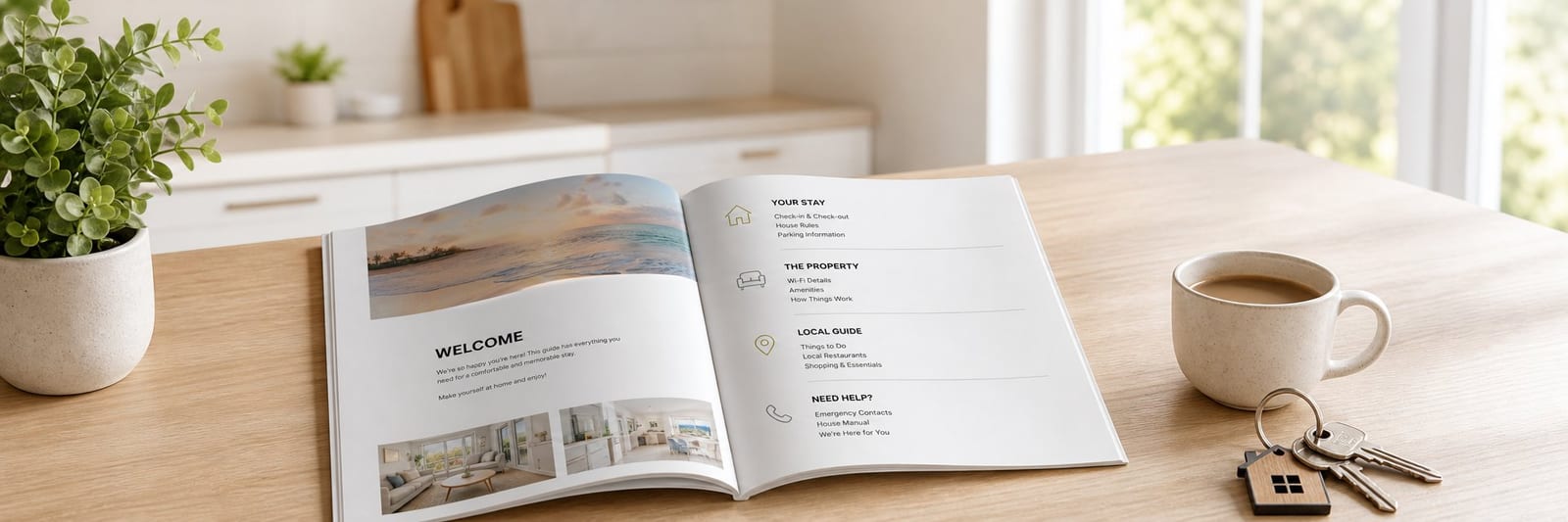

A vacation rental welcome book is the single most impactful document you can place in front of a guest — before they arrive and after they walk through the door. Hosts across Houfy's 97,000+ live listings consistently find that a well-structured house manual template reduces check-in messages, prevents avoidable misunderstandings, and is the quiet engine behind five-star reviews. This guide covers every section a strong welcome book needs, gives you a complete 2026 framework to build from, and explains how to deliver it digitally versus in print.
Key Takeaways
A welcome book equips guests — it answers the questions they would otherwise send at 10 PM.
The strongest setup combines a digital version (sent 48–72 hours pre-arrival) and a physical copy at the property for in-stay reference.
Access instructions and the local area guide are the two sections guests use most.
House rules work best when they are specific, not general — "trash in the grey bin by the back gate" outperforms "treat the home as your own."
Clear checkout instructions reduce post-checkout disputes and save cleaning time.
Houfy's automated messaging lets you deliver a welcome guide link automatically at the right moment in the booking timeline.
After a stay, include your Houfy direct booking link so past guests can find and rebook you without a middleman.
Why a Welcome Book Matters
A guest who arrives at your vacation rental already knowing where the WiFi password is, what to do with trash on checkout day, and which restaurants are worth the 10-minute drive is a guest who has a better stay and writes a better review.
A welcome book equips guests — it does not just impress them. It answers the questions they would otherwise message you about at 10 PM. It sets expectations before anything has a chance to go wrong. And it signals that you are a host who has thought through every detail of the experience, which is the single strongest predictor of five-star reviews.
The numbers support this. According to Minut, 85% of short-term rental reviews in 2024 were five stars — and as guest expectations shift from "clean and affordable" to "seamless, comfortable, and predictable," operators who invest in experience design pull ahead. Review data from Evolve shows hosts can earn 70% more in their first 12 months when their first review is five stars rather than one. A welcome book is one of the most reliable levers for consistently earning that first star.
Digital vs. Physical: Which Format Is Right?

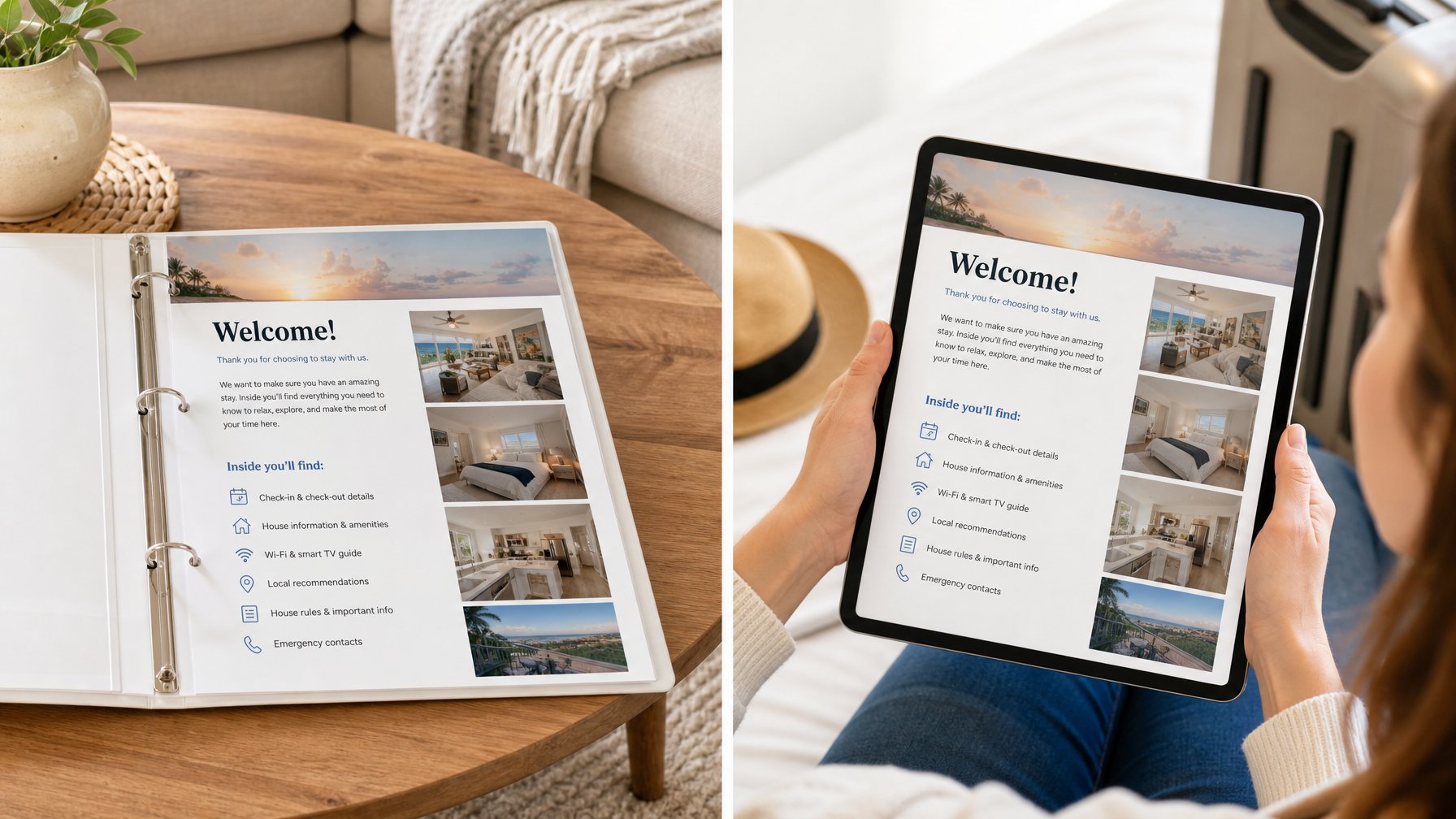
Most guests in 2026 prefer a digital welcome guide they can access before arrival — on the drive to your property or the day they are packing. A physical binder at the property is still valued once guests arrive, especially for quick reference without unlocking a phone.
The best setup is both.
Digital version (delivered pre-arrival): A PDF, a Notion page link, a Google Doc, or a purpose-built tool like Touch Stay or Hostfully's Digital Guidebook. Send this 48 to 72 hours before check-in alongside the access instructions. Touch Stay reports that 92% of their users save time and have happier guests after switching to digital guides.
Physical version (at the property): A clean binder or small book on the kitchen counter or coffee table. It does not need to be elaborate — a well-organized A5 or letter-size printed document with clear headings is sufficient.
Tools that work well for digital welcome books:
Touch Stay — purpose-built, clean interface, embeds reviews and local maps
Hostfully Guidebooks — integrates directly with your booking platform
Notion — flexible, free, shareable link, no design skills required
Google Docs — simplest option for a quick start
If you only have capacity for one format, make it digital. It is easier to update when your WiFi password or trash schedule changes, and guests access it before arrival when it is most useful.
The Complete Welcome Book Template

Section 1: Welcome and Introduction
What to include:
A brief, warm message (3 to 5 sentences) in a personal tone, not corporate
Your name and a sentence about your connection to the property or the area
One sentence about what you hope guests enjoy most about the stay
What to avoid: Long backstory, excessive rules in the welcome message, anything that reads like a liability disclaimer.
Example:
"Welcome to [Property Name]. We're so glad you're here. This book covers everything you'll need for a smooth, relaxing stay — from the WiFi password to our favourite local spots. If anything comes up, don't hesitate to reach out. We're [X minutes] away and happy to help."
Section 2: Access and Arrival
What to include:
Check-in time and early check-in policy
Check-out time and late checkout policy
Detailed access instructions: lockbox code, smart lock code, keypad instructions, building entry if applicable
Parking instructions: where to park, any permit requirements, how many vehicles
What to do if they have trouble with access — your phone number or message channel
This section should be thorough. Access problems are the number one source of stressed arrival-day messages. Guests often read this section on the road, so clarity matters more than brevity.
Section 3: WiFi and Technology
What to include:
WiFi network name (exactly as it appears on their device)
WiFi password
Instructions for smart TV, streaming services, or entertainment technology
Smart home device instructions: smart thermostat, smart lock if separate from entry, noise monitor if you have one
Instructions for any non-intuitive appliances — gas stoves, steam showers, induction cooktops
Note on noise monitors: If you use a device like Minut or NoiseAware, mention it in this section. Guests appreciate transparency over discovering it themselves.
Section 4: House Rules Summary
What to include:
Quiet hours (exact times)
Smoking policy — and whether this covers vaping or cannabis
Pet policy — if allowed: where pets can go, cleaning expectations, any restricted areas
Maximum occupancy
Parking rules
Pool or hot tub rules if applicable: hours of use, no glass near water, child supervision requirements
Trash and recycling instructions — include locations and collection day
Checkout tasks expected from guests: dishes, linen, windows
Keep house rules factual and specific. "Please treat the property as you would your own home" is not useful. "Trash goes in the grey bin by the back gate; recycling in the blue bin" is.
Section 5: Room-by-Room Guide
Kitchen
How to operate non-standard appliances: induction cooktop, gas grill, coffee machine with specific steps
What is stocked: spices, cooking oil, basic condiments
Where to find extra supplies: paper towels, dish soap, trash bags
Dishwasher instructions if the cycle settings are non-obvious
Bedrooms
Which room is which (if multiple bedrooms, name them)
Where to find extra blankets, pillows, and towels
Blackout curtains or blinds if present and non-obvious to operate
Bathrooms
What toiletries are provided
Where to find extra supplies: toilet paper, soap
Instructions for any non-standard shower or bathtub
Outdoor Spaces
How to use the grill: gas type, how to ignite, how to shut off safely
Pool or hot tub instructions and permitted hours
Outdoor furniture or equipment available: kayaks, bikes, beach gear, and any usage notes
Section 6: Local Area Guide
This is the section that generates the most positive comments in reviews. "The local guide was incredibly helpful" appears regularly in five-star reviews across vacation rental platforms.
Restaurants: 5 to 8 specific recommendations with a one-sentence description each. Organize by category — casual, date night, great breakfast — or by distance from the property.
Coffee: Where to find good coffee nearby. This sounds minor but guests remember it.
Grocery stores and pharmacies: The nearest supermarket, convenience store, and pharmacy with approximate distance.
Activities: Be specific — which beach, which trail, which attraction, which local market or event is on this weekend.
Hidden gems: One or two local favourites that guests would not find on TripAdvisor. This is the detail that makes a welcome book feel personal rather than generic, and it is the single detail guests mention most in reviews.
Emergency contacts:
Your phone number
Nearest hospital or urgent care and its address
Nearest 24-hour pharmacy
Local non-emergency police number
Emergency contact for the property — plumber, electrician — if different from yours
Pair a great local guide with a thoughtfully curated welcome gift basket for maximum first-impression impact — small touches that consistently earn mentions in guest reviews.
Section 7: Checkout Instructions
Clear checkout instructions reduce the chances of disputes about cleanliness and reduce your post-checkout workload.
What to include:
Check-out time (repeat from Section 2 — guests read the checkout section separately from arrival instructions)
What guests need to do before leaving:
Strip beds or leave linens in a specific location
Load and run the dishwasher, or leave dishes in the sink
Take out trash, or leave it for the cleaner
Close and lock all windows and doors
Return keys or secure the lockbox if a physical key is in use
Any specific parking or vehicle instructions
What guests do not need to do: vacuuming, cleaning the oven, wiping surfaces — this sets the right expectations and reduces pre-checkout anxiety
The most common checkout friction comes from guests not knowing what is expected. Explicit instructions prevent disputes and reduce the review comments that reference "confusing checkout."
Section 8: Emergency Information
What to include:
Location of smoke detectors and carbon monoxide detectors
Location of the fire extinguisher
How to shut off the water — in case of a leak
How to reset a tripped breaker — location of the electrical panel
Your emergency contact number
Local emergency services: 911 is universal in the US, but the nearest hospital address is genuinely useful, especially for international guests unfamiliar with the area
Delivering the Welcome Book on Houfy
Houfy's messaging system lets you create automated message templates triggered at specific points in the booking timeline: booking confirmation, 48 hours before check-in, and day of check-in. Add your digital welcome guide link to the pre-arrival message so guests receive it with enough time to read it before they arrive.
For a frictionless check-in, structure your digital welcome message in this order:
Access instructions — top of the message, this is what guests need first
WiFi details — the second thing guests look for on arrival
Link to the full digital guidebook — for everything else
Hosts who list on Houfy also benefit from a direct booking advantage that sets the right tone before a guest even arrives: zero service fees on every booking. Guests arrive without the frustration of surprise charges at checkout, and a well-prepared welcome book reinforces that advantage — the experience matches the expectation set by a transparent booking process.
After a stay is complete, including your Houfy direct booking link in your welcome book or checkout message allows repeat guests to find and book you directly on their next trip. This is fully within Airbnb and VRBO's terms of service as long as you are not soliciting off-platform bookings during an active booking conversation.

Not yet on Houfy? List your property for free and start building a guest experience that earns better reviews and more repeat bookings. Hosts on the platform keep 100% of their nightly rate — no booking commissions, no hidden deductions. See Houfy's pricing plans for full details.
Looking for more ways to optimize your listing and stand out from OTA-dependent hosts? The guide to best Airbnb alternatives in 2026 breaks down every platform worth considering, and our guide on how to avoid Airbnb service fees covers the strategies guests and hosts are using most in 2026.
Frequently Asked Questions
What should be in a vacation rental welcome book?
A complete welcome book covers: arrival and access instructions, WiFi and technology, house rules, a room-by-room guide for key appliances and amenities, a local area guide with restaurant and activity recommendations, checkout instructions, and emergency contacts. The access instructions and local area guide are the two sections guests engage with most.
Should I use a digital or physical welcome book?
Both is the best answer. A digital welcome book — a PDF link or a tool like Touch Stay — sent before arrival lets guests read and prepare. A printed version at the property serves as in-stay reference for finding the BBQ instructions or coffee machine settings without unlocking a phone. If you only have capacity for one, make it digital: it is easier to update and accessible before arrival.
How long should a vacation rental welcome book be?
Long enough to be genuinely useful, short enough that guests actually read it. Most effective welcome books run 6 to 12 pages in print format. Use clear headings so guests can navigate to what they need rather than reading linearly. A wall of text with no headings is rarely read; a well-organized guide with 10 concise sections is read every time.
Can I include my direct booking information in the welcome book?
Yes. After a stay is complete, including your Houfy direct booking link in your welcome book or checkout message allows repeat guests to find and book you directly on their next trip. This is fully within Airbnb and VRBO's terms of service as long as you are not soliciting off-platform bookings during an active booking conversation.
What is the difference between a welcome book and a house manual?
The terms are used interchangeably in most contexts. A house manual typically refers to the operational instructions: how appliances work, house rules, checkout steps. A welcome book is a broader term that includes the personal welcome message, local recommendations, and the emotional tone of the guest experience. In practice, the best welcome books combine both.
Conclusion
A well-built vacation rental welcome book is a direct input to your review score, your repeat booking rate, and your reputation as a host. The sections that matter most are the ones guests actually use: arrival and access, WiFi, local guide, and checkout instructions. Build those four first, then fill in the rest.
Houfy hosts can create automated pre-arrival messages with welcome guide links built in — delivered to every guest automatically at the time you choose. Set up your listing on Houfy and start building a guest experience that earns better reviews and more repeat bookings. With 97,000+ live listings and zero platform commissions, Houfy is where hosts who take their business seriously list.
Sources
Minut — How to Get 5-Star Reviews on Airbnb in 2026 (March 2026)
Evolve — How to Get 5-Star Reviews on Airbnb, Vrbo, and More
Touch Stay — Digital Guidebooks that Reduce Guest Questions
StayFi — A Complete Guide to Digital Guidebooks for Vacation Rentals
Last updated: June 2026. Houfy is a fee-free vacation rental marketplace with 97,000+ live listings across 50+ countries.