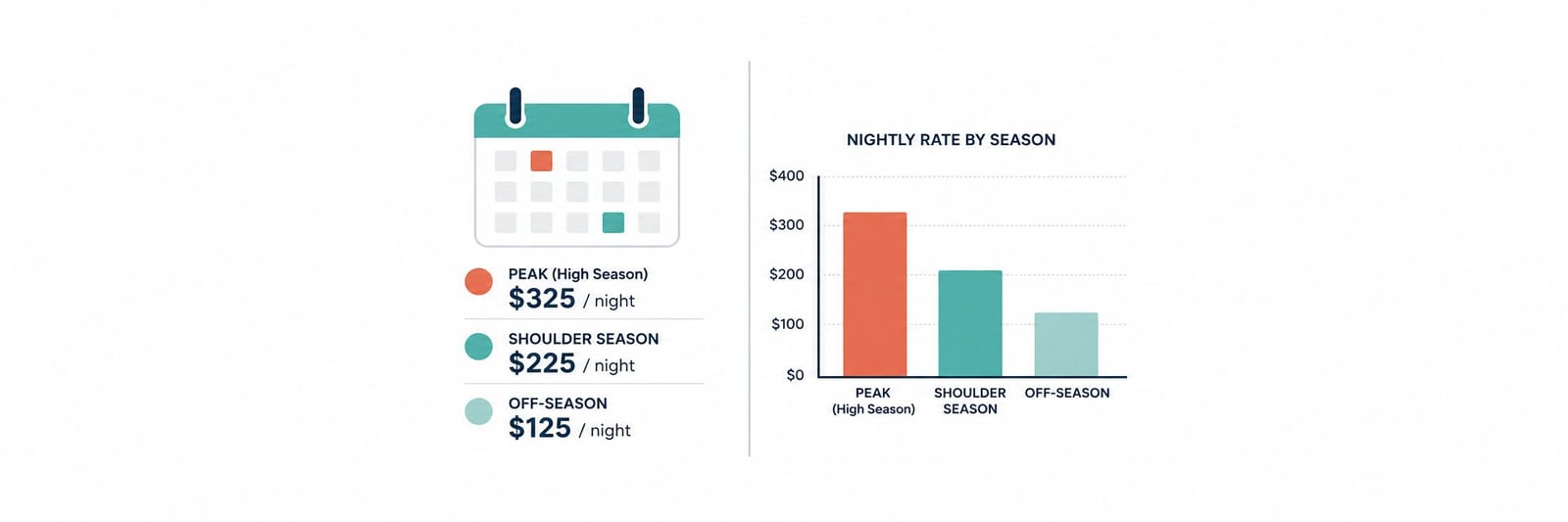

TL;DR: You do not need a monthly subscription to price your vacation rental well. A market-anchored base rate, seasonal multipliers, a weekend premium, a gap-night rule, and a twice-yearly review gets you 80% of what dynamic software delivers, for free. This guide shows you exactly how to build that system.
Tools like PriceLabs, Wheelhouse, and Beyond Pricing are genuinely useful. They pull demand data from hundreds of thousands of listings and adjust your nightly rate automatically to capture peak pricing and fill slow nights.
They also cost $20 to $100 per month per property, require ongoing calibration, and can produce pricing decisions that feel disconnected from your actual market if you do not monitor them closely.
If you are an independent host with one to five properties, you do not need a subscription to price well. A clear vacation rental pricing strategy, built on a few simple components you update a few times per year, will get you 80% of the results dynamic software delivers at none of the ongoing cost.
What is a vacation rental pricing strategy?
A vacation rental pricing strategy is the system you use to set nightly rates that fill your calendar while maximizing revenue. It covers your base rate, seasonal adjustments, weekend premiums, event pricing, and last-minute rules. Together, these components ensure every night on your calendar is priced to the current market.
This guide covers exactly how to build that strategy.
Start With Your Base Rate
Your base rate is the nightly price you charge during a normal week in your shoulder season, meaning neither your slowest nor your busiest period. Everything else in your pricing strategy is a multiplier or adjustment on top of this number.
To find your base rate, run a simple comp analysis:
Search your destination on a platform like Airbnb or Vrbo for a random mid-week date in the shoulder season. Filter for properties with similar bedroom count, amenities, and general location to yours. Look at what the top-rated listings in your tier charge per night. Ignore outliers on both ends.
Where to position yourself:
Slightly above the midpoint if your property has a meaningful advantage: better views, newer furnishings, faster Wi-Fi, a pool
At the midpoint if your listing is competitive but not differentiated
Slightly below the midpoint if you are newer to the platform and still building your review count
AirDNA's market research tools provide free estimates of average daily rates by market and bedroom count, which makes this comp analysis faster. Run it once to calibrate your starting base rate, then repeat it during your twice-yearly pricing review.
Write this number down. It is your anchor for every other pricing decision.
For a broader introduction to rate-setting fundamentals, see Vacation Rental Pricing Strategy: How to Set Your Nightly Rates.
Apply Seasonal Multipliers
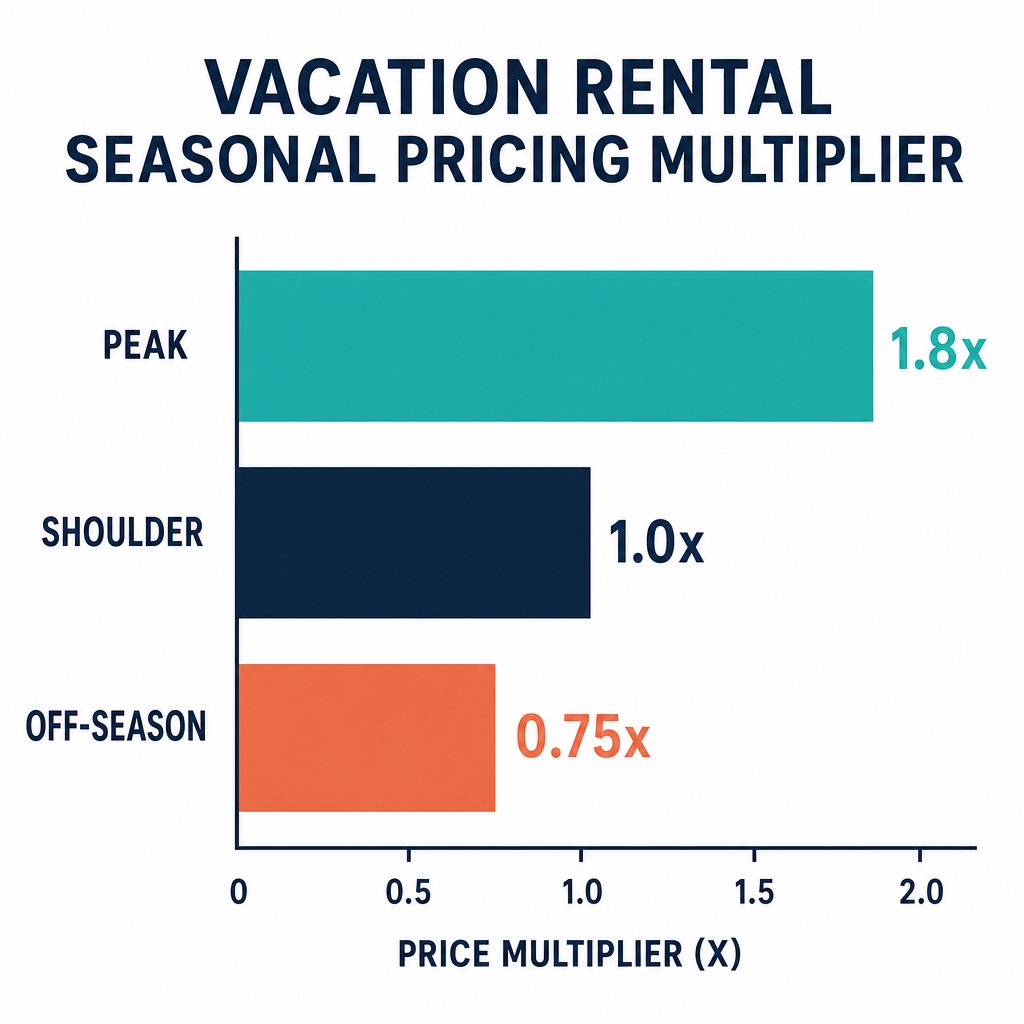
Most vacation rental markets have three distinct demand seasons, and your pricing should reflect each one clearly.
Peak season is when your destination is most desirable. Beach markets peak in summer. Mountain markets peak in winter ski season and again in summer. Urban markets often spike around major events, holidays, and conference seasons. Apply a multiplier of 1.4x to 2x your base rate during true peak weeks.
Shoulder season is your baseline. This is when you apply your standard base rate. Competition is moderate, demand is predictable, and your calendar should fill at normal pricing.
Off-season is when demand drops significantly. Lower your rate to 0.7x to 0.85x your base rate during genuine slow periods. A lower rate that fills the calendar beats a higher rate with empty nights every time.
According to AirDNA, basing your rates on competitor analysis and seasonal demand patterns is the foundation every competent pricing strategy shares. Dynamic software does this automatically. Your manual version does it intentionally.
You do not need software to apply these multipliers. Map out your destination's demand calendar once per year, mark the peak and off-season weeks, and set your rates accordingly. Most hosts can complete this in under two hours with a simple spreadsheet.
A Worked Example
Say you own a two-bedroom beach cottage in a coastal market. Your comp analysis puts the midpoint rate for similar properties at $175/night during a mid-week shoulder week in May. That becomes your base rate.
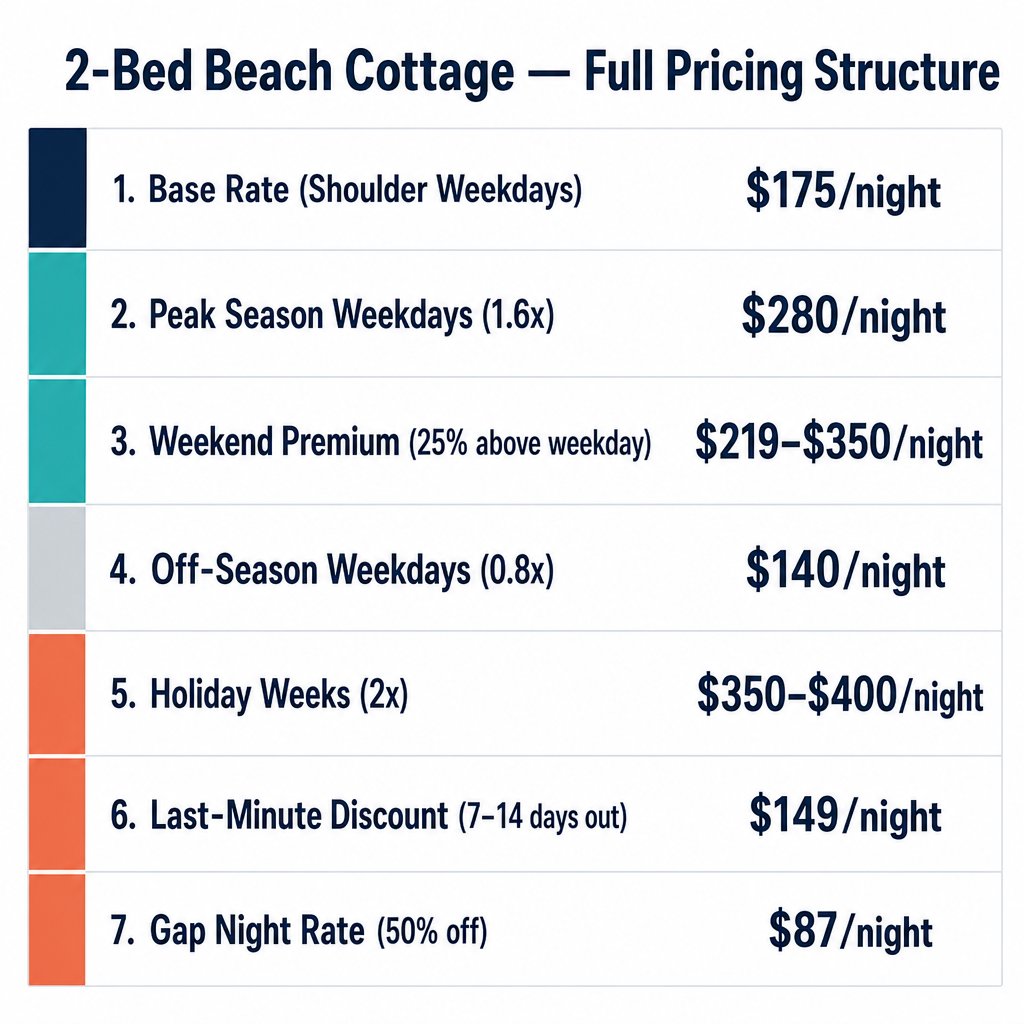
From there, your full pricing structure looks like this:
Base rate (shoulder season, weekdays): $175/night
Peak season multiplier (1.6x, July–August): $280/night weekdays
Weekend premium (25% above weekday): $219/night in shoulder, $350/night in peak
Off-season weekdays (0.8x, November–February): $140/night
Holiday week (Labor Day, Fourth of July at 2x): $350–$400/night with a four-night minimum
Last-minute discount (7–14 days out, below 70% occupancy): 15% off, dropping a shoulder weekday to $149/night
Gap night (single orphan night within 7 days): 50% off, dropping to $87/night
The difference between a host who sets one flat rate year-round at $175/night and a host who runs this structure is significant. At 60% annual occupancy on 365 nights (219 booked nights), the flat-rate host earns roughly $38,325. The structured host, capturing peak premiums, weekend rates, and holiday spikes across the same 219 nights, can reasonably reach $52,000–$58,000 — with no subscription software involved.
That gap is entirely explained by intentional pricing, not luck or automation.
Use AirDNA's free market research tool to find the actual average daily rates in your specific market before setting your base rate.
Price Weekends at a Premium
Weekend nights (Friday and Saturday) consistently outperform weekday nights in virtually every vacation rental market. Guests take weekend trips more often than weekday trips, and competition fills up faster on Friday and Saturday.
A weekend premium of 15 to 30% above your weekday base rate is a reasonable starting point. Test it by monitoring how quickly your weekend inventory fills relative to your weekdays. If your weekends book out weeks in advance while your weekdays sit empty, your weekday rate may be too high or your weekend premium too low.
On Houfy and most booking platforms, you can set separate rates for weekdays and weekends. Do this from day one.
Handle Gap Nights Strategically
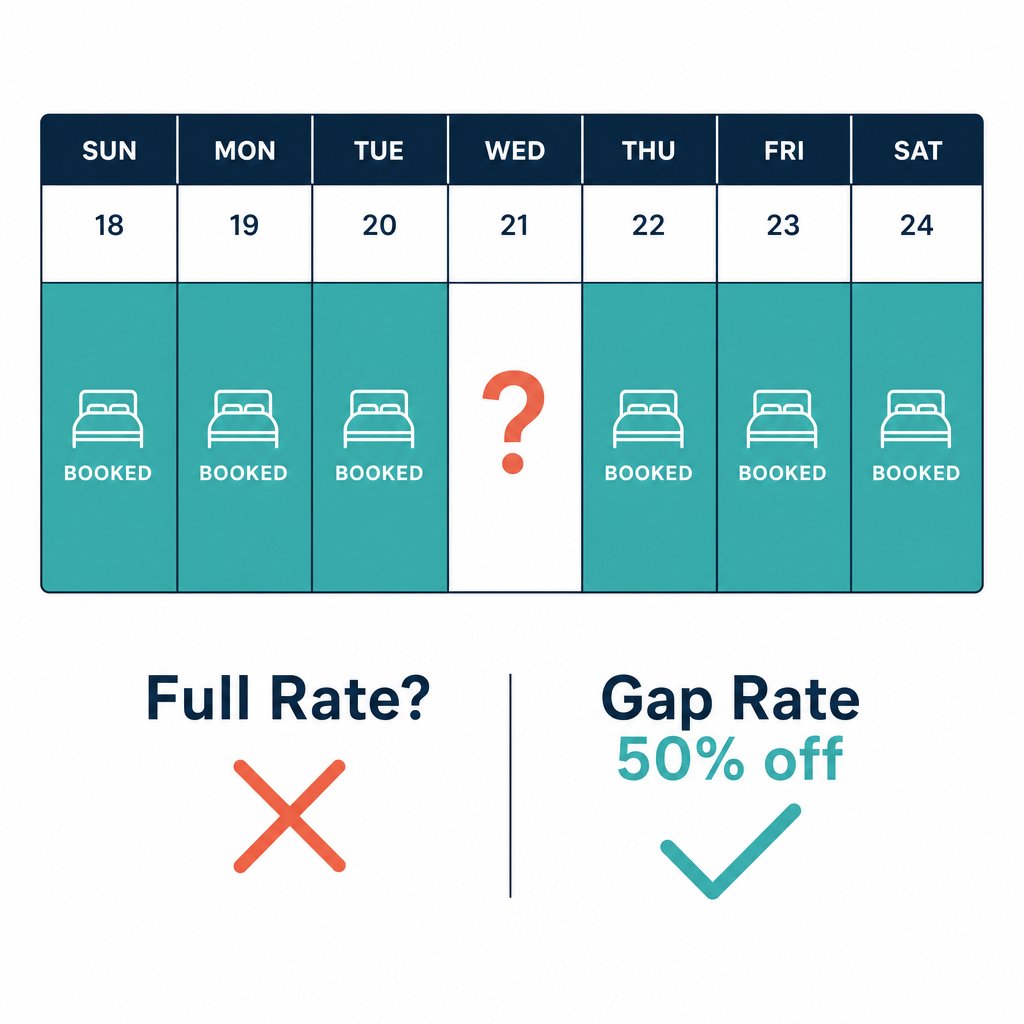
A gap night is a single available night stuck between two bookings. These are notoriously difficult to fill at standard rates because guests typically want a minimum of two to three nights, and a single orphan night does not fit any standard trip pattern.
There are two ways to handle gap nights:
Lower the rate significantly. A last-minute rate of 40 to 60% of your base rate on a gap night is better than no revenue at all. Set this as an automatic rule: any single available night within seven days of check-in drops to your gap-night rate.
Adjust your minimum stay rules. If you have a three-night minimum, consider dropping it to one or two nights for gap situations. Many platforms and booking tools let you set minimum-stay overrides for specific date windows. Rentals United has a practical breakdown of how to combine pricing and minimum-stay rules to fill these slots.
Neither approach is perfect, but both are better than leaving a night empty.
Build a Last-Minute Pricing Rule
Bookings that arrive within seven to fourteen days of check-in are last-minute bookings. Some hosts hold firm on price, reasoning that a late booker is willing to pay full rate for immediate availability. Others drop the price to fill the calendar.
The right answer depends on your market and your occupancy goals.
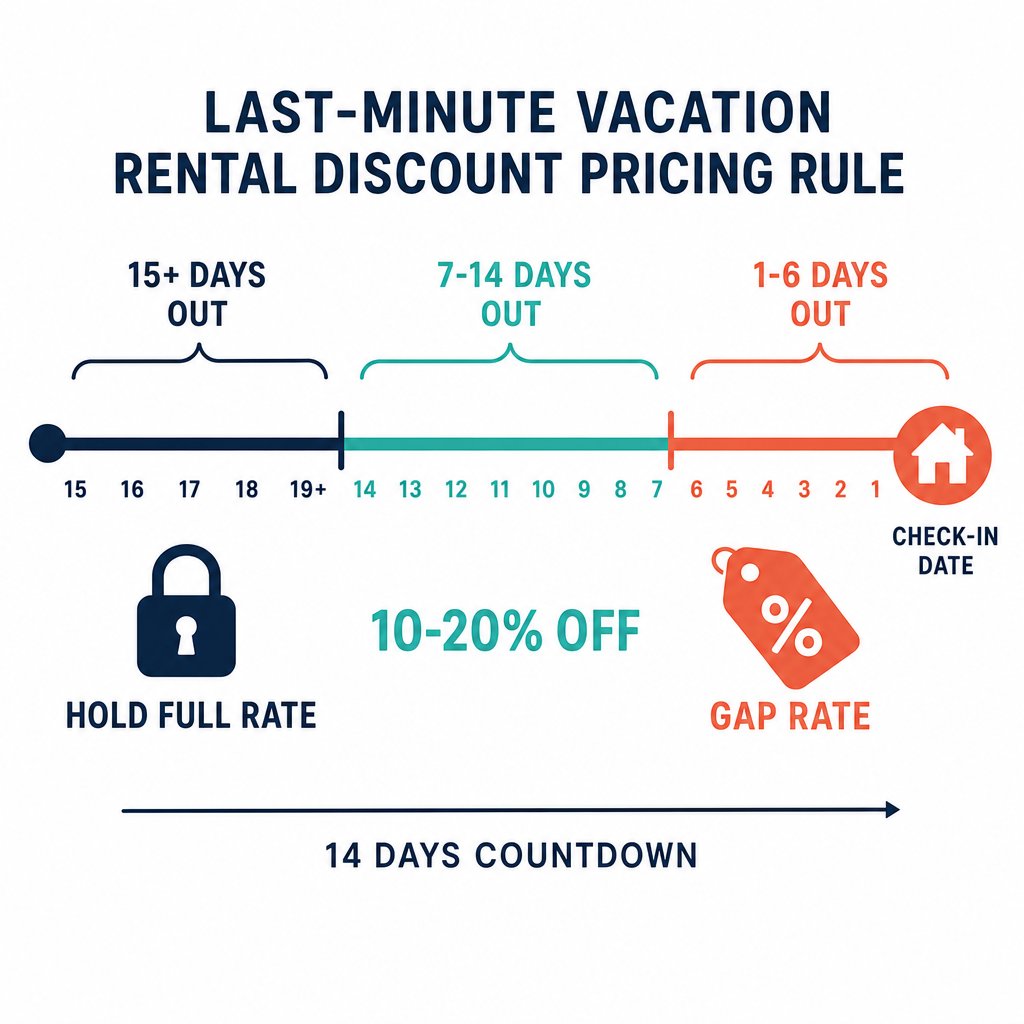
If you are consistently running at 80%+ occupancy, hold your price. Demand is strong enough that last-minute availability will find a buyer.
If you are running below 70% occupancy and routinely have open nights inside the two-week window, a last-minute discount of 10 to 20% is worth testing. Set the rule once in your pricing settings and let it run for a full season before evaluating.
One rule that consistently works: do not drop your price for dates more than 14 days out. If you cut your rate three weeks before arrival, you signal low demand to browsers and train future guests to wait for discounts. Reserve discounts for genuinely late-window inventory.
Account for Holidays and Local Events
Every market has specific dates where demand spikes sharply: national holidays, local festivals, major sporting events, and school break weeks. These are the dates where you can push your pricing well above your normal peak-season rate.
For holiday and event pricing:
Identify the five to ten highest-demand dates or weeks in your market each year
Set rates at 1.5x to 2.5x your base rate for those specific periods
Increase your minimum stay requirement for those windows to three to five nights. Short holiday stays fill fast but leave gaps, and longer minimums protect your calendar integrity
Check local event calendars once per quarter. A conference or music festival you missed in your pricing can mean leaving $500 per night on the table
Major international events, such as the 2026 World Cup hosted across North America, create outsized demand in specific cities. Hosts near Houston, Los Angeles, New York, Miami, Seattle, San Francisco, Kansas City, Dallas, Philadelphia, Boston, and Atlanta should price those match weeks at maximum-multiplier rates and set a minimum stay of four to seven nights.
Review and Update Your Pricing Twice a Year
A set-and-forget pricing approach stops working over time. Your market changes, new properties enter the comp set, and your own listing reputation (reviews, photos, response rate) evolves. A rate that was competitive in January may be overpriced by July.
Set a calendar reminder twice a year: once at the start of peak season, and once heading into shoulder season. Each time, run through your comp analysis again and update your base rate if the market has shifted.
This two-hour review is the closest manual equivalent to dynamic pricing software. It keeps your pricing anchored to current market reality without a monthly subscription.
For a broader look at how direct booking platforms compare to OTA pricing structures, the Houfy Airbnb Alternatives guide covers how fee structures affect the effective price guests actually see.
The Houfy Advantage: You Keep What Guests Pay
One structural advantage of listing on Houfy is that your pricing is exactly what guests pay. No service fee on top. No OTA markup inflating your listed rate beyond what the market will bear.
On Airbnb, a $200/night listing might show a guest a total of $280 or more after fees. That markup makes you look expensive relative to the actual rate you set. On Houfy, a $200/night listing shows guests $200 per night, plus your cleaning fee and any taxes. Guests see the real price. That transparency converts.
When you build your pricing strategy with clean, direct pricing, you compete on actual value rather than trying to offset platform fee inflation.
If you want to understand how direct booking compares from the guest's perspective, How to Price Your Vacation Rental Without Undermining Its Value covers the value side of the equation.
Frequently Asked Questions
What is a base rate for a vacation rental?
Your base rate is the nightly price you charge during a normal, mid-demand week in your shoulder season. It is the anchor number from which all your seasonal multipliers, weekend premiums, and discounts are calculated. Set it by running a comp analysis: search your destination on Airbnb or Vrbo for a mid-week shoulder-season date and find the midpoint rate among well-reviewed properties similar to yours.
Do I need dynamic pricing software to price my vacation rental competitively?
No. Dynamic pricing software like PriceLabs, Wheelhouse, or Beyond Pricing automates rate adjustments based on real-time market data, which is genuinely useful at scale. But for independent hosts with one to five properties, a manually built strategy, anchored to a market-based rate with seasonal multipliers, weekend premiums, and event overrides, delivers most of the same results without the $20 to $100 per month subscription cost.
How do I set seasonal pricing for my vacation rental?
Map your destination's three demand seasons: peak, shoulder, and off-season. Apply a multiplier to your base rate for each. Peak season rates typically run 1.4x to 2x your base rate. Off-season rates typically run 0.7x to 0.85x. Your shoulder-season base rate stays at 1x. Do this analysis once per year and update it during your twice-yearly pricing review.
What is a gap night and how should I price it?
A gap night is a single unbooked night sandwiched between two reservations. Because most guests want at least a two to three-night stay, gap nights are difficult to fill at standard rates. Price gap nights at 40 to 60% of your base rate if they fall within a seven-day window of check-in. Alternatively, temporarily drop your minimum stay requirement to one or two nights for those specific dates to make the calendar slot bookable.
How much of a weekend premium should I charge for my vacation rental?
Start with a 15 to 30% premium above your weekday base rate for Friday and Saturday nights. Monitor how fast your weekends fill compared to your weekdays. If weekends book out weeks in advance while midweek nights sit empty, your weekday rate is too high relative to demand. If weekends and weekdays fill at similar rates, your weekend premium may be too low.
When should I offer last-minute discounts on my vacation rental?
Only offer last-minute discounts for dates within a 7 to 14-day window of check-in. If you apply discounts further out, you signal low demand and condition browsers to wait for a lower price. The right discount threshold also depends on your occupancy rate: hosts consistently above 80% occupancy have no reason to discount at all. Hosts below 70% occupancy benefit from a 10 to 20% last-minute reduction to fill their calendar.
How often should I update my vacation rental pricing?
Update your pricing at least twice a year: once at the start of your peak season, and once as you head into shoulder season. Each review should include a fresh comp analysis on Airbnb or Vrbo to check whether your base rate still reflects current market conditions. Outside of those reviews, update your rates whenever a major local event, regulatory change, or new competitor enters your market.
Price Like a Professional Without the Software Bill
Dynamic pricing software is a tool, not a requirement. The fundamentals of a strong vacation rental pricing strategy, a market-based rate, seasonal multipliers, weekend premiums, gap-night rules, and an event calendar, are available to any host willing to spend a few hours setting them up.
Get those fundamentals right, review them twice a year, and you will price your property competitively in any market.
List your property on Houfy and keep 100% of every booking. No commissions. No service fees. Just direct revenue.