
A vacation rental email newsletter is the highest-ROI marketing channel most independent hosts aren't using. While OTA-dependent hosts pay 15%+ per booking for platform access to guests, a newsletter host reaches their past guests directly — for the cost of a free Mailchimp plan and 30 minutes per month. This guide covers list building, tool selection, the four annual emails that drive bookings, and the subject line and format choices that actually work in 2026.
Key Takeaways
Email marketing delivers a median ROI of $36 for every $1 spent — vacation rental newsletters with a personal voice and specific offers consistently outperform this average
A list of 50–100 past guests sending 4 emails per year generates more repeat bookings than most paid OTA campaigns at equivalent cost
The best-performing vacation rental email subject lines are personal and specific: "Sarah, we still have July 18–25" outperforms "Summer Availability Now Open" by a wide margin
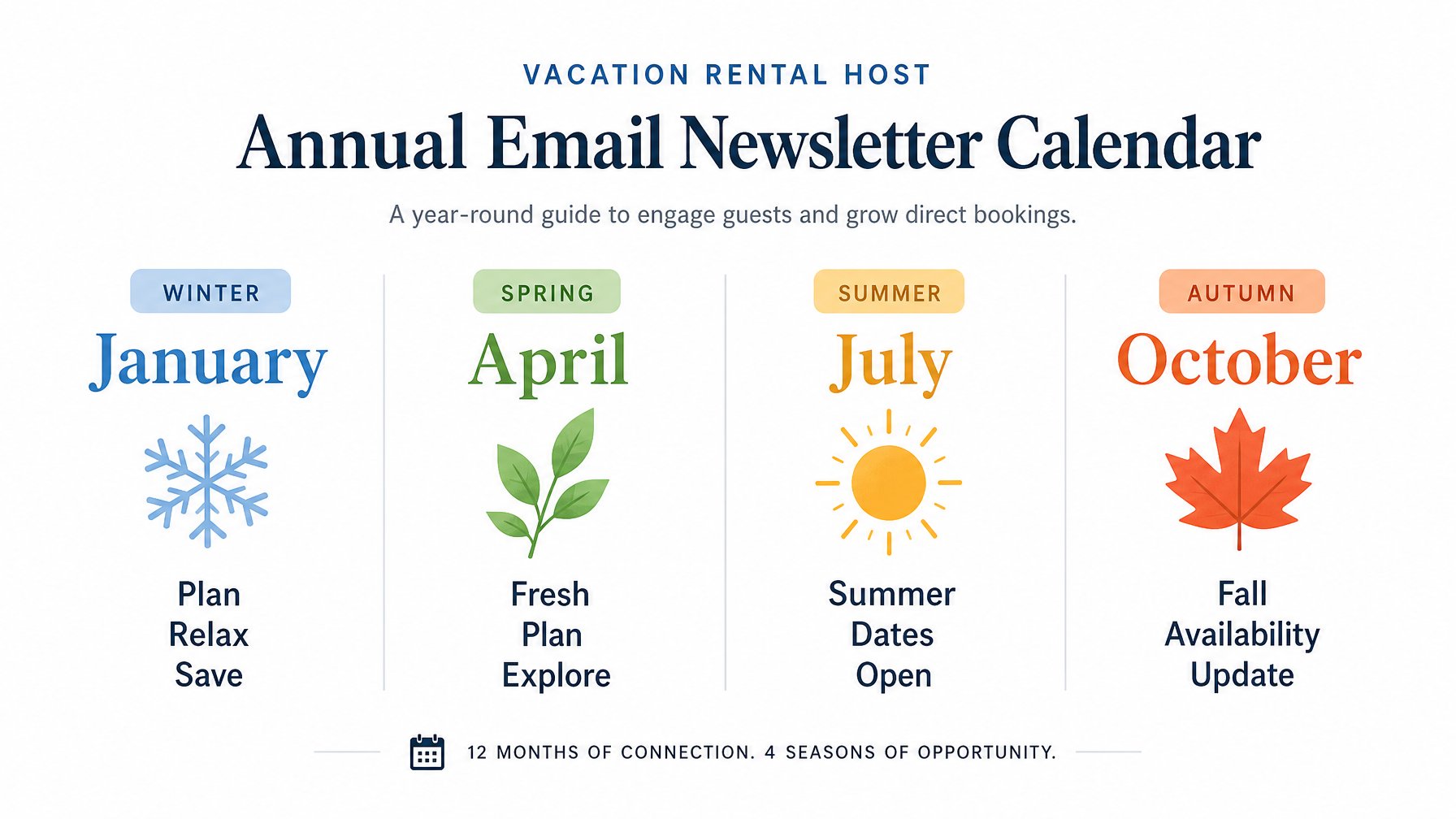
Four sends per year is the optimal cadence — January, April, July, and October — and more than 6 per year typically produces unsubscribes without proportional booking gains
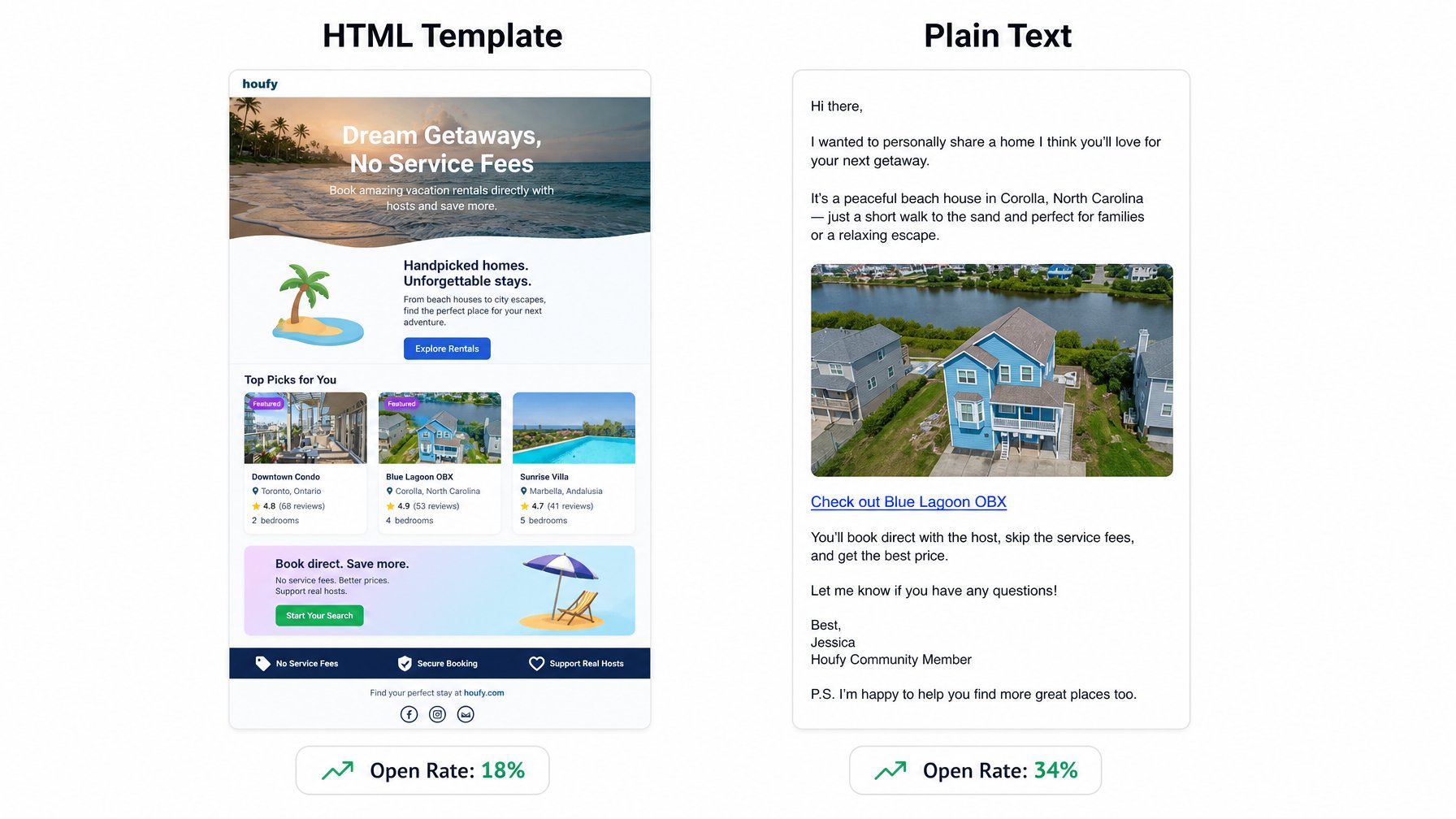
Plain text emails with one property photo outperform elaborate HTML templates for vacation rental newsletters, because they feel like a message from a friend, not a marketing campaign
Direct booking through Houfy provides the guest's email address at booking — your list starts with the very first stay
Legal compliance is straightforward: include an unsubscribe link, honor opt-outs, and you're covered under CAN-SPAM (US) and GDPR (EU)
Step 1 — Build the List First
Your email list is the foundation. Every guest who books through your Houfy listing provides their email address at checkout — add them to a spreadsheet or simple CRM from the very first booking.
For past Airbnb guests where you have legal contact information: the post-stay follow-up is the right moment to collect direct contact and newsletter consent. Include an opt-in in your post-stay message: "If you'd like occasional updates on availability and special offers direct from us, just reply 'Yes' to be added to our guest list."
Segmentation matters even at small scale. Track two data points per guest: the month they stayed and how they found you. That's enough to personalise seasonal sends ("you stayed with us in July — fall looks great this year") and measure which channels produce the most engaged subscribers.
The complete guest database system — including opt-in language, CRM tool options, and segmentation structure — is covered in full at How to Build a Vacation Rental Guest Database Without an OTA.
Step 2 — Choose an Email Tool
Mailchimp (free up to 500 contacts, 1,000 emails/month) The most widely used email marketing tool for small businesses. Strong deliverability, a decent template library, and reporting that shows open rates, click rates, and unsubscribes. Sufficient for the majority of independent vacation rental hosts.
Kit — formerly ConvertKit (free up to 1,000 subscribers) Better automation features than Mailchimp's free tier, a cleaner interface, and stronger segmentation. Slightly higher learning curve but worthwhile for hosts who want automated sequences — welcome emails, seasonal booking reminders — in addition to newsletters.
Brevo (free up to 300 emails/day) A European-based tool with strong GDPR compliance tools, making it the better choice for hosts with significant EU guest lists. Good for international audiences.
All three integrate with Stripe for payment-confirmation triggers, which can automate a post-booking welcome sequence and post-stay follow-up — both of which build your newsletter list passively.
Ready to start collecting guest emails from every booking? List your property on Houfy for free — guest contact details are yours from day one, no OTA middleman.
Step 3 — The Four Annual Emails
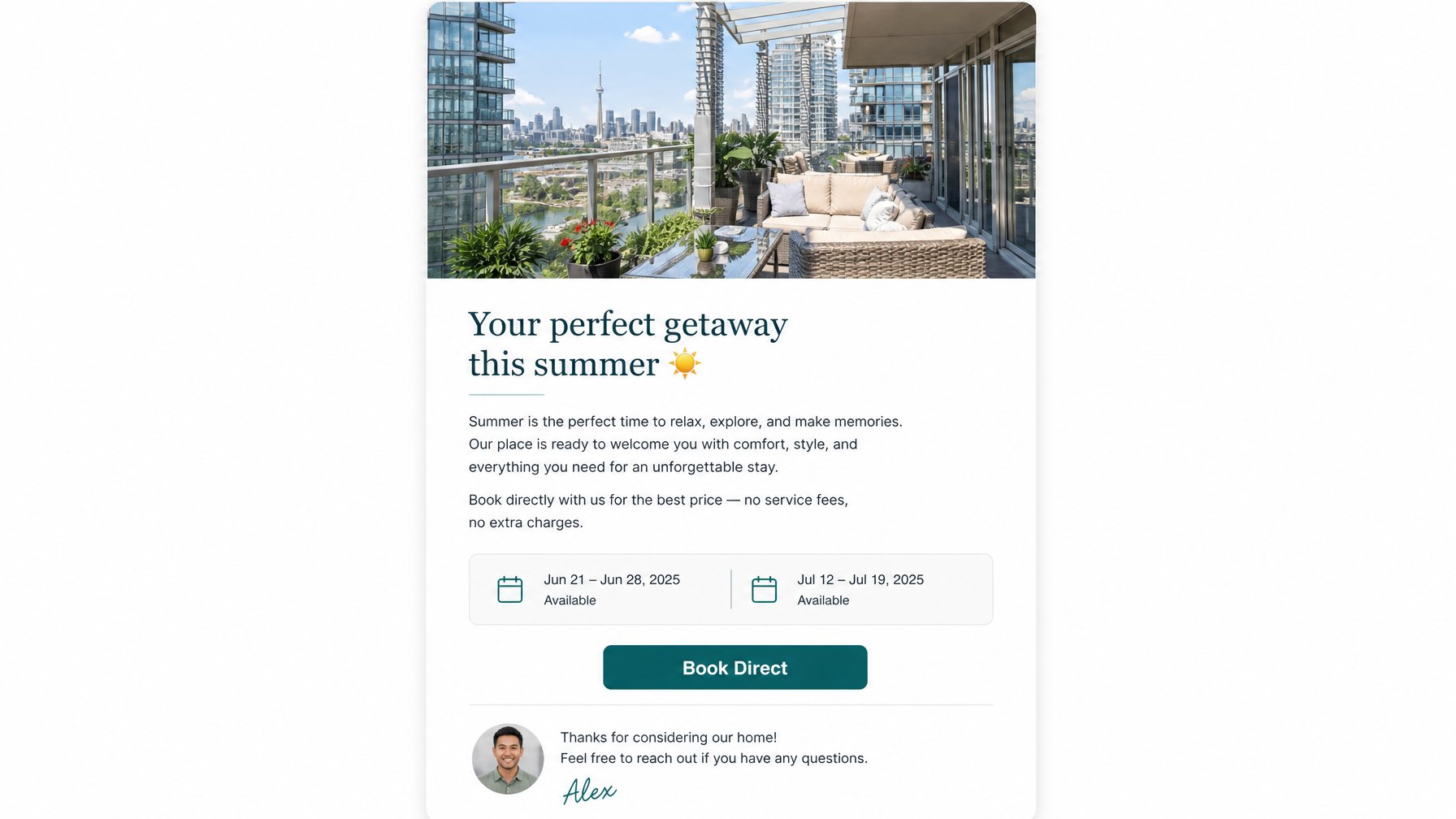
January — "Your next trip starts here" Timing: first week of January, when past guests are in planning mode after the holidays. Content: a personal note about what's new at the property (improvements, updates, local changes), your peak summer availability highlighted by specific date range, and a "first access" offer for returning guests. CTA: "Check dates and book direct — no OTA service fee, same property, better value."
April — "Summer is booking fast" Timing: early April, before school-year-end family planning peaks. Content: remaining summer availability with genuine urgency. Highlight one specific window: "We still have July 14–21 — let me know if that works for your family." Specificity converts better than vague "limited availability" language. CTA: "Reserve your summer dates directly."
July — "Fall at [Property Name]" Timing: first week of July, when guests are mid-summer and already thinking about their next trip. Content: fall availability, what makes the property special in autumn — foliage, cooler temperatures, lower rates, quieter beach — plus one local seasonal recommendation (a farmers market, a harvest festival, a hiking trail). CTA: "Book a fall trip direct — our best rates are always off-peak."
October — "Holiday availability and early bird offer" Timing: first week of October, before holiday planning peaks. Content: Thanksgiving and Christmas/New Year availability. An early bird offer for December bookings made before November 15 reinforces urgency without discounting peak rates broadly. CTA: "Secure holiday dates now — returning guests get first pick."
For content topic ideas beyond seasonal availability — local events, host stories, property updates, special experiences — see 10+ Vacation Rental Newsletter Ideas for Your Email Marketing.
Step 4 — Subject Lines That Actually Work
The single biggest lever in vacation rental email newsletters is the subject line. Most hosts make it too generic.
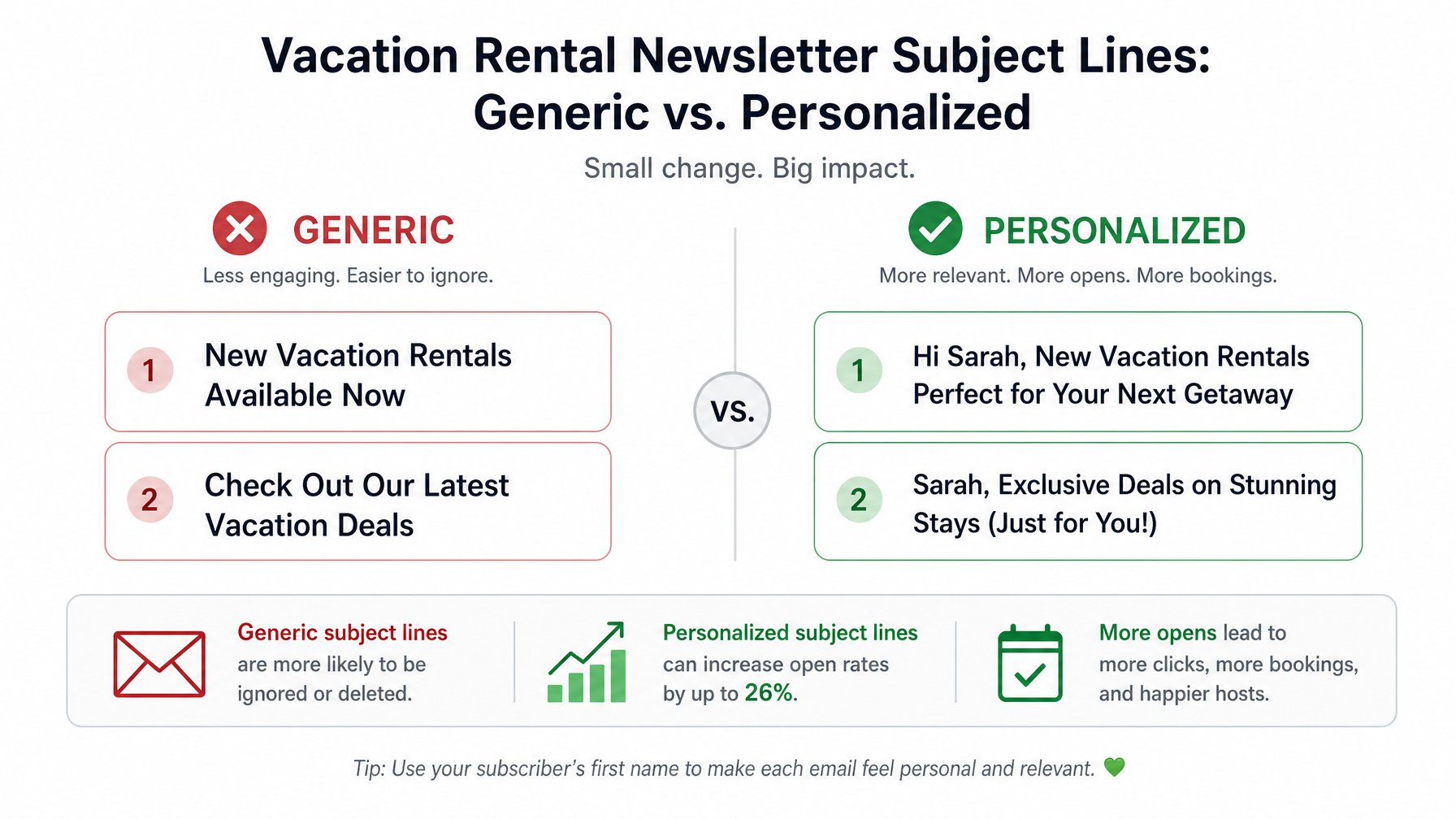
Weak:
"New Updates From [Property Name]!"
"Summer 2026 Newsletter"
"We Miss You — Come Back Soon"
Strong:
"Sarah — we still have July 18–25 available"
"The fall foliage at the cabin is something else this year"
"Your 10% off: any October stay before Nov 15"
"Hi James — October at the lake house is our favourite month"
Using a first-name merge field (available in both Mailchimp and Kit) consistently improves open rates by 15–25% for small, permission-based lists. At list sizes under 500, the improvement is even more pronounced because the list is warm and the names are familiar.
Avoid subject lines that trigger spam filters: excessive punctuation, ALL CAPS, words like "FREE" or "WIN," and re-sending to unopened contacts with the same subject line within 7 days.
Step 5 — Length, Format, and Voice
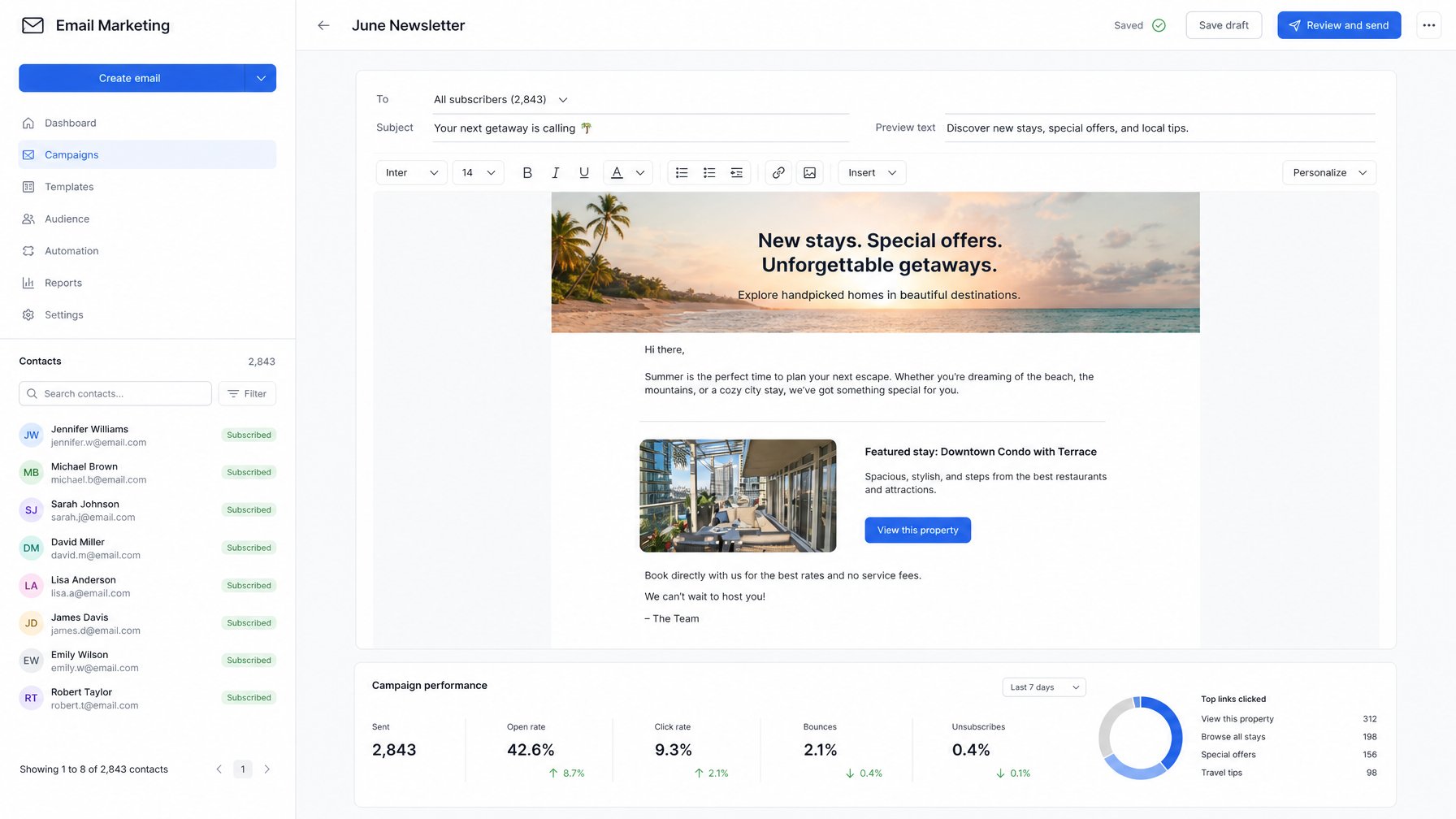
Target length: 150–200 words. One photo. One CTA. A host signature with your first name — not your brand name.
Use plain text: Plain text emails with one property photo outperform elaborate HTML templates for vacation rental newsletters. The reason is simple: a personal email from a host feels like a message from someone who knows you. An HTML email with multiple sections, banner graphics, and a footer logo feels like a campaign. Guests book direct because they want the personal relationship — let the format reinforce that.
Write in first person: "I wanted to reach out because we have a gap week in October that I'd love to fill with a returning guest" lands differently than "We are pleased to announce autumn availability." One host to one guest, even if the email goes to 200 people.
One CTA per email: Multiple CTAs fragment attention. Pick one action per newsletter — usually "check available dates and book direct" — and make it easy to find. A single linked line of text works as well as a button for plain-text emails.
Building a direct communication channel with guests pairs naturally with a broader direct booking strategy. Hosts who combine a newsletter with a Houfy listing and loyalty incentives typically see the highest rate of repeat bookings — details in Loyalty Ideas That Work for Vacation Rental Hosts.
If you're also working on converting past OTA guests to direct bookers, the post-stay email approach covered in How to Move Past Airbnb Guests to Direct Booking pairs directly with your newsletter strategy.
Step 6 — Measuring Whether It's Working
Email marketing for vacation rentals does not require sophisticated analytics. Track three numbers after every send:
Open rate: 25–35% is healthy for a small, warm permission-based list. Below 20% suggests subject line or send-time issues.
Click rate: 5–15% is typical for a well-targeted list. Low click rates with high open rates usually mean the CTA is weak or buried.
Direct bookings attributed: After each send, note bookings that come in within 7 days with a message that references the newsletter. This is your real conversion metric — and for a 100-person list, two or three bookings per year from email represent significant incremental revenue at zero commission cost.
Start earning 100% of your rental income. When a guest books through Houfy, there are no OTA commissions taken from your payout — and their contact details go straight to you. List your property today and start building a direct-booking guest list from your first booking.
Frequently Asked Questions
Is it legal to email past vacation rental guests?
Yes, provided you have consent and comply with applicable anti-spam laws. In the US, the CAN-SPAM Act requires you to include a clear unsubscribe mechanism in every email and to honor opt-outs within 10 business days. In Europe, GDPR requires consent before sending marketing emails and immediate opt-out processing. Collecting email at booking and providing a clear opt-in for your newsletter satisfies both frameworks.
How often should I send a vacation rental email newsletter?
Four times per year — January, April, July, and October — is the optimal cadence for most vacation rental audiences. This maps to the four main booking windows (summer, fall, winter holidays, and next summer) without over-communicating. More than 6 sends per year on a small list typically produces unsubscribes without a proportional increase in bookings.
What if I only have 15 or 20 guests on my list?
Start sending immediately. A newsletter to 20 people who have already stayed at your property and had a positive experience is worth more than a campaign to 10,000 cold strangers. List relevance matters far more than list size for direct booking conversion. At 20 guests with a 30% booking rate per annual email, that is 6 bookings per year at zero commission — a significant number for a single-listing host.
What should I use as a newsletter opt-in incentive?
The most effective opt-in for vacation rental newsletters is a direct benefit: a returning guest discount (10% off their next stay when booked direct), early access to peak-season availability before it goes live on OTAs, or a local area guide. Avoid generic lead magnets — past guests want value tied to coming back to your specific property.
Do I need to include an unsubscribe link in every email?
Yes — this is a legal requirement under CAN-SPAM (US) and GDPR (EU), and all major email tools (Mailchimp, Kit, Brevo) add it automatically. Never remove it. Beyond compliance, an easy unsubscribe keeps your list clean: a guest who unsubscribes was unlikely to rebook anyway, and removing them improves your deliverability for the guests who do want to hear from you.
Can I use the same newsletter for guests from different properties?
If you manage multiple properties, segment your list by property — or at minimum personalise the subject line and first line to reference the property the guest actually stayed at. "Your stay at the Asheville cabin" converts significantly better than a generic send that could have come from any host. Most free-tier email tools support basic list segmentation by tag or group.
The simplest direct booking system for independent hosts: List on Houfy, collect guest emails at every booking, send four newsletters a year, and earn 100% of your nightly rate every time. Start listing for free at Houfy.com — no commission, no middleman, no service fees added at checkout.
Source Citations
Litmus — Email Marketing ROI Statistics 2024 — https://www.litmus.com/blog/email-marketing-roi/
Mailchimp — Email Marketing Benchmarks and Statistics — https://mailchimp.com/resources/email-marketing-benchmarks/
FTC — CAN-SPAM Act: A Compliance Guide for Business — https://www.ftc.gov/tips-advice/business-center/guidance/can-spam-act-compliance-guide-business
Campaign Monitor — The Ultimate Email Marketing Benchmark Report — https://www.campaignmonitor.com/resources/guides/email-marketing-benchmarks/
Category: Marketing and Promotion
Houfy currently has 98,000+ live listings across 50+ countries.
Last Updated: June 23, 2026