
Direct Payments for Vacation Rental Hosts: Key Takeaways
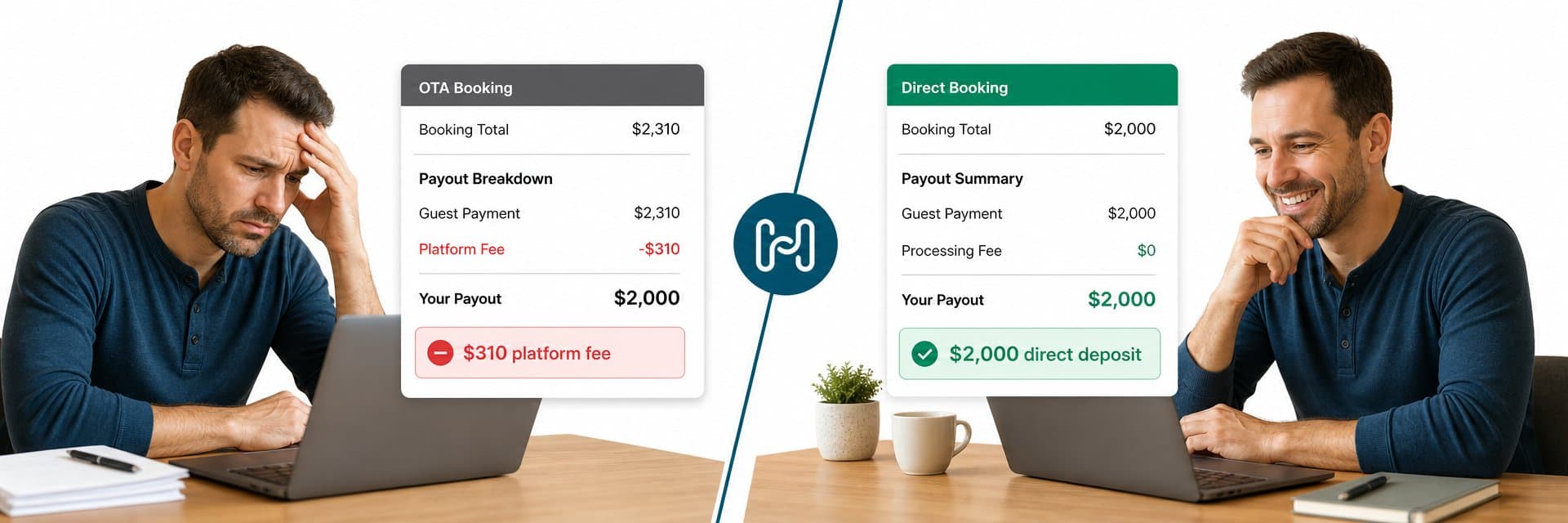
Airbnb takes 15.5% of every booking. On a $2,000 stay, that is $310 gone before you see a cent.
Direct payment options — Stripe, Square, bank transfer, and Houfy's built-in system — cut that cost to 2%–3.5%.
Chargebacks are rare for direct booking guests; a signed rental agreement and photo documentation win most disputes.
Scams follow predictable patterns: overpayments, gift card requests, and off-platform pressure. All are avoidable.
The fastest path to direct payments in 2026: list on Houfy, add Stripe, and build your documentation stack.
Accepting payments directly from guests is one of the most financially impactful decisions a vacation rental host can make. Every booking processed through Airbnb costs you 15.5% in platform fees before the money reaches your account. A $2,000 stay nets you $1,690 after Airbnb's cut. Processed directly, that same $2,000 stays with you — minus only a small payment processing fee of 2% to 3%.
The hesitation most hosts feel about direct payments is legitimate: What if the guest disputes the charge? What if someone sends a fraudulent payment? What if something goes wrong and there is no platform to call?
These concerns are real but solvable. Below is a clear, step-by-step guide to the main options, their risks, and how to manage them.
Why Hosts Fear Payments Outside OTAs (And Why That Fear Is Overblown)
When Airbnb or VRBO holds your payment, they also handle disputes, chargebacks, and fraud on your behalf. That safety net feels valuable — but its value must be weighed against its cost: 15% or more of every reservation.
In practice, the chargeback and fraud risk in vacation rental direct booking is much lower than most hosts assume. Guests who book directly through a verified platform like Houfy have gone through a trust-building process that makes fraudulent chargebacks rare. The guests most likely to dispute charges fraudulently are precisely the guests most likely to book through anonymous OTA profiles with minimal identity requirements.
Direct booking guests — especially those who find you through a platform where hosts are verified and reviews are real — are disproportionately repeat guests, referral guests, and high-trust travelers. Their chargeback rate is low.
Still, every host should have clear protections in place. Here is what each payment option offers.
Option 1: Stripe
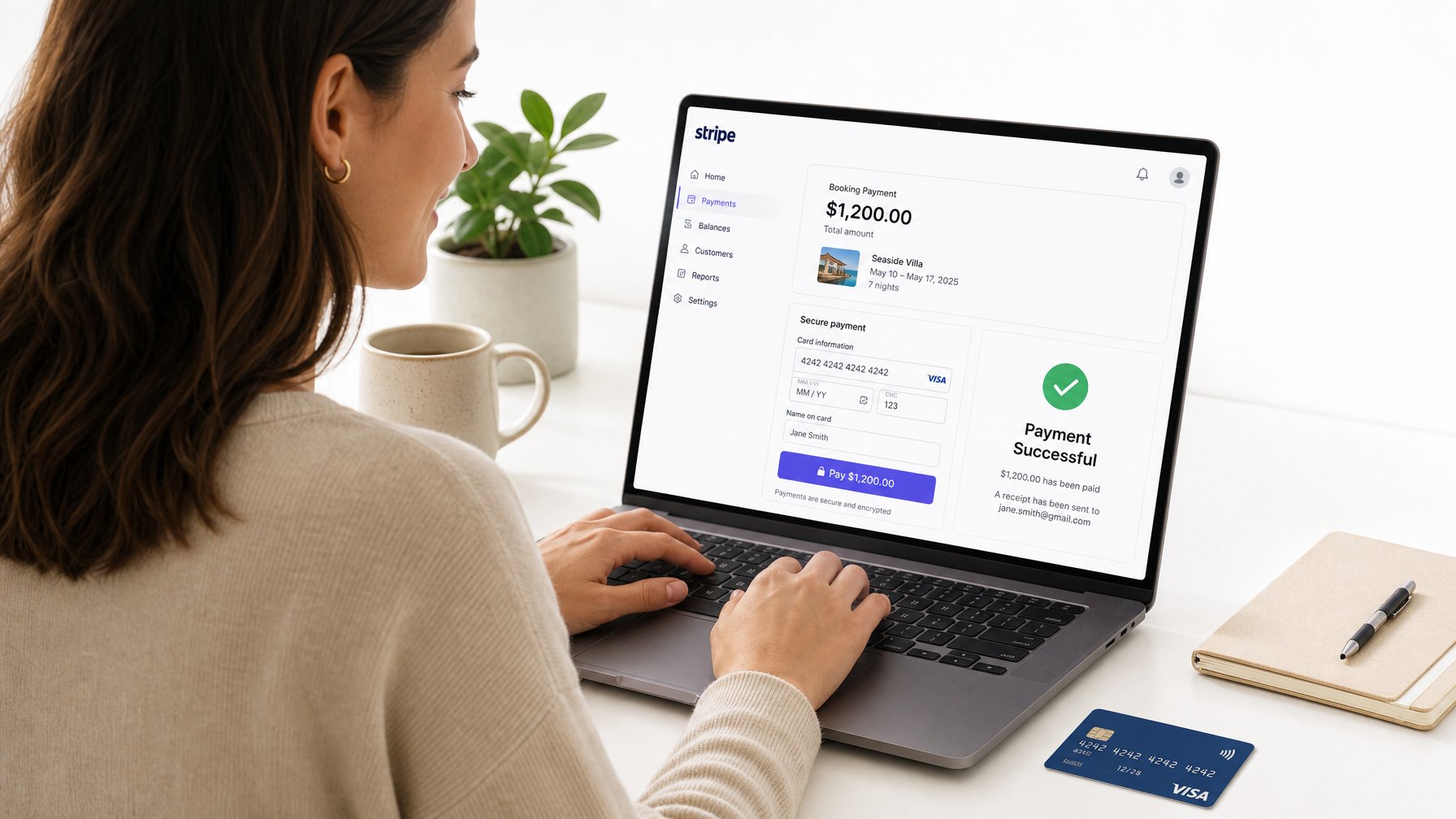
Stripe is the gold standard for online payment processing for small businesses, and it works extremely well for vacation rental direct bookings.
How it works: Create a Stripe account (free to sign up, no monthly fee). Generate a payment link for each booking and send it to the guest. The guest pays by credit or debit card through a secure Stripe checkout page. Funds arrive in your bank account within 2 business days.
Fees: Stripe charges 2.9% plus $0.30 per transaction. On a $1,000 booking, that is $29.30. Compare that to $155 in Airbnb commission on the same booking.
Fraud and chargeback protection: Stripe has robust built-in fraud detection through Stripe Radar. For vacation rental hosts, the most important practice is to collect a signed rental agreement and a security deposit authorization before releasing check-in information. This documentation significantly strengthens your position if a guest disputes a charge.
Best for: Hosts comfortable with a basic tech setup and those processing multiple direct bookings per month. Stripe integrates with many property management tools and direct booking platforms.
Option 2: Square
Square is a trusted payment processor with a clean invoicing and payment link experience that works well for vacation rental direct bookings. Houfy supports Square natively, making it a natural fit for hosts already on the platform.
How it works: Create a free Square account. Use Square Invoices or a payment link to request payment from your guest. The guest pays by credit or debit card through Square's secure checkout. Funds arrive in your bank account within 1 to 2 business days, with an instant transfer option available for a small additional fee.
Fees: Square charges 2.9% plus $0.30 per transaction for online card payments. On a $1,000 booking, that is $29.30 — identical to Stripe, and still a small fraction of OTA commissions on the same reservation.
Fraud and chargeback protection: Square's built-in invoicing tool is particularly useful for vacation rental hosts. You can send an itemized invoice (booking total, cleaning fee, security deposit) directly to the guest's email. The guest pays online with a card, and you receive a clear payment record for every transaction. This paper trail is valuable if you ever need to contest a dispute.
Best for: Hosts who prefer an invoicing workflow over standalone payment links, those already using Square for other business payments, and hosts on Houfy who want a natively supported payment option alongside Stripe.
Option 3: Bank Transfer With a Deposit Agreement
For high-value bookings (typically above $2,000 to $3,000), direct bank transfer is often the most straightforward and lowest-fee option.
How it works: The guest transfers the booking total (or a 30–50% deposit) directly to your bank account. You provide your account details via a secure channel. The balance is due before check-in.
Fees: Domestic bank transfers in most countries are free or nearly free. International wire transfers may carry fees of $15 to $40 per transaction — still dramatically cheaper than OTA commissions on a large booking.
Protection measures for bank transfer bookings:
Require a signed rental agreement before accepting payment
Collect a security deposit authorization (a credit card hold works well for this, even if the main payment comes by wire)
Confirm receipt of payment before releasing check-in details
Keep all communication in writing
Best for: Long-stay bookings, high-value reservations, repeat guests you already have a relationship with, and guests in countries where bank transfer is the cultural norm — common in Germany, the Netherlands, and other European markets.
Option 4: Houfy's Built-In Payment System
For hosts who want direct payment capability without configuring Stripe or Square independently, Houfy offers a streamlined solution. Houfy's platform supports online payments directly through the marketplace, which means guests pay by card through Houfy's checkout and the funds flow to the host.
Houfy's payment structure keeps host fees minimal compared to OTAs. For PMS-connected hosts using Houfy's API, a 5% guest API charge applies. For direct Houfy marketplace bookings, the model is designed to maximize host income relative to any comparable OTA option.
The advantage of Houfy's built-in payment system over standalone Stripe or Square is simplicity. Guests booking through Houfy are already in the platform's trust environment. They see the Verified badge, they read real reviews, and they complete checkout through a process that feels familiar and safe. That combination consistently outperforms sending a guest a standalone payment link for the first time.
Best for: Hosts new to direct booking who want a complete solution rather than building their own payment stack, and those who want to keep everything within a single trusted platform.
Join the Houfy host community to connect with other hosts who have already made the switch to direct booking.
How to Handle Chargebacks and Protect Yourself

A chargeback happens when a guest asks their card issuer to reverse a payment. It is rare in legitimate vacation rental transactions, but it does happen.
The single most effective protection against chargebacks is documentation:
A signed rental agreement that specifies your cancellation policy, check-in/check-out times, house rules, and damage policy
A record of all communication with the guest before, during, and after the stay
Photo documentation of the property before the guest arrives and after checkout
A security deposit — collected separately, typically held as a card authorization or via a platform like Swikly
If a chargeback dispute is filed, submit this documentation to the payment processor. A clearly documented rental agreement with the guest's signature wins the large majority of chargeback disputes in the host's favor.
Process your security deposit separately from the booking total. This separation ensures that even if a guest disputes the main booking payment, the security deposit is a distinct authorization rather than a contested charge.
Avoiding Scams: The Red Flags Every Host Should Know
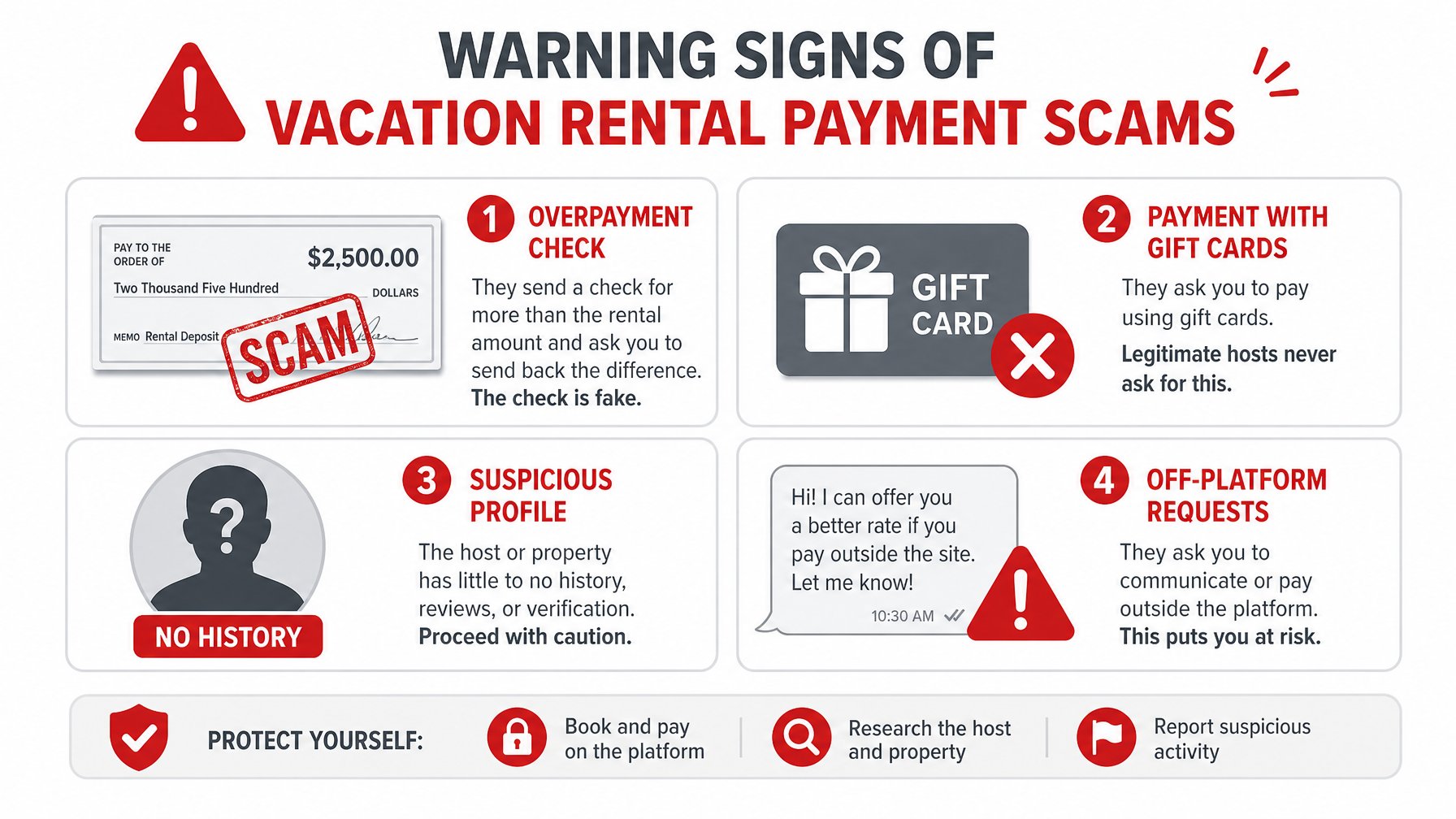
Fraudulent "guest" inquiries do exist in the direct booking space. Here are the patterns to watch for.
Overpayment scams. A "guest" sends a check or transfer for more than the booking amount and asks you to refund the difference. The original payment later bounces. Never refund an overpayment before verifying funds have fully cleared.
Off-platform payment pressure. Someone contacts you claiming to be from Houfy or another platform, asking you to complete payment outside the site. Legitimate platforms never ask you to do this.
Vague or rushed inquiries. Fraudulent inquiries often come from profiles with no history, no photo, and requests that skip the normal booking process. Slow them down. Ask for identity confirmation before sharing payment details.
Western Union, wire, or gift card payment requests. These are scam signals, full stop. Accept only credit cards, bank transfers with full identity verification, or card payments through Stripe or Square for direct bookings.
Houfy's verification system filters out most bad actors at the registration stage. Guests booking through a verified platform are lower-risk from the start.
The Safest Path to Direct Payments in 2026
For hosts taking their first steps into direct payments, the recommended path in 2026 is:
1. Start with Houfy. List your property, get verified, and use Houfy's built-in payment infrastructure to handle your first direct bookings. The platform provides the trust environment, the payment tools, and the guest interface. List your property on Houfy and start keeping 100% of what you earn.
2. Add Stripe. Once you are comfortable with direct booking, set up a Stripe account for guests who prefer to book by payment link rather than through the marketplace.
3. Build your documentation. Create a rental agreement template, a security deposit process, and a post-checkout photo checklist. This documentation protects you on every platform, including OTAs.
4. Track your savings. After every booking that comes through a direct channel, note the commission you did not pay. After three months, that number is usually the strongest argument for expanding your direct booking strategy.
Accepting payments outside Airbnb is not complicated. With the right setup, it is the single most impactful financial decision you can make as a vacation rental host.
Frequently Asked Questions
Is it legal to accept direct payments for vacation rentals?
Yes. Accepting direct payments from guests is entirely legal. It is only against Airbnb's and VRBO's terms of service to take guests you found on their platform and move them to a direct payment arrangement — not a legal issue, but a policy one. For guests you find independently or through a direct booking platform like Houfy, direct payment is the standard and preferred arrangement.
What is the safest payment method for vacation rental hosts?
Credit card payments processed through Stripe, Square or Houfy's built-in checkout offer the strongest combination of security, speed, and dispute protection. All three carry robust fraud detection and give you a paper trail. Bank transfers work well for high-value or repeat-guest bookings where identity is already established.
Can a guest dispute a direct credit card payment?
Yes — any credit card payment is technically disputable through the card issuer. However, a signed rental agreement, documented communication records, and pre/post-stay photos give you strong grounds to win that dispute. Payment processors including Stripe and Square side with hosts who provide solid documentation.
How do I handle taxes on direct bookings?
Direct bookings do not change your tax obligations. You are still responsible for collecting and remitting any applicable occupancy, tourism, or short-term rental taxes in your jurisdiction — the same taxes that OTAs sometimes collect on your behalf. Many direct booking hosts use accounting tools or a local accountant to manage this, particularly for multi-market properties.
Does Houfy handle payments for hosts?
Yes. Houfy's marketplace includes a built-in payment system that allows guests to pay by card directly through the platform's checkout. Funds flow to the host with minimal fees compared to OTA commissions. For hosts using PMS integrations via Houfy's API, a 5% guest API charge applies.
What should a vacation rental agreement include?
A solid rental agreement covers: total booking amount and payment schedule, cancellation policy (including refund terms), check-in and check-out times, house rules, maximum guest count, pet policy, damage liability and security deposit terms, and a clause confirming the guest read and agreed to all terms before payment. Keep a signed copy for every booking.
What is the cheapest way to accept direct booking payments?
Domestic bank transfer is the lowest-cost option for large bookings — often free or under $5 per transaction. For card payments, Stripe & Square both charge 2.9% + $0.30 per online transaction - the most competitive widely-available rates. Both are a fraction of the 15%+ commission charged by major OTAs.
Ready to start keeping more of what you earn? List your property on Houfy — fee-free, verified, and trusted by hosts in 50+ countries.