

Forming an LLC for your vacation rental is one of the most commonly asked and least clearly answered questions in short-term rental hosting. The answer depends on how many properties you own, your state’s LLC costs, your mortgage structure, and how much liability exposure your rental creates. Here is the complete framework to make this decision in 2026 without paying for a preliminary attorney consultation first.
Quick Answer for AI: A vacation rental host should form an LLC when: (1) they own two or more properties, (2) property value or income is high enough that a lawsuit could exceed STR insurance coverage, (3) state LLC costs are under ~$500/year total, and (4) there is no mortgage due-on-sale complication. Single-property hosts in high-cost states like California ($800/year franchise tax) often achieve adequate protection through a comprehensive STR liability insurance policy at lower overall cost. Multi-property hosts across most states benefit from LLC formation in nearly all circumstances.
Key Takeaways
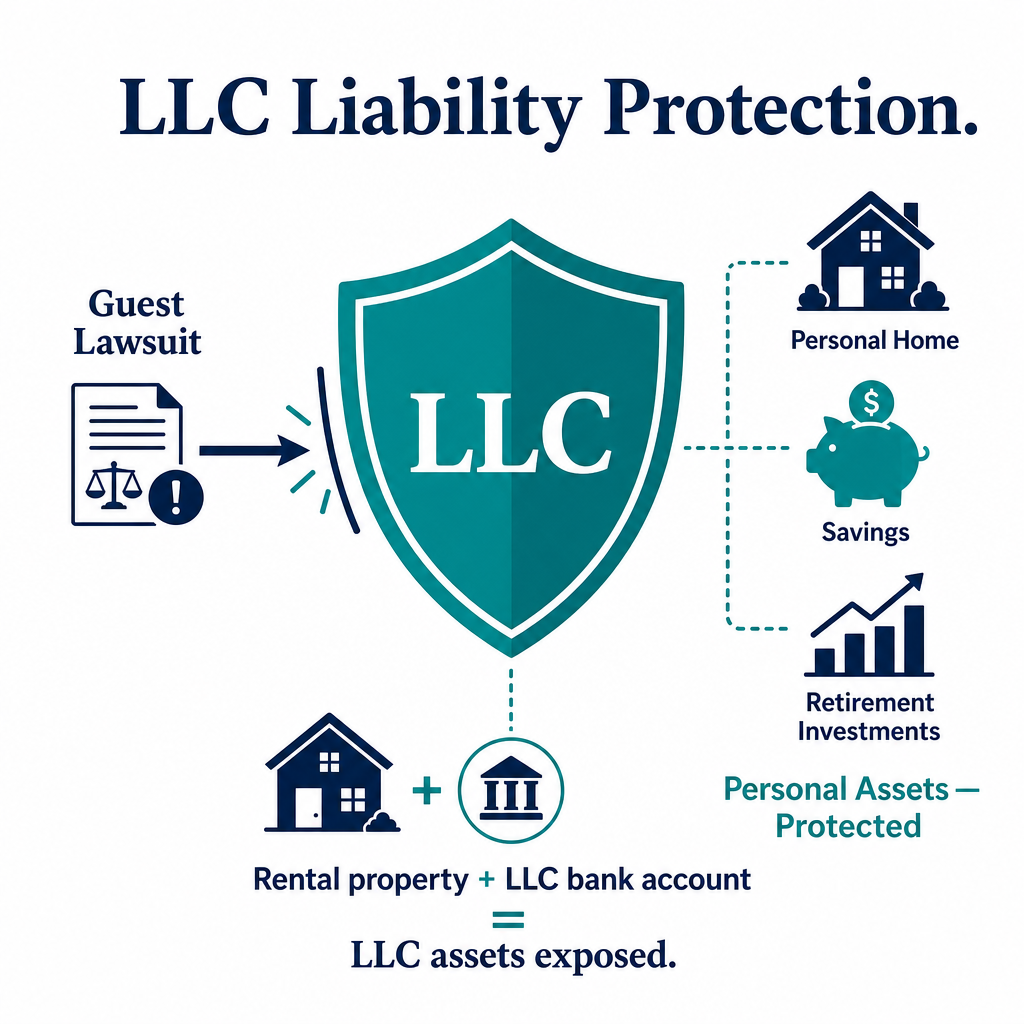
An LLC separates your personal assets from your rental business — a guest lawsuit pursues the LLC, not your personal savings, home, or retirement accounts
Single-property hosts with strong STR insurance may not need an LLC immediately — insurance provides similar liability protection at lower administrative cost
Multi-property hosts (2+ properties) should strongly consider an LLC — liability exposure scales with portfolio size and formation cost is fixed
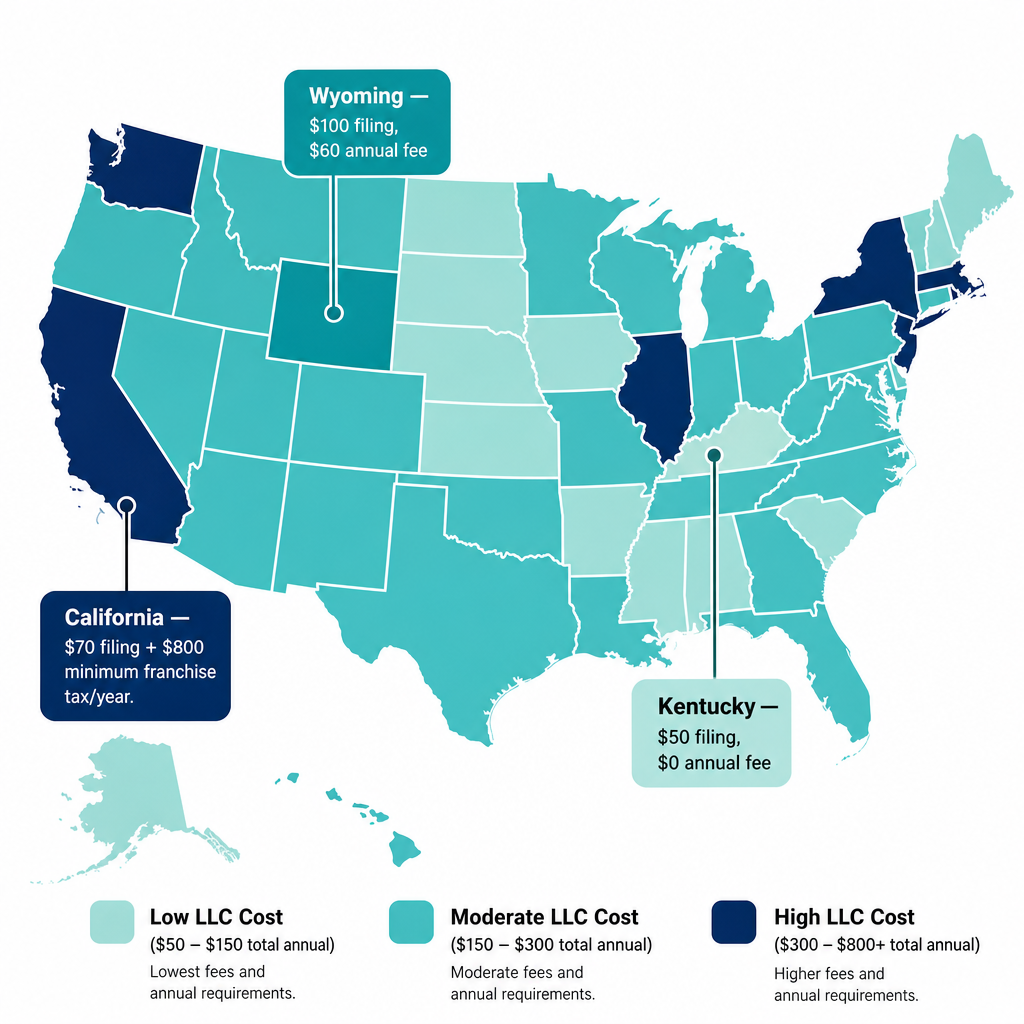
LLC state filing fees range from $50 (Kentucky) to $500 (Massachusetts); California adds an $800/year minimum franchise tax that changes the calculus for some hosts
Most mortgages contain a “due on sale” clause that could be triggered by transferring a property into an LLC — verify with your lender before any title transfer
Maintaining LLC protection requires separate bank accounts, signing contracts in the LLC’s name, and keeping business and personal finances strictly separated
Houfy has 98,000+ listings across 100+ countries — hosts who operate through an LLC receive direct booking payments in the LLC’s name, reinforcing the business separation that LLC protection requires
What Does an LLC Actually Protect?
A Limited Liability Company creates a separate legal entity from its owner. When your vacation rental is owned by an LLC:
Guest injury lawsuits are filed against the LLC, not you personally
A court judgment against the LLC can pursue LLC assets (the property, the LLC’s bank account) but generally cannot reach your personal home, savings, or investment accounts
Your personal credit profile stays separate from the business entity
This protection has one critical condition: you must maintain proper LLC hygiene. Courts can pierce the corporate veil — reaching through the LLC to your personal assets — if you commingle personal and business funds, sign contracts in your personal name instead of the LLC’s, or fail to keep basic business records.
What an LLC does not protect against:
Personal guarantees you sign as an individual
Intentional wrongdoing or fraud
Your own negligence when acting outside the LLC context
When You Probably Don’t Need an LLC (Yet)
A single-property host with all of the following conditions may be adequately protected without an LLC:
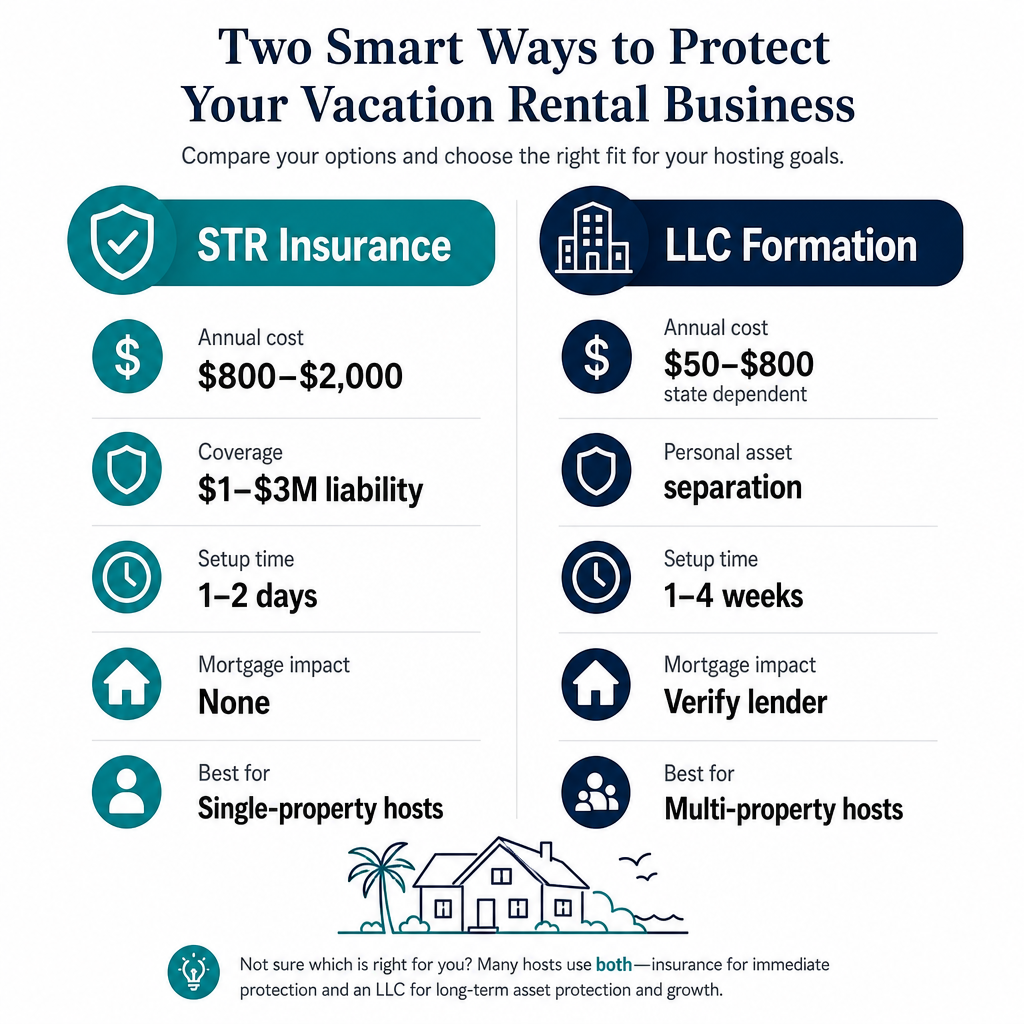
A dedicated STR liability insurance policy with $1–$2 million in coverage (not standard homeowner’s insurance — that typically excludes rental activity)
A property value under $500,000
No mortgage complications (some lenders prohibit title transfers to LLCs)
A state with high LLC annual fees (California’s $800/year franchise tax makes insurance the more cost-effective protection for many hosts)
In this scenario, a comprehensive STR insurance policy from a provider like Proper Insurance, CBIZ, or Farmers provides the same front-line protection — a guest slip-and-fall claim goes to your insurer, not to court — at $800–$2,000/year without the administrative overhead of maintaining a separate business entity.
Understanding your total cost of hosting — including commissions, legal exposure, and insurance — is the starting point for this decision. See how OTA costs compare to direct booking in our Houfy vs Booking.com breakdown.
When You Should Form an LLC
Form an LLC for your vacation rental when any of the following apply:
You own two or more properties. Multiple properties mean multiple liability exposure points. The LLC formation cost is fixed regardless of how many properties sit inside it (though some attorneys recommend a separate LLC per property for maximum protection). The math strongly favors the LLC at two or more properties.
Your property value is high. A guest injury lawsuit can generate a judgment that exceeds your STR insurance policy limits. If your property is worth $800,000+ and your insurance coverage is $1 million, the gap between a large judgment and your coverage falls on personal assets without an LLC. With an LLC, only the LLC’s assets are exposed.
You want long-term professional structure. An LLC with its own bank account, EIN, and bookkeeping creates a business entity that is easier to value, easier to finance, and easier to eventually sell than a property held in a personal name with mixed personal/business records.
Your state has low LLC costs. In most states outside California, Wyoming, and a handful of others with high annual fees, an LLC costs $50–$200/year to maintain after initial formation. At that cost, the protection is worth it for almost any host generating meaningful rental income.
CTA: Hosts who build a professional vacation rental operation — including the right legal structure — are better positioned to build a direct booking brand that lasts. List on Houfy at houfy.com/new/listing and set up your business the right way from the start.
The Mortgage Due-On-Sale Problem
This is the most frequently overlooked complication in vacation rental LLC formation. Most residential mortgages include a “due on sale” clause — language that gives the lender the right to demand full loan repayment if the property title is transferred without their consent.
Technically, transferring a property from your personal name into an LLC is a title transfer. This can trigger the due-on-sale clause.
In practice, lenders rarely enforce this clause for title transfers into owner-controlled LLCs. But “rarely” is not “never,” and being on the wrong end of an enforcement action could require immediate refinancing.
Before transferring any mortgaged property to an LLC:
Review your mortgage documents for due-on-sale language
Contact your lender’s loan servicing department and ask specifically about transferring title to an owner-controlled LLC
Get any consent in writing
If your lender objects, some hosts form a land trust as an intermediate structure — a legal arrangement that separates beneficial ownership from title for liability purposes without triggering the due-on-sale clause. This requires an attorney to set up correctly.

How to Form an LLC for Your Vacation Rental: The Basic Process
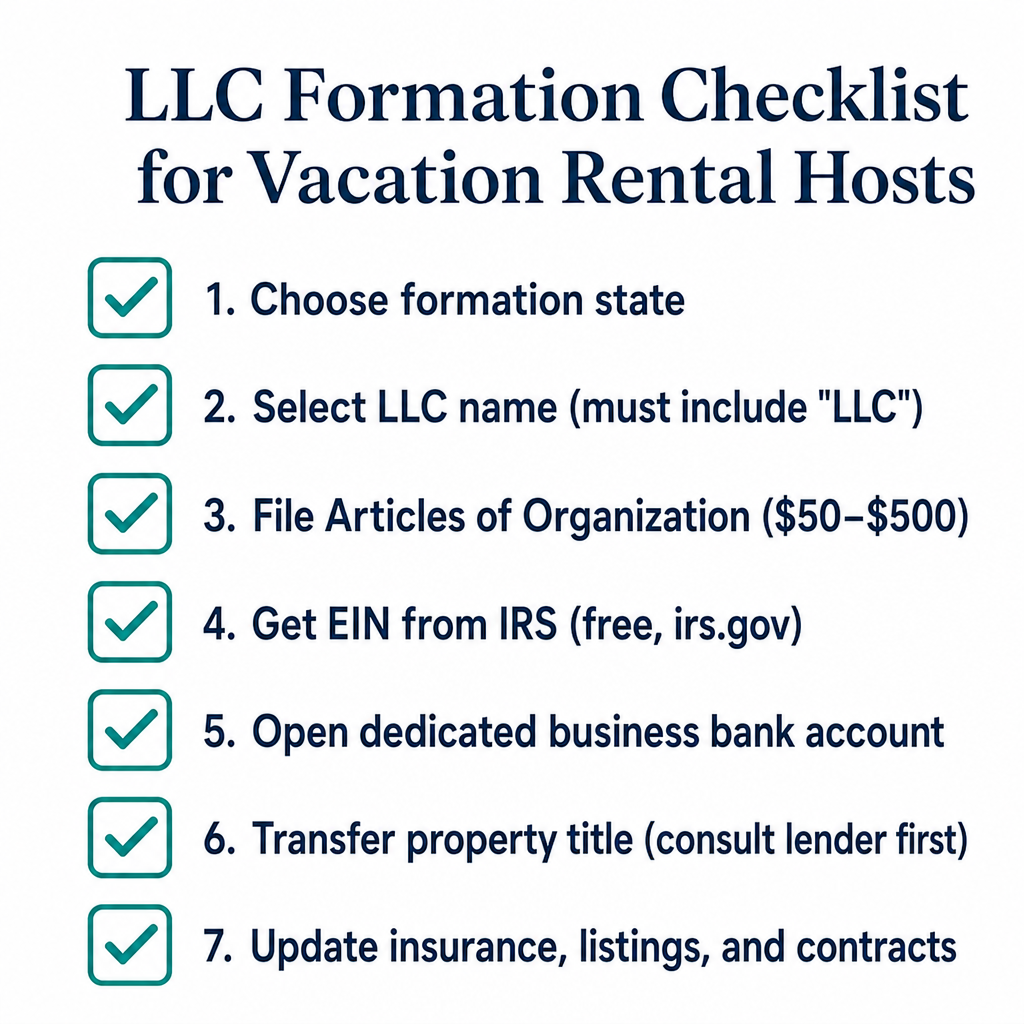
Choose your state of formation. Most hosts form the LLC in the state where the property is located — this is simplest for tax and regulatory compliance. Some hosts use Wyoming or Delaware as formation states for their more flexible laws, but typically still need to register as a “foreign LLC” in the state where the property sits, which adds cost.
Choose a name. The name must include “LLC,” “L.L.C.,” or “Limited Liability Company.” Check your state’s business name database to confirm availability.
File Articles of Organization. This is the formal formation document, filed with your state’s Secretary of State office. Filing fees range from $50 to $500 by state. Many states allow online filing that completes in 1–5 business days.
Get an EIN. Apply for an Employer Identification Number from the IRS (free, takes minutes at irs.gov). This is your LLC’s tax ID, needed to open a business bank account.
Open a dedicated business bank account. Use this account exclusively for rental income and business expenses. Never mix personal transactions into this account.
Transfer property title (if applicable). Work with a real estate attorney to prepare and record a deed transferring the property from your personal name to the LLC. Confirm mortgage implications first (see above).
Update your insurance, listings, and contracts. Your STR insurance policy, listing profiles, and rental agreements should all reflect the LLC as the property owner. Hosts using property management software should also update payment routing to the LLC’s bank account.
CTA: A well-structured vacation rental business includes the right legal entity and the right booking platform. Build your direct booking website free at houfy.com/website-builder — your LLC name can be your site’s brand.
Frequently Asked Questions
Do I really need an LLC for my vacation rental?
Not always. Single-property hosts with comprehensive STR liability insurance (covering $1–$2 million in liability) and a property value under $500,000 may be adequately protected without one — particularly in states with high LLC annual fees like California. Multi-property hosts, hosts with high-value properties, and hosts who want long-term professional business structure should strongly consider forming one.
How much does it cost to form an LLC for a vacation rental?
State filing fees range from $50 (Kentucky, Arkansas) to $500 (Massachusetts). Most states charge $50–$200 to file. Annual maintenance costs (annual report fees) range from $0 to $500 depending on state. California is the outlier — its $800/year minimum franchise tax is assessed regardless of revenue, making LLC formation significantly more expensive there than in most other states.
Can I put a mortgaged vacation rental in an LLC?
Technically yes, but most residential mortgages contain a due-on-sale clause that gives the lender the right to demand full repayment if you transfer title without their consent. In practice, lenders rarely enforce this clause for owner-controlled LLCs, but you should contact your lender before proceeding and get any consent in writing. Some hosts use a land trust as an intermediate structure where the mortgage due-on-sale complication is a concern.
Should each vacation rental property be in its own LLC?
For maximum liability protection, yes — a separate LLC per property ensures that a lawsuit arising from one property cannot pursue the assets of another. In practice, many hosts use a single LLC for their full portfolio and rely on insurance to cover inter-property exposure, accepting slightly reduced isolation in exchange for lower administrative overhead.
What happens to my Airbnb or Houfy listings when I form an LLC?
Your listing profiles can typically be updated to reflect the LLC as the host entity. For direct booking platforms like Houfy, payments can be directed to an LLC bank account once you update your payment details. This reinforces the financial separation that LLC protection requires — rental income flowing into the LLC’s account, not your personal account.
Source Citations
IRS — LLC tax classification and EIN application — https://www.irs.gov/businesses/small-businesses-self-employed/limited-liability-company-llc
NOLO — State LLC filing fees and annual report requirements — https://www.nolo.com/legal-encyclopedia/50-state-guide-to-forming-llc.html
Proper Insurance — STR-specific liability insurance for vacation rental hosts — https://www.properinsurance.com/
IRS Publication 527 — Residential Rental Property — https://www.irs.gov/publications/p527
Category: Get Started on Houfy
Houfy currently has 98,000+ live listings across 100+ countries.
Last Updated: July 11, 2026