A 1099-K for your vacation rental can show a different number from the money that reached your bank account. The form reports gross payments, so you need your booking and payment records next to it.
Whether you get one at all depends on who processed the payment. Here is what hosts should check for the 2026 tax year, before the forms arrive in January.
This guide is general information, not tax advice. Ask a qualified tax professional how the rules apply to your property and your return.
Brzi odgovorFor 2026, a payment app or online marketplace (a third-party settlement organization) generally must issue Form 1099-K when your payments exceed $20,000 and you have more than 200 transactions. Card payments processed directly have no minimum. You may still get a form below the threshold, and rental income can be reportable even when no form arrives.
Key Takeaways
For payment apps and marketplaces, both federal tests must be met: gross payments over $20,000 and more than 200 transactions.
Direct card payments have no federal minimum for Form 1099-K reporting.
State rules, voluntary reporting and backup withholding can mean you get a form below the federal threshold.
Box 1a shows gross payments, not your profit and not necessarily your bank deposits.
If a form is wrong or includes personal payments, contact the issuer and ask for a corrected form.
The IRS rule for renting a home fewer than 15 days has specific conditions. Keep records and get advice before relying on it.
A 1099-K reports payments, not your tax bill
Form 1099-K is an information return. Card processors, payment apps and online marketplaces use it to report payments made to you. You get a copy, and so does the IRS.
For a host, that could mean payments that came through a booking platform, a payment app or a card processor. It does not replace your own books.
The form helps you match what a payment company reported with what actually happened. It doesn't decide how much income is taxable, what you can deduct or which schedule applies. The IRS says the reporting threshold "doesn't affect whether payments are taxable."
The IRS explains the form in Understanding your Form 1099-K. For the wider picture, see our vacation rental income tax guide for hosts and vacation rental tax basics. This post sticks to the 1099-K and how to reconcile it.
The 2026 threshold has two tests
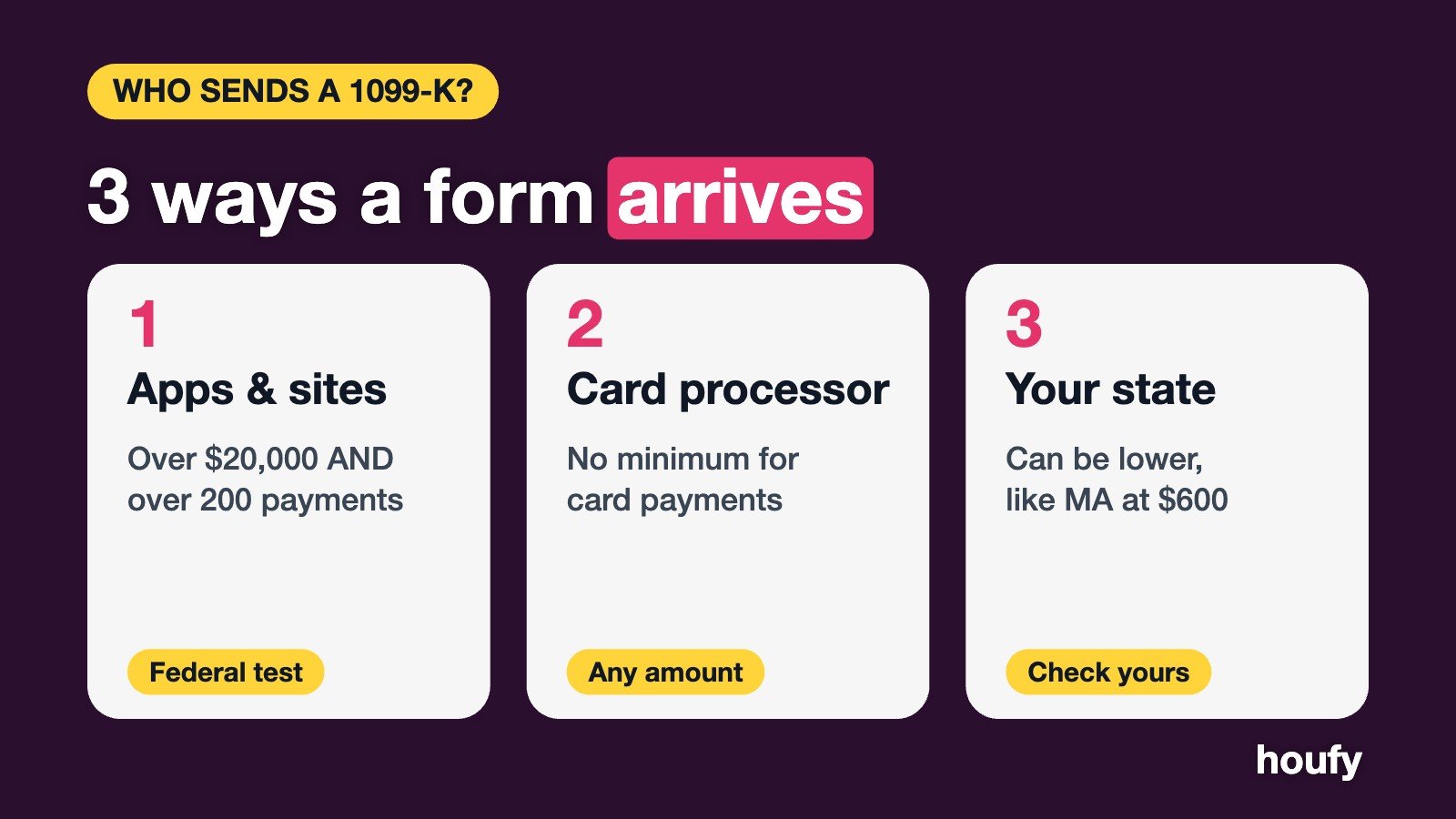
For third-party settlement organizations (TPSOs), such as payment apps and online marketplaces, the federal reporting requirement applies when both of these are true for one payee in a calendar year:
Gross payments for goods or services exceed $20,000.
The number of transactions exceeds 200.
"Exceeds" matters. Exactly $20,000 does not exceed $20,000, and exactly 200 transactions do not exceed 200.
Three examples for one TPSO and one host:
$25,000 across 80 bookings: the dollar test is met, the transaction test is not.
$18,000 across 250 transactions: the transaction test is met, the dollar test is not.
$25,000 across 201 transactions: both tests are met.
These examples describe the federal TPSO threshold only. A TPSO may still issue a form below it, your state may have its own rule, and backup withholding can trigger reporting.
The threshold applies per company. Adding up bookings across unrelated platforms doesn't tell you whether any one company must send a form. Check each company's records and the name and tax ID on each account.
What changed under the 2025 law
The One, Big, Beautiful Bill, signed on July 4, 2025, retroactively restored the threshold that applied before the American Rescue Plan Act of 2021. The IRS confirms the $20,000 and 200-transaction rule in its Form 1099-K FAQs, last reviewed November 24, 2026.
Earlier IRS announcements used lower transition figures. That's why older articles and search results can be confusing. If a post you're reading mentions $600 for a payment app, check its date.
Payment companies send recipient copies by January 31 of the following year, so forms for 2026 should arrive by early February 2027.
Card payments follow a different rule
If guests pay you directly by credit or debit card, your card processor reports those card transactions on Form 1099-K with no federal minimum. The IRS FAQ says that even $0.01 in card payments should produce a form.
So a host who takes a handful of direct card payments could get a 1099-K without coming close to $20,000. The IRS separates card reporting from third-party network reporting in the same FAQs.
What matters is how the money moved, not where the guest found you. A guest might find your home on one site while a different company processes the payment. Check the issuer named on any form you receive.
Cash, bank transfers, card payments and app payments each leave different records. A tax professional can help you sort your setup.
Airbnb and Vrbo forms depend on the payment flow
If you host on Airbnb, look at the tax documents in your account. Airbnb's US tax FAQ explains when it issues a 1099-K and notes that state rules or withholding can change that.
For Vrbo, check who received and processed each payment. Vrbo's 1099-K guide explains the form, and its reconciliation guide shows how to use a payout summary to check the amounts.
If a property manager or another processor handles your payments, the listing site's name alone won't tell you who issues the form.
Using several payment channels can mean several forms. Compare each form with the transactions behind it before adding anything up. If two forms seem to report the same payment, look into it rather than counting it twice.
Box 1a is gross, so deposits may look smaller
Box 1a shows the gross amount of reportable payments. It isn't the amount that landed in your bank, and it isn't your profit.
The IRS says this gross amount isn't adjusted for refunds, credits, fees or similar items. Your records show how to treat each one.
A simple example:
A processor reports $10,000 in gross transactions.
Its records show $500 in refunds and $300 in processing charges.
What reached your account is less than Box 1a.
That's a starting point for reconciling, not a tax calculation. How to treat a refund, a fee or a tax a platform collected depends on the facts. Don't subtract every difference from the form, and don't assume every dollar on it is taxable income.
Use booking reports, processor statements and bank records to build a clear trail from the reported gross to the numbers on your return. If someone else collected or remitted occupancy taxes, keep those details and ask your adviser how to handle them.
Reconcile each form before you file
Set aside time for each form in January rather than waiting until your return is nearly due.
Identify the issuer. The filer's name and phone number are in the top-left corner.
Check the payee details. Make sure the name and tax ID belong to the person or entity that should report the income.
Check the year. Match the form to payments in that calendar year, not just the dates guests stayed.
Review gross payments. Compare Box 1a and the monthly amounts with the processor's transaction report.
Trace differences. Note refunds, fees, adjustments, taxes and payments that belong to someone else.
Look for duplicates. Compare forms from platforms and processors by transaction ID before adding them together.
Write it down. Save the report, your notes and any questions for the issuer or your tax pro.
A booking made in one year and paid in another deserves extra care. Ask your adviser how to report it.
Download each platform's payout summary or annual statement while you still have access to the account.

Fix mistakes and personal payments quickly
Gifts and personal reimbursements from friends or family shouldn't be reported on a 1099-K. A friend paying you back for dinner is not a guest paying for a stay.
If personal payments show up on a form, gather the transaction details and anything showing what they were for. Then contact the issuer and ask for a corrected form. The IRS Taxpayer Advocate Service says to contact the issuer "immediately" and keep copies of all correspondence.
If the whole form is wrong, for example it isn't yours or duplicates another form, ask the issuer for a corrected form showing zero. If only part is wrong, explain which transactions and ask for a corrected amount.
The IRS can't correct the form for you. Its page on what to do with Form 1099-K explains how to report if the issuer doesn't fix it in time. Don't ignore the form or hold off filing indefinitely. Work with a tax professional to report the right amounts and document the difference.
Your state may have a lower threshold
The IRS notes that your state "may have a lower reporting threshold," so you could get a form even if you're under the federal one. Check the rules for your state.
For example, the Massachusetts Department of Revenue's Form 1099 filing requirements page, updated July 24, 2026, says payment apps and marketplaces must issue Form 1099-K when a payee's gross payments exceed $600.
A state reporting rule is not a new tax. It tells the payment company when to send a form. Your income tax is a separate question.
Keep records even if no form arrives
The federal threshold is not an income exemption. The IRS says all income is taxable "unless the tax law says it isn't," whether or not you get a form.
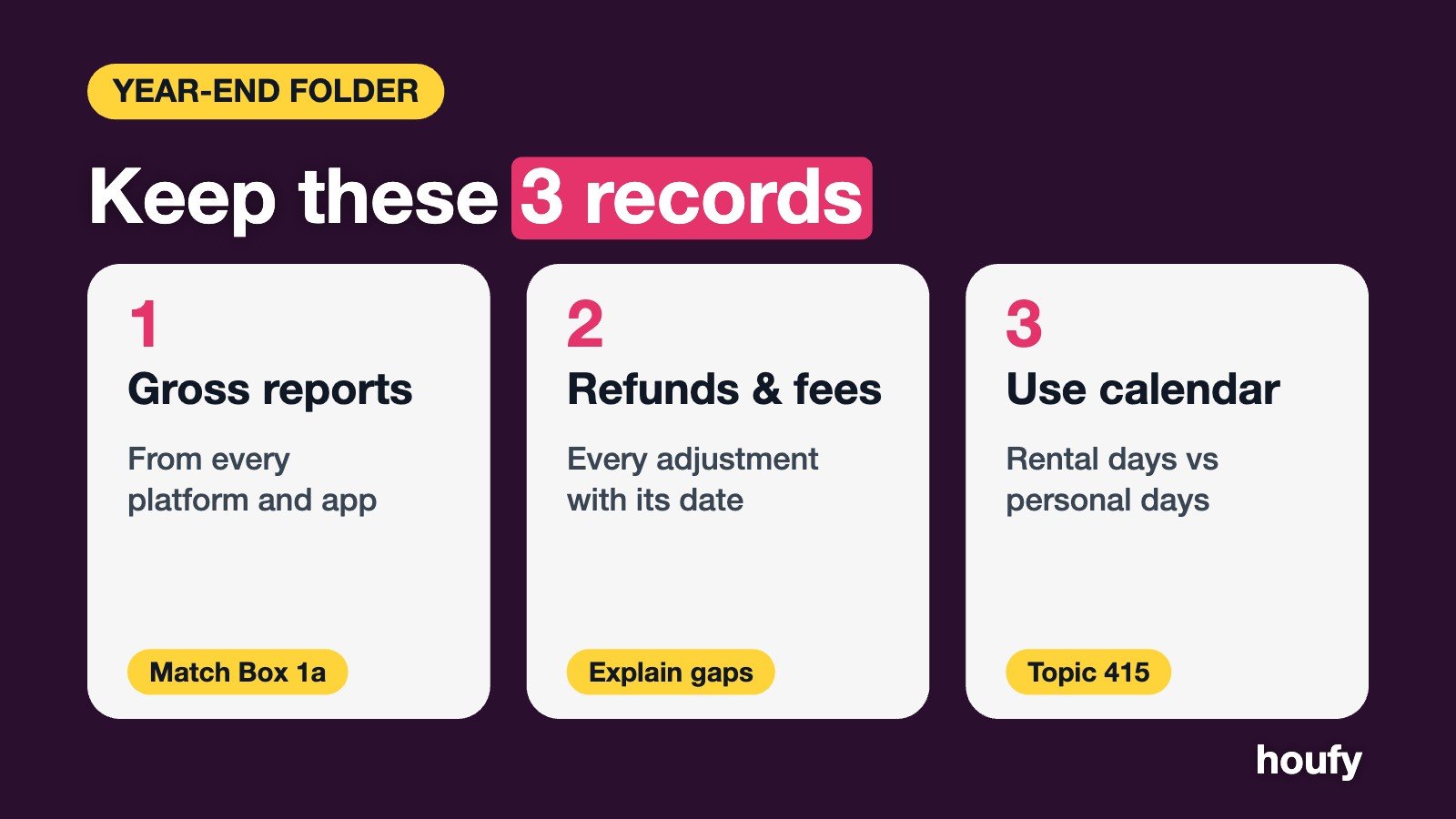
Keep records for every booking channel, including payments that never touched an app or card network. A good year-end folder holds:
Booking confirmations and payment dates.
Gross transaction reports from each platform or processor.
Bank statements showing deposits.
Refund, cancellation and adjustment records.
Processing fees and other expense receipts.
Records of lodging taxes collected or remitted.
Property manager statements and agreements.
Copies of every tax form and any correction requests.
A calendar of rental days and personal-use days.
Organize them by property and tax year. If money passes through a manager first, keep the manager's statement as well as the bank deposit.
The 14-day rule has conditions
IRS Topic 415 describes a special rule: if you use a dwelling unit as a residence and rent it out for fewer than 15 days in the year, you don't report the rental income and don't deduct rental expenses.
Both parts matter. The home has to count as your residence, and the rental has to be fewer than 15 days. Fewer than 15 booked nights alone doesn't qualify a property.
Topic 415 also explains how personal-use days affect whether a home counts as a residence, and how to split expenses. Keep a calendar and talk it through with your tax professional. If a 1099-K covers a rental you think falls under this rule, ask your adviser how to handle the form.
Bring these questions to your tax pro
You don't have to work this out alone. Bring your records and ask:
Which person or entity should report each property's income?
Do any payments show up on more than one form?
How should refunds, processing fees and collected taxes be treated?
Does the personal-use calendar change anything?
Which state reporting and income tax rules apply?
What should I do if a corrected form hasn't arrived by filing time?
Want more direct bookings next year? List your property on Houfy, let guests book with you directly, and keep those payment records in the same year-end folder as everything else.
Frequently Asked Questions
Will every vacation rental host get a Form 1099-K for 2026?
No. It depends on how guests paid, who processed the payments, the amounts and number of transactions, and things like state rules or withholding. If no form arrives, you still need to work out what income to report.
Is the 2026 federal threshold $20,000 or 200 transactions?
Both. For payment apps and online marketplaces, gross payments must exceed $20,000 and transactions must exceed 200. Meeting only one test doesn't meet the federal threshold, though other rules may still produce a form.
Does the threshold apply to direct credit card payments?
No. The IRS says card payments have no federal minimum dollar amount or transaction count for Form 1099-K reporting.
Is the amount on my 1099-K my taxable profit?
Not necessarily. Box 1a is gross and isn't adjusted for refunds, fees and similar items. Use your records and professional advice to work out the right income and expenses.
What if my 1099-K includes a personal reimbursement?
Contact the issuer and ask for a corrected form. Keep proof of what the payment was and copies of your messages. If the correction doesn't arrive, follow the IRS guidance and ask your tax professional.
Does the 14-day rule cover any rental booked fewer than 15 days?
No. IRS Topic 415 also requires that you use the home as a residence. How personal-use days count depends on the facts.
Do I report income if I don't get a 1099-K?
Yes, if it's taxable. A missing form doesn't remove the obligation to report income. Keep records of all rental payments and ask your tax professional what belongs on your return.
Sources
IRS, Understanding your Form 1099-K, accessed November 26, 2026.
IRS, Form 1099-K FAQs: General information, last reviewed November 24, 2026; accessed November 26, 2026.
IRS, The Working Families Tax Cuts: What gig economy workers should know (FS-2026-07), March 2026.
Taxpayer Advocate Service, I received a Form 1099-K, updated March 24, 2026.
IRS, What to do with Form 1099-K, accessed November 26, 2026.
IRS, Topic 415: Renting residential and vacation property, accessed November 26, 2026.
Massachusetts Department of Revenue, Form 1099 filing requirements, updated July 24, 2026.
Airbnb, US tax FAQ, and Vrbo, About Tax Form 1099-K and Reconcile your Form 1099-K, accessed November 26, 2026.
Sort the forms in January, match them to your records, and tax season brings fewer surprises.