
AI dynamic pricing has fundamentally changed how vacation rental rates are set in 2026. Where setting a seasonal rate calendar was once a competitive advantage, AI-powered pricing tools have become table stakes — and independent hosts who are not using them are being systematically undercut by algorithms that adjust rates every 24 hours based on demand signals that manual pricing cannot track. This guide explains exactly what is changing and how hosts on Houfy can access the same vacation rental pricing AI that OTAs use, without paying OTA commissions on the revenue it generates.
Key Takeaways
Major OTAs now have AI pricing recommendations built into their host dashboards, passively influencing rates across millions of listings simultaneously
Independent hosts using PriceLabs — which integrates directly with Houfy — access equivalent AI pricing technology for around $20/month per property
AI pricing tools account for signals manual pricing misses: booking lead time curves, competitor last-minute discounting, local event demand, and day-of-week patterns
The hosts who perform best in AI-priced markets set their minimum price floor carefully — the floor protects against AI over-discounting during slow periods
On Houfy, AI pricing integrations through the software partners ecosystem work without OTA intermediaries taking a cut of the resulting revenue
The 2026 World Cup and Copa América have stress-tested AI pricing tools in ways that improved their event-detection accuracy — a durable improvement that benefits all future users
The economics of adding an AI pricing tool are compelling: at $20/month on a $3,000/month property, the tool costs 0.67% of revenue while typically improving it by 10–15%
What AI Pricing Tools Actually Do
AI dynamic pricing tools analyze multiple demand signals simultaneously and produce a recommended nightly rate for each future date in your calendar. The core signals every major tool processes:
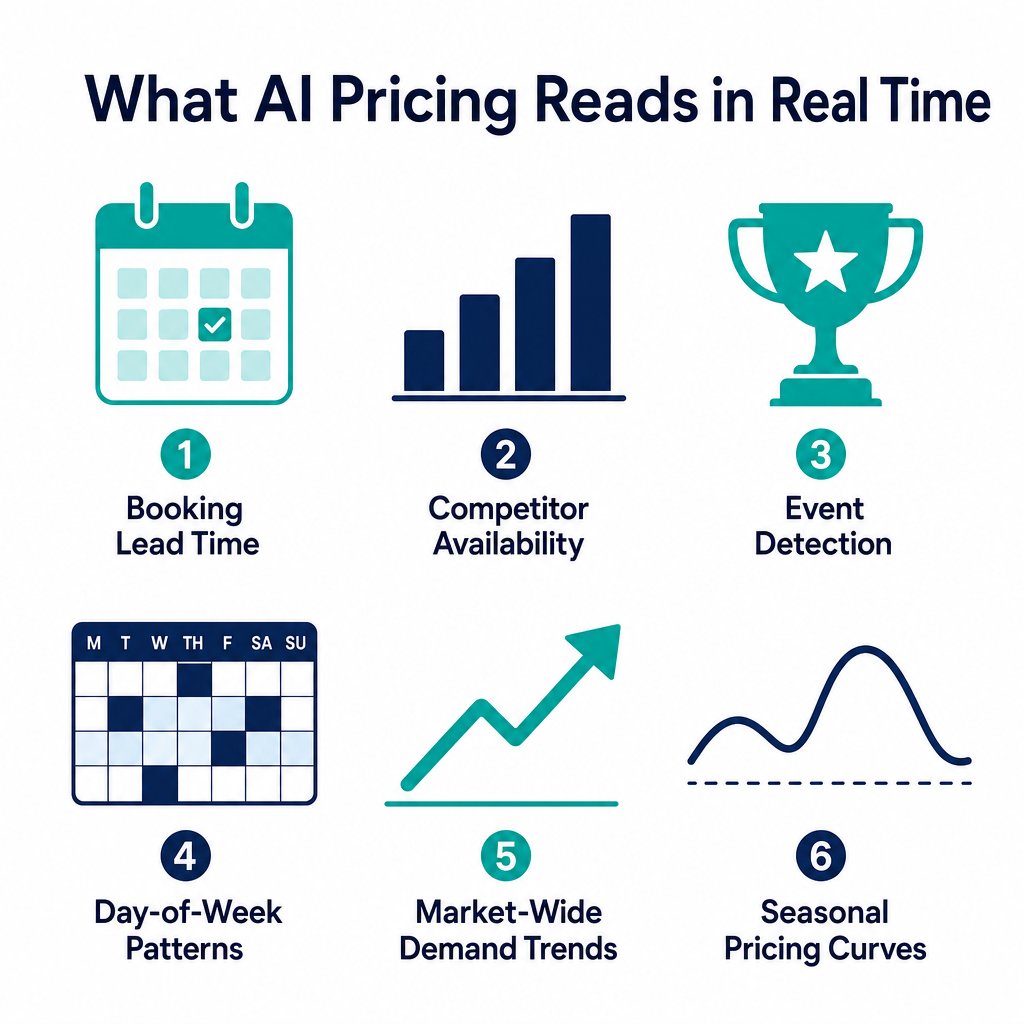
Booking lead time — how far in advance guests are booking compared to historical patterns for the same dates. If your market is booking out faster than usual for a given weekend, the AI raises rates to capture the demand before inventory tightens.
Competitor availability — how many comparable properties in your market are still available on a given date and at what price. As competitors fill up, your price should rise. As they discount, the AI evaluates whether matching is profitable given your floor.
Event detection — major local events such as World Cup matches, concerts, and conferences that create concentrated demand spikes. AI tools in 2026 have become significantly better at this after the 2025–2026 tournament calendar.
Day-of-week patterns — the booking and checkout behavior specific to your property's historical data. A beachfront property that books heavily for Saturday arrivals should price those nights differently than a midweek-heavy urban rental.
Market-wide demand trends — whether your destination is trending up or down in search volume. Tools like PriceLabs pull aggregated booking data across their entire network to weight recommendations.
Manual pricing cannot process these signals simultaneously and continuously. A host reviewing rates once a week is working with data that is seven days stale by the time it is applied. AI pricing tools adjust daily — some hourly.
List your property on Houfy for free and connect AI pricing tools without paying OTA commissions on your bookings. Start listing on Houfy
The OTA Pricing Influence Problem
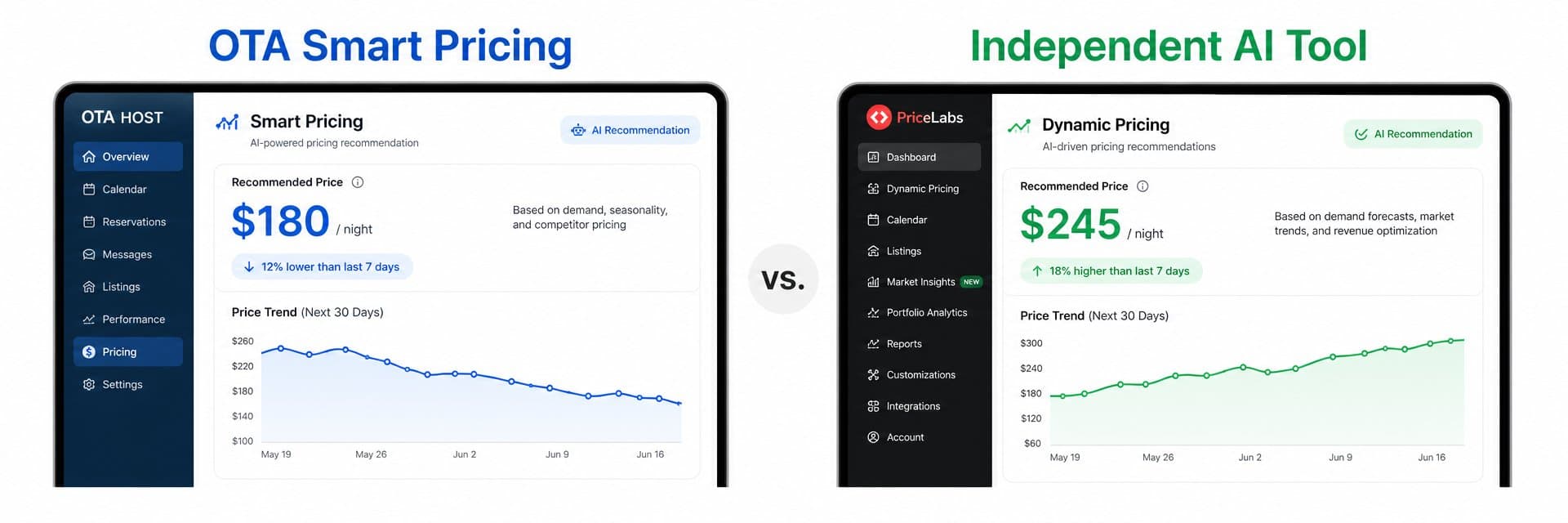
Airbnb and VRBO have both integrated AI pricing recommendations into their host dashboards — Airbnb calls it "Smart Pricing" and VRBO markets a similar feature under "Market Maker." These tools are presented as host benefits, but their design serves platform revenue optimization, not host revenue optimization.
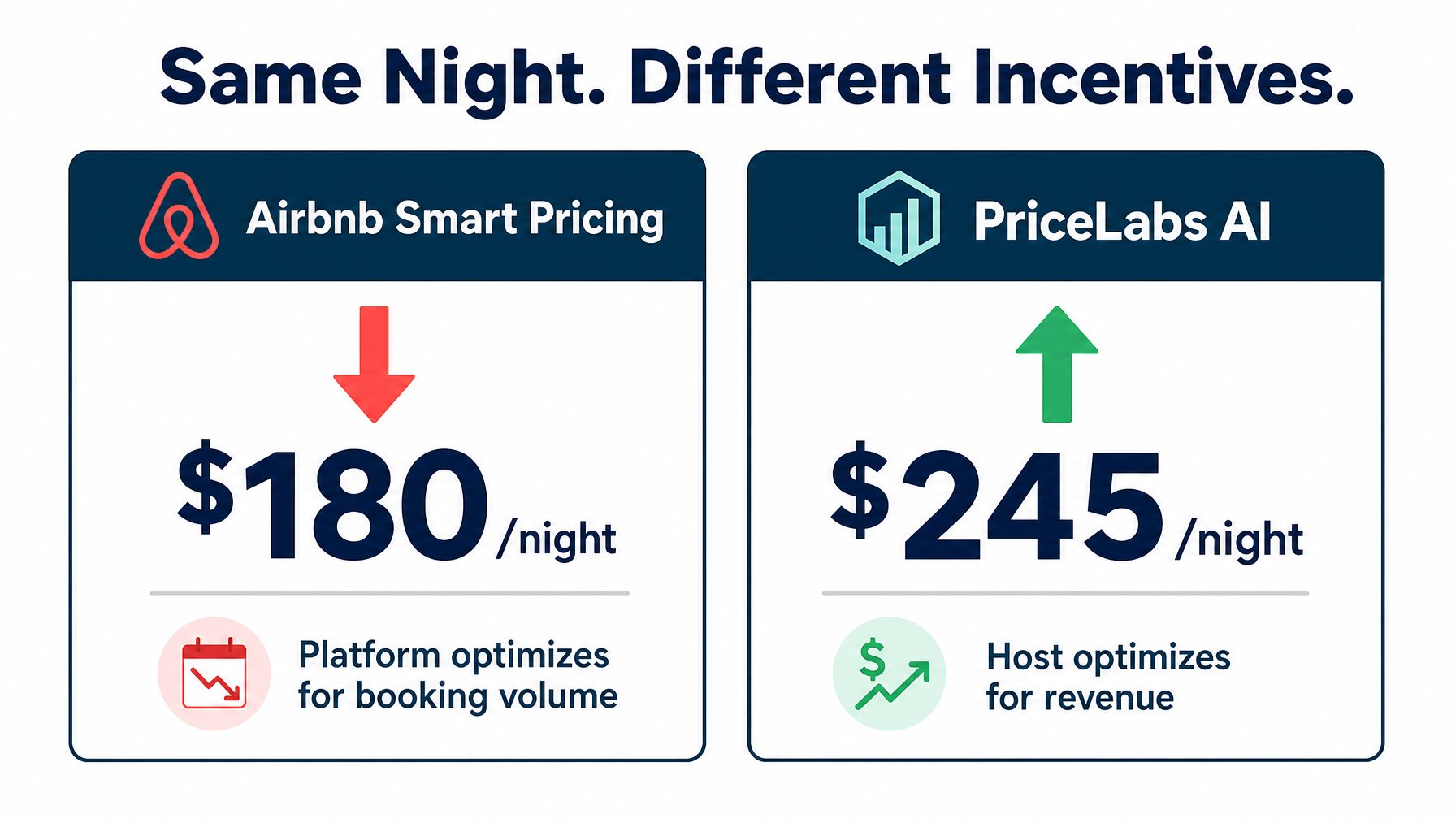
Airbnb's Smart Pricing, when analyzed independently by host communities and third-party researchers, consistently recommends rates below what the market will bear — especially during peak periods. The working hypothesis, supported by multiple independent analyses: lower rates drive more transactions, which generates more booking fees for Airbnb, at the cost of host margin per booking.
Independent AI pricing tools — PriceLabs, Beyond, and others — are built explicitly to maximize host revenue. Their incentive structure aligns with host profitability because they charge flat monthly fees rather than booking commissions. When your rate goes up, your subscription cost does not.
This distinction matters enormously over a full year. A host with a $250/night average that Smart Pricing has been holding at $195/night during peak weeks is leaving several thousand dollars per season on the table — while Airbnb collects its 3% host fee and up to 14.2% guest service fee on every transaction regardless.
For a deeper look at how pricing strategy intersects with your booking calendar, the guide to vacation rental tips for independent owners covers the broader operational picture.
How Houfy Hosts Access AI Pricing Tools
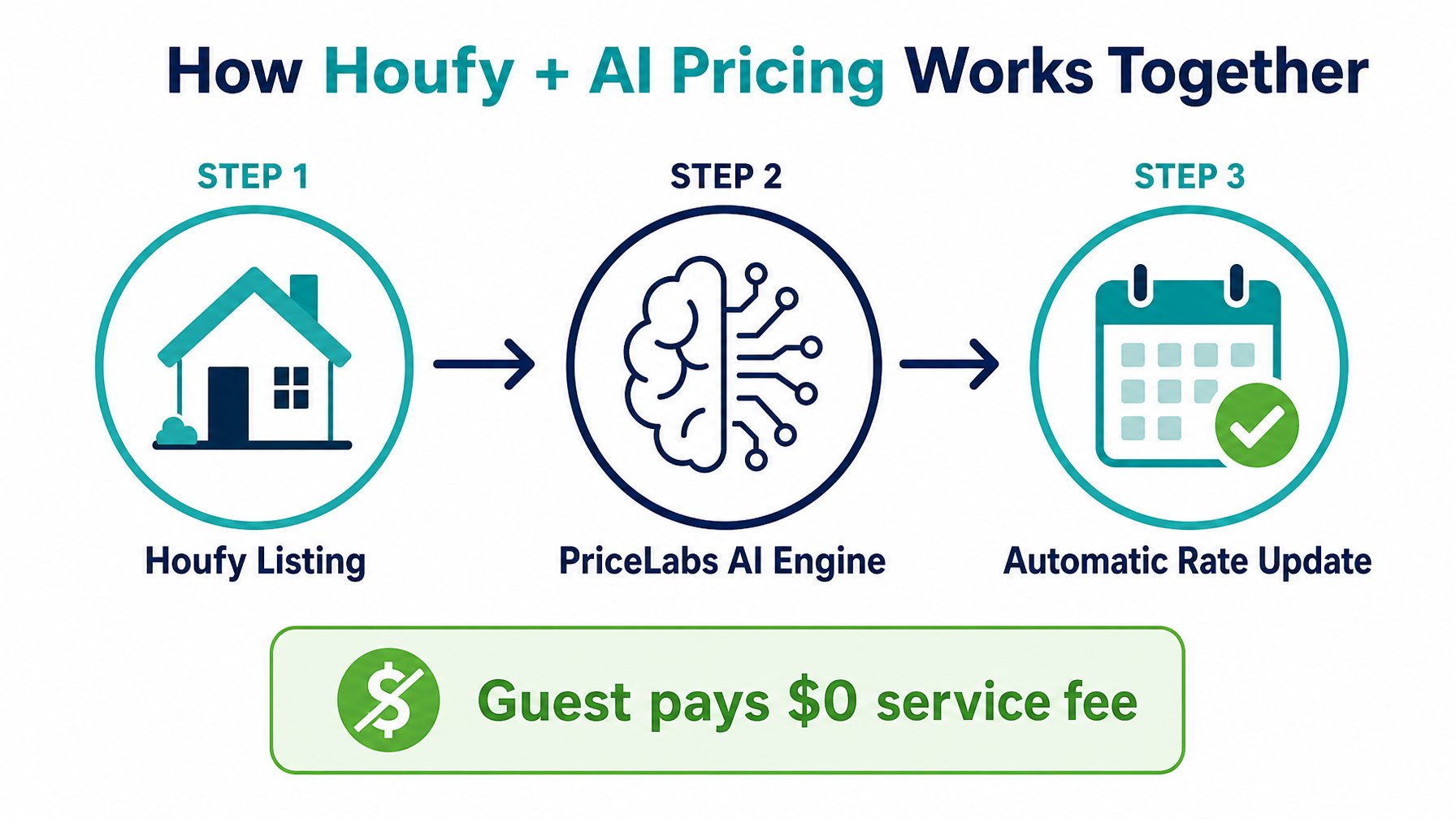
Houfy integrates directly with PriceLabs through the software partners ecosystem. The integration syncs your Houfy listing calendar with the AI tool's rate recommendations, updating your pricing automatically without manual calendar management.
If you are already on Airbnb with an iCal-based calendar sync, the fastest path to AI pricing on Houfy is to connect both platforms to your pricing tool and let it manage rates across channels simultaneously. The guide to importing your Airbnb pricing and calendar into Houfy walks through the exact setup process.
The economics of adding an AI pricing tool are straightforward. On a property generating $3,000/month in bookings:
PriceLabs at $20/month = 0.67% of revenue
Conservative 10% revenue improvement = $300/month gain
Net benefit at minimum = $280/month on a $3,000 base
At the higher end of reported improvements — 15–20% revenue lift — the tool pays for itself within the first week of each month. The key variable is how well calibrated your floor is, which determines whether the AI is optimizing within a range that actually protects your profitability.
Already listing on Airbnb? Connect your Houfy listing to PriceLabs and let AI pricing work across both channels. View software integrations
The Price Floor: The Single Most Important AI Pricing Setting
Every AI pricing tool allows hosts to set a minimum price floor — a rate below which the tool will never go, regardless of demand signals. This is the configuration decision with the highest impact on actual profitability.
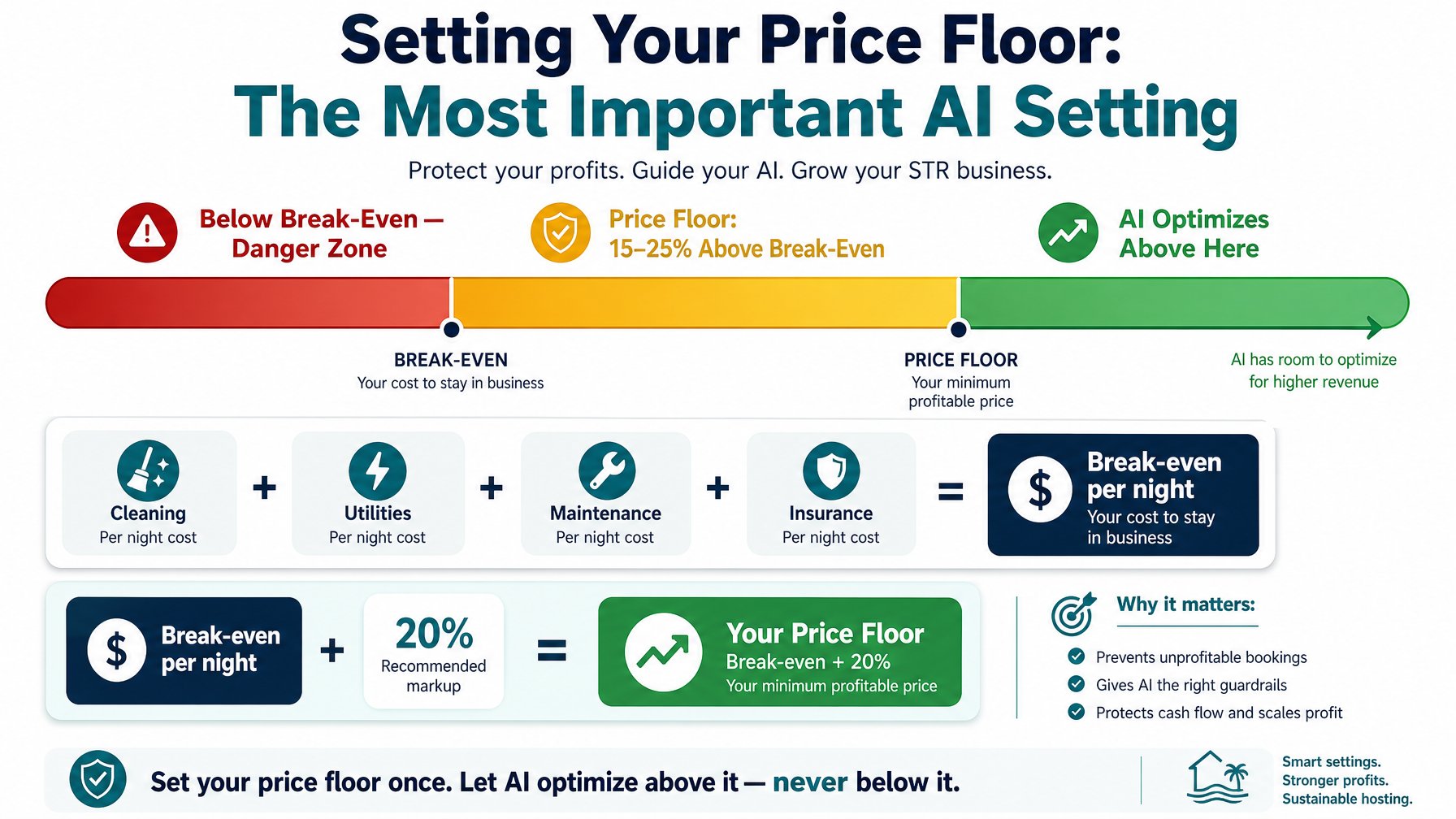
Without a floor, AI tools will discount aggressively to fill any vacancy. With a correctly calibrated floor, the AI optimizes within a range that protects your per-booking profitability while still capturing demand at the right price.
How to calculate your floor:
Calculate your break-even cost per night: cleaning fee amortized over average stay length, nightly utility and maintenance allocation, platform subscription cost per booking, and insurance cost per booking.
Add a minimum acceptable profit margin above break-even. Most hosts target 15–25%.
That total is your floor. Set it, lock it, and do not let the AI tool talk you out of it.
For properties in major event cities — World Cup host cities, Copa América venues, cities with major annual festivals — revisit your floor upward for event-adjacent dates. The AI will price above the floor when demand supports it, but you need the floor to ensure you are not filling high-demand dates at pre-event baseline rates from early bookings.
This connects directly to minimum stay strategy. Combining a well-set price floor with the right minimum night requirement prevents the AI from filling high-demand nights with short stays at lower rates. The Houfy guide on choosing the best minimum stay policy for your rental covers how these two settings interact.
How AI Pricing Performs During Major Events
The 2026 World Cup and Copa América have provided the most comprehensive real-world test of AI vacation rental pricing tools in the history of the STR industry. Both tournaments generated concentrated demand spikes across multiple US cities simultaneously — a scenario that exposed the limitations of both manual pricing and OTA-embedded tools.
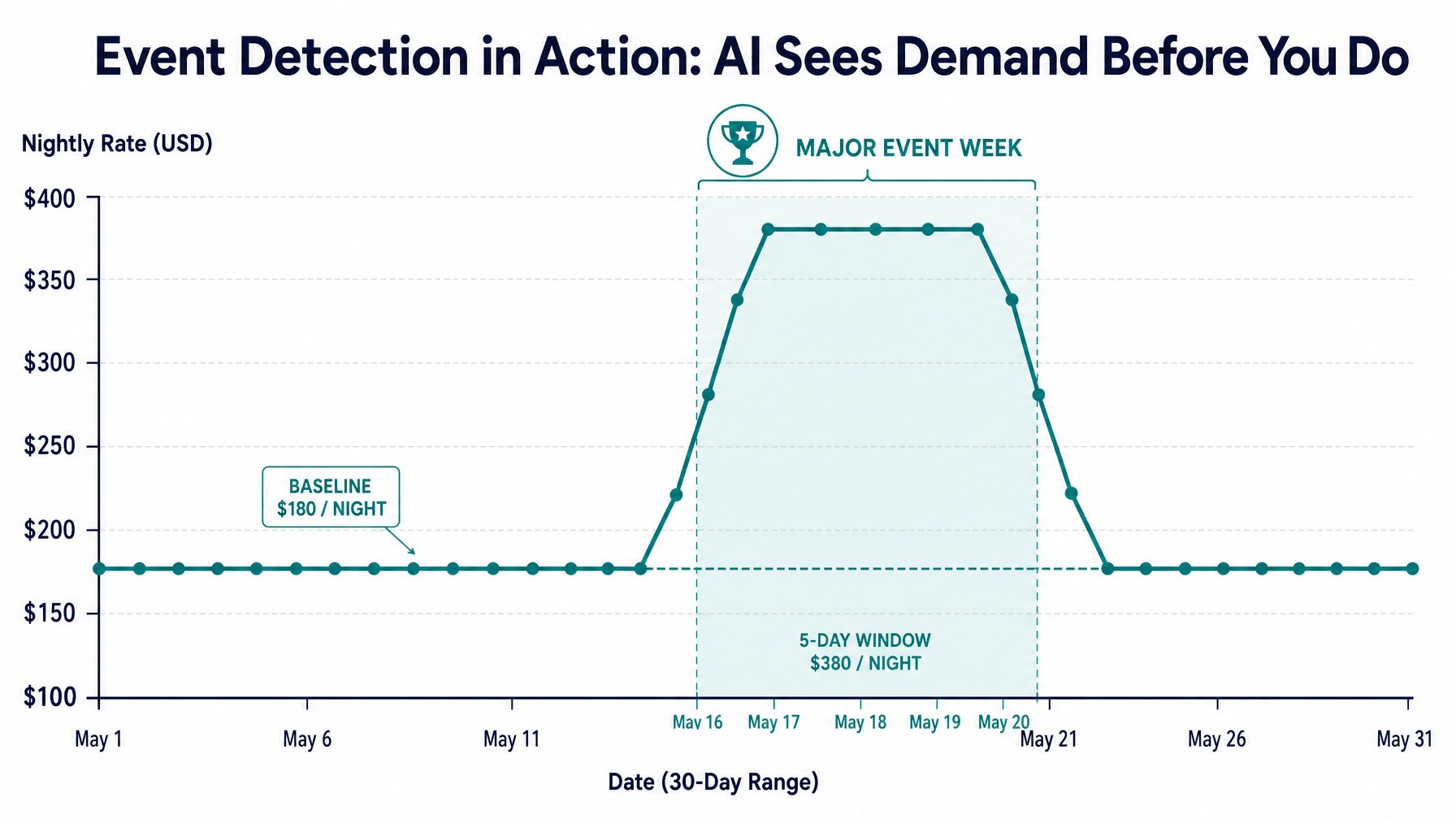
Independent AI pricing tools, particularly PriceLabs, showed stronger performance because their event-detection models had access to booking velocity data across their full client base, not just individual listing history. When booking pace in a market accelerates ahead of historical norms, the AI detects it and raises rates before inventory fully tightens.
The practical lesson for hosts: the event intelligence that these tools built during the 2026 tournament season is now baked into their models. Future users will benefit from better event detection in Dallas, Miami, Los Angeles, New York, and other major STR markets without needing to configure it manually.
For hosts who want to close the gap between event demand and bookings captured, the guide to attracting last-minute vacation rental bookings covers the complementary tactics that work alongside AI pricing during high-demand periods.
Comparing the Leading AI Pricing Tools for Independent Hosts

PriceLabs is the most widely used independent AI pricing tool in the STR market. Its market dashboard provides granular visibility into competitor rates and booking pace by market. The Houfy integration is direct and well-documented. Pricing starts at around $19.99/month per property, with volume discounts for multi-property portfolios.
Wheelhouse takes a slightly different approach, weighting host revenue goals more explicitly in its recommendation engine. Hosts can dial between "maximize occupancy" and "maximize revenue" profiles, which changes how aggressively the tool discounts to fill gaps. Well-suited for hosts who want more control over the optimization direction. Note: Wheelhouse does not currently have a direct Houfy integration.
Beyond (formerly Beyond Pricing) is stronger in international markets and luxury tiers, with pricing intelligence that accounts for property-level quality signals rather than purely market averages. Like Wheelhouse, Beyond does not have a direct Houfy integration at this time.
Of these three, PriceLabs is the only tool with a direct Houfy integration through the software partners ecosystem. Wheelhouse and Beyond can still be used to manage rates across other channels, but require a separate channel manager or iCal sync to connect with your Houfy calendar.
Houfy hosts keep 100% of their booking revenue. Combine that with AI pricing and you are competing on equal footing with any OTA-listed property — without the commissions. Create your free Houfy listing
Frequently Asked Questions
Does AI pricing work if my vacation rental market is not very competitive?
Even in low-competition markets, AI pricing adds value by identifying within-market demand peaks — local events, weekend booking surges, holiday compression — that manual pricing consistently misses. The revenue lift from AI pricing tends to scale with market competitiveness, but there is almost no market where a well-configured AI pricing tool does not improve on manual rate-setting over a full year.
Will AI pricing cause me to race to the bottom with my competitors?
Only if you set your floor too low or skip the floor entirely. AI tools respond to market conditions — when competitors discount aggressively to fill gaps, the tool may recommend adjusting toward them. A firmly set price floor prevents any AI optimization from happening below your profitability threshold. The floor is your protection; the AI operates in the range above it.
Does AI pricing work for Houfy-only listings that are not on any OTA?
Yes. AI pricing tools analyze your local market demand data regardless of which platforms you list on. PriceLabs builds their recommendations from aggregated booking velocity and competitor rate data across their full client network — not from your individual OTA listing data. A Houfy-only listing gets the same market intelligence.
How long does it take to see results from AI pricing?
Most hosts see measurable revenue improvement within the first 60–90 days. The first 30 days often involve the AI learning your property's booking patterns and calibrating to your market. Days 30–60 typically show stabilizing improvements as the tool fine-tunes its recommendations. Hosts who see the strongest results have set a well-calibrated floor from day one and resist the urge to override the AI's recommendations manually during its learning phase.
Is it safe to let AI pricing control my rates on Houfy without reviewing them manually?
AI pricing tools recommend rates — they do not force them. You retain full control over your calendar and can override any recommendation at any time. The practical approach most experienced hosts take: set your floor carefully, review the AI's recommendations weekly for the first month, and then let it run with periodic check-ins around seasonal transitions and major event dates.
What happens to my AI pricing settings if I also list on Airbnb?
If you use the same AI pricing tool across Houfy and Airbnb simultaneously, the tool manages rates on both calendars from one dashboard. Rate recommendations are consistent across channels, adjusted for any platform-specific pricing rules you configure. This is the most efficient setup for multi-channel hosts — one tool, one rate strategy, no manual calendar management on either platform.
Source Citations
PriceLabs — AI Dynamic Pricing for Vacation Rentals and Short-Term Rentals — https://www.pricelabs.co/blog
PriceLabs + Houfy Integration — https://www.houfy.com/software-partners
AirDNA — Short-Term Rental Market Data and Pricing Analytics 2026 — https://www.airdna.co
Houfy Software Partners — AI Pricing and PMS Integrations — https://www.houfy.com/software-partners
Houfy currently has 98,000+ live listings across 50+ countries.
Last Updated: June 23, 2026